
Recommended Pressure Control Switches for Domestic Water Systems: 5 Options Worth Shortlisting
Recommended Pressure Control Switches for Domestic Water Systems: 5 Options Worth Shortlisting
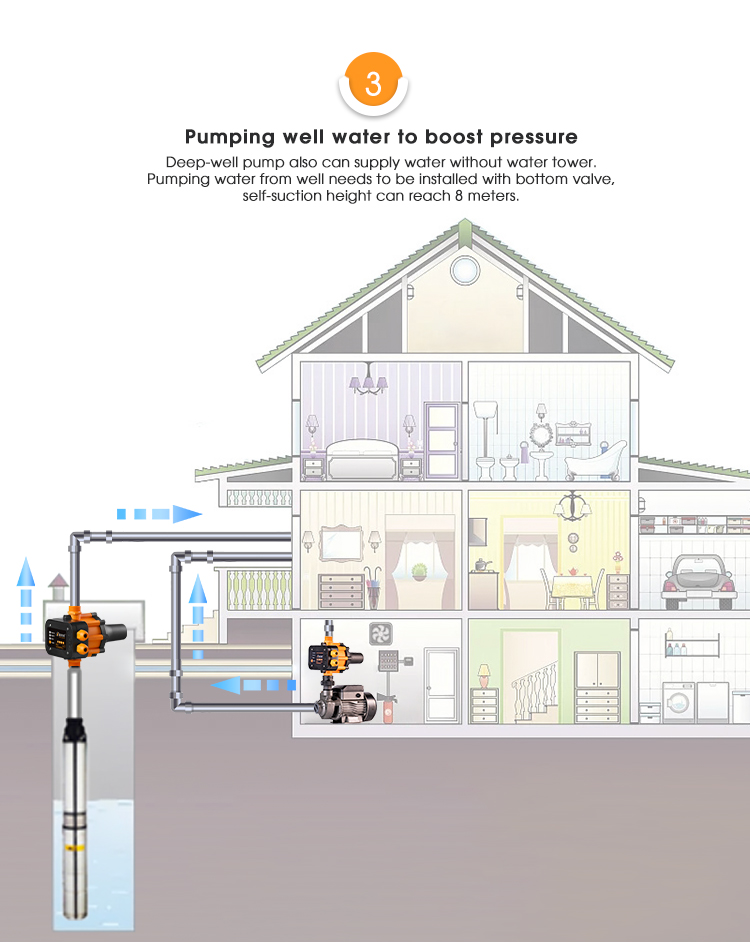
A pressure control switch in a domestic water system is the component that starts the pump when line pressure falls to a preset cut-in value and stops it when pressure reaches the cut-out value. Because it governs both water comfort and pump life, the control layer — not the pump alone — usually decides whether a household system runs quietly and economically or short-cycles until something fails.
This shortlist examines five pressure control options suited to domestic and residential water supply, drawn from three product families made by Monro Switch: electronic pump pressure controllers (EPC series), mechanical pressure controls (KRS series) and float switches (FPS series) for tank-level control. It is written for buyers at the discovery and research stage — people who need to know which switch family fits a given house, pump and protection requirement before price comparison begins.
What a pressure control switch actually controls in a house
The operating logic is simple and consistent across product families. The controller activates the pump at the preset low-pressure setpoint and deactivates it at the high-pressure setpoint, responding to changes in system pressure; the matched equipment is a water pump, and the working medium is clean water. In a domestic installation this produces the familiar behaviour of a booster set: open a tap, pressure falls, the pump starts; close the tap, pressure recovers, the pump stops.
Every other line on the specification sheet exists to support that single decision. Rated voltage determines compatibility with the local supply — household products are typically offered at 220–240V or 110–120V. Motor power rating determines whether the unit can carry the pump. Connection thread determines whether it fits existing pipework. Ingress protection (IP rating) determines where it may be installed. Dry-run protection determines whether an empty tank turns into a burnt motor.
The problem: domestic water failures usually start at the control layer
Most pressure complaints in residential buildings trace back to a mismatch between the controller and the system it serves, rather than to the pump itself. The recurring patterns are recognisable:
- Wrong starting pressure relative to pump lift. If the start pressure is set above what the pump can deliver against the actual delivery height, the pump never reaches cut-out and runs continuously. Monro's own selection guidance links the two directly: a starting pressure of 1.2 bar corresponds to a maximum water use height of about 12 m, and the pump lift should be at least (1.2 + 0.8) × 10 m, or roughly 20 m, for that duty.
- No run-dry protection. A pressure switch that only reacts to pressure cannot tell the difference between a closed tap and an empty tank. Without dry-run sensing, the pump can run without water until the motor is damaged.
- Ingress protection ignored. Mechanical controls are commonly rated IP20 or IP44, while electronic pump controllers in the same catalogue are typically IP65. A low-IP device installed in a wet pump room or an outdoor cabinet invites nuisance tripping and corrosion, regardless of how well it performs electrically.
- Voltage and thread mismatch. Household supplies differ by market, and pipe threads differ too. A controller sold with G threads will not seal properly on a system built for NPT threads — one of the most common reasons a technically suitable unit is returned.
Read as an opportunity rather than a risk list, these four points form the buyer's shortlisting framework: power match, pressure-and-lift match, protection rating, and connection compatibility. The five options below are grouped against that framework.
The supplier behind this shortlist
Monro Switch is the trading identity of ZHEJIANG MONRO MACHINERY & ELECTRONIC CO.,LTD, a manufacturer established in 2010 and located in Wenling City, Zhejiang Province, China. The company specialises in pump controllers, pressure switches and float switches, and offers more than 40 models of pressure controllers for water pump systems and air compressors. It reports a 30,000 m² factory, approximately 200 employees, a 10-engineer R&D team, and annual production capacity of about 2.88 million units of the EPC series, 3.24 million units of the KRS series and 0.6 million units of the FPS series. Around 90% of products are exported, with markets listed as Asia, Europe, North and South America, the Middle East and Africa.
For buyers, two supplier facts matter more than the headline numbers. First, the company operates an ISO 9001:2015 quality management system, with TUV (Germany) and CE (Europe) certifications and selected models approved under the CUL standard for the United States and Canada. Second, model-level compliance evidence is documented rather than implied: the EPC-14 automatic pump control unit, for example, is certified to CE-EMC with certificate number AE 505987560001 issued by TÜV Rheinland LGA Products GmbH, referencing EN IEC 55014-1:2021, EN IEC 55014-2:2021, EN 61000-3-2:2019+A1 and EN 61000-3-3:2013+A1+A2 under Directive 2014/30/EU for the EU market. That level of traceability is the practical difference between a catalogue claim and a document a customs or utility reviewer can accept.
The shortlist: five options for domestic water systems
The five options below span three control approaches — electronic, mechanical and float-based — because domestic water systems do not all have the same problem to solve. None of them is presented as universally superior; each is defined by the duty it is built for.
1. EPC-1.1 — pump pressure control switch for domestic installations
The EPC-1.1 is a pump pressure control switch used for maintaining constant pressure in domestic water systems. It is designed for domestic applications and is suitable for use with surface or submersible pumps. Rated voltage is 220–240V or 110–120V, power frequency 50/60 Hz, with maximum power options of 0.75 kW, 1.1 kW or 1.5 kW. Starting pressure can be specified at 1.2 bar, 1.5 bar or 2.2 bar. The unit carries an IP65 protection rating, a maximum working temperature of 55°C, and connection thread options of G1", G1 1/4", G1 1/2" and NPT1". Monro describes the installation as simple, saving time and space.
Why it leads the shortlist: it offers the widest connection-thread selection in this group, including an NPT option for markets that use tapered pipe threads, while keeping a household-grade protection rating. A buyer who is unsure about the discharge connection has four answers built into one model, and the 1.2/1.5/2.2 bar starting-pressure choice covers the lift range of most residential boosters.
2. EPC-3P — the pressure-gauge variant of the EPC-3 controller
The EPC-3 is a pump pressure control rated 220–240V or 110–120V, 50/60 Hz, with maximum power options of 0.55 kW, 0.75 kW, 1.1 kW and 1.5 kW, starting pressure settings of 1.2 bar, 1.5 bar or 2.2 bar, a G1" connection, IP65 protection and a maximum working temperature of 55°C. The EPC-3P adds a pressure gauge for real-time pressure monitoring and switches the pump off automatically when there is a water shortage. Monro also lists a built-in check valve, run-dry protection, constant pressure at constant flow, and an adjustable starting pressure range of 1.2–2.5 bar for the EPC-3P.
Why it is shortlisted: the gauge turns an invisible setting into a readable one. On service call-outs and during commissioning, an installer can confirm actual line pressure instead of inferring it from pump behaviour — a small feature that shortens fault-finding considerably in multi-storey or long-pipe-run installations.
3. EPC-16 — compact electronic controller with dry-run protection and check valve
The EPC-16 is a pump pressure switch rated for 220–240V, 110–120V or 100–240V at 50/60 Hz, with maximum power of 1.5 kW or 0.75 kW, starting pressure settings of 1.2 bar, 1.5 bar or 2.2 bar, a maximum working pressure of 10 bar, a G1" connection, IP65 protection and a maximum working temperature of 60°C. Its listed features include built-in run-dry protection, a built-in check valve, a smart program that can automatically restart the pump, toolless starting-pressure adjustment, constant pressure at constant flow, and compatibility with surface or submersible pumps.
Why it is shortlisted: three voltage options cover multiple destination markets from one model, the toolless adjustment reduces installation time, and the 10 bar maximum working pressure leaves headroom above typical domestic mains-plus-booster duty. The built-in check valve also removes one field-fitted component and one potential leak path from the installation.
4. KRS-2 — mechanical pressure control for simple on/off duty
The KRS-2 is a mechanical pressure control that automatically starts and stops the water pump according to the setting pressure. It is rated 110–240V at 50/60 Hz with a rated current of 10(4)A, a minimum cut-in of 0.5 bar and a maximum cut-out of 3.0 bar. Pressure ranges are offered in 1.0–1.8 bar, 1.2–2.2 bar and 2.2–3.0 bar — bar-based ranges tuned to household pressure levels rather than industrial PSI bands. The base is available in zinc alloy or plastic, contacts in single or double configuration, screw types in 1/4"F, 3/8"F, 1/4"M and 3/8"M, with an IP20 rating and a maximum working temperature of 55°C.
Why it is shortlisted: there is nothing to programme. For straightforward tank-plus-pump houses where the homeowner wants a mechanically adjustable, easily replaceable switch, the KRS-2's low bar range is a better match than a wider industrial range would be.
5. FPS-5 — mechanical float switch for tank and reservoir level control
The FPS-5 is a mechanical float switch without cable or micro-switch, designed to adjust the liquid level in water tanks, buckets and pools, and able to serve as a float valve for a water tank. Service pressure is 7 bar, operating pressure 0.2–6 bar, over pressure 15 bar, operating temperature 0–50°C and storage temperature −20 to 60°C. The container material is PC-ABS-POM-NYLON, and connection threads are G1", G3/4" and G1/2". Monro describes quick triggering and a stable, strong structure. For installations that need electrical level switching instead, the FPS-1 float switch is rated 250V, 50/60 Hz, relay current 16(8)A, IP68, with a maximum working temperature of 55°C, and supports automatic fill-water, automatic drainage with lack-water protection, and combined fill/drain modes.
Why it is shortlisted: where a property stores water in a tank or cistern, level control is a separate problem from line pressure. A float switch solves it mechanically, without electronics, and is the natural companion to any of the four pressure-side options above.
Five options at a glance
| Model | Family / role | Electrical | Pressure setting | Protection & temperature | Connection |
|---|---|---|---|---|---|
| EPC-1.1 | Pump pressure control switch, domestic | 220–240V / 110–120V, 50/60 Hz, 0.75 / 1.1 / 1.5 kW | Starting pressure 1.2 / 1.5 / 2.2 bar | IP65, 55°C | G1", G1 1/4", G1 1/2", NPT1" |
| EPC-3P | Pump pressure control with pressure gauge | 220–240V / 110–120V, 50/60 Hz, 0.55 / 0.75 / 1.1 / 1.5 kW | Starting pressure 1.2 / 1.5 / 2.2 bar (adjustable 1.2–2.5 bar) | IP65, 55°C | G1" |
| EPC-16 | Pump pressure switch with dry-run protection | 220–240V / 110–120V / 100–240V, 50/60 Hz, 1.5 / 0.75 kW | Starting pressure 1.2 / 1.5 / 2.2 bar; max working pressure 10 bar | IP65, 60°C | G1" |
| KRS-2 | Mechanical pressure control | 110–240V, 50/60 Hz, 10(4)A | Ranges 1.0–1.8 / 1.2–2.2 / 2.2–3.0 bar; cut-in min 0.5 bar, cut-out max 3.0 bar | IP20, 55°C | 1/4"F, 3/8"F, 1/4"M, 3/8"M |
| FPS-5 | Mechanical float switch (level control) | No cable or micro-switch | Operating 0.2–6 bar; service 7 bar; over pressure 15 bar | Operating 0–50°C; storage −20 to 60°C | G1", G3/4", G1/2" |
Where each option stops working: limits and trade-offs
A shortlist that only lists strengths is not usable for procurement. The following boundaries apply to the options above, and they come from the published specifications rather than from competitive positioning.
- Electronic controllers are specified for clean water. The domestic application record lists the medium as clean water at a working pressure of 0.5–10 bar. Systems handling dirty, abrasive or chemically treated media fall outside that description.
- Temperature ceilings are real. The EPC-1.1, EPC-3 series and KRS-2 are rated to a maximum working temperature of 55°C, and the EPC-16 to 60°C. The FPS-5 float switch operates between 0°C and 50°C. These are cold-water components; they are not designed for hot-water lines or recirculating hot-water circuits.
- Protection ratings differ inside the same catalogue. The KRS-2 is IP20, which means it needs a dry, protected enclosure. By contrast, the EPC-2.1 — an option some buyers consider because it lists a wider 1.5–3.0 bar adjustable starting pressure — carries a lower IP44 rating and an R1" connection, so it trades exposure resistance for adjustment range. Confirming the IP rating against the actual installation location matters more than the model name.
- Feature sets are not uniform across the EPC family. Some models list a built-in check valve and run-dry protection, others list neither. Buyers should confirm the exact feature list of the exact model on order, rather than assuming that a feature present in one EPC model is present in all of them.
- A float switch does not regulate pressure. The FPS-5 and FPS-1 control liquid level in a tank; they do not start and stop a pump on line pressure. Using a float switch as a substitute for a pressure controller will not deliver stable household pressure.
- Compliance is model-specific. Documented certification, such as the CE-EMC certificate issued for the EPC-14 control unit, applies to the model named on the certificate. Buyers importing into a regulated market should request the certificate for the specific model and market rather than accepting a general statement of conformity.
One further boundary concerns the shortlist itself: all five options come from a single manufacturer's range. That is useful for buyers who value consistent documentation, spares and service from one supplier, but it is not a substitute for market comparison. Publicly consolidated brand-level market-share data for the pump controller niche is limited, so the practical comparison remains specification against specification, certificate against certificate.
Application fit: domestic and residential water supply
Monro records domestic / residential water supply as a defined application for its EPC-series controllers. The application record specifies a working fluid of water, rated voltage of 220–240V or 110–120V, a pressure range of 0.5–10 bar, a maximum working temperature of 55°C and IP65 protection, with automatic pump start/stop as the function and a water pump as the matched equipment. The same record notes that the medium should be clean water, and lists destination markets spanning Europe, Asia, the Middle East, Africa and Latin America.
Read against the shortlist, that record explains the split between the options. The EPC models cover the pressure side of a residential system, from a single-family booster through to small apartment-building supply. The FPS models cover the storage side where a tank, cistern or rooftop reservoir is part of the design. The KRS mechanical controls sit between the two, for houses where a robust, low-cost switching device with a bar-based range is preferred over an electronic controller.
Market context: what is changing in pressure control
Two data points frame the category. The global pressure switch market was valued at USD 3.2 billion in 2025, and is projected to grow from USD 3.38 billion in 2026 to USD 5.13 billion by 2034, according to Fortune Business Insights. Within that market, Market Research Future reports that electromechanical pressure switches accounted for approximately 62% of global share in 2024, with solid-state electronic pressure switches at approximately 38%. Buyers should note that estimates in this category vary by scope: some research counts only appliance-level controls, while other estimates include broader industrial verticals, which produces differences of roughly 14% between published figures on the same metric.
Two structural drivers sit behind those numbers. The first is regulatory. IEC 60730-2-6:2025 is the current international standard for automatic electrical pressure sensing controls used in, on or with equipment for household appliance and similar use — a reminder that domestic pressure controls are compliance products, not generic switches. The second is trade classification: water pump pressure switches are commonly traded under HS Code 853650, the classification for electrical switches for a voltage not exceeding 1000 volts. For importers, the combination of a household-specific standard and a well-defined tariff heading makes documentation quality a purchasing criterion in its own right.
Future outlook
The direction of the category is toward electronic controllers absorbing functions that used to require separate devices. Models in the current EPC range already combine pressure, flow and timing modes in a single housing — the EPC-12P, for example, offers a pressure mode for systems without a water tower, a flow mode for tower pressurisation, and a timing mode for filling a tower on a schedule within 0.1–24 hours. Protection functions are following the same path: the EPC-19 lists rotor anti-blocking protection that runs the pump for 10 seconds after 24 hours of inactivity, and an automatic restart cycle during water shortage to test water supply.
The practical consequence for buyers is that the boundary between a "pressure switch" and a "pump controller" is dissolving. On a five-year view, a domestic installation that is specified purely on pressure setpoints today may be expected to deliver level awareness, dry-run protection and scheduled operation tomorrow — which argues for choosing a control family whose documentation already covers those functions, rather than the lowest-specification unit that solves only the immediate pressure problem.
Quick-selection checklist before ordering
The following sequence follows Monro's published guidance on choosing an automatic pump controller, and it can be applied to any of the five options above — or to a competing product.
- Match the motor power. Compare the pump's rated power against the controller's maximum power rating; the EPC-1.1 covers 0.75 kW, 1.1 kW and 1.5 kW, while the EPC-16 covers 1.5 kW and 0.75 kW.
- Set the starting pressure from lift and use height. The starting pressure must correspond to the maximum water use height and remain below the pump's achievable lift. At a 1.2 bar starting pressure, the maximum water use height is about 12 m, and the pump lift should be at least (1.2 + 0.8) × 10 m ≈ 20 m.
- Confirm voltage and frequency. Domestic supplies are commonly 220–240V or 110–120V; confirm against the nameplate, and consider a triple-voltage model where several markets are served from one stock item.
- Match the thread to the pipework. Choose between G and NPT standards at the ordering stage. The EPC-1.1 covers G1", G1 1/4", G1 1/2" and NPT1"; the FPS-5 covers G1", G3/4" and G1/2".
- Check the IP rating against the installation location. A wet pump room, an outdoor cabinet or a basement subject to flooding calls for a higher rating than a dry, protected enclosure.
- Decide on dry-run protection and check valve. If the water source can run dry, confirm that the chosen model lists run-dry protection; if a check valve is required, confirm whether it is built in.
- Add a float switch if the system stores water. Tank level control is a separate function from pressure control and should be specified separately.
FAQ
What does a pressure control switch do in a domestic water system?
It starts and stops the water pump automatically according to the setting pressure. The controller activates the pump at the preset low-pressure setpoint and deactivates it at the high-pressure setpoint in response to system pressure changes; the matched equipment is a water pump, and the working medium for domestic models is clean water at a pressure range of 0.5–10 bar.
How do I choose an automatic pump controller for a household pump?
Two checks come first: match the motor power of the water pump, and select a starting pressure suited to both the pump lift and the maximum water use height. For example, at a starting pressure of 1.2 bar the maximum water use height is about 12 m, and the pump lift should be at least (1.2 + 0.8) × 10 m, approximately 20 m.
What starting pressure should I specify for a domestic booster?
Starting pressure options across the EPC range are typically 1.2 bar, 1.5 bar and 2.2 bar, with adjustable ranges such as 1.2–2.5 bar on the EPC-3P and toolless adjustment on the EPC-16. The correct value is the lowest one that still delivers acceptable pressure at the highest outlet in the building without exceeding the pump's lift capability.
How should a pump pressure controller be installed?
Check the pump separately first to confirm it operates normally and that the nameplate parameters match the controller; the pump head must be at least 0.8 bar higher than the controller's start-up pressure. Install the controller in the direction shown by the arrow on its housing, connect the power cord to a separate plug wire and seal the joint with waterproof insulating tape, then open the main outlet valve and all faucets before switching on the power supply.
Do I need a float switch as well as a pressure controller?
Only if the system stores water in a tank, cistern or reservoir, because level control and pressure control are different functions. The FPS-5 is a mechanical float switch without cable or micro-switch for adjusting liquid level in tanks, buckets and pools, with operating pressure of 0.2–6 bar and connection threads of G1", G3/4" and G1/2". The FPS-1 covers the same role electrically, rated 250V with a 16(8)A relay current, IP68 protection and automatic fill-water, drainage and combined modes.
The Monro Switch 2025 catalogue, including full EPC, KRS and FPS specification tables and the automatic pump controller selection guide, is available as a PDF: https://cdn.socialarks.com/sbsp/25242/common/2026/0821/Monro%20catalogue%202025.pdf — company information: www.monroswitch.com