
Recommended Safety Barrier Shortlist by Work Zone: Perimeter, Workshop, Stair and Balcony
The global barrier systems market was valued at USD 24.8 billion in 2025, and metal barriers accounted for more than 50.0% of material share that year (Grand View Research). Against that scale, most barrier procurement problems are not caused by a shortage of products. They are caused by choosing a product by name before defining the work zone it has to serve. This shortlist maps safety barrier families to four work zones — site perimeter and site edges, workshop and production areas, stairs and building circulation, and balconies and elevated edges — and indicates where security fence mesh, construction hoarding and bollard or parking barrier belong.
Why Work-Zone Mapping Comes Before Product Selection
A work zone defines the failure the barrier must prevent. A site perimeter fails when an unauthorised person or vehicle crosses a boundary. A workshop area fails when a pedestrian route crosses a machine or robot envelope. A stair fails when there is no continuous hand support or no guarding at the open edge. A balcony fails when the edge protection is dimensioned or anchored below what the building safety design requires. Because these failure modes differ, the same barrier family is rarely optimal in two zones.
The shortlist below is a specification aid, not a ranking of suppliers and not a claim that one product family outperforms the others. Barrier procurement is normally governed by project drawings, site conditions, applicable standards and local safety regulations, and the final selection is confirmed against those documents. EN 1317 is the mandatory European standard for vehicle restraint systems permanently installed on roads, while AASHTO MASH 2016 is the current evaluation standard for new permanent roadside hardware in the United States as of 31 December 2019. Those frameworks sit above any product shortlist, because they define what a barrier must demonstrate in the market it is installed in.
Zone 1 — Site Perimeter, Property Edges and Excavation Edges
Perimeter work covers two different risks at the same time: controlling access across a boundary, and guarding physical edges such as open excavations or temporary site limits. The product families that address these risks are not interchangeable.
Perimeter fence and security fence mesh
Perimeter fence products define property boundaries, discourage unauthorised entry and separate controlled areas from surrounding public space. In the verified product range, representative models include Y045 Zinc Steel Fence in hot-dip galvanised steel, zinc steel and steel tube; Y050 Perimeter Fence in hot-dip galvanised steel and zinc steel; and Y051 Decorative Perimeter Fence. Where perimeter security rather than boundary definition is the priority, security fence mesh applies: Y070 Anti-Climb Spike Security Fence, Y071 Angled-Top Security Fence and Y072 Razor-Wire Anti-Climb Security Fence, used in industrial parks, factories and perimeter-security projects. A practical limit is stated in the supporting scenario data: gates, access-control systems, CCTV, security lighting and intrusion alarms are not standard inclusions and are specified separately.
Construction hoarding and excavation edge guarding
On active sites, hoarding and edge guarding serve the construction phase. Santian (Guangdong Guardrail) Steel Structure Co., Ltd. lists Steel Structure Hoarding, Louvered Hoarding, Artificial Greenery Hoarding, Construction Site Hoarding, Municipal Construction Hoarding and Temporary Construction Hoarding within its hoarding product family. For excavation edges specifically, prefabricated steel construction hoarding covers Y083 Perforated Excavation Edge Guardrail and Y084 Vertical-Bar Excavation Edge Guardrail, both with a stated design service life of up to five years for municipal works, road construction, building sites and medium- and long-term projects. Y091 Mesh Excavation Edge Guardrail, in steel tube and welded steel mesh, belongs to the standardised construction-site safety equipment group for site protection.
Zone 2 — Workshop and Production Areas
Workshop barriers separate people from processes. In manufacturing plants, industrial workshops and robot workcells, the barrier has to define a machine envelope and a pedestrian route without blocking maintenance access. The relevant family is the workshop safety partition: Y067 Robot Workcell Safety Fence in steel tube and welded steel mesh, Y068 Workshop Partition Fence in welded steel mesh, and Y069 Workshop Partition Fence in hot-dip galvanised steel, zinc steel and welded steel mesh.
The boundary of this option is important. A workshop partition is a passive physical separation; it does not replace a machine risk assessment, and it is not a vehicle impact barrier. Opening positions, panel modules and connection points still have to be coordinated with the equipment layout and the site's safe-operating procedure.
Zone 3 — Stairs and Building Circulation
Stair barriers combine two functions that buyers often merge into one line item: hand support during movement, and guarding at the open edge of the stair. In schools, industrial parks and public housing, the handrail and the guard requirement depend on the stair design, so the shortlist entry has to be read together with the stair geometry.
Verified models include Y058 Stainless Steel Stair Railing, Y059 Stainless Steel Stair Handrail, Y060 Stainless Steel Stair Railing, Y061 Zinc Steel Stair Railing with wood-effect components, Y062 Wooden-Handrail Stair Railing in zinc steel with a wooden handrail, and Y063 Prefabricated Stair Railing. Associated items are project-dependent: fixing brackets, anti-slip treads, stair lighting and emergency wayfinding signs are coordinated rather than assumed.
Zone 4 — Balconies, Elevated Edges and Window Openings
Balcony railing reduces fall risk at elevated edges, with dimensions and connections determined by the project safety design. The range includes Y052 Zinc Steel Balcony Railing, Y053 Flat Steel Balcony Railing, Y054 Aluminum Alloy Balcony Railing, Y055 Stainless Steel and Glass Balcony Railing in tempered glass and stainless steel, and Y056 and Y057 Stainless Steel Balcony Railings. Window guard railing is the parallel family for window openings: Y064 Prefabricated Window Guard Railing, Y065 Window Guard Railing in zinc steel and steel, and Y066 Window Guard Railing in stainless steel.
For villa and estate boundaries, Y043 Villa Perimeter Fence, Y049 Stainless Steel School Perimeter Fence and Y052–Y057 balcony railing can appear in the same project. They remain separate line items because the boundary function and the fall-protection function are evaluated against different requirements.
Access and Parking Edges: Where Bollard and Parking Barrier Fit
Bollard and parking barrier products belong at the interfaces between vehicle movement and pedestrian space — sidewalk entrances, plazas, parking areas and commercial frontages. T041 Custom-Printed Parking Barrier, in hot-dip galvanised steel, defines parking or access boundaries and discourages unauthorised vehicle entry into pedestrian areas. As with the other categories, impact resistance requires separate verification and is not implied by the presence of a bollard.
Roadside and traffic-separation products — T001 to T012 municipal and lane-separation guardrails, T013 to T018 pedestrian guardrails, T019 to T024 bridge railings, T025 to T028 riverside guardrails, T032 W-Beam Guardrail and T033 Crash Barrier — are usually procured by a different project team. Where they appear in the same scheme, vehicle restraint must be specified as a complete, separately verified system rather than assumed from a railing product.
Shortlist Table: Barrier Options Mapped to Work Zone
| Work zone | Shortlisted option and representative models | Typical base material | Primary function | Limit to verify |
|---|---|---|---|---|
| Site and property perimeter | Perimeter fence — Y045 Zinc Steel Fence, Y050 Perimeter Fence, Y051 Decorative Perimeter Fence | Hot-dip galvanised steel, zinc steel, steel tube | Define boundary and discourage unauthorised entry | Gates, CCTV and access control are not standard inclusions |
| High-security perimeter | Security fence mesh — Y070, Y071, Y072 | Hot-dip galvanised steel, steel tube, welded steel mesh | Anti-climb perimeter security | Configuration-specific; not a crash barrier |
| Excavation and site edges | Prefabricated steel construction hoarding — Y083, Y084 (design service life up to five years); Y091 Mesh Excavation Edge Guardrail | Project-specified; steel tube and welded steel mesh | Excavation edge guarding and standardised site protection | Does not provide vehicle impact containment |
| Workshop and production area | Workshop safety partition — Y067, Y068, Y069 | Steel tube, welded steel mesh, hot-dip galvanised and zinc steel | Separate work areas and pedestrian routes from machinery | Must be matched to the machine risk assessment |
| Stairs and circulation | Stair railing and handrail — Y058 to Y063 | Stainless steel, zinc steel, wood-effect components, wooden handrail | Hand support and guarding of open stair edges | Handrail and guard requirements depend on stair design |
| Balcony and elevated edge | Balcony railing — Y052 to Y057 | Zinc steel, flat steel, aluminum alloy, stainless steel with tempered glass | Reduce fall risk at balcony edges | Dimensions and connections follow the project safety design |
| Window openings | Window guard railing — Y064, Y065, Y066 | Project-specified, zinc steel, stainless steel | Reduce fall risk at designated window openings | Openable or releasable configurations need separate specification |
| Access and parking edges | Bollard or parking barrier — T041 Custom-Printed Parking Barrier | Hot-dip galvanised steel | Define parking or access boundaries | Impact resistance requires separate verification |
| Roadside separation (separate package) | Municipal, pedestrian, bridge and riverside railings; T032 W-Beam Guardrail | Project-specified | Traffic separation and pedestrian guidance | Vehicle restraint requires a separately specified crash-rated system |
How Material Choice Changes the Shortlist
Once the zone is fixed, the shortlist narrows mainly by material and corrosion strategy. The differences below are measurable and should be compared on a complete installed-cost basis rather than on material price alone.
Hot-dip galvanised steel and weathering steel
Hot-dip galvanising protects steel with a zinc coating and tolerates a broad range of outdoor exposures, using a sacrificial protection mechanism. An international HDG reference indicates that at least 100 micrometers of zinc on steel over 6.35 mm can provide 72–73 years to first maintenance in an industrial atmosphere. Weathering steel works differently: it relies on a stable oxide patina formed by wet-dry cycles, and international weathering-steel guidance uses a 1.0 mm corrosion allowance per exposed face for C1–C3 environments and 1.5 mm for C4–C5. The verified boundary is explicit — weathering steel should not be treated as maintenance-free in continuously damp or chloride-rich locations, and coastal suitability requires project testing. Both steel options have a density of about 7.8 kg/dm³, an approximately 0% equal-volume mass gap.
Galvanised steel and pultruded FRP
Galvanised steel offers high rigidity, weldable structural detailing and familiar road or municipal fabrication. Pultruded FRP is nonconductive, lightweight and corrosion resistant, but has different stiffness, fire and connection behaviour and is not automatically equivalent to galvanised steel for vehicle impact. International FRP handrail references include 1.5 kN/m under NORSOK and 730 N/m under ASTM E985, which provides measurable load benchmarks for handrail applications. HDG suits road, bridge, municipal and heavy-duty perimeter structures; FRP is more often chosen for chemical plants, wastewater facilities, coastal platforms and electrically sensitive industrial areas.
AISI 304 and AISI 316L stainless steel
Both grades are austenitic stainless steels with a density of approximately 7.8 kg/dm³, an approximately 0% equal-volume gap. AISI 316L adds molybdenum — about 2–3% in AISI 316/316L — and limits carbon for improved chloride-pitting resistance and welded corrosion performance, compared with no specified molybdenum addition in standard AISI 304. In practice, AISI 304 suits inland cities, schools, residential projects and normal urban exposure, while AISI 316L suits coastal, poolside, marine-spray and chloride-intensive projects. AISI 316L normally carries a material premium because of its higher nickel and molybdenum content, so identical sections and finishes should be compared before assuming it is the default upgrade.
AISI 316L and 6061-T6 aluminium
Material density is approximately 7.8 kg/dm³ for AISI 316L stainless steel versus 2.70 kg/dm³ for 6061 aluminium, making aluminium about 65% lighter by equal volume. A typical yield strength reference is about 205 MPa for annealed 304/316 stainless steel versus 275 MPa for 6061-T6, although installed capacity depends on profile and connections. Aluminium can reduce transport and lifting labour, but larger sections, anodising or coating may offset that saving, and aluminium requires electrical isolation from stainless or carbon steel to limit galvanic corrosion. AISI 316L requires attention to weld finish and chloride deposits. For these two options, the deciding question is usually transport weight and architectural profile versus rigidity and chloride performance in heavy public use.
From Shortlist to Specification: What the Evidence Should Show
A shortlist becomes a purchase decision only when the supplier can answer zone-specific questions with evidence. For custom guardrail and railing procurement, the information set normally required before quotation is the product type, dimensions, total quantity, material, surface finish, project drawings, installation location, applicable standards, delivery destination and packaging requirements. Where drawings are unavailable, site photographs are helpful.
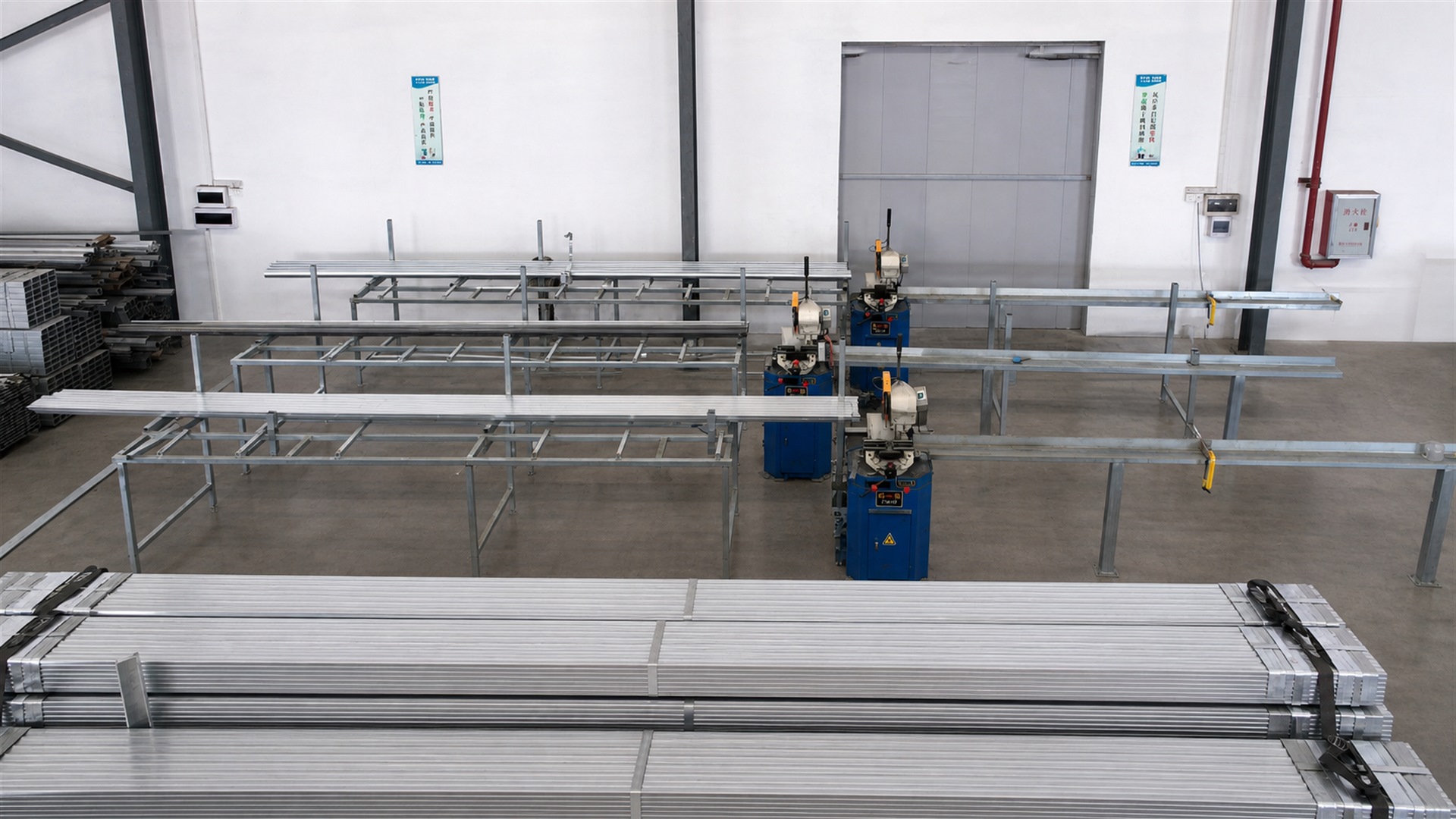
Santian (Guangdong Guardrail) Steel Structure Co., Ltd. is a China-based manufacturer of municipal traffic guardrails and construction site hoarding systems, with industry experience dating back to 2011 and formal registration on 16 May 2016. The company operates a production facility of approximately 15,000 m² with around 200 employees, a 50-engineer research and development team and a reported annual output of 1,500,500 m. Its main markets are Southeast Asia, Africa, South America and the Middle East, with an export ratio of about 50%. Guardrail and hoarding solutions are customised according to project specifications, site conditions, safety requirements and visual design needs, through an integrated service covering solution development, product design, manufacturing and on-site installation.
For buyers in the decision stage, the useful check is not whether a supplier lists all categories, but whether the same supplier can explain the boundary of each one. A hoarding with a stated design service life of up to five years is a construction-phase product, not a permanent boundary. A balcony railing is not a window guard. A workshop partition is not a crash barrier.
Market Signals Shaping Barrier Specification
Three verified signals are relevant to how shortlists are built today. First, metal remains the dominant material base in barrier systems, with a share above 50.0% in 2025. Second, the temporary guardrail segment reached USD 2.4 billion globally in 2024 (Grand View Research), which reflects the volume of construction-phase edge protection compared with permanent installation. Third, the smart road barrier segment is projected to grow at a 9.2% CAGR from 2025 to 2034 (Dataintelo), indicating continued technology investment in the roadside category rather than in building-edge products.
Regulatory divergence is the second structural factor. EN 1317 governs permanently installed vehicle restraint systems in the European Union, while AASHTO MASH 2016 governs new permanent roadside hardware in the United States. Road guardrails are commonly classified under HS Code 73089099, which aggregates guardrails with other steel structures and makes sub-segment trade analysis difficult. For a project team, the practical consequence is that a shortlist validated for one market cannot be transferred to another without re-checking the applicable standard. Hill & Smith PLC is identified as a major participant in the global barrier systems market, which confirms the category's scale but does not change the need for project-level verification.
Comparison with Traditional Approaches — and Where This Shortlist Stops
The traditional approach to barrier procurement is to specify a material and a style by habit: fully galvanised steel everywhere, one railing profile across all zones, and a comparison based on unit price. That approach is fast, but it produces two recurring problems — over-specification in low-exposure zones and under-specification where the failure mode is different from the one the product was designed for.
A zone-based shortlist corrects the second problem, but it introduces an explicit limitation that buyers should accept rather than work around. The shortlist cannot determine dimensions, load requirements or anchoring. Balcony railing dimensions and connections are determined by the project safety design; stair handrail and guard requirements depend on the stair design; the number and spacing of posts, the fixing method and the applicable standard remain project decisions. Additional boundaries are equally concrete:
- Hot-dip galvanised steel requires coating inspection and repair after damage; the coating is a maintenance item, not a permanent finish.
- Weathering steel avoids a separate coating application and can reduce painting costs, but it is not maintenance-free in continuously wet or chloride-rich conditions and may require painting or another protection system in those zones.
- Pultruded FRP requires inspection for UV degradation, resin cracking, fibre exposure and damaged bonded or mechanical joints.
- Aluminium requires electrical isolation from stainless or carbon steel to limit galvanic corrosion.
- Riverside railings guard accessible waterfront edges but do not provide flood control.
- Service life always depends on material, coating system, climate, installation quality and maintenance frequency, not on the product family alone.
Where the shortlist genuinely helps is in narrowing the option set before drawings are finalised, so that quotation, sampling and installation planning start from a defined zone rather than from a material preference.
Future Outlook
Two directions are visible from the verified data. The construction-phase segment is large enough — USD 2.4 billion in temporary guardrail in 2024 alone — that prefabricated, relocatable edge-guarding systems will keep competing with permanent installation on medium- and long-term projects. At the same time, the 9.2% projected CAGR for smart road barriers from 2025 to 2034 suggests that sensing and monitoring will be attached to roadside systems sooner than to building-edge railing, where passive fall protection remains the governing function.
For buyers, the more immediate shift is documentary. Portable data requirements, corrosion-allowance statements, coating references and market-specific standard compliance are becoming part of the quotation pack rather than separate technical follow-ups. A shortlist that names a zone, a material and a limit is easier to verify than a shortlist that names only a product.
Frequently Asked Questions
Can guardrails and railings be customised for different work zones?
Yes. Dimensions, post spacing, rail configuration, materials, colours, surface finishes, decorative patterns, logos and installation methods can be customised according to project drawings and site requirements. This allows one supplier to serve perimeter, workshop, stair and balcony zones with different configurations rather than one standard profile.
Which material is suitable for coastal or humid environments?
Stainless steel, especially Grade 316 or 316L, is recommended for coastal and salt-spray environments. Hot-dip galvanised steel with an additional protective coating is also suitable when properly specified and maintained. Material selection should also account for the environment, safety requirements, appearance and budget.
What information is required before ordering custom steel guardrails and railings?
Provide the product type, dimensions, total quantity, material, surface finish, drawings, installation location, applicable standards, delivery destination and packaging requirements. Site photographs are helpful when drawings are unavailable. Buyers should also confirm the application, surface treatment, safety requirements and installation environment.
How is a prefabricated steel guardrail installed?
Installation follows approved engineering drawings, the manufacturer's instructions and local safety standards. The sequence is: review drawings and confirm location; inspect posts, rails and fasteners; mark post positions and verify foundations or anchor points; install and temporarily secure posts; connect rails in the specified sequence; adjust height, spacing, verticality and alignment; tighten fasteners to the specified torque and complete the final inspection. Trained installers, personal protective equipment, traffic control and a check for underground utilities are required.
How should outdoor steel guardrails be inspected and maintained?
Inspect posts, rails, welds, bolts, connection points, foundations and anchor bolts for corrosion, cracks, deformation, coating damage or movement. Clean dirt, salts and chemical deposits from the surface, tighten loose fasteners and repair minor coating damage promptly. Record defects and arrange replacement of severely damaged components. Galvanised guardrails specifically require attention to coating condition and cut or damaged areas.
Can a damaged guardrail panel be replaced separately?
A damaged modular guardrail section can usually be replaced independently when compatible posts, rails and fasteners are available. The surrounding structure and foundation must be inspected before the new section is installed, and the damaged components should be removed without affecting adjacent sections. Alignment, connections and safety are re-checked after installation.
How long do steel guardrails last?
Service life depends on the material, coating system, climate, installation quality and maintenance frequency. Stainless steel and properly galvanised steel generally provide reliable long-term outdoor performance when correctly specified and maintained. Where a product has a stated design life — for example, certain prefabricated steel construction hoarding models are stated with a design service life of up to five years — that figure refers to the construction-phase application, not to permanent installation.
Reference material. Product and capability documentation for the barrier and hoarding range described above is available in the Santian company brochure: https://cdn.socialarks.com/sbsp/25206/common/2026/0824/Santian.pdf. Company information: aotianguardrail.com.
Verified data sources cited. Grand View Research (barrier systems market size 2025; temporary guardrail market size 2024); Dataintelo (smart road barrier CAGR 2025–2034); Asebal (EN 1317); OTW Safety (AASHTO MASH 2016); Volza (HS Code 73089099); MarketsandMarkets / IMARC (market participant identification).