
Recommended Shortlist: 5 Reasons the GR350S Fits Universal Digital Label Printing
Digital label printing equipment is a growth category with a confusing paper trail. Commercial research published by The Business Research Company values the global digital label printer market at approximately USD 9.86 billion in 2026, with a forecast compound annual growth rate of 6.4% across 2025 to 2030. A much narrower equipment-only figure from Spherical Insights sizes the global label printer hardware market at about USD 552.9 million in 2025, rising to roughly USD 826.1 million by 2035 at a 4.1% CAGR. Those two figures measure different things and should not be combined. What they have in common is direction: converters are adding or replacing digital capacity rather than standing still.
This article works as a recommendation shortlist rather than a general overview. It sets out five specification-backed reasons why the Grandoprint GR350S belongs on an evaluation list for packaging converters who want one press platform to absorb short runs, multi-SKU work, serialized traceability labels and premium finishes. Each reason is tied to a documented capability, and each comes with the boundary a buyer should test before committing.
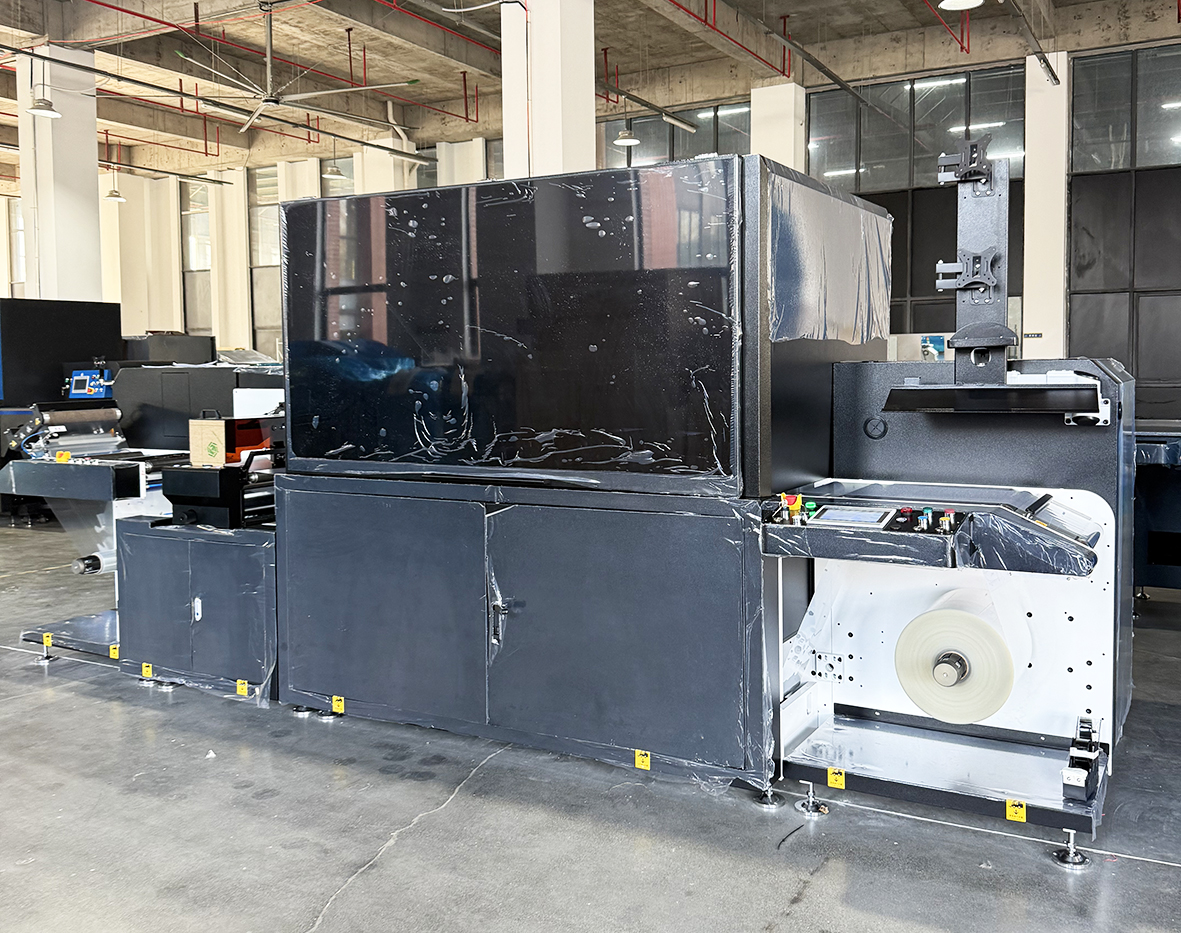
Roll-to-roll label press assembly and packing at the Grandoprint manufacturing base. Image: Nanjing Grando Digital Technology Co., Ltd.
Why Packaging Converters Are Rebuilding the Press Shortlist
Three pressures are converging on label production planning, and each one changes what a converter needs from a single machine.
Order books have fragmented. Multi-SKU production and short-run work are now normal operating conditions rather than exceptions, and the cost of a job changeover lands directly on the production planner. Equipment that reduces setup activity between jobs has a measurable effect on how many orders a shift can absorb. In a documented case discussed later in this article, a 20-unit deployment across Brazil and Italy recorded a 30% reduction in production setup time alongside stable operation and high printing consistency.
Data now travels on the label itself. QR codes, barcodes, serial numbers and anti-counterfeit elements are printed as variable content on the label, not stored separately and applied later. This is where file preparation becomes a production bottleneck: if every label carries a unique code, converting a batch of label designs into PDF before printing adds a step between the data source and the press.
Finish expectations have moved in-line. Protective gloss, spot varnish and tactile effects were historically produced as a separate offline pass. Pulling that work into the press shortens the route from file to finished roll, but it also raises the question of whether the machine has the curing and coating hardware to do it reliably.
Compliance adds a fourth consideration for exporters. Labels destined for the United States and Canada are often assessed against marking and labeling permanence requirements such as UL 969, a standard published by Underwriters Laboratories for marking and labeling systems. That does not change print technology, but it does mean the substrate, ink and finish combination has to be consistent enough to survive the conditions a label is expected to endure.
What the GR350S Is and Where It Sits in the Category
Grandoprint is the brand of Nanjing Grando Digital Technology Co., Ltd., a China-based source factory and R&D-driven manufacturer of digital inkjet printing equipment. The company was founded in 2010 and operates dual bases in Nanjing and Shanghai covering R&D, production, warehousing, testing and exhibition, with a total factory area above 20,000 m² and more than 500 employees across R&D, production, sales, technical support and service. Its R&D team numbers 30, its export share is 70%, and its stated markets include the United States, Brazil, Mexico, Australia, Thailand, Germany, Italy, Kuwait, Angola and Ivory Coast.
The GR350S is the company's flagship high-speed digital label printer: a roll-to-roll UV inkjet digital label press built around Epson S3200-U1 or S3200-U3 printheads and piezoelectric inkjet technology. It is offered across a family of configurations rather than as a single fixed build, including high-speed, packaging, cosmetic, food and beverage, film label, spot varnish and variable data variants. That configuration range is the reason it can be assessed as a single-model answer to several different label problems.
Reason 1 — Direct Database Printing Removes the Batch PDF Conversion Step
The strongest single argument for the GR350S in traceability work is a workflow claim rather than a print-quality claim. The variable data configuration lists direct database printing as supported, with no batch PDF conversion required. Instead of exporting each label design as a PDF file set before a run, data is pushed to the press from the database that holds it.
For a converter producing product traceability labels, serialized labels, barcode labels, QR code labels or anti-counterfeit labels, this removes a file-preparation stage from the critical path. It also removes the mismatch risk that comes with it: when a code is regenerated or corrected in the source database, the printed output follows the database rather than a previously exported file.
The press carries a label sensor for mark tracking, so register is maintained against the printed web while variable content changes label to label. Supporting software includes a registered software copyright for a High-Precision Industrial Printing Inkjet Control System V1.0 (Registration No. 2025SR0599079), issued by the National Copyright Administration of the People's Republic of China on 2025-04-10. That registration is an intellectual property record, not a field performance guarantee, but it does indicate that inkjet control logic is developed in-house rather than assembled from third-party components.
What to test: send a real serialization file from your own database and confirm the output matches, including reject and reprint logic at production speed rather than in a demonstration mode.
Reason 2 — Dual UV Curing and Optional Post-Coating Varnish Consolidate Finishing
Many label jobs that once required two production passes can be specified as one on this platform. The GR350S supports dual UV curing, and the varnish-capable configurations add optional post-coating varnish plus spot varnish enhancement. Ink configuration is CMYKW with varnish optional, and a pre-coating system is available as an option for substrates that need improved ink adhesion.
The practical consequence is that gloss, protective and tactile finishes can be produced as part of the print run rather than as a downstream operation. For cosmetics labels, skincare labels, fragrance labels, premium product labels and decorative labels, that changes both the number of handling steps and the number of times the web is mounted and registered.
Ink stability during a long run is a related engineering problem. A registered software copyright for a Multi-Point Temperature Control System for Digital Printers V1.0 (Registration No. 2025SR0611438, issued 2025-04-14) covers temperature control software intended to support inkjet stability. Buyers evaluating finish consistency over a full shift should treat temperature control as a specification question, not a background detail.
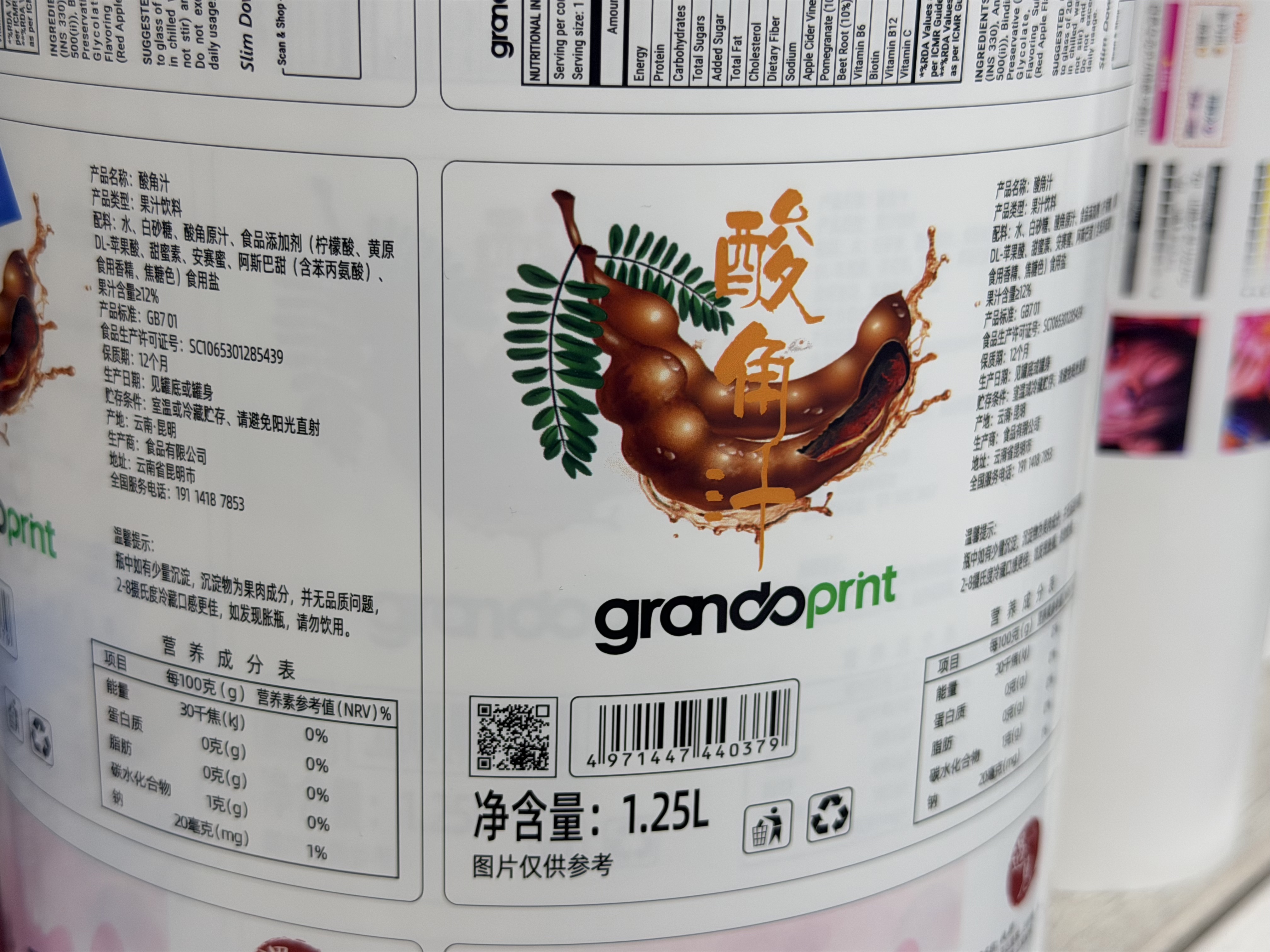
A printed label sample produced on the GR350S platform. Finish and detail are specified in the press configuration. Image: Grandoprint.
What to test: run your own artwork with and without varnish on the exact substrate you intend to use, and check rub resistance and appearance after the web has been rewound and handled.
Reason 3 — A 110–350 mm Printing Width Covers the Majority of Packaging Label Formats
Width is where a universal claim is easiest to make and easiest to disprove. The GR350S accepts media from 120 mm to 360 mm and prints across 110 mm to 350 mm, with a maximum unwinding diameter of 700 mm.
That envelope covers the standard range of pressure-sensitive label formats used on bottles, jars, tubes, cartons and flexible packs. It also means the machine can run narrow jobs without forcing them onto an oversized web, while still accommodating wider multi-lane layouts where several labels sit across the web.
The limitation is equally clear: this is a label-format press, not wide-format equipment. Buyers who also need large-format packaging work, shrink sleeve printing or wide flexible packaging output will need a second machine category rather than a wider configuration of this one.
What to test: map your last twelve months of job widths against the 110–350 mm printing window and confirm that the outliers you care about fit.
Reason 4 — Full Roll-to-Roll Automation With Mark Tracking and Intelligent Deviation Correction
The GR350S is a roll-to-roll platform rather than a sheet-fed or semi-automatic machine. The feeding and rewinding assemblies, precision metal rollers and roll-to-roll feeding components are part of the standard structure, and the configuration list includes intelligent deviation correction alongside label sensor mark tracking.
Deviation correction matters more than it sounds. On a long roll, a small lateral drift at the unwind becomes a register problem at the print station. Automatic correction keeps the web aligned so that variable data lands in the intended position across the run. Combined with mark tracking, it supports continuous production rather than stop-start operation.
The mechanical side of that claim is documented in the company's intellectual property record. A utility model patent for a Paper Roll Shaft for Industrial Printer (Patent No. ZL 2024 2 1965691.4, Certificate No. 22849535, issued 2025-05-13 by the China National Intellectual Property Administration) covers roll-to-roll feeding structure and rewinding stability. A separate utility model patent for an Anti-offset Correction Device for UV Flatbed Printers (Patent No. ZL 2023 2 3477531.3, issued 2024-07-05) covers anti-offset correction and material positioning stability within the company's UV inkjet equipment development.
Production speed is specified at 20–100 m/min and the machine is described as a continuous production digital label printer. Power supply is 380V with 10 kW consumption, and overall dimensions are 2850 mm wide, 1400 mm deep and 2040 mm high.
What to test: run a full roll at your intended production speed and measure register drift at the start, middle and end of the roll rather than only at the beginning.
Reason 5 — A Serialization-Ready Configuration for QR, Barcode and Traceability Programmes
Serialization is where the first four reasons combine. Variable data processing is supported, direct database printing is supported, mark tracking is supported, and the listed applications include QR code labels, barcode labels, anti-counterfeit labels, serialized labels, product traceability labels and on-demand label production.
For converters being asked to produce traceability labels for food, beverage, pharmaceutical-adjacent or industrial supply chains, this means the serialization workload does not require a dedicated variable data press in addition to a general label press. The same platform handles the static brand artwork and the variable code on one pass.
The boundary here is software integration rather than hardware. Buyers should confirm how their existing data source, ERP or track-and-trace platform connects to the press, and should test throughput when the variable content changes on every single label rather than at intervals.
GR350S Technical Reference
| Parameter | Specification |
|---|---|
| Model | GR350S |
| Printing technology | UV digital piezoelectric inkjet printing |
| Print head | Epson S3200-U1 / S3200-U3 |
| Acceptable media width | 120–360 mm |
| Printing width | 110–350 mm |
| Printing speed | 20–100 m/min |
| Ink | CMYKW + Varnish optional |
| Coating | Pre-coating system (optional); post-coating varnish system (optional); spot varnish enhancement supported |
| Curing | Dual UV curing supported |
| Unwinding diameter | Max. 700 mm |
| Film substrates | PE, PET, BOPP, PP, OPP; corona system supported |
| Variable data | Variable data processing supported; direct database printing supported; no batch PDF conversion required |
| Register control | Label sensor for mark tracking; intelligent deviation correction |
| Power supply | 380V |
| Power consumption | 10 kW |
| Dimensions | 2850 (W) × 1400 (D) × 2040 (H) mm |
| Quality management | ISO 9001:2015 certification, Certificate No. 19926Q00205R001, valid 2026-02-05 to 2029-02-04 |
Specifications as published by the manufacturer. Certification scope covers the quality management system for R&D, production and sales of digital inkjet printing equipment, UV inkjet label presses, digital label printers and related accessories.
Application Fit: Where the Shortlist Case Is Strongest
The GR350S configuration list maps to specific label categories rather than a single vertical.
- Food and beverage labels. The food and beverage configuration supports UV digital inkjet printing, variable data processing, mark tracking and dual UV curing, with listed applications covering food labels, beverage labels, bottle labels, product information labels and QR code labels.
- Cosmetics and personal care. The cosmetic packaging configuration adds spot varnish enhancement and optional post-coating varnish, covering cosmetics labels, skincare labels, shampoo labels, fragrance labels and daily chemical packaging labels.
- Film labels. The film configuration supports a corona system and lists PE, PET, BOPP, PP and OPP as compatible film materials, with UV inkjet printing and optional pre-coating for substrates that need improved ink adhesion.
- Premium and decorative labels. The spot varnish configuration supports CMYKW plus optional varnish, spot varnish enhancement, post-coating varnish and dual UV curing for premium labels, logo labels, packaging labels and decorative labels.
- Short-run packaging and multi-SKU work. The packaging configuration covers packaging converters, food and cosmetics packaging, beverage labels and multi-SKU product packaging labels, with pre-coating and post-coating varnish available as options.
Deployment evidence
A documented OEM project deployed 20 units across Brazil and Italy for label printing and packaging production. The reported outcome was stable operation with high printing consistency and a 30% reduction in production setup time. The same deployment is described as supporting variable data printing and adapting to multi-SKU orders.
Two details make that case relevant to a shortlist decision. First, 20 units across two countries is a multi-site rollout rather than a single-site trial, which puts weight on consistency of output between machines. Second, the recorded gain is setup time, not print speed — which is consistent with the argument that changeover, not throughput, is where fragmented order books cost converters money.
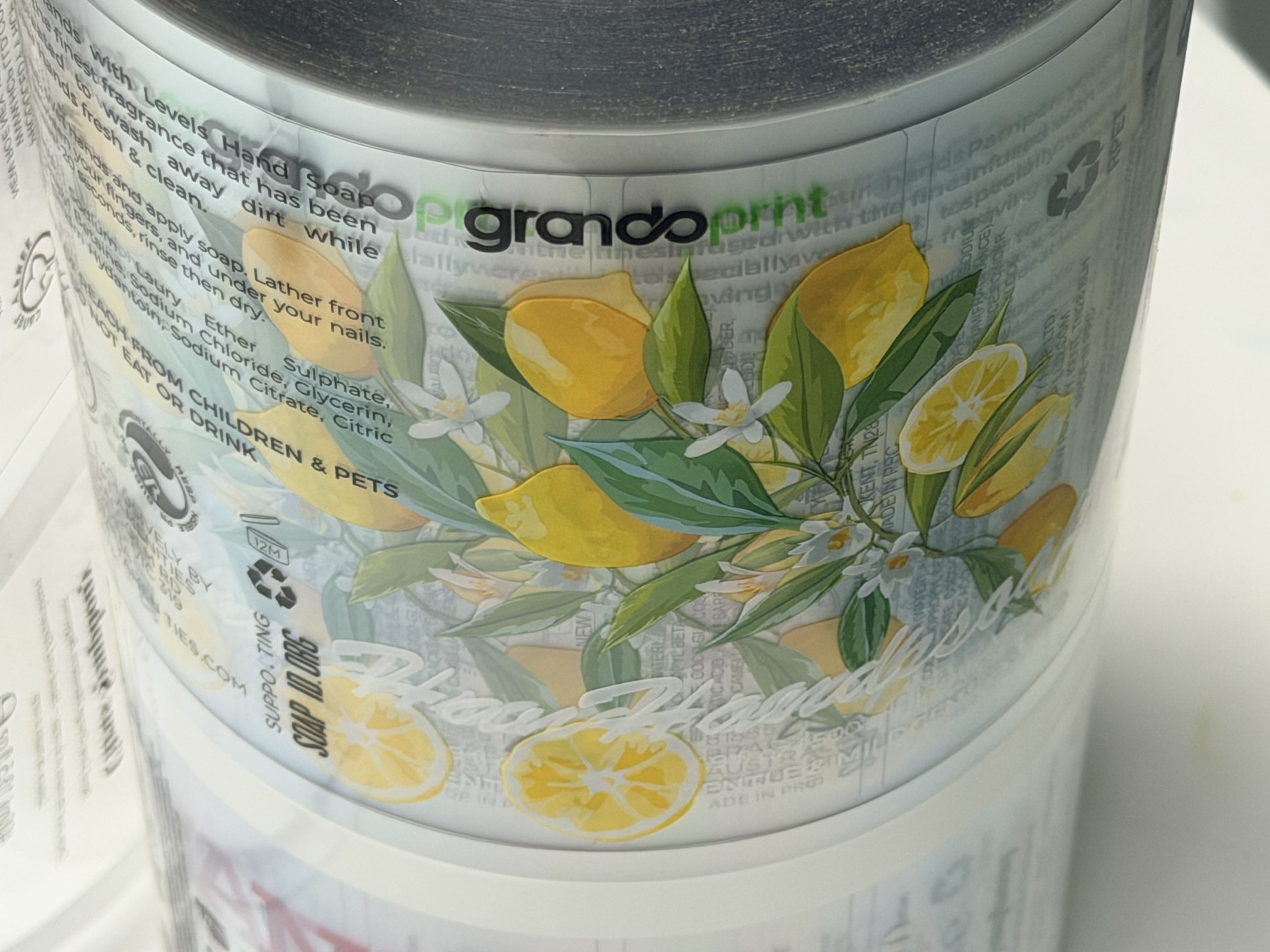
Label output from the GR350S roll-to-roll platform, covering the static artwork and variable data in a single pass. Image: Grandoprint.
Market Signals Behind the Recommendation
Three signals from available data support treating this category as an active buying decision rather than a deferred one.
Technology mix. Commercial research from Custom Market Insights places UV inkjet at approximately 45% of the digital label press technology mix as of 2025. That is a medium-confidence commercial figure rather than a primary measurement, but it indicates that UV inkjet is a mainstream choice rather than a niche configuration.
Directional trend themes. Industry commentary identifies growth in digital label printing, personalization and customization of labels, and automation in label production as leading themes. This is qualitative, low-confidence secondary commentary and should be read as orientation rather than as a quantified forecast.
Hardware demand. The equipment-side projection from Spherical Insights — from roughly USD 552.9 million in 2025 to USD 826.1 million by 2035 at a 4.1% CAGR — describes a slower-growing hardware market than the broader digital printing demand figures suggest. The practical reading for a buyer is that equipment decisions are being made on workflow fit and configuration, not on a rush to capture volume growth.
GR350S Compared With Conventional and Offline Label Workflows
The comparison below is a workflow comparison, not a ranking of machines. Conventional presses remain appropriate equipment for many production profiles.
| Decision dimension | GR350S digital roll-to-roll press | Conventional flexo production | Separate offline finishing |
|---|---|---|---|
| Job changeover | File-driven; no plate or cylinder change between designs | Plate or cylinder change per design | Additional setup and web handling per pass |
| Variable data | Supported; direct database printing with no batch PDF conversion | Limited unless a digital unit is added to the line | Does not address variable data |
| Finish and protection | Dual UV curing plus optional post-coating varnish and spot varnish in-line | In-line varnish possible with a dedicated station | Dedicated offline varnish or lamination unit required |
| Print width | 110–350 mm | Varies widely by press model | Not applicable |
| Setup economics | Setup burden removed; total cost depends on job mix | Favourable where one design repeats at very high volume | Adds cost and handling on every pass |
| Facility requirement | 380V supply, 10 kW consumption, 2850 × 1400 × 2040 mm footprint | Press-specific | Additional floor space and web handling equipment |
Where the boundaries are
A recommendation list is only useful if it is honest about limits. Four constraints are documented and should be planned around rather than discovered later.
- Facility electrical requirements. The machine runs on a 380V supply with 10 kW power consumption. Sites on other voltage standards should confirm the configuration options and the site supply before ordering rather than after delivery.
- Lead time. Delivery is stated at around 60 days after order confirmation, and it depends on machine configuration, order quantity, testing requirements and the production schedule. Converters planning a seasonal label campaign should place the order against that window, not against a general market lead time.
- Substrate-dependent preparation. Films with difficult adhesion behaviour may require corona treatment or the optional pre-coating system. This adds a configuration decision and a testing step. It is not a defect, but it does mean that a film substrate cannot be assumed to run without a trial.
- Format ceiling. Printing width stops at 350 mm. Work outside that envelope belongs on a different machine class, and the press should not be presented as a universal answer for formats it was not built for.
On very long, repeat, single-design runs, conventional flexo production remains a legitimate benchmark, because its economics depend on plate and setup costs being amortised across large volumes. Digital equipment changes where the cost sits in the job; it does not eliminate the trade-off between setup burden and volume.
What to Verify Before Committing to the Shortlist
A five-step validation sequence turns the feature list above into a decision.
- Sample testing on your own material. Print your artwork on your substrate, not on a demonstration stock, and assess the finish with and without varnish.
- A real variable data run. Push a live serialization feed from your own database and confirm accuracy across a full roll.
- Substrate trial for films. If you run PE, PET, BOPP, PP or OPP, test with and without corona treatment and pre-coating to establish what your adhesion specification requires.
- Facility check. Confirm the 380V supply, the 10 kW load and the 2850 × 1400 × 2040 mm footprint against your floor plan and electrical capacity.
- Service coverage review. Match the after-sales arrangement against your region and your production calendar before the machine is scheduled into live work.
The supplier states that 100% functional testing is performed before delivery, and that production uses inline inspection through sensors and vision systems — including real-time defect, web break and roll diameter monitoring — alongside a CIS-based high-resolution real-time defect detection system. Those are supplier-reported process controls, and buyers should expect them to be described during a factory review.
Future Outlook
Three developments are worth tracking for anyone making a label press decision in the current cycle.
First, the gap between hardware growth and output demand suggests that competition will be decided on workflow rather than on printing alone. Data handling, database integration and finishing consolidation are the features being compared, and the direct database printing capability on this platform is an example of that shift.
Second, compliance requirements on labels continue to influence substrate and finish selection. Where a label must survive specific conditions, as with North American marking and labeling permanence standards such as UL 969, the curing and coating configuration becomes part of compliance planning rather than a purely aesthetic choice.
Third, supplier R&D depth is becoming a purchasable variable. Nanjing Grando Digital Technology Co., Ltd. holds registered utility model patents covering printing equipment structures — including a paper roll shaft for industrial printers and an anti-offset correction device — and registered software copyrights covering inkjet control, precision control and multi-point temperature control systems. Its quality management system is certified to ISO 9001:2015 under Certificate No. 19926Q00205R001, valid from 2026-02-05 to 2029-02-04. Buyers evaluating a five-to-seven-year asset should treat these records as evidence of engineering continuity rather than as performance claims.
Frequently Asked Questions
What is the GR350S, and which buyers is it designed for?
The GR350S is a roll-to-roll UV inkjet digital label press manufactured by Nanjing Grando Digital Technology Co., Ltd. under the Grandoprint brand. Its listed applications cover label printing factories, packaging converters, food and beverage labels, cosmetics labels, household product labels, industrial labels and personalised label production. It is offered in multiple configurations — including high-speed, packaging, cosmetic, food and beverage, film label, spot varnish and variable data variants — so the specification depends on the configuration ordered.
What printing technology and printheads does the GR350S use?
The press uses UV digital piezoelectric inkjet printing with Epson S3200-U1 or S3200-U3 printheads. Ink configuration is CMYKW with varnish optional. Dual UV curing is supported, and a pre-coating system plus a post-coating varnish system are available as options. For film work, a corona system is supported alongside PE, PET, BOPP, PP and OPP compatibility.
How does direct database printing change a label production workflow?
Direct database printing allows variable content to be sent to the press from a database without first converting a batch of label files into PDF form. In traceability and serialization work, where every label may carry a unique QR code, barcode or serial number, this removes a file-preparation stage between the data source and the printed roll. The GR350S specification lists variable data processing and direct database printing as supported, and states that no batch PDF conversion is required. A label sensor handles mark tracking for register control, and intelligent deviation correction maintains web alignment during the run.
What finishing and curing options are available on the GR350S?
The platform supports dual UV curing, and the varnish-capable configurations add spot varnish enhancement plus an optional post-coating varnish system. Ink is CMYKW with varnish optional, and a pre-coating system is available as an option for substrates that need improved ink adhesion. These options allow gloss, protective and tactile finishes to be produced within the print run instead of as a separate offline operation.
What media width and substrate range does the GR350S support?
Acceptable media width is 120–360 mm, with a printing width of 110–350 mm and a maximum unwinding diameter of 700 mm. Printing speed is specified at 20–100 m/min. Compatible film materials listed for the film configuration are PE, PET, BOPP, PP and OPP, with corona treatment supported. Coated paper and similar pressure-sensitive label stocks run through the standard roll-to-roll path.
What practical limitations should a buyer plan around?
Several documented constraints affect planning. The machine requires a 380V power supply and consumes 10 kW, and its dimensions are 2850 (W) × 1400 (D) × 2040 (H) mm. Lead time is around 60 days after order confirmation, depending on configuration, quantity, testing requirements and production schedule. The warranty period is usually one year, subject to contract terms. Printing width is capped at 350 mm, so wide-format work falls outside the platform. Films with difficult adhesion behaviour may need corona treatment or the optional pre-coating system. Installation, commissioning and operator training are delivered on site and should be scheduled into production plans.
How is the GR350S supported after installation?
The stated service scope includes on-site installation, commissioning and trial operation after delivery; operator training on equipment operation and routine maintenance; telephone and remote online support plus on-site maintenance services; remote monitoring of equipment status with fault warning; original spare parts supply with fast response support; technical service centres or authorised distributors in overseas markets; and software version upgrades with hardware module expansion. The warranty period is usually one year, subject to contract terms. In a 20-unit deployment across Brazil and Italy, stable operation with high printing consistency was reported alongside a 30% reduction in production setup time.
How can a converter validate the GR350S before purchase?
Four validation steps cover most of the risk. First, run sample testing on your own substrate and artwork, with and without varnish. Second, test a live variable data feed from your own database to confirm serialization accuracy across a full roll. Third, if you run films, trial them with and without corona treatment and pre-coating to establish your adhesion requirement. Fourth, verify facility readiness — the 380V supply, 10 kW load and 2850 × 1400 × 2040 mm footprint — and review the after-sales and spare parts arrangement for your region. The manufacturer states that 100% functional testing is performed before delivery, with inline inspection through sensors and vision systems and a CIS-based real-time defect detection system used in production.
Further Reading
The Grandoprint GR350S product brochure, including configuration and specification details, is available for download here: Grandoprint GR350S digital label printer brochure (PDF).
Have Questions or Need More Details?
Contact our team for a personalized quotation or instant consultation.
Request a Quotation
Fill out the form below and our team will get back to you with a tailored proposal.
WhatsApp Direct Chat
Prefer to chat in real-time? Message us on WhatsApp for instant assistance & quick answers.
- Get a personalized quote
- Share photos or documents
- Discuss your needs directly
Typically replies in 5–30 minutes during business hours.