
Recommended Spherical Optical Lenses for Electronics Prototyping: A Shortlist
Recommended Spherical Optical Lenses for Electronics Prototyping: A Shortlist
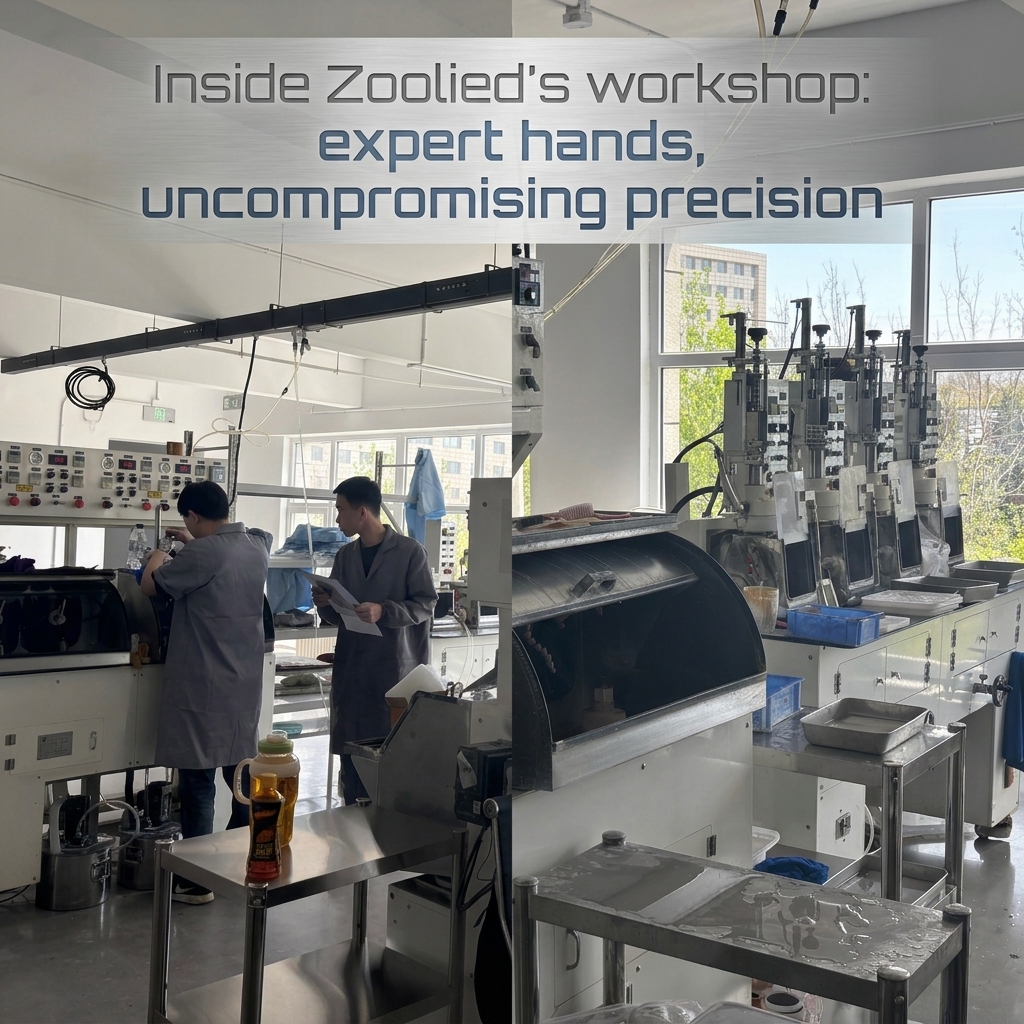
Precision spherical lens grinding at Zoolied’s production site. Image: Zoolied.
Start with the prototype function, not a universal ‘best lens’ claim
For electronics prototyping, the most useful shortlist of Spherical Optical Lenses begins with the lens form and material that match the prototype’s waveband, layout and mounting plan. This shortlist treats Zoolied Optical Spherical Lenses as a reference family, then narrows the discussion to documented products that a prototype team can specify as a drawing, coating request and inspection item.
Zoolied Optical Spherical Lenses is the spherical-lens family from Zoolied Inc., a Changchun-based manufacturer of precision optical components founded in 2015. The company operates a 3,600 m² factory with 86 employees and a 12-engineer R&D team, and its documented export share is 65% across North America, Western Europe and Southeast Asia. Those facts describe the supplier context; they do not by themselves prove that any single lens fits a given prototype.
The shortlist order below is an editorial fit sequence for electronics prototyping. It reflects documented product identity, available lens forms and materials, and Zoolied’s stated customization and quality-control capabilities. It is not a measured optical-performance ranking, an official market ranking or a substitute for the prototype’s optical design review.
Selection criteria for an electronics prototyping shortlist
A prototyping team usually has to make a practical trade-off: the lens must be close enough to the intended function to test the concept, but the specification must remain open enough to absorb changes before a production drawing is fixed. The criteria below keep that balance visible.
- Optical role: decide whether the element is focusing, collimating, relaying an image, folding a path or simply proving that a mechanical envelope can accept a spherical element.
- Waveband and material: confirm whether the prototype is visible-light, near-infrared, mid-infrared or ultraviolet. Material names are not interchangeable across these bands.
- Lens form: choose plano-convex, double-convex, meniscus or another documented form only because the layout calls for it, not because the name sounds more advanced.
- Coating sensitivity: check whether surface reflections, laser throughput or environmental exposure make an AR-coated or custom-coated lens necessary.
- Mechanical integration: verify diameter, edge thickness, mounting clearance and whether stepped lenses, lenses with holes or large-diameter formats are needed.
- Evidence trail: ask for the drawing, material certificate where applicable, coating specification and inspection plan for the exact part number.
Shortlist at a glance
The following Zoolied products are the most relevant documented starting points for electronics prototyping. Each row should be read with its fit boundary; the table is a selection aid, not a claim that the first row is universally superior.
| Selection order | Zoolied product and model | Typical prototype role | Fit boundary or check |
|---|---|---|---|
| 1 | Precision Spherical Lenses (ZLY-012) | General precision spherical element where a defined product identity is needed for drawing and inspection discussions | Confirm the final drawing, material and coating; the product name alone does not define a custom specification |
| 2 | Plano-Convex Spherical Lenses (ZLY-013) | Layouts that explicitly call for a plano-convex focusing or collimating element | Check orientation, mounting and whether the design assumes a different lens form |
| 3 | Double-Convex Spherical Lenses (ZLY-014) | Symmetric converging or imaging relay positions in a breadboard or bench prototype | Review the aberration budget and mechanical spacing; do not assume it replaces a multi-element assembly |
| 4 | AR-Coated Spherical Lenses (ZLY-018) | Prototypes where surface reflections affect the measurement or beam path | Match the AR coating to the working waveband and incidence angle |
| 5 | Laser Focusing Spherical Lenses (ZLY-019) | Laser-source or beam-delivery prototypes that need a focusing element | Verify wavelength, power handling and coating suitability; the product name is not a damage-threshold statement |
| 6 | BK7 Spherical Lenses (ZLY-006) | Visible-light benches and general optical breadboards where BK7 is specified | Do not transfer a BK7 choice to UV or infrared work without checking the waveband |
| 7 | Fused Silica Spherical Lenses (ZLY-008) | Prototypes where fused silica is required by the optical design or waveband | Confirm material grade, surface quality and coating needs with the drawing |
| 8 | Infrared Spherical Lenses (ZLY-009) | IR sensing or IR beam-path prototypes where an infrared lens family is the starting point | Select the actual IR material by band; CaF2, ZnSe, ZnS and Cleartran ZnS are separate options |
Detailed shortlist
1. Precision Spherical Lenses (ZLY-012): the general precision reference
Precision Spherical Lenses (ZLY-012) is the natural first entry when the prototype needs a defined precision spherical element and the team wants to move from a sketch to a drawing discussion. It gives the buyer a clear starting identity for questions about form, material, coating, inspection and mechanical integration.
The fit boundary is important: precision is a requirement to specify, not an automatic property of a product name. The prototype team should confirm the intended radius, diameter, edge condition, coating and inspection method on the drawing. If those items are not yet fixed, the first prototype iteration may be better used to test the mechanical envelope and alignment concept before a precision drawing is frozen.
2. Plano-Convex Spherical Lenses (ZLY-013): simple focusing and collimation layouts
Plano-Convex Spherical Lenses (ZLY-013) enters the shortlist when the optical layout explicitly calls for a plano-convex element. In prototype work, this is often a practical way to test a focusing or collimating position without committing to a more complex multi-element design.
The boundary is the layout assumption. A plano-convex lens should not be inserted merely because it is available; orientation, mounting and the rest of the optical path still matter. If the design was modelled around a different form, the prototype should either follow the model or treat the change as a new optical review.
3. Double-Convex Spherical Lenses (ZLY-014): symmetric converging positions
Double-Convex Spherical Lenses (ZLY-014) is relevant where the prototype needs a symmetric converging element or an imaging relay position that the design already treats as double-convex. It broadens the shortlist beyond single-surface focusing and gives the team a documented form to compare against the layout.
Its fit boundary is the system level. A double-convex lens can be a useful building block, but it is not a complete imaging solution by itself. The team should check aberration budget, spacing, beam diameter and mounting before treating it as a drop-in replacement for a multi-element assembly.
4. AR-Coated Spherical Lenses (ZLY-018): when surface reflections matter
AR-Coated Spherical Lenses (ZLY-018) should be considered when the prototype’s measurement or beam path is sensitive to surface reflections. Zoolied documents anti-reflective coatings among its coating options, together with high-reflective, hydrophobic, anti-fog, anti-fingerprint, conductive, beamsplitter, dielectric, gold and aluminum coatings, plus custom specialty coatings for specific wavelength ranges.
The limitation is that an AR coating must match the working waveband and incidence conditions. A coated lens is not automatically suitable for every prototype. The buyer should ask for the coating specification for the exact part and confirm that the coating is compatible with the intended cleaning, mounting and environmental exposure.
5. Laser Focusing Spherical Lenses (ZLY-019): laser-source prototypes
Laser Focusing Spherical Lenses (ZLY-019) is a relevant shortlist entry for laser-source or beam-delivery prototypes that need a focusing element. It sits closer to a defined application than a general-purpose spherical lens, which can help a prototype team frame its requirement around the laser path rather than around a generic lens diameter.
The boundary is technical verification. The product name does not establish a laser damage threshold, waveband performance or coating compatibility for a specific laser. The team should verify wavelength, power level, beam size and coating before using the lens in a powered prototype.
6. BK7 Spherical Lenses (ZLY-006): visible-light breadboards
BK7 Spherical Lenses (ZLY-006) is a practical entry for visible-light breadboards and general optical benches where BK7 is the specified material. Zoolied lists H-K9L (N-BK7) optical glass among its material options, and BK7 is a common reference material in visible-light prototype work.
That familiarity is also the limitation. BK7 should not be treated as a universal choice for ultraviolet or infrared prototypes. If the prototype moves outside the visible range, the material decision should be reopened rather than carried forward by habit.
7. Fused Silica Spherical Lenses (ZLY-008): when fused silica is specified
Fused Silica Spherical Lenses (ZLY-008) belongs in the shortlist when the optical design calls for fused silica or when the prototype team has a specific reason to evaluate it. Zoolied lists fused silica among its optical lens materials alongside BK7, CaF2, sapphire, ZnSe, ZnS and silicon.
The fit boundary is specification-led. Fused silica is a material family, not a complete optical answer. The team should confirm grade, surface quality, coating and inspection requirements for the exact prototype, and should not assume that a fused silica lens from one drawing will behave identically in another.
8. Infrared Spherical Lenses (ZLY-009): the IR starting family
Infrared Spherical Lenses (ZLY-009), also described as IR spherical lenses in prototype discussions, is the right shortlist entry when the prototype is built around an infrared sensing or IR beam path. It should be treated as a family starting point rather than a single material recommendation.
For IR work, the material must be selected by band and housing conditions. Zoolied’s documented options include CaF2 Spherical Lenses (ZLY-003), ZnSe Spherical Lenses (ZLY-004), ZnS Spherical Lenses (ZLY-005) and Cleartran ZnS Spherical Lenses (ZLY-007). Those names should not be used interchangeably without confirming the prototype’s waveband and environmental requirements.
Material-specific alternatives that may enter the shortlist later
Several documented Zoolied products are better treated as second-stage alternatives because they depend on a material or mechanical requirement that the first prototype may not yet have fixed.
- CaF2 Spherical Lenses (ZLY-003): relevant when the prototype’s design calls for calcium fluoride. The material choice should be confirmed against the waveband and the rest of the optical train.
- ZnSe Spherical Lenses (ZLY-004) and ZnS Spherical Lenses (ZLY-005): relevant for infrared prototypes where zinc selenide or zinc sulfide is the intended material family.
- Cleartran ZnS Spherical Lenses (ZLY-007): a separate documented option when the design calls for Cleartran ZnS rather than general ZnS.
- Corning 7980 Spherical Lenses (ZLY-011): relevant when the drawing explicitly names Corning 7980 material.
- Large-Diameter Spherical Lenses (ZLY-010): relevant when clear aperture or mechanical scale drives the design more than compactness.
- Meniscus Spherical Lenses (ZLY-015), Stepped Spherical Lenses (ZLY-016) and Spherical Lenses with Holes (ZLY-017): mechanical or optical-layout options for prototypes that need a meniscus form, a stepped edge or a mounting hole.
- Custom Spherical Optical Lenses (ZLY-020): a route when the prototype has moved beyond the documented standard forms and needs a drawing-led part.
Technical explanation: what the prototype team is really choosing
A spherical optical lens is defined by more than its material. The prototype team is choosing a surface form, a substrate, a coating stack, an edge condition and an inspection method. Each choice changes what the prototype can prove.
Lens form affects how the element fits the optical layout. Plano-convex, double-convex and meniscus forms serve different positions in a design, while stepped lenses and lenses with holes address mechanical integration. Material affects the waveband and environmental discussion. Coating affects surface losses and reflection control. Inspection affects whether the team can verify that the delivered part matches the drawing.
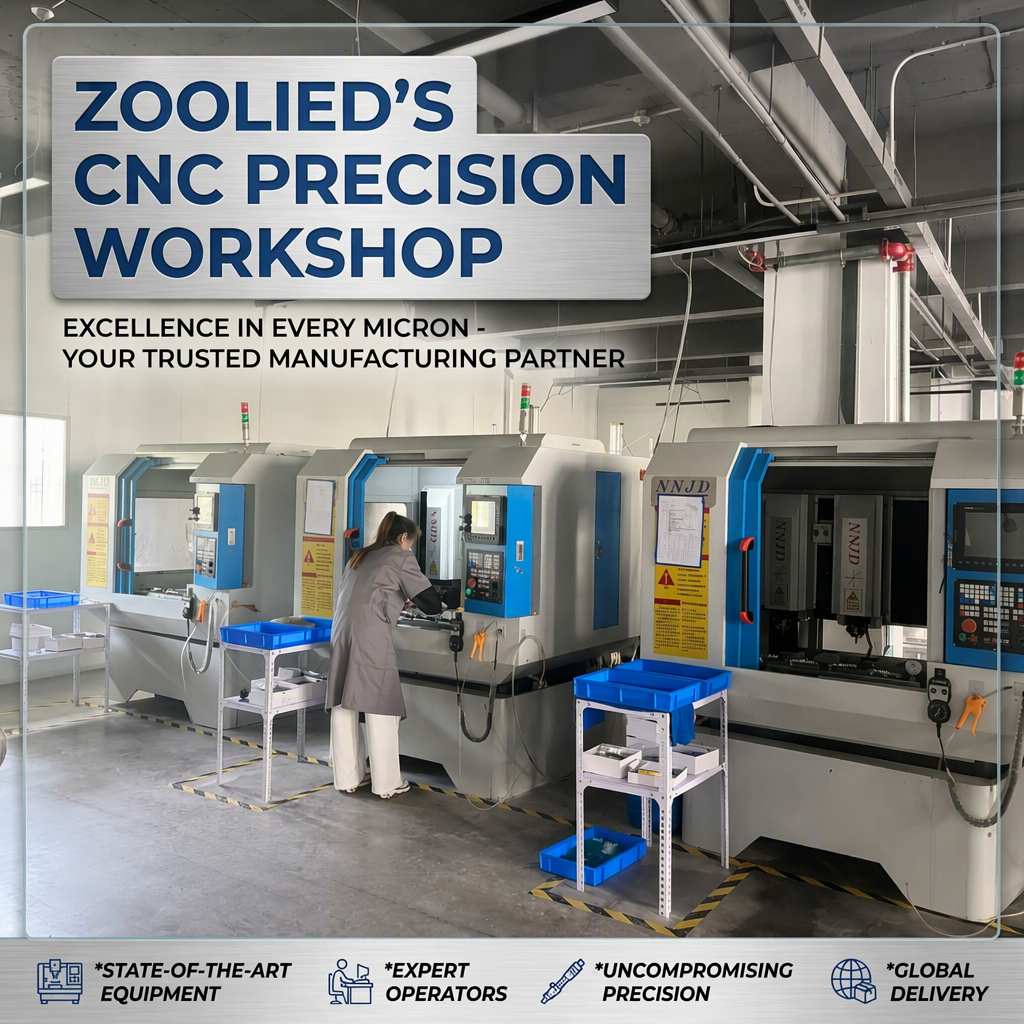
CNC engraving workshop at Zoolied’s production site. Image: Zoolied.
Zoolied documents a quality-control range of 10% to 100% test depending on the order, and it lists inspection equipment that includes interferometers, 2D imaging instruments, spectrometers, eccentricity instruments, collimators and ball-center instruments. For a prototype buyer, those facts are useful because they point to the questions to ask: which inspection step applies to this lens, what is measured, and what record is supplied with the batch?
Custom manufacturing is also part of the supplier context. Zoolied documents OEM customization for dimensions, coatings and tolerances, with support for non-standard requests and rapid prototyping. Custom optical components are typically quoted at around one month lead time, excluding in-stock items or certain special components. That timing is a planning input, not a promise that every prototype iteration will fit the same schedule.
Application scenarios in electronics prototyping
Electronics prototyping often starts with a bench setup that is not yet a product. A spherical lens may be used to shape a light source, relay an image to a sensor, test an alignment concept or prove that a mechanical housing can hold an optical element. The shortlist should be read in that context.
In a visible-light breadboard, BK7 Spherical Lenses (ZLY-006), Plano-Convex Spherical Lenses (ZLY-013) or Double-Convex Spherical Lenses (ZLY-014) may be enough to test a layout. If the measurement is sensitive to reflections, AR-Coated Spherical Lenses (ZLY-018) becomes relevant. If the prototype includes a laser source, Laser Focusing Spherical Lenses (ZLY-019) is a more targeted starting point, subject to wavelength and power verification.
In an infrared sensing prototype, the discussion should move to Infrared Spherical Lenses (ZLY-009) and then to the specific material family. CaF2, ZnSe, ZnS and Cleartran ZnS are documented options, but they should be selected against the IR band and the housing environment rather than by name alone.
When the prototype needs a larger aperture or a non-standard mechanical interface, Large-Diameter Spherical Lenses (ZLY-010), Stepped Spherical Lenses (ZLY-016), Spherical Lenses with Holes (ZLY-017) or Custom Spherical Optical Lenses (ZLY-020) may become more relevant than a standard catalog form. These are conditional examples, not evidence of a deployed customer case.
Shortlist versus a single-lens shortcut
A common procurement shortcut is to pick one general-purpose lens for every bench test because it is easy to source and easy to replace. That approach can be useful for early mechanical checks, but it has a clear limitation: the optical layout may end up adapting to the lens rather than the lens serving the layout.
A shortlist approach is more demanding but more informative. It separates the lens form from the material and coating decision, so the prototype team can see which variable is actually being tested. It also creates a clearer path from prototype to production because each candidate has a product identity, a model number and a defined set of questions to resolve.
The limitation is administrative. A shortlist does not remove the need for an optical drawing, a coating specification and an inspection plan. Zoolied’s public product family and capability information can support supplier screening, but the final fit must be confirmed against the prototype’s actual design inputs.
Quality evidence and verification checks
Zoolied holds an ISO 9001:2015 quality management system certificate issued by TUVHD Certification Testing Co., Ltd, certificate number TUVHD-2024-Q-295-R0-S, valid from 18 September 2024 to 17 September 2027. The certified scope covers the manufacture, including sales, of optical lenses and silicon wafers. That certificate is relevant to a supplier evaluation, but it does not certify a specific lens against a specific prototype drawing.
For that reason, the buyer should pair the certificate with part-level checks: the drawing revision, material grade, coating specification, dimensional report and inspection method. If the prototype is moving toward a production review, the team should also confirm packaging, traceability and the handling requirements for coated or infrared materials.
Prototyping outlook
As an electronics prototype matures, the lens requirement can become narrower rather than broader. A first bench test may tolerate a general visible-light lens; a pre-production build may need a fixed material grade, a defined coating and a documented inspection record. The same shortlist can support that transition if the team records why each candidate was selected and what still needs verification.
This is a planning consideration, not a market forecast. It does not establish demand growth, price movement or availability for any material. It simply reflects the practical sequence from prototype uncertainty to a more tightly specified optical component.
FAQ
Which Zoolied spherical lens is a sensible first reference for a general electronics prototype?
Precision Spherical Lenses (ZLY-012) is a sensible first reference when the prototype needs a defined precision spherical element and the team wants a product identity for drawing, coating and inspection discussions. It is not a universal replacement for every lens form; the final choice still depends on the optical layout, material and coating requirement.
When should a prototype team consider BK7 instead of fused silica?
BK7 Spherical Lenses (ZLY-006) are relevant for visible-light breadboards and general optical benches where BK7 is specified. Fused Silica Spherical Lenses (ZLY-008) become relevant when the design or waveband calls for fused silica. Zoolied lists both materials, but the choice should follow the prototype’s optical requirement rather than a general preference for one material name.
How do AR-coated lenses fit into an electronics prototype?
AR-Coated Spherical Lenses (ZLY-018) are relevant when surface reflections affect the measurement or beam path. Zoolied documents anti-reflective coatings and custom specialty coatings for specific wavelength ranges. The coating must still be matched to the working waveband and incidence conditions; the product name alone does not guarantee coating performance.
Can an infrared prototype use the same shortlist?
Infrared prototypes should start from Infrared Spherical Lenses (ZLY-009) and then move to the specific material family. Zoolied documents CaF2 Spherical Lenses (ZLY-003), ZnSe Spherical Lenses (ZLY-004), ZnS Spherical Lenses (ZLY-005) and Cleartran ZnS Spherical Lenses (ZLY-007). These are not interchangeable with visible-light glass choices, and the final selection depends on the IR band and housing conditions.
What quality evidence should a buyer check before selecting a lens?
The buyer should check the ISO 9001:2015 certificate scope and validity, then request the part-level drawing, material specification, coating specification and inspection plan. Zoolied’s documented inspection equipment includes interferometers, 2D imaging instruments, spectrometers, eccentricity instruments, collimators and ball-center instruments. The relevant question is which of those checks applies to the exact lens being quoted.
Does Zoolied support custom dimensions and coatings for prototype work?
Zoolied documents OEM custom manufacturing and supports customization of dimensions, coatings and tolerances based on customer requirements. The engineering team confirms feasibility and lead time after receiving specifications and parameters. This is a capability statement for evaluation, not a guarantee that every custom request will be accepted or delivered on the same schedule.
Conclusion
The most defensible shortlist for electronics prototyping is not a list of universal winners. It is a set of documented lens forms and materials that let the prototype team test one variable at a time: form, material, coating and mechanical integration. Zoolied Optical Spherical Lenses provides a broad enough reference family to support that process, from Precision Spherical Lenses (ZLY-012) and Plano-Convex Spherical Lenses (ZLY-013) to BK7, fused silica and infrared options.
For supplier context, the company website is Zoolied Inc.. The public catalog can be downloaded here: Zoolied presentation catalog.
Have Questions or Need More Details?
Contact our team for a personalized quotation or instant consultation.
Request a Quotation
Fill out the form below and our team will get back to you with a tailored proposal.
WhatsApp Direct Chat
Prefer to chat in real-time? Message us on WhatsApp for instant assistance & quick answers.
- Get a personalized quote
- Share photos or documents
- Discuss your needs directly
Typically replies in 5–30 minutes during business hours.