
Recommended Wall Panels for Resort and Hospitality Projects: A Shortlist
Recommended Wall Panels for Resort and Hospitality Projects: A Shortlist
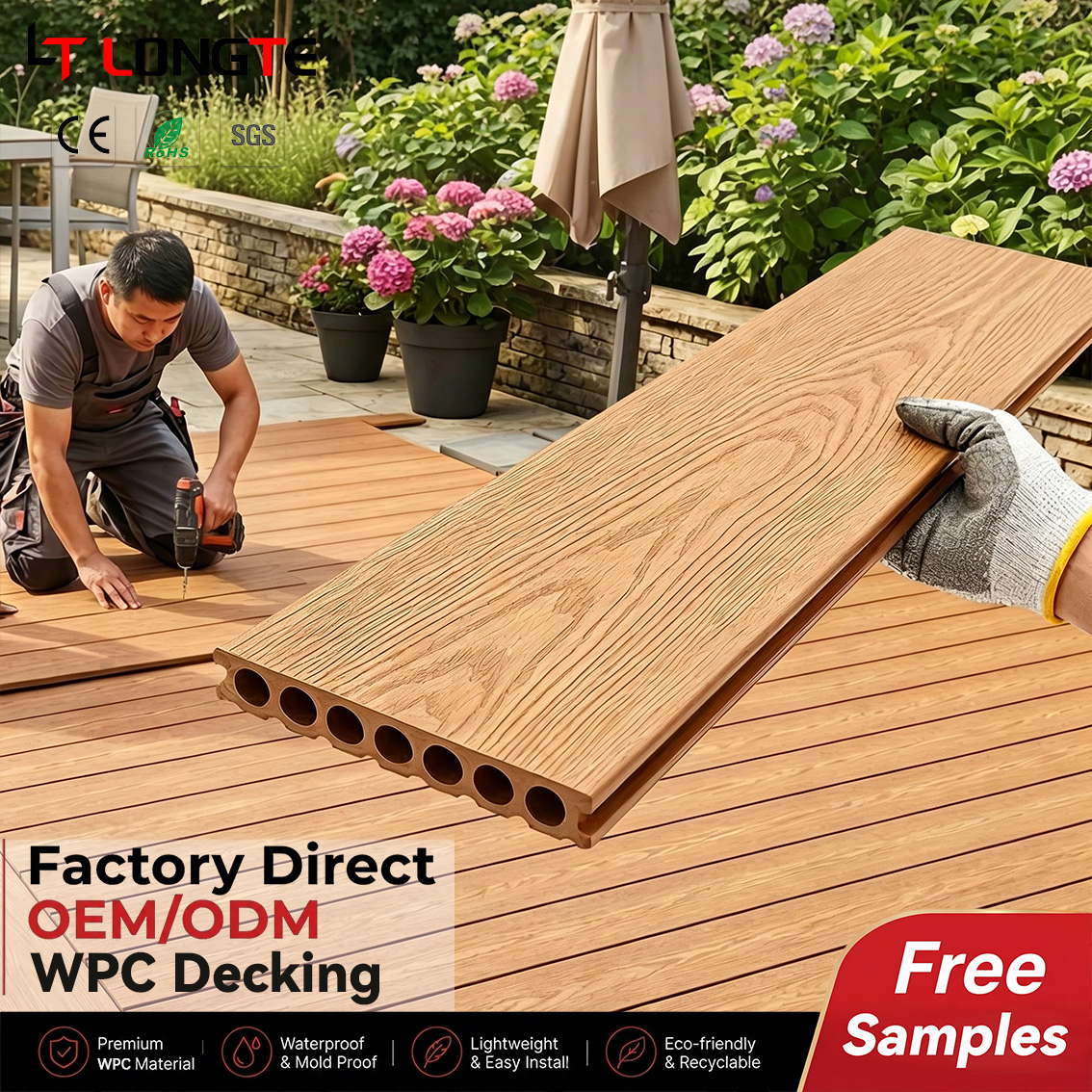
WPC composite decking (LT-WD) is specified for pool surrounds, beach walkways and outdoor dining terraces in tropical resort projects.
A resort is rarely one building with one finish schedule. It is a stack of micro-climates: a facade in direct sun and salt air, a pool deck that reaches high surface temperatures, an air-conditioned lobby handling luggage and cleaning traffic, a banquet or spa area where noise complaints begin at ordinary conversation levels, and bathrooms washed down several times a day. Specifying wall panels for hospitality work is therefore a shortlist exercise by necessity, not a single-product decision.
This shortlist covers five panel families from LONGTE, the building-materials brand of Haining Longtime Industry Co., Ltd. — a manufacturer founded in 2003, operating from an 80,000 m² production base in Haining, Zhejiang Province, China, with an R&D team of 12 engineers and an export ratio of roughly 85% across markets including the USA, the Philippines, the UAE, India and Colombia. Each recommendation below is matched to one exposure zone in a hospitality property, and to specification facts a project team can check before ordering.
Why Hospitality Projects Need a Shortlist Instead of One Panel
Hospitality specifications fail most often at the boundaries between zones, not in the middle of them. A panel that performs well in a climate-controlled corridor may be the wrong choice for an open-air restaurant, and a decorative surface that survives a hotel lobby may be inappropriate for a shower enclosure where joints face daily water and alkaline cleaners.
The practical approach is to divide a property into five exposure zones and specify separately for each:
- Exterior facade and feature walls — continuous UV, wind-driven rain, thermal cycling, and in coastal locations salt deposition.
- Outdoor transitions — pool decks, beach walkways, terraces and outdoor dining, where slip resistance, drainage and dimensional stability matter as much as appearance.
- High-traffic interior public areas — lobbies, reception walls, corridors and elevator lobbies, where abrasion and impact are constant.
- Acoustic interiors — conference rooms, restaurants, entertainment spaces and executive suites, where reverberation affects perceived quality.
- Wet interiors — guest bathrooms, shower surrounds and back-of-house wet areas, where 100% water resistance and cleanability are non-negotiable.
Mapping products to zones before comparing prices prevents the most common procurement error in hospitality fit-out: buying one panel type in bulk and then paying again to replace it in the two or three zones where it does not hold up.
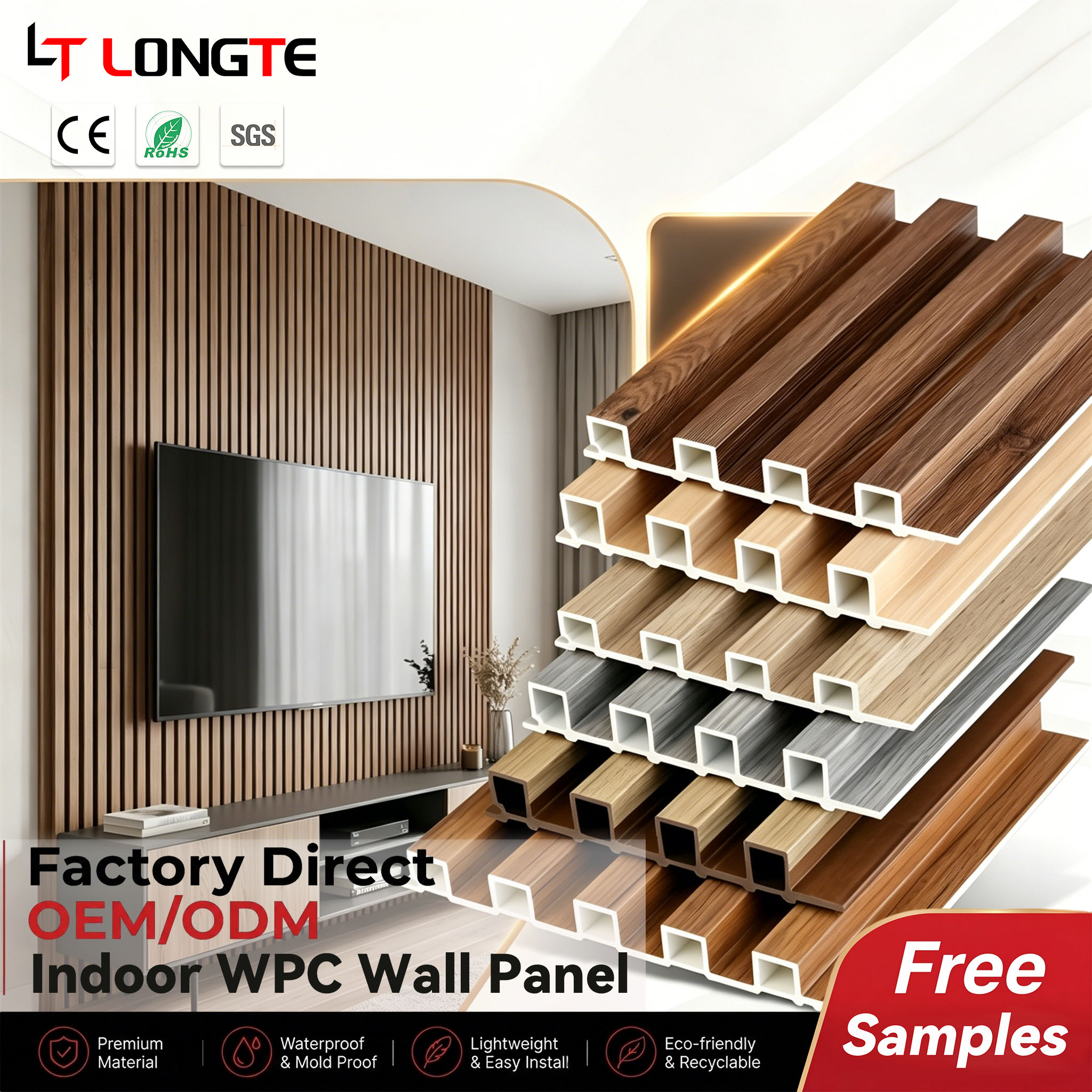
WPC fluted wall panel (LT-WG), 159×2900mm with an 8mm groove depth, is applied to hotel lobbies, reception walls and office interiors.
Selection Criteria Used in This Shortlist
The products below were screened against seven criteria that hospitality buyers can verify from documentation rather than from showroom samples:
| Criterion | What a project team should confirm |
|---|---|
| Material composition | Base polymer or mineral content, and whether the surface is a coating, film or veneer |
| Dimensions and thickness | Panel module size against wall grid, to control cutting loss and joint layout |
| Fire performance | Declared class and the test report behind it, matched to the relevant local authority |
| Water and UV exposure | Whether the product is rated for permanent exterior or wet-area installation |
| Acoustic performance | NRC range and the installation detail that produces it |
| Weight and fixing | Load on the substrate and whether rebar, mortar or scaffolding is required |
| Certification evidence | Certificate number, issuing body, standard and applicable market |
The Shortlist at a Glance
| Zone | Product (model) | Verified dimensions | Key performance facts |
|---|---|---|---|
| Exterior facade, villa and restaurant exteriors | PU Faux Stone Wall Panel (LT-PU) | 600×1200mm, 20–30mm thick, 2–3 kg/m² | Weather-resistant, impact-resistant, fire rating B1; polyurethane foam with surface coating; CE to EN 15102:2007+A1:2011 (cert. TD15322305) |
| Pool decks, beach walkways, terraces | WPC Composite Decking (LT-WD) | 140/146mm × 22–25mm × 2200/2900mm | Anti-UV, waterproof, anti-slip, termite-proof; wood powder + HDPE + additives; CE to EN 14041:2018 (cert. TD15322306) |
| Hotel lobby, reception, corridors | WPC Fluted Wall Panel (LT-WG) | 159×2900mm, 12mm thick, 8mm groove depth | Waterproof, termite-proof, fire rating B1; wood powder + PVC + additives; 3D fluted cladding |
| Acoustic interiors: restaurants, suites, conference, spa | Acoustic Slat Wood Wall Panel (LT-AC) | 600×2400mm, 21mm thick | NRC 0.5–0.85, fireproof B1; MDF slats with polyester acoustic felt; CE to EN 13950:2014 and EN 14496:2005 (cert. TD15322304) |
| Bathrooms, shower surrounds, wet interiors | SPC Stone Plastic Composite Wall Panel (LT-SW) | 1220×2800mm, 4mm thick | 100% waterproof, wear-resistant, anti-scratch, fire rating B1; limestone powder + PVC + UV layer |
Exterior Facades: PU Faux Stone Wall Panel (LT-PU)
For resort facades, entrance archways and restaurant exteriors, the PU Faux Stone Wall Panel is the lightest stone-look option on this shortlist. Each panel measures 600×1200mm at 20–30mm thickness and weighs 2–3 kg/m², which is a fraction of the load imposed by natural stone cladding. The panel is formed from polyurethane foam with a surface coating, and is rated weather-resistant, impact-resistant and fireproof at B1.
The practical consequence of the low weight is installation method. Because the panel does not require rebar, mortar or scaffolding, the delivered cost of this product is 60–70% cheaper than natural stone, and the facade can be applied directly to a prepared substrate. Maintenance also differs: the panel needs no chipping repair, no efflorescence treatment and no re-sealing, whereas natural stone typically requires annual sealing and crack repair.
On a villa or resort facade in a hot, dusty climate, that combination — low structural load, no wet trades and predictable maintenance — is usually the deciding factor rather than the visual finish alone.
Pool Decks and Beach Walkways: WPC Composite Decking (LT-WD)
Outdoor transitions are where hospitality projects lose money to premature replacement. WPC Composite Decking is supplied in 140mm and 146mm widths, 22–25mm thickness, and 2200mm or 2900mm lengths, produced from wood powder, HDPE and additives. The product is rated anti-UV, waterproof, anti-slip and termite-proof, with a documented lifespan of 15+ years.
Compared with traditional wood decking such as pine, cedar or teak, the composite provides UV, water and termite resistance with a service life of 15–25 years against 5–8 years for wood. Maintenance is limited to rinsing with water, while wood requires annual sanding, sealing, staining and termite treatment — an annual maintenance cost of roughly 8–12% of the initial investment. Under direct sun, surface temperature is 10–15°C lower than dark wood, and total cost over 15 years is about 60% lower.
The product is CE-attested to EN 14041:2018 under certificate TD15322306, issued by EUTEST Belgelendirme (Turkey) for the EU market, and also carries certification number HN202410860. Swimming pool surrounds, garden decking, balconies and terraces are the standard applications.
Hotel Lobbies and High-Traffic Interiors: WPC Fluted Wall Panel (LT-WG)
Lobby and reception walls carry the highest interior traffic in a hotel, and they are also the surfaces photographed most often. The WPC Fluted Wall Panel measures 159×2900mm at 12mm thickness with an 8mm groove depth, delivering a 3D fluted cladding profile composed of wood powder, PVC and additives. It is waterproof, termite-proof and rated B1 for fire performance.
The 2900mm length is significant for hospitality work: it reduces the number of horizontal joints on tall lobby walls, which lowers both installation time and the number of seams that can collect dust in service. The product is specified for living-room TV backgrounds, hotel lobbies and offices — the same profile that suits a reception desk wall suits a residence feature wall.
Acoustic Interiors: Acoustic Slat Wood Wall Panel (LT-AC)
Noise is a guest-experience issue as much as a design issue. The Acoustic Slat Wood Wall Panel is supplied at 600×2400mm and 21mm thickness, with an NRC range of 0.5–0.85 and a B1 fire rating. It is built from MDF slats over a polyester acoustic felt backing, with a wood veneer face.
Typical hospitality applications include hotel restaurants, conference rooms, executive suites and entertainment spaces. In hospitality and media environments, this product family is specified where sound absorption, acoustic diffusion and a decorative slat wall are required together, with a working condition of NRC 0.5 or above. Installation is normally paired with acoustic felt backing, wood mounting rails and an LED strip channel, and the panel is designed for easy on-site cutting, with fireproof B1 performance required for commercial use.
The acoustic panel holds CE certification under EN 13950:2014 and EN 14496:2005, in compliance with Construction Products Directive Regulation (EU) No 305/2011, certificate number TD15322304, issued by EUTEST Belgelendirme (Turkey) for the EU market.
Bathrooms and Wet Interiors: SPC Stone Plastic Composite Wall Panel (LT-SW)
Guest bathrooms are cleaned repeatedly, exposed to steam and splash, and inspected by every guest. The SPC Stone Plastic Composite Wall Panel is a rigid stone-plastic panel at 1220×2800mm and 4mm thickness, made from limestone powder, PVC and a UV layer. It is rated wear-resistant, anti-scratch and 100% waterproof, with fire rating B1.
The 2800mm panel height allows a shower or vanity wall to be clad with few or no horizontal joints, which is the main mechanism by which wet-area wall systems fail in service. Bathrooms, kitchens, hotels and commercial interiors are the specified applications for this product.
Technical Notes: What These Specifications Mean on Site
Three technical points determine whether a shortlist survives contact with a construction programme.
Weight and substrate. The PU Faux Stone Wall Panel at 2–3 kg/m² is a veneer, not a structural element. It must be fixed to a flat, continuous, sound substrate; the lightweight advantage applies to the panel and its fixings, not to the wall behind it. The same logic applies to the 4mm SPC panel and the 12mm WPC fluted panel.
Acoustic performance is an assembly property. An NRC of 0.5–0.85 for the Acoustic Slat Wood Wall Panel is achieved by the combination of slat spacing, felt backing and the cavity or rail system behind the panel. Change the substructure and the measured absorption changes. Buyers should confirm the installation detail that produced the declared figure rather than the panel alone.
Material choice is bounded by moisture. Wood-powder and MDF-based products — including the fluted WPC panel and the acoustic slat panel — are appropriate for interiors with normal humidity. In continuously wet areas such as shower surrounds, the mineral-and-PVC SPC wall panel is the appropriate choice on this shortlist.
Application Evidence: Two Hospitality Reference Projects
Philippines — beachfront resort, resort developer and landscape contractor. A project combining approximately 8,000 m² of WPC composite decking and 3,500 m² of wall panel was applied to pool deck, beach walkway, villa terrace and restaurant outdoor dining areas. Three years after installation the material remained in condition with zero warping and zero fading despite tropical humidity and salt air, and the resort placed a repeat order for phase-two expansion. The specification notes for this project record termite-proof, salt-corrosion-resistant performance with anti-slip R11 grade, matched to a tropical resort aesthetic. The decking and panel scope for this project is associated in the product record with the PU Faux Stone Wall Panel (product 6490).
UAE — villa developer and luxury interior fit-out company. A villa community and five-star hotel project used approximately 6,000 m² of PU stone panel and 4,000 m² of acoustic panel across villa exterior feature walls, hotel lobby walls and executive suite acoustic walls. After more than two years there were no recorded complaints; the installation passed the Dubai Civil Defense fire test and the developer signed a three-year exclusive frame agreement. The specification highlights record UV stability in a 45°C+ climate, lightweight installation onto gypsum wall construction, and B1 fire rating compliance with UAE regulations. This scope is associated in the product record with the WPC Fluted Wall Panel (product 6488).
Certification and Compliance Baseline
For hospitality work, fire performance is the first document a consultant will ask for, and a class claim without a report number is not usable in a submittal.
| Certificate / report | Number and body | Standard | Scope |
|---|---|---|---|
| Fireproof Test Report, Class B1 | BITFR202507063, BITFR (Henan) Company Limited (CNAS L14889) | GB/T 20284-2006, GB/T 8626-2007, GB 8624-2012 | PVC wall panel, Class B1(B), China / Global |
| CE Attestation of Conformity | TD15322305, EUTEST Belgelendirme (Turkey) | EN 15102:2007+A1:2011 | PU stone wall panel, EU market |
| CE Attestation of Conformity | TD15322306, EUTEST Belgelendirme (Turkey) | EN 14041:2018 | WPC decking, EU market |
| CE Attestation of Conformity | TD15322304, EUTEST Belgelendirme (Turkey) | EN 13950:2014, EN 14496:2005 | Acoustic panel, EU market |
| CE + RoHS Verification of Conformity | HN202410860 / HN202410860-CE, Ningbo Helmsman Quality Testing Services Co., Ltd (HQTS) | RoHS Directive 2011/65/EU and amendment (EU) 2015/863 | PVC wall panel, WPC wall panel, SPC wall panel, fluted wall panel, PVC marble sheet, bamboo charcoal wood veneer panel, WPC decking, SPC flooring — EU / Global |
Two external standards are worth tracking when a project has an EU end-use. Commercial WPC wall panels are expected to meet EN 13501-1 fire safety requirements, ideally achieving a B-s1, d0 rating. Bamboo charcoal wood veneer panels are increasingly certified to E0 formaldehyde emission standards, defined as ≤ 0.07 mg/m³. Where a local authority applies its own standard — the Dubai Civil Defense test cited in the UAE project is one example — a CE or Chinese B1 report supports but does not automatically replace local approval.
How These Panels Compare with Traditional Finishes
Against natural stone cladding. A lightweight PU stone panel delivers a 60–70% lower delivered cost than natural stone and removes rebar, mortar and scaffolding from the programme. Maintenance is limited to cleaning, with no chipping repair, efflorescence treatment or re-sealing, while natural stone requires annual sealing and crack repair. The trade-off is that the panel is a decorative veneer with a specified substrate requirement, and it does not provide the mass, thermal inertia or impact resistance of a structural stone wall.
Against traditional wood decking. WPC composite decking offers a 15–25 year service life against 5–8 years for wood, with maintenance limited to rinsing rather than annual sanding, sealing, staining and termite treatment, and a total cost over 15 years approximately 60% lower. The trade-offs are real: composite decking requires a properly drained substructure and clip system, spans are governed by joist spacing rather than by the board alone, and dark colours still absorb heat — the measurable advantage is that surface temperature remains 10–15°C lower than dark wood.
Against conventional wet-area tiling. The SPC wall panel and the acoustic slat panel are panelised systems. They reduce wet trades and shorten the critical path on a floor-by-floor hotel programme, but they also require flat substrates and disciplined joint detailing at corners and penetrations. Where a designer needs a fully monolithic tiled finish with site-applied grout, a panel system is a compromise rather than a direct substitute.
Market Signals for 2026 and Beyond
The direction of the category is toward panelised, engineered surfaces rather than site-applied ones, and third-party market data supports that reading.
The global wall panel market was valued at USD 32.4 billion in 2025 and is projected to reach USD 43.7 billion by 2033, according to Dataintelo. Estimates vary by source and by how broadly the category is defined — a separate 2023-base estimate places the market at USD 17.1 billion — so the useful signal is the growth direction rather than a single figure. Within the category, the global Wood Plastic Composites market reached USD 8.89 billion in 2025 with a projected CAGR of 11.7% through 2033, as reported by Grand View Research. PU stone wall panel sales reached USD 3.7 billion in 2024, a figure associated with a 70–80% weight reduction compared with natural stone. Regionally, Asia-Pacific accounts for approximately 42.3% of global wall panel market share, and China is the top exporter of PVC marble sheets, with 1,480 documented export records as of late 2025.
For hospitality procurement, the implication is straightforward: the supply base is consolidating around manufacturers who can document composition, dimensions and certification together, because that is what a hotel operator's technical advisor now requests before a sample is approved.
Future Outlook
Three shifts are likely to shape resort and hospitality wall panel specification over the next several years.
First, fire and emissions documentation will move from a differentiator to a baseline. As EN 13501-1 expectations and E0 formaldehyde limits spread beyond the EU, projects that once accepted a class claim will expect a report number, an issuing body and an expiry date.
Second, weight will keep displacing mass. The PU stone category's growth is tied directly to a 70–80% weight reduction against natural stone, and lightweight veneers change the substrate, the crane plan and the labour profile of a facade package.
Third, hospitality clients will continue to buy outdoor performance as a lifecycle figure rather than a unit price. The 15–25 year decking lifespan and the near-zero annual maintenance described in the composite data are more relevant to an operator's asset plan than the initial container price.
FAQ
Which wall panel is most suitable for a resort's exterior facade?
A lightweight stone-look panel is usually the best fit for resort facades, because it removes rebar, mortar and scaffolding from the installation. The PU Faux Stone Wall Panel (LT-PU) measures 600×1200mm at 20–30mm thickness, weighs 2–3 kg/m², and is rated weather-resistant, impact-resistant and fireproof B1. Its delivered cost is 60–70% lower than natural stone. It is a veneer, so it must be fixed to a flat, continuous, sound substrate, and it does not provide the structural mass of a stone wall.
Can WPC composite decking be used for pool decks and beach walkways in tropical climates?
Yes, where the substructure is designed for drainage and the board spans respect the joist spacing. WPC Composite Decking (LT-WD) is supplied at 140/146mm × 22–25mm and 2200/2900mm lengths, made from wood powder, HDPE and additives, and is rated anti-UV, waterproof, anti-slip and termite-proof with a documented lifespan of 15+ years. A beachfront resort project in the Philippines applied it to pool deck, beach walkway, villa terrace and outdoor dining areas; three years after installation the material showed zero warping and zero fading in tropical humidity and salt air, with an anti-slip R11 grade recorded for the specification.
What fire rating should wall panels for hotel and resort projects carry?
Commercial hospitality interiors generally call for a Class B1 equivalent, and EU end-uses increasingly reference EN 13501-1. The PU Faux Stone Wall Panel holds CE attestation to EN 15102:2007+A1:2011 (certificate TD15322305), the Acoustic Slat Wood Wall Panel to EN 13950:2014 and EN 14496:2005 (certificate TD15322304), and WPC Composite Decking to EN 14041:2018 (certificate TD15322306). On the Chinese standard side, a Fireproof Test Report (Class B1(B) per GB 8624-2012, certificate BITFR202507063) covers PVC wall panel products. Local authorities may still require their own test, as with the Dubai Civil Defense approval referenced in a UAE villa and hotel project.
Which wall panel is suitable for hotel bathrooms and shower areas?
A rigid, waterproof, mineral-based panel is the appropriate choice for continuously wet interiors. The SPC Stone Plastic Composite Wall Panel (LT-SW) is 1220×2800mm at 4mm thickness, made from limestone powder, PVC and a UV layer, and is rated 100% waterproof, wear-resistant, anti-scratch and fire rating B1. The 2800mm panel height allows shower and vanity walls to be clad with few or no horizontal joints, which is a common failure point in wet-area wall systems. Wood-powder and MDF-cored decorative panels are better reserved for interiors with normal humidity.
Do LONGTE wall panels carry EU certification for hospitality projects?
Several product families hold EU-market documentation. The PU stone wall panel carries CE attestation TD15322305 to EN 15102:2007+A1:2011; the acoustic slat panel carries TD15322304 to EN 13950:2014 and EN 14496:2005; WPC decking carries TD15322306 to EN 14041:2018, all issued by EUTEST Belgelendirme (Turkey). A CE and RoHS Verification of Conformity, HN202410860, issued by Ningbo Helmsman Quality Testing Services Co., Ltd, covers PVC wall panel, WPC wall panel, SPC wall panel, fluted wall panel, PVC marble sheet, bamboo charcoal wood veneer panel, WPC decking and SPC flooring under RoHS Directive 2011/65/EU and amendment (EU) 2015/863. LONGTE is the brand of Haining Longtime Industry Co., Ltd., a manufacturer founded in 2003 and based in Haining, Zhejiang Province, China.
Summary
The five products above cover the exposure zones that define a resort or hospitality property: LT-PU for exterior facades and feature walls, LT-WD for pool decks and beach walkways, LT-WG for lobbies and high-traffic interiors, LT-AC for acoustic interiors, and LT-SW for bathrooms and wet areas. Each carries a documented specification, and four of the five carry EU-market certification or attestation with a traceable certificate number. A full specification catalogue covering dimensions, materials and certification for these and related product families is available as a downloadable PDF: LONGTE product catalogue.