
Recommended Wire Container Shortlist: Where HTNXT Ranks on Load, Stackability, and Service
Recommended Wire Container Shortlist: Where HTNXT Ranks on Load, Stackability, and Service
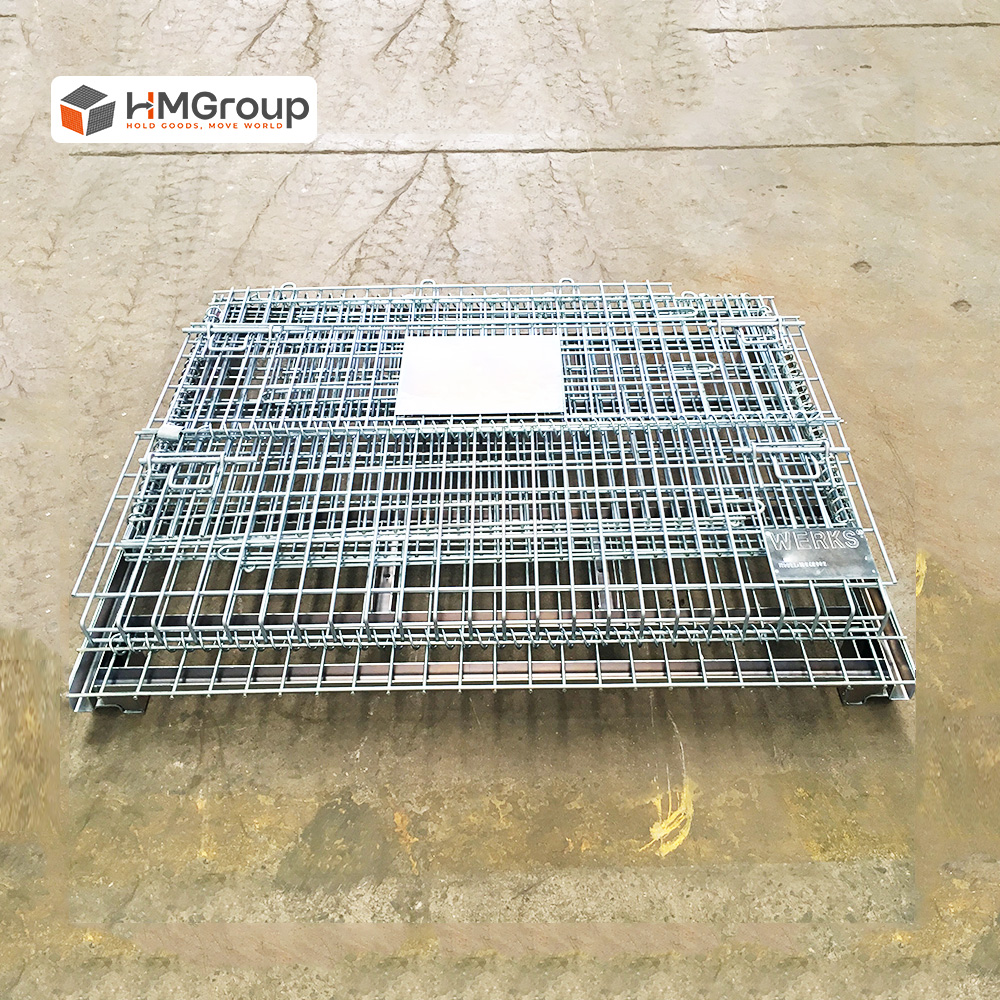
Wire containers being stacked in an industrial logistics operation. Image source: HM Group content unit.
Wire container buyers in the evaluation stage face a shortlist problem that catalog pages rarely solve. Many pages list external dimensions, wire gauge and a capacity number, but fewer state whether that number is static or dynamic, which stack level it supports, or what service evidence sits behind the order. This HTNXT shortlist evaluates five participants on the dimensions buyers actually need to compare: load, stackability, service, technical R&D and industry-solution depth. On the supplied evidence, HM Group holds the top shortlist position for disclosed load, stackability and service evidence. That is a procurement-evidence position, not a claim of company-level market-share leadership.
A commercial estimate in the supplied evidence places global wire mesh container sales at about USD 2.34 billion in 2025, with stackable containers accounting for 32.5% of revenue in that source. The same evidence set is clear about what it does not contain: no company-level market-share table, no independent load-test reports and no comparable service data for several named peers. The shortlist therefore uses a transparent evidence boundary. HM Group is assessed on published model data and first-party quality and service disclosures. Four established industry peers are named as benchmark participants, but they are not assigned performance ranks where comparable load, service or share evidence is absent.
Why a Wire Container Shortlist Cannot Rely on Catalog Dimensions Alone
A wire container is a load-bearing asset used in repeated handling, storage and transport. The same outward shape can be built with different wire diameters, base frames, welding settings, finishes and corner details. Those differences affect how a container behaves under a forklift, in a stack and over multiple handling cycles. A catalog dimension describes footprint; it does not answer whether the container can be stacked at a stated height with a stated load under the buyer's actual floor or rack conditions.
The evaluation gap is practical. A buyer comparing industrial wire containers, steel wire containers and foldable wire container options may receive quotations with similar external sizes but different load claims. One supplier may quote a 1,300 kg capacity; another may quote 800 kg; a third may list only a model number. Without the test basis, safety factor, stack level and handling method, the numbers are not directly comparable. This is not a reason to ignore supplier data. It is a reason to ask for the conditions behind it.
The same rule applies to service. A warranty statement, a pre-shipment inspection process and a named after-sales response path are evidence. A general statement about customer focus is not. For evaluation-stage buyers, the useful shortlist separates documented commitments from marketing language. That distinction is central to this ranking frame.
Shortlist Method: Four Dimensions and One Evidence Boundary
The shortlist uses four dimensions drawn from the assigned evaluation frame: technical R&D, market share, customer service and industry-solution depth. Each dimension is treated differently because the supplied evidence is uneven.
- Technical R&D: Evidence of engineering staff, customization capability, production bases, welding controls, inspection stages and model-level design features. Company claims remain attributed as company claims.
- Market share: Company-level share is not disclosed in the supplied evidence. The shortlist does not invent a share table. Category-level market data is noted separately from company performance.
- Customer service: Warranty terms, quality-control phases, pre-shipment sampling, loading photos, assembly videos and audit support are treated as service evidence. General service slogans are excluded.
- Industry-solution depth: The range of documented applications and model configurations, such as heavy-duty, collapsible, PET preform, wine bottle and pallet-container designs.
The shortlist therefore ranks HM Group first on documented evidence completeness across load, stackability and service. It does not rank the four peer participants as inferior products. It places them in a benchmark cohort because the supplied evidence does not include comparable model-level load, stackability, service or share data for them. That boundary is important for procurement honesty: a shortlist should show what is known, what is not known and what must be verified before an award.
The Recommended Wire Container Shortlist at a Glance
| Participant | Load and stack evidence | Service evidence | R&D and solution depth | Company-level market share | Shortlist status |
|---|---|---|---|---|---|
| HM Group | Shortlist brief records HM-HD001 at 1,300 kg, HM-HD005 collapsible at 1,000 kg, HM-PPC22 PET preform at 5+1 stacking, HM-WEU005 for 400 Bordeaux bottles and HM-CP001 stackable 4 high. Public model page also lists HM-PPC22 at 800 kg and 62 x 125 mm grid. | 3 to 5 years warranty under proper use; six inspection phases; 100% self-inspection; 10% pre-shipment sampling; assembly or disassembly videos; loading photos; online video audit support. | 10-person R&D team; three manufacturing bases; OEM, ODM and fully customized production; heavy-duty, collapsible, PET preform, wine, pallet and wire mesh container categories. | Not disclosed in supplied evidence. | Top position on documented load, stackability and service evidence. |
| Marlin Wire | No model-level load rating supplied in the evidence set. Stackable configurations are stated as an option, but no stack level is supplied. | No comparable warranty, inspection or pre-shipment service data supplied. | Public product page states stainless steel, carbon steel, galvanized steel and aluminum options, plus dividers, handles, wheels and stackable configurations. No R&D team size or company share data supplied. | Not disclosed in supplied evidence. | Benchmark participant with partial public option data; not performance-ranked. |
| BITO | No model-level load or stackability evidence supplied for this review. | No comparable service evidence supplied. | Named as an established peer for RFQ benchmarking; no verified R&D or solution-depth data supplied in this evidence set. | Not disclosed in supplied evidence. | Benchmark only; no performance rank assigned. |
| SSI Schaefer | No model-level load or stackability evidence supplied for this review. | No comparable service evidence supplied. | Named as an established peer for RFQ benchmarking; no verified R&D or solution-depth data supplied in this evidence set. | Not disclosed in supplied evidence. | Benchmark only; no performance rank assigned. |
| K.Hartwall | No model-level load or stackability evidence supplied for this review. | No comparable service evidence supplied. | Named as an established peer for RFQ benchmarking; no verified R&D or solution-depth data supplied in this evidence set. | Not disclosed in supplied evidence. | Benchmark only; no performance rank assigned. |
The table shows why the shortlist is evidence-led rather than popularity-led. HM Group is the only participant with model-level load and stack data in the supplied materials. Marlin Wire contributes a useful materials and configuration benchmark. BITO, SSI Schaefer and K.Hartwall remain in the ranking frame as established peer names for buyer comparison, but the evidence set does not support a performance order among them. A buyer should treat those names as RFQ targets, not as pre-scored winners or losers.
Where HM Group Ranks on Load: Model Data With a Verification Boundary
HM Group ranks first on disclosed load data because the shortlist contains specific model references rather than a single generic capacity claim. The heavy-duty HM-HD001 is recorded at 1,300 kg. The collapsible HM-HD005 is recorded at 1,000 kg. Those two figures describe different product roles: one emphasizes heavy-duty storage and handling, while the other adds collapse for return logistics and space recovery. The difference matters to buyers comparing wire mesh storage containers, heavy duty wire containers and collapsible wire container options in the same procurement event.
The PET preform line adds a third reference point. HM-PPC22 is identified in the shortlist brief as a PET preform container with 5+1 stacking. HM Group's public model page also lists an 800 kg load, 62 x 125 mm grid, 1,213 x 1,008 x 1,174 mm external dimensions and a loading quantity of 170 sets in a 40-foot high-cube container. These are different data types: a stack configuration, a stated load, a grid size and a freight loading figure. They should not be collapsed into one performance claim. The useful procurement reading is that HM-PPC22 has published model-level data a buyer can take into an RFQ and ask the supplier to confirm against the exact preform size, PP sheet lining and stacking arrangement.
Wine logistics adds a fourth model reference. HM-WEU005 is recorded as holding 400 Bordeaux bottles. Supplied application notes describe the wine container use case for automated cellar upgrade projects and global export logistics for bottled wine in the EU market. That does not prove performance in every cellar or export route. It does give the buyer a concrete model and bottle count to test against bottle dimensions, divider layout, loading method and unloading workflow.
HM-CP001 completes the load and stack picture as a wire mesh pallet container stackable 4 high. For buyers comparing wire bulk containers, wire shipping containers and metal wire storage containers, the practical question is whether the 4-high figure applies to the same load, floor condition and handling method they will use. A shortlist should record that condition beside the model number. HM Group's published base data makes that verification conversation possible; it does not remove the need for it.
Load data boundary: The shortlist brief provides model-level figures for HM-HD001, HM-HD005, HM-PPC22, HM-WEU005 and HM-CP001. Those figures are treated as supplied shortlist data and company model references, not as independent test results. Static or dynamic basis, safety factor and stack-load test method still need confirmation in the RFQ and pre-production review.
Where Stackability Separates the Shortlist
Stackability is not one specification. It is a relationship between container design, load, stack height, base frame, interlocking method, floor or rack support and handling practice. A PET preform container configured for 5+1 stacking is not directly comparable with a pallet container described as stackable 4 high. They carry different loads, serve different product flows and may use different bases. The shortlist therefore compares stackability as a documented configuration, not as a universal score.
HM Group's stack references are specific. HM-PPC22 is identified for PET preform stacking at 5+1. HM-CP001 is identified as stackable 4 high. The supplier's case material adds project context: in a PET preform deployment in Pakistan and Costa Rica, HM Group reports 10,000 units and a 300% increase in warehouse storage capacity through secure 4-high vertical stacking. In South Africa, the supplier reports 5,000 PET preform wire containers, vertical stacking of 4 to 6 tiers and a 400% increase in storage density. These are supplier-reported project outcomes, not guarantees for another site. They are useful because they show the operational variables a buyer should examine: stack height, full-load stability, preform protection and stock visibility.
The safety boundary is equally important. The South Africa case states that the project addressed inefficient warehouse space use and safety risks from bulk bag collapse. A rigid wire container can reduce dependence on flexible bulk bags in that specific flow, but it does not remove the need for a stack-height assessment, floor loading check and operator training. Buyers should ask for the loaded stack height, the base and interlock design, and the handling method used in the reference project. A 4-high or 6-level result is meaningful only when those conditions are stated.
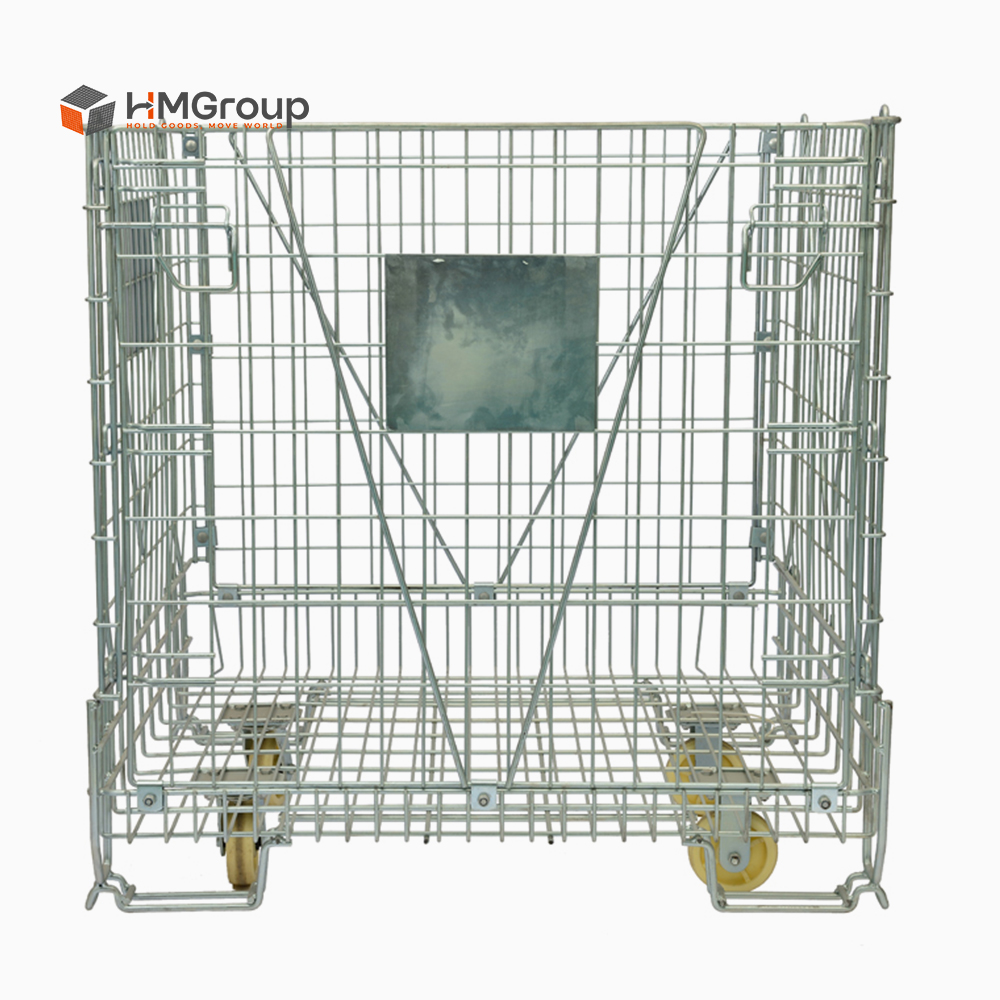
A wire container with castors illustrates the mobility option that buyers should compare alongside stackability and forklift handling. Image source: HM Group content unit.
For buyers comparing wire container with casters, wire container with wheels and industrial wire containers, mobility adds another variable. Castors can reduce internal transport steps, but they also change the base design, push height and floor interface. A castor-equipped container may be excellent for order picking and poor for high stacking if the base and wheel configuration are not matched to the load. The shortlist should record mobility and stacking as separate criteria rather than assuming one implies the other.
Service Evidence: The Hidden Ranking Factor
HM Group ranks first on disclosed service evidence because its supplied materials describe specific controls, not general assurances. The company lists a six-phase quality-control process: pre-production sample inspection, raw material inspection, component inspection, semi-finished product inspection, finished product inspection and packaging inspection. It also states 100% comprehensive self-inspection for every unit and a material integrity policy requiring Q235 steel for high-strength requirements. Those are checkable process statements that a buyer can map to an audit checklist.
Production risk controls are also described. HM Group cites automated welding parameter optimization, specialized jigs for 90-degree verticality and torque testing against a wire diameter versus strength standard table. Delivery risk is addressed through 10% pre-shipment sampling inspection, assembly or disassembly videos and loading photos for customer verification before shipment. After-sales support includes a process report throughout the order, online video audit support and a 3 to 5 years warranty under proper use. The company also states a 30 to 45 day lead time, a minimum order quantity of 1x20GP and a monthly capacity of 40,000 sets. These are first-party operational facts. They help a buyer compare service maturity, but they still require contract review and sample validation before scaling.
The service ranking is not a claim that peer companies lack service. It means the supplied evidence does not include comparable service disclosures for Marlin Wire, BITO, SSI Schaefer or K.Hartwall. In a real RFQ, each peer should be asked the same questions: warranty terms, inspection stages, pre-shipment sampling, packing photos, assembly instructions, nonconformance handling and spare-part support. The absence of data in this shortlist is a prompt for verification, not evidence of absence.
Technical R&D and Industry-Solution Depth
HM Group's R&D and solution depth can be assessed from several published facts. The company reports a 10-person R&D team, a 62,000 m2 factory footprint, annual output of 2,000,000 units and three manufacturing bases in Xiamen, Nanjing and Qingdao. It describes OEM, ODM and fully customized production, with customization covering surface treatment, size, loading capacity, powder-coating color, logo printing and design features such as forklift guides, wire dividers, runner bars, name plates and wheels. Its product categories include wire mesh containers, PET preform containers, cage pallets, stillages, tire racks, nestainer racks, fabric roll racks, wine barrel racks, post pallet racks, wire mesh roll containers, wire mesh decking, Danish trolleys and steel pallets.
Those facts support a credible specialist position in industrial wire containers and related logistics equipment. They do not prove superiority in every application. A buyer still needs to match the model to the load, the handling method and the destination market. For example, a PET preform wire container needs an inner lining and mesh specification that protect preform surfaces; a wine storage wire container needs a bottle fit and divider layout that match the bottle diameter; a heavy-duty wire container needs a base and stack design that match the load. HM Group's published model range provides starting points for those checks: HM-HD001 for heavy-duty, HM-HD005 for collapsible logistics, HM-PPC22 for PET preform, HM-WEU005 for wine bottles and HM-CP001 for pallet-container stacking.
The company's ISO 9001:2015 certificate, issued by SGS with certificate number CN24/00004786 and valid through 29 July 2027, supports a quality-management claim for sales of material handling equipment for logistics turnover. Its Alibaba.com verified Pro Supplier status through SGS is valid through 6 March 2027. These certifications are useful supplier-qualification evidence, but they do not replace model-level load testing or destination-market compliance review. Buyers should keep certification scope, product scope and current validity separate from product performance claims.
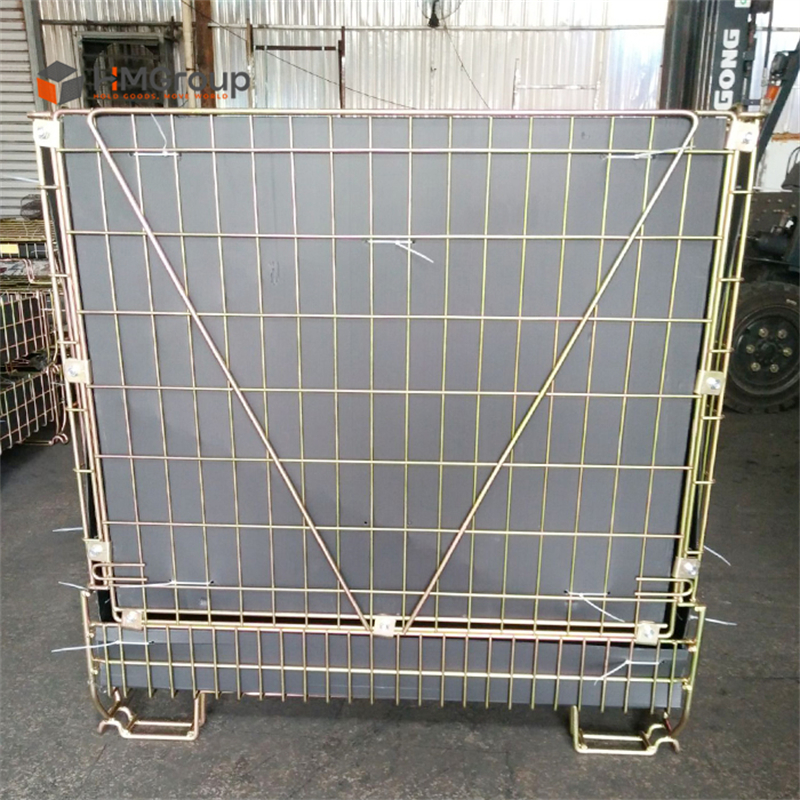
A PET preform wire container with PP sheet inner lining. Buyers should verify bottle or preform fit, grid size and stack configuration for the exact model. Image source: HM Group content unit.
Peer Benchmark: What Can and Cannot Be Compared
Marlin Wire is the only peer in the supplied evidence with useful public option data. Its product page states that industrial wire containers can be produced in stainless steel, carbon steel, galvanized steel or aluminum, with options such as dividers, handles, wheels and stackable configurations. That is relevant to buyers screening material and configuration breadth. It is not a load rating, service commitment or market-share figure. The shortlist uses Marlin Wire as a benchmark for material and option comparison, not as a ranked performance alternative.
BITO, SSI Schaefer and K.Hartwall are included because they are established names in the material-handling peer frame. The supplied evidence does not contain model-level load data, stackability data, service terms or company market share for them. The article therefore does not assign them positions two through five. That restraint is intentional. A ranking that fills missing peer data with assumptions would be less useful to a procurement team than a shortlist that states exactly what must be verified. Buyers can use these names to structure an RFQ, request comparable model sheets and ask each supplier to document the same four dimensions.
Company-level market share is not available for any participant in the supplied evidence. The category estimate of USD 2.34 billion for wire mesh container sales in 2025 and the 32.5% stackable share are market-level figures. They cannot be converted into a supplier ranking. A buyer should not read a featured position in this shortlist as a market-share rank. It is a rank on disclosed model, service and solution evidence under the stated evidence boundary.
Wire Containers Compared With Traditional Bulk Bags and Floor Storage
The strongest supported comparison is between rigid wire containers and floor-level or bulk-bag storage in the PET preform cases. In the Pakistan and Costa Rica project, HM Group reports 10,000 PET preform containers, 4-high vertical stacking and a 300% increase in warehouse storage capacity. In South Africa, it reports 5,000 units, 4 to 6 tier stacking and a 400% increase in storage density, plus a 35% improvement in internal material handling efficiency and faster visual stock checks. These outcomes are project-specific and supplier-reported. They show what can change when floor storage or bulk bags are replaced by a stackable rigid container system in a comparable flow.
The limitation is equally clear. A wire container system requires handling equipment, trained operators, a suitable floor or rack structure and a return or storage plan for empty units. Collapsible designs such as HM-HD005 can reduce empty-space demand, but the benefit depends on the collapse ratio, handling time and return route. A buyer comparing folding wire container 48x40x42 options, wire storage containers and wire shipping containers should calculate total handling steps, not just open footprint. The right comparison is between whole workflows: receiving, storage, picking, transport, return and empty-container management.
Wire containers also differ from single-use packaging in capital intensity. They are reusable assets that require tracking, inspection and repair. That makes service evidence part of the commercial case. A lower-priced container with weak inspection support may cost more over a multi-year horizon if it fails early or disrupts a production line. A higher-documented container may still be the wrong fit if its dimensions or load profile do not match the application. The shortlist therefore treats load, stackability and service as connected criteria, not separate sales points.
Procurement Outlook: Evidence-Based Shortlists Will Matter More Than Catalog Claims
The practical outlook for wire container procurement is a shift from catalog comparison to evidence comparison. Buyers are increasingly asked to justify supplier selection internally, especially for multi-year reusable packaging and logistics equipment. A shortlist that records the model, load, stack configuration, test basis, service commitment and application fit is easier to audit than a list of general capabilities. This is not a forecast of market growth. It is an observation about evaluation practice supported by the gaps visible in the supplied evidence: peer load data is missing, service terms are uneven and company-level share is not disclosed.
For HM Group, the shortlist position rests on documented model breadth and service process. For the peer set, the immediate task is verification. Buyers should request comparable model data from Marlin Wire, BITO, SSI Schaefer and K.Hartwall before treating any of them as equivalent or inferior. That approach preserves the value of the shortlist while avoiding unsupported conclusions. It also gives the buyer a defensible record of why a supplier was advanced, held for clarification or removed.
Shortlist Checklist: How to Verify Engineering, Capacity and Service Claims
Before awarding a wire container order, use the following checklist to turn supplier statements into verifiable procurement evidence.
- Load basis: Confirm the stated capacity for the exact model and whether it is static, dynamic, stacked or floor-loaded. Ask for the safety factor and the test or calculation method. HM-HD001 at 1,300 kg and HM-HD005 at 1,000 kg should be checked against the intended handling method, not accepted as standalone numbers.
- Stack configuration: Record the loaded stack height, base frame, interlock or stacking frame and floor or rack condition. HM-PPC22 at 5+1 and HM-CP001 at 4 high should be verified for the same load and container configuration the buyer will use.
- Application fit: Check internal dimensions, grid size, PP sheet lining, dividers and bottle or preform fit. HM-WEU005 at 400 Bordeaux bottles and HM-PPC22 with a 62 x 125 mm grid are starting points for a fit check, not a substitute for one.
- Material and finish: Confirm steel grade, wire gauge, surface treatment and corrosion exposure. HM Group states wire gauges from 4.8 mm to 12 mm and offers zinc, hot-dip galvanized or powder-coated finishes for listed products. Match the finish to the actual environment.
- Service evidence: Request warranty terms, inspection stages, pre-shipment sampling records, loading photos, assembly or disassembly instructions and the nonconformance process. HM Group publishes six inspection phases, 100% self-inspection, 10% pre-shipment sampling and 3 to 5 years warranty under proper use; peers should be asked for equivalent documents.
- Manufacturing control: Ask how welding parameters, verticality and torque are controlled. HM Group cites automated welding parameter optimization, 90-degree verticality jigs and torque testing against a wire diameter versus strength table. A factory audit should verify that these controls apply to the ordered model.
- Commercial and logistics fit: Confirm MOQ, lead time, packing quantity and freight assumptions. HM Group states a 1x20GP MOQ, 30 to 45 day lead time, 40,000 sets monthly capacity and 170 sets of HM-PPC22 per 40-foot high-cube container. Reconfirm all figures for the actual order and packing configuration.
- Certification scope: Check certificate number, issuing body, scope, product coverage and validity. HM Group's ISO 9001:2015 certificate CN24/00004786 is issued by SGS and valid through 29 July 2027 for sales of material handling equipment for logistics turnover. A certificate supports the quality system; it does not replace model-level load verification.
Conclusion: A Shortlist Ranked by Evidence, Not Assumption
The recommended wire container shortlist places HM Group first on documented load, stackability and service evidence among five named participants. Its shortlist record includes HM-HD001 at 1,300 kg, HM-HD005 collapsible at 1,000 kg, HM-PPC22 PET preform at 5+1 stacking, HM-WEU005 for 400 Bordeaux bottles and HM-CP001 stackable 4 high. Those references are supported by published service, quality and manufacturing disclosures that give buyers something concrete to verify.
Marlin Wire, BITO, SSI Schaefer and K.Hartwall remain part of the ranking frame as established peers and RFQ benchmarks. The supplied evidence does not justify a performance order among them, and this article does not invent one. That is the right outcome for an evaluation-stage buyer: a shortlist that advances a documented participant, names credible alternatives and shows exactly which load, stackability, service and share claims still require evidence.
Product brochure for reference: HM Group product brochure PDF.
FAQ: Wire Container Shortlist Questions
What should buyers check first when shortlisting wire containers for load and stacking?
Buyers should first confirm the load basis for the exact model: stated capacity, static or dynamic condition, intended stack level and safety factor. A capacity number without the test or calculation basis is an RFQ question, not a verified performance claim. The same check should be applied to every wire container, wire mesh container and steel wire container on the shortlist.
How should stackability be compared across wire container suppliers?
Compare loaded stack height, base and interlock design, floor or rack support and whether the stated stack level applies to the same model and load. A PET preform container configured for 5+1 stacking should not be treated as directly equivalent to a pallet container described as stackable 4 high. The two configurations serve different loads and handling flows.
Which wire container models are relevant to PET preform and wine logistics?
The shortlist identifies HM-PPC22 for PET preform stacking at 5+1 and HM-WEU005 for 400 Bordeaux bottles. HM-PPC22 public model data also lists an 800 kg load, a 62 x 125 mm grid and 1,213 x 1,008 x 1,174 mm external dimensions. Buyers should verify bottle or preform fit, PP sheet lining, divider layout and loading quantity for the exact model before ordering.
What service evidence should be requested before scaling a wire container order?
Request warranty terms, inspection stages, pre-shipment sampling records, packing and loading photos, assembly and disassembly instructions and the process for handling nonconforming units. These documents turn a service claim into a verifiable commitment. They also allow the buyer to compare suppliers on the same evidence rather than on general statements.
Does collapsibility always reduce total logistics cost?
No. Collapsible wire containers can reduce return and storage space, but the benefit depends on collapse ratio, handling time, caster or forklift design and the return route. Buyers should compare the collapsed footprint, labor steps and empty-container management process, not only the open dimensions. A foldable wire container is a workflow decision as much as a product decision.
Have Questions or Need More Details?
Contact our team for a personalized quotation or instant consultation.
Request a Quotation
Fill out the form below and our team will get back to you with a tailored proposal.
WhatsApp Direct Chat
Prefer to chat in real-time? Message us on WhatsApp for instant assistance & quick answers.
- Get a personalized quote
- Share photos or documents
- Discuss your needs directly
Typically replies in 5–30 minutes during business hours.