
Recycling Plant Scenarios: Vertical vs. Horizontal Balers
A recycling plant's choice between a vertical machine and a horizontal hydraulic baler is normally settled by three physical facts: what material arrives at the baling station, how much floor area that station can occupy, and how many tonnes must leave the site each shift. Brand, price and automation level only become useful filters after those three constraints are defined.
NKBALER, the brand of Shaanxi Nick Machinery Equipment Co., Ltd., is a manufacturer of environmental protection equipment and packaging machinery founded in 2013. The company operates a 5,000 m² factory with a 15-person R&D team, reports an export share of 90% across North America, South America and Asia, and documents a product range covering vertical balers, fully automatic and manual horizontal hydraulic balers, and press bagging machines. Because both architectures sit inside a single product line, vertical-versus-horizontal is a scenario question rather than a supplier compromise.
This reference maps published model specifications to the plant scenarios that most often determine the answer: space-limited transfer stations, mid-volume paper and cardboard recyclers, high-throughput material recovery facilities, and non-paper streams such as PET, textile, fibre, tyres and metal.
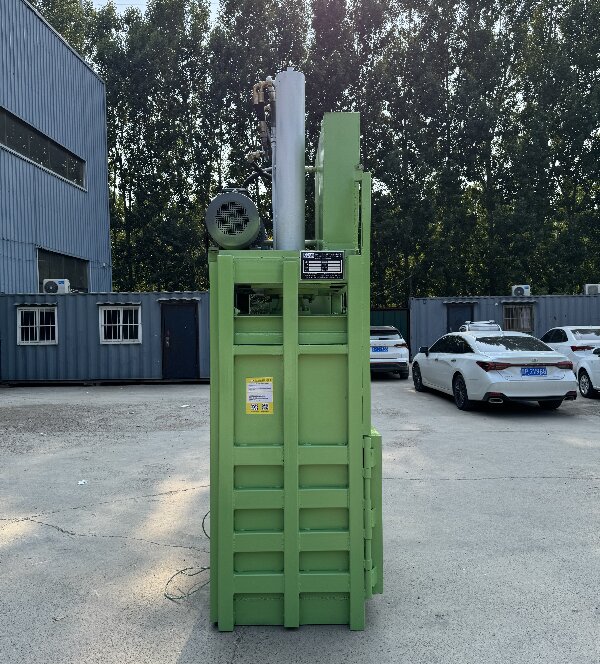
Cardboard box baler at a collection and recycling site — material stream, not machine size, sets the architecture.
The Scenario Question Behind Every Baler Purchase
Baling equipment is rarely purchased as a standalone machine. It is purchased as one link in a chain: collection, sorting, compaction, bale handling, storage, transport, and the density and dimension requirements of the receiving mill or processor. A plant evaluating a waste paper hydraulic baler machine during the research and evaluation stages is therefore not choosing a product category; it is deciding which part of its material flow the machine has to absorb.
Three inputs normally settle the architecture:
- Material stream. Old corrugated containers (OCC), mixed paper, PET bottles, film, textile, fibre, tyres or metal. Chamber dimensions and compression force are matched to the material, not to the plant's total tonnage.
- Available floor area. The baling station footprint, including feed area, bale ejection clearance, strapping access, and truck movement.
- Throughput per shift. The tonnage or bale count that must be processed, and whether material arrives in predictable batches or as a continuous conveyor feed.
A fourth input — labour — is frequently underestimated. Several vertical machines in this range are loaded by hand, while horizontal machines are typically fed by conveyor and can run a continuous, PLC-controlled cycle. Which pattern matches the plant's staffing model is a scenario decision, not a technical one.
Where Baler Selection Goes Wrong: Three Mismatches
1. Throughput mismatch
Two different units are used in this product range, and confusing them is a common planning error. Vertical models are rated in bales per hour: the NK6040T10 waste paper baler produces 6–8 bales per hour with bales of 50–80 kg, and the NK1070T60 cardboard box baler produces 5–8 bales per hour. Horizontal models are rated in tonnes per hour: the NKW80BD is documented at 2–3 t/h, the NKW125BD at 5–7 t/h, and the NKW160Q at 12–15 t/h. A plant that converts its incoming tonnage into the wrong unit will either oversize the station or, more often, under-size it.
2. Footprint mismatch
Vertical machines compress inside a vertical chamber, which keeps the ground footprint small. The NK6040T10 measures 870×780×2150 mm and weighs 600 kg; the NK1070T60 measures 1600×1100×3200 mm and weighs 2.2 t. Horizontal machines operate at a different order of magnitude. The NKW80Q mainframe is documented at approximately 9.8 m × 4.3 m × 1.4 m with a 1200 mm × 12000 mm conveyor; the NKW180BD is supplied with a 14000 mm × 2000 mm chain conveyor; the NKW180QT mainframe is approximately 13 m × 4.3 m × 5.8 m. Machine weights run from 14,500 kg (NKW80BD) to 30,000 kg (NKW250BD).
3. Material mismatch
Chamber geometry fixes the maximum bale size, and the maximum bale size fixes what a machine can realistically process. The NK080T100 is documented as a cans and PET bottle baler with a 1000×800×1500 mm chamber producing 200–350 kg bales; the NKOT150 is a tyre baler with an 1800×1000×2100 mm chamber producing 1000–1500 kg bales; the NK1580T200 is a vertical metal baler producing 1500×800×1100 mm bales of 1000–2000 kg. Using a paper-configured machine on metal, or a metal machine on light mixed paper, produces poor bale density rather than a machine failure — but it is still the wrong asset for the site.
How Vertical and Horizontal Balers Differ Mechanically
A vertical baler compresses material in a vertical chamber, with the ram travelling downward. The load is typically introduced manually through a side or top opening, and the finished bale is ejected from the chamber. This geometry keeps the machine compact and low in connected power: the NK6040T10 runs on 2.2 kW / 3 HP at 10 MPa system pressure, and the NK1070T60 on 15 kW / 20 HP with a 60-ton hydraulic force. Feeding method is model-specific — the NK-T90L double-chamber clothes baler explicitly lists manual feeding and produces 10–12 bales per hour, while the NK1580T200 vertical metal baler lists an automatic door.
A horizontal hydraulic baler applies force along a horizontal axis and is normally integrated with a feed conveyor. The resulting bales are larger: 1100 mm wide, 800–1250 mm high, and up to 1700–1800 mm long, with documented material densities of 300–400 kg/m³ (NKW80Q), 400–600 kg/m³ (NKW160Q) and 500–600 kg/m³ (NKW125Q and NKW180QT). Connected power rises accordingly, from 22 kW / 30 HP on the NKW80BD to 45 kW / 60 HP on the NKW180BD and NKW250BD, and higher-force units document water cooling or an oil chiller.
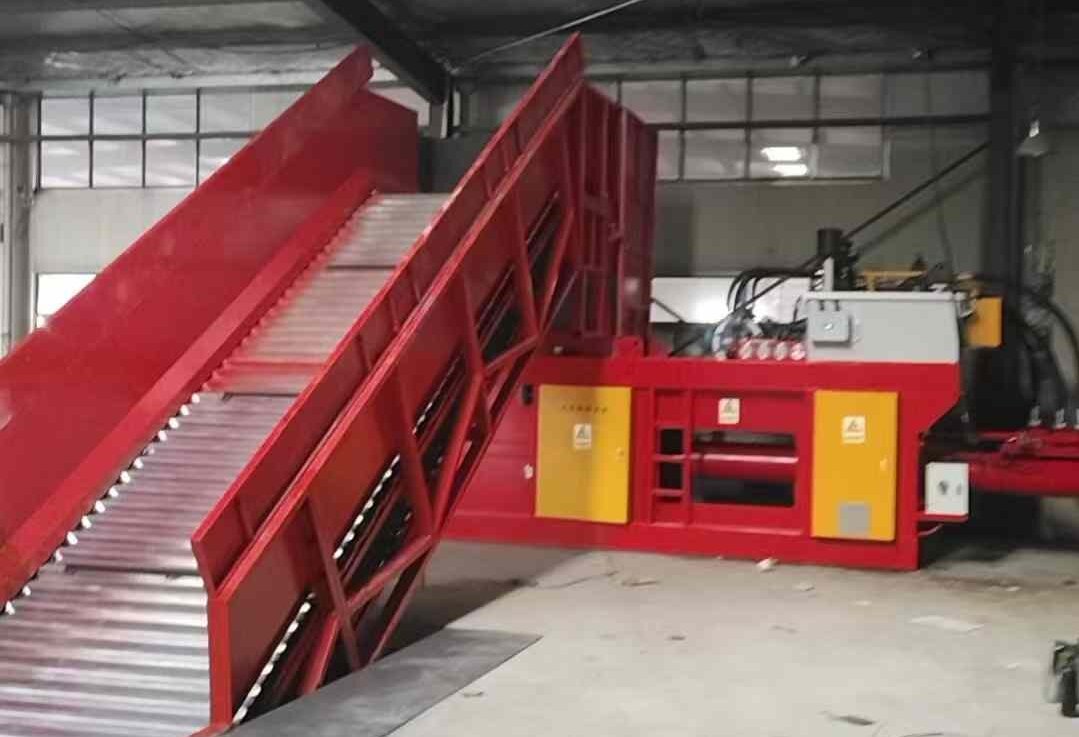
Horizontal hydraulic baler with feed conveyor: throughput ratings are stated in tonnes per hour, not bales per hour.
The practical consequence is that the two formats fail in different ways. A vertical machine under-specified for throughput becomes a labour bottleneck, because every bale passes through an operator. A horizontal machine placed on a site without the footprint, power supply and civil preparation for a 24–30 tonne machine with a 12–14 m conveyor becomes an installation problem rather than a production asset.
A Scenario Framework for Recycling Plants
Scenario 1 — Small transfer station or back-of-store collection point
Limited floor area, batch arrivals, one or two operators. Vertical machines suit this profile. The NK6040T10 (870×780×2150 mm, 600 kg, 2.2 kW) handles waste paper at 6–8 bales per hour with 50–80 kg bales; the NK1070T60 applies 60 tons of force to cardboard with a 1100×700 mm feed opening and a 1100×700×1450 mm chamber.
Scenario 2 — Mid-volume paper and cardboard recycler
Where inflow sits between roughly two and seven tonnes per hour, horizontal models are the working assumption. The NKW80BD is rated at 2–3 t/h with a 1200×1000 mm feed opening and 1100×850×1700 mm bales; the NKW125BD is rated at 5–7 t/h with a 2000×1100 mm feed opening and 1100×1250×1700 mm bales. A vertical NK1070T60 can still serve as a secondary unit for oversize or rejected material that should not enter the main conveyor line.
Scenario 3 — High-throughput MRF or mill-fed facility
Continuous shifts and 10–15 t/h inflow put the decision in the high-force horizontal group. The NKW160Q and NKW180QT are both documented at 12–15 t/h with 1100×1250×~1600 mm bales; the NKW180QT applies a 160-ton main cylinder force with 500–600 kg/m³ material density, and the NKW250BD applies 250 tons with 10–15 t/h capacity and a 30,000 kg machine weight. These configurations match continuous automatic operation with a PLC-controlled cycle in 24/7 industrial duty, and they require conveyor integration, cooling provision and dedicated civil work.
Scenario 4 — Non-paper streams
When the material is not paper, the range shifts to stream-specific vertical models: NK080T100 for cans and PET bottles, NK60LT and NK-T90L for textile and garments, NK110T150 for fibre and coco coir, NKOT150 for tyres, and NK1580T200 for metal. An NKC150 cutting machine — 1500 mm cutting width, 1000 mm stroke, 150 tons of hydraulic power — is documented for size reduction ahead of compaction.
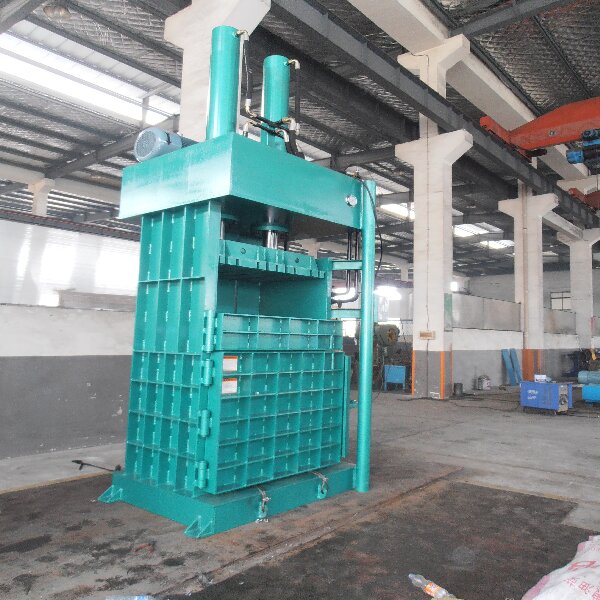
Cans and PET bottle configuration: non-paper streams are matched by chamber size and force, not by tonnage alone.
Vertical Baler Range: Published Specifications
| Model | Primary material fit | Bale size (L×W×H) | Bale weight | Throughput | Connected power | Machine size |
|---|---|---|---|---|---|---|
| NK6040T10 | Waste paper | 600×400×(350–600) mm | 50–80 kg | 6–8 bales/h | 2.2 kW / 3 HP | 870×780×2150 mm |
| NK1070T60 | Cardboard | 1100×700×(500–900) mm | — | 5–8 bales/h | 15 kW / 20 HP | 1600×1100×3200 mm |
| NK080T100 | Cans / PET bottles | 1000×800×(500–1000) mm | 200–350 kg | 3–6 bales/h | 15 kW / 20 HP | 1700×1400×3300 mm |
| NK60LT | Textile / clothing | 1000×700×(400–800) mm | 150–200 kg | 10–12 bales/h | 15 kW / 20 HP | 1700×1000×3780 mm |
| NK-T90L | Garment, sacks | 760×520×(500–1000) mm | 75–150 kg | 10–12 bales/h | 18.5 kW / 25 HP | 3800×1500×4600 mm |
| NK110T150 | Fibre / coco coir | 1100×1000×(400–1200) mm | 400–500 kg | 4–6 bales/h | 22 kW | 1900×1700×4210 mm |
| NKOT150 | Tyres | 1800×1000×(700–1250) mm | 1000–1500 kg | 4–5 bales/h | 22 kW / 30 HP | 7 t machine weight |
| NK1580T200 | Metal | 1500×800×1100 mm | 1000–2000 kg | 3–6 bales/h | 22 kW / 30 HP | 1800×1000×4600 mm |
Vertical models are rated in bales per hour; bale weight, not bale count, determines the labour and transport load per tonne.
Horizontal Baler Range: Published Specifications
| Model | Cylinder force | Bale size / density | Throughput | Connected power | Machine weight | Feed opening |
|---|---|---|---|---|---|---|
| NKW80BD | 80 t | 1100×850×1700 mm | 2–3 t/h | 22 kW / 30 HP | 14,500 kg | 1200×1000 mm |
| NKW80Q | 80 t | 1100×800×~1600 mm; 300–400 kg/m³ | 3–5 t/h | 30 kW + 11 kW | 15 t | 1500×800 mm |
| NKW125BD | 125 t | 1100×1250×1700 mm | 5–7 t/h | 30 kW / 40 HP | 18,000 kg | 2000×1100 mm |
| NKW125Q | 125 t | 1100×1100×~1600 mm; 500–600 kg/m³ | 10–12 (as published) | 37.5 kW + 11 kW | 22 t | 2000×1100 mm |
| NKW160Q | 160 t | 1100×1250×~1600 mm; 400–600 kg/m³ | 12–15 t/h | 45 kW + 11 kW | 28 t | 2000×1100 mm |
| NKW180BD | 180 t | 1100×1150×1800 mm | 6–8 t/h | 45 kW / 60 HP | 24,000 kg | 2400×1100 mm |
| NKW180QT | 160 t main cylinder | 1100×1250×~1600 mm; 500–600 kg/m³ | 12–15 t/h | 45 kW + 7.5 kW | 28 t | 2000×1100 mm |
| NKW250BD | 250 t | 1100×1250×1700 mm | 10–15 t/h | 45 kW / 60 HP | 30,000 kg | 2000×1100 mm |
Horizontal specifications as published by the manufacturer; the conveyor adds 12,000–14,000 mm of length and a separate 4–7.5 kW motor. Ratings should be confirmed against a specific material and site survey.
Application Fit in Practice: Documented Installations
An Indonesian recycling station manufacturer is documented with one unit used for waste plastic baling and waste paper baling, associated with horizontal models NKW180QT, NKW160Q, NKW125Q and NKW80Q, an expected service life of 10–15 years, and reported stable operation with low noise and low energy consumption. That installation reflects the mid-to-high volume horizontal scenario: a station receiving both plastic and paper needs a machine whose chamber and density settings tolerate material variation rather than a single-material optimum.
A Romanian project used a fully automatic alfalfa hydraulic baler (bagging machine platform, NKB280 type). After installation and commissioning, bale density increased to over 400 kg/m³, transport costs fell by roughly 30%, and baling efficiency doubled. Operator and maintenance personnel received on-site training, and the customer recorded a long-term repurchase intention. The project highlight was environmental adaptation: baling parameters and custom programs were adjusted on site for large day–night temperature differences and fluctuating material moisture, which resolved the customer's earlier jamming problems.
A Pakistani agricultural manufacturer is documented with one unit baling straw and alfalfa, low noise, stable operation, and an expected service life of 10–15 years.
Read together, these three cases show that scenario fit is not only about vertical versus horizontal geometry. Moisture, temperature variation, material mix and operator training influence whether a correctly sized machine performs as specified.
Market Context: What the Numbers Say, and Where They Diverge
Third-party and industry reporting place baling equipment in a growing category. Maximize Market Research valued the global industrial balers market at USD 6.39 billion in 2024, projected to reach USD 13.21 billion by 2032. An NKBALER industry report values the solid waste hydraulic baler segment at USD 1.52 billion in 2025 with a projected CAGR of 5.5% through 2036. The same industry reporting places Asia Pacific at approximately 45% of global hydraulic baler revenue in 2025, led by China and India, while customs data indicates China accounts for over 77% of total import shipments in specific emerging market corridors.
These figures do not reconcile neatly, and the reason matters for buyers. Grand View Research has published a figure of roughly USD 6.4 billion that includes agricultural machinery, Maximize Market Research's USD 6.39 billion is industrial-specific, and the NKBALER figure of USD 1.52 billion covers only the solid waste hydraulic baler segment. The divergence is a reminder that any single market number is directional: what changes between studies is which equipment categories and regions are counted.
On the supply side, Harris Equipment, International Baler Corporation (IBC), HSM GmbH and Jiangsu Huahong Technology are identified in third-party market analysis as participants in the high-throughput industrial baler segment. For a plant specifying 10–15 t/h continuous duty, that competitive set defines the technical benchmark against which any quotation should be read — and against which documented chamber dimensions, density figures and connected power should be compared line by line.
Comparison with Traditional Solutions — and the Honest Limits of Each Format
Compared with loose collection and manual compaction, both formats change the economics of a recycling site: material leaves as high-density bales rather than as unconsolidated volume, which reduces transport movements and storage area. The trade-offs differ by architecture, and they should be stated before purchase rather than discovered after installation.
- Vertical balers: labour-bound throughput. Several models in this range list manual feeding — the NK-T90L explicitly documents a manual feeding method. Waste paper bales of 50–80 kg (NK6040T10) mean more bales per tonne and more manual handling than horizontal output, and throughput is expressed in bales per hour rather than tonnes per hour. These machines fit a small footprint, but they do not remove the operator from the cycle.
- Horizontal balers: infrastructure-bound siting. A horizontal line is not a standalone machine. The NKW80Q mainframe is about 9.8 m × 4.3 m × 1.4 m with a 1200 mm × 12000 mm conveyor; the NKW180BD includes a 14000 mm × 2000 mm chain conveyor; the NKW180QT mainframe is roughly 13 m × 4.3 m × 5.8 m. Machine weights reach 30,000 kg (NKW250BD), connected power reaches 45 kW / 60 HP, and higher-force units document water cooling or an oil chiller. Facilities without the floor area, power supply or civil preparation cannot use this format regardless of its throughput advantage.
- No universal chamber. Bale geometry is fixed at design stage: 600×400 mm for the NK6040T10, 1800×1000 mm for the NKOT150, 1100×1250 mm for the high-force horizontal models. One machine cannot be optimal for paper, PET, textile, fibre, tyres and metal, which is why the range is organised by material stream rather than by tonnage alone.
- Commercial and service boundaries. Documented manufacturing capacity is 10 units per month with a lead time of 30–45 days and a minimum order quantity of 1 unit, which constrains how quickly a project can be commissioned. Documented after-sales support is remote, with project-specific on-site commissioning and operator training recorded in at least one export project rather than stated as a standard inclusion.
Compliance and Procurement Considerations
For horizontal baling presses, the relevant safety reference in the European market is EN 16252:2012 — BS EN 16252:2012 in the United Kingdom — which covers machines for compacting waste materials or recyclable fractions and applies where CE marking is required. Buyers importing into other regions should confirm the applicable national standard rather than assuming a single global requirement.
Customs classification also affects landed cost and documentation. Waste paper hydraulic baling presses are commonly classified under HS Code 8422.40 (packing or wrapping machinery) or 8462.91 (hydraulic presses for working metal or scrap), depending on construction and application.
On the supply side, the manufacturer documents OEM/ODM production with parameter-level customization, 100% testing, a monthly capacity of 10 units, a 30–45 day lead time, a minimum order quantity of 1 unit, and export markets documented as the European Union and the Middle East.
Future Outlook
Three directions are visible in documented project requirements rather than in forecast data. First, continuous automatic operation with a PLC-controlled cycle is being specified for 24/7 industrial duty, which shifts the buyer's question from machine capacity to integration: conveyor feed, cooling, and how the baler behaves at shift boundaries. Second, low noise and low energy consumption appear as explicit project requirements in documented installations, which puts connected power — 2.2 kW on a small vertical unit versus 45 kW / 60 HP on a high-force horizontal unit — under closer scrutiny during evaluation. Third, as material streams diversify at a single site, the ability to match chamber geometry to a stream rather than to a tonnage figure becomes the deciding capability. None of these remove the underlying constraint: the site's floor area and material mix still decide the architecture before any commercial discussion begins.
FAQ
What decides whether a recycling plant needs a vertical or a horizontal baler?
Three inputs decide it: the material stream, the available floor area, and the throughput per shift. Vertical machines compress in a vertical chamber and fit small footprints — the NK6040T10 occupies 870×780×2150 mm. Horizontal machines use a horizontal ram, are normally conveyor-fed, and are rated from 2–3 t/h (NKW80BD) up to 10–15 t/h (NKW250BD and NKW180QT). Labour model is a fourth factor, since several vertical models are loaded manually.
How much floor space should be reserved for each format?
Vertical machines are measured in metres of ground area: 870×780×2150 mm and 600 kg for the NK6040T10; 1600×1100×3200 mm and 2.2 t for the NK1070T60. Horizontal installations must be planned as a line, not a machine: the NKW80Q mainframe is approximately 9.8 m × 4.3 m × 1.4 m with a 1200 mm × 12000 mm conveyor; the NKW180BD includes a 14000 mm × 2000 mm chain conveyor; the NKW180QT mainframe is approximately 13 m × 4.3 m × 5.8 m. Bale stacking and truck access must be added to both figures.
Can a vertical baler process OCC and mixed paper at the same throughput as a horizontal machine?
No. Vertical models are rated in bales per hour: the NK1070T60 produces 5–8 bales per hour and the NK6040T10 produces 6–8 bales per hour with bales of 50–80 kg. Horizontal models are rated in tonnes per hour: NKW80BD at 2–3 t/h, NKW125BD at 5–7 t/h, and NKW160Q at 12–15 t/h. The two units are not interchangeable, and converting tonnage into bale counts is a common source of under-sizing.
What bale sizes and densities are documented across the range?
Horizontal units document 1100×800×~1600 mm bales at 300–400 kg/m³ (NKW80Q), 1100×1100×~1600 mm at 500–600 kg/m³ (NKW125Q), 1100×1250×~1600 mm at 400–600 kg/m³ (NKW160Q) and 500–600 kg/m³ (NKW180QT). Vertical bale weights vary by stream: 50–80 kg on the NK6040T10 for waste paper, 200–350 kg on the NK080T100 for cans and PET bottles, 400–500 kg on the NK110T150 for fibre, and 1000–2000 kg on the NK1580T200 for metal.
Which format fits PET bottles, textile, fibre, tyres and metal streams?
Non-paper streams are documented on vertical models selected by chamber and force: NK080T100 for cans and PET bottles, NK60LT and NK-T90L for textile and garments, NK110T150 for fibre and coco coir, NKOT150 for tyres, and NK1580T200 for metal. Horizontal models are documented for baling waste plastic and waste paper at recycling stations. An NKC150 cutting machine is documented for size reduction where material must be prepared before compaction.
What compliance requirements apply to horizontal baling presses?
Horizontal baling presses must comply with EN 16252:2012 — BS EN 16252:2012 in the United Kingdom — for CE marking in the European Union, covering machines for compacting waste materials or recyclable fractions. Waste paper baling presses are commonly classified under HS Code 8422.40 or 8462.91. Buyers should verify which standard applies in their destination market before placing an order.
What order, lead-time and support factors should be planned for?
The manufacturer documents OEM/ODM production with parameter-level customization, a minimum order quantity of 1 unit, 100% testing, a monthly production capacity of 10 units, and a lead time of 30–45 days. Export markets are documented as the European Union and the Middle East. After-sales support is documented as remote, with project-specific on-site commissioning and operator training recorded in at least one export project.
For most recycling plants the architectural decision is made by the material and the site, not by the machine. Matching a documented chamber size, throughput rating and footprint to the material stream answers the vertical-versus-horizontal question earlier and more reliably than any price comparison performed first. Model specifications referenced in this article are as published by the manufacturer and are documented at www.nkbaler.com.