
Redefining Scale: Stackable 314Ah vs 125 kW Industrial ESS
Scale in commercial and industrial energy storage is no longer a single number. Two systems sized for the same annual throughput can differ in how they grow, how they are serviced in year twelve, and how much of the original investment survives a change in the load profile. The more useful comparison in 2026 is therefore between two design logics rather than two datasheets: stackable modular formats, represented in the SolisStorage portfolio by FlexCore-ID with 314Ah cells, and industrial cabinet formats, represented by EverCore with its 125 kW hybrid inverter.
SolisStorage is the dedicated energy storage subsidiary of Ginlong (Solis) Technologies Co., Ltd. (Shenzhen Stock Exchange: 300763), a solar inverter manufacturer and energy storage solution provider founded in 2005 whose portfolio spans residential, commercial and industrial, and utility-scale applications. That background matters only because it explains where the two formats came from: one is built to follow a load as it grows, the other is built to concentrate as much conversion and control as possible into a single serviceable unit.
Why Scale Became a Configuration Question
For most of the last decade, sizing a C&I energy storage system meant one decision: how many kilowatt-hours to install. The answer was usually derived from a peak-demand charge or a single arbitrage window, and the system was specified as one block. That approach still works where the load is stable, the tariff is simple, and capital is available in one tranche. It works less well under three conditions that are now common.
The first is phased capital. Industrial owners frequently approve storage in stages, tied to a production line, a building extension, or a budget cycle, which means the system has to accept a second increment without a second engineering project. The second is PV retrofit. Sites that already own a PV array want storage to absorb an existing generation profile, not a theoretical one, and the required capacity often becomes clear only after a year of metered data. The third is revenue stacking. In mature European markets, a C&I battery earns from peak-shaving, grid ancillary services, demand response and virtual power plant dispatch in the same asset, and each revenue stream has its own duration and cycling requirement.
Two failure modes follow. Over-sizing locks capital into capacity that the site may not need for years, and it is difficult to redeploy. Under-sizing through fragmentation produces the opposite problem: several small systems that each need their own connection, protection and monitoring, and that collectively cost more to operate than one coordinated plant. The stackable-versus-industrial question is really a question about which failure mode a given site is more exposed to.
Two Design Logics, One Question: Where Does the Next Increment Come From?
A stackable format such as FlexCore-ID treats the module as the unit of growth. Capacity is assembled from stacks built on 314Ah cells, so a site can start close to its present requirement and add increments that follow the load rather than anticipate it. The advantage is granularity: capital tracks demand, the physical footprint can be assembled in constrained plant rooms, and a phased project does not need to re-engineer its power electronics each time energy capacity increases.
An industrial cabinet format such as EverCore inverts that logic. The scaling unit is the 125 kW hybrid inverter, which integrates the power conversion system, static transfer switch, PV inverter, circuit breaker protection and energy management system into one enclosure. Energy then follows power: a single inverter can connect up to six battery cabinets in parallel on the DC side, so storage capacity grows linearly without a second inverter investment. Solis reports that this avoids roughly 10% of the cost that a comparable expansion would otherwise carry.
| Design question | Stackable format (FlexCore-ID, 314Ah) | Industrial cabinet format (EverCore, 125 kW) |
|---|---|---|
| Unit of growth | An added module or stack | An added battery cabinet on the DC side (up to six per inverter) or an added 125 kW unit |
| Location of power conversion | Distributed close to the stack | Concentrated in one integrated hybrid inverter |
| Expansion economics | Incremental, proportional to module count | Solis reports approximately 10% lower expansion cost by avoiding a second inverter |
| Typical fit | Smaller or space-constrained sites, phase-built projects, distributed loads | Sites with a defined C&I load block and multi-market revenue ambitions |
| Main caution | More discrete units to connect, monitor and service | A fixed per-inverter envelope; larger plants require deliberate paralleling and plant-level coordination |
The stackable column describes format logic. Configuration-specific figures should be taken from the current product datasheet rather than from this table.
Inside the Industrial Format: What 125 kW Concentration Buys
The engineering argument for the industrial format is that most lifecycle cost is created by complexity, not by capacity. EverCore separates AC and DC physically: the hybrid inverter sits outside the battery cabinet, so roughly 6 kW of power-electronic heat dissipates directly to ambient while only about 3.5 kW of electrochemical heat remains inside the cabinet. Solis states that this allows temperature uniformity close to liquid-cooled designs while retaining air cooling, on the principle that reducing heat generation is more efficient than improving heat removal.
The same separation is applied to protection and to structure. The inverter as an independent unit reaches IP66, while the battery cabinet maintains IP55; drawing on its power-electronics experience, Solis concludes that this separated protection design reduces the system's full-lifecycle failure rate by 50%. Structurally, DC-side expansion is independent, which is what allows six cabinets to follow one inverter.
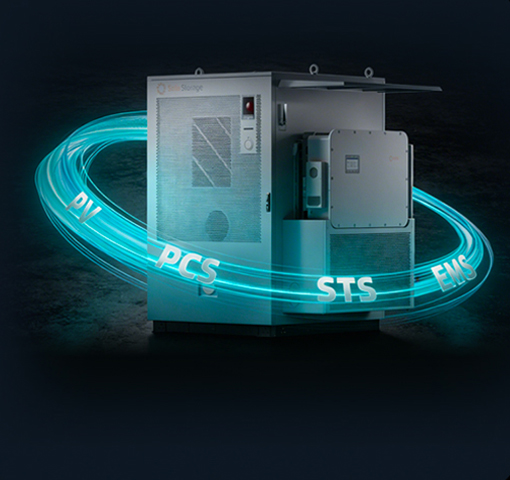
Integrated architecture: power conversion, transfer switching, PV conversion, protection and energy management consolidated in one 125 kW unit.
Control follows the same consolidation. Conventional systems run separate processors for the battery management system, power conversion, energy management and transfer switching, producing a multi-node topology in which protocol compatibility, latency and multi-vendor fault-finding all become operational risks. EverCore uses a single central controller that schedules the entire system from one core, which reduces failure points and shortens fault location. On the power side, the integrated design delivers grid-tied to off-grid transfer in under 10 ms without an external static transfer switch, removes the need for an external PV inverter, supports both DC and AC coupling with PV over-sizing up to 200%, and allows up to six units to be paralleled for direct grid connection without an external grid cabinet.
The 314Ah Cell and the Air-Cooling Argument
Cell choice determines how much of the thermal problem exists in the first place. EverCore uses A-grade 314Ah lithium iron phosphate cells developed for C&I duty, with internal resistance of 0.15 ± 0.05 mΩ against 0.17 mΩ for the 280Ah cells still common in the segment. Solis calculates that each 10% reduction in internal resistance lowers charge-discharge heat generation by roughly 20%, which addresses thermal risk at the electrochemical source rather than at the cooling system.
Cycle life moves in the same direction: 8,000 cycles at 0.5C with remaining capacity at or above 70%, against around 7,000 cycles for 280Ah cells. At 500 cycles per year, that extends the economic lifecycle from roughly 14 years to 16 years — a difference that shows up in project IRR rather than in a specification table. The cooling design supports this with three separate air ducts, a patented diversion duct for the inverter and Coanda-effect airflow attachment across battery pack surfaces, which Solis reports improves heat dissipation efficiency by 30% compared with conventional air cooling. Combined with IP66/IP55 protection and C4-grade anti-corrosion coating, the system is rated for -25°C to 55°C and altitudes up to 4,000 m.
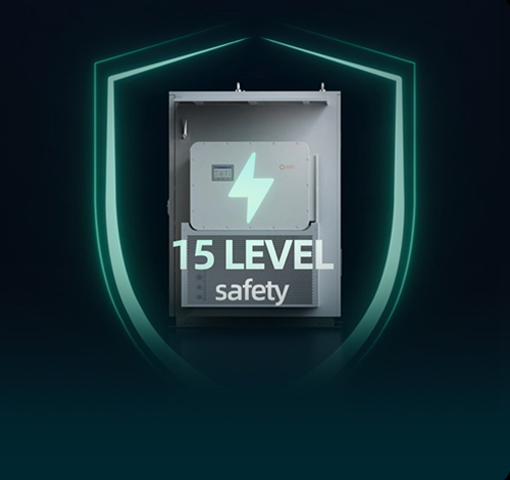
Safety is layered across cell, pack and system levels, with 1,000°C-rated insulation between packs and staged fire suppression.
Safety architecture follows the same three-level structure: a 15-layer protection scheme spanning cell, pack and system, thermal insulation rated to 1,000°C between packs to block lateral propagation, and staged fire response using pack-level aerosol, cabinet-level aerosol and fire-fighting water channels. For insurers and owners, this is the part of the specification that is hardest to compare across quotes and easiest to under-read.
What German and Danish Sites Reveal About Format Choice
Germany and Denmark are useful reference markets because their commercial buyers rarely purchase storage for a single revenue stream. German C&I projects typically combine peak-shaving with participation in frequency containment and automatic or manual frequency restoration reserves, demand response and VPP dispatch. Danish and wider Nordic projects operate against aggregator platforms and shorter arbitrage windows, which places a premium on cycling discipline and on the system's ability to be dispatched by a third party rather than by the owner's own logic.
That has a direct consequence for format selection. Where the revenue model depends on external dispatch, the system's software openness — not its nameplate capacity — becomes the deciding variable. Solis reports that EverCore has been connected, or is in the process of being connected, with 102 third-party VPP and EMS operators across 11 European countries, including integration with the Kraken platform under Octopus Energy in the UK, mainstream Nordic aggregators such as Check Watt, and dozens of local EMS providers in the German-speaking region and Benelux. The company's own AI platform, deployed at more than 5,500 storage stations, integrates wholesale and retail price data to optimise charge-discharge strategies at minute-level resolution.
Site archetypes in these markets also tend to cluster. Industrial manufacturing, low-carbon industrial parks, hospitals, cold-chain logistics and small-scale agriculture all appear as C&I use cases in SolisStorage's own application material, and they differ sharply in load shape. A cold-chain site has a relatively flat, non-deferrable load and needs reliability more than arbitrage flexibility. A manufacturing plant with shift-based demand can shift load meaningfully and benefits from a longer duration block. A hospital sits closer to the first category. In practice, the industrial cabinet format fits sites where the load block is already defined and the value comes from coordinated dispatch, while the stackable format fits sites where the load is smaller, distributed, or still being measured.
Market Signals Behind the Format Debate
The direction of the market is not in dispute, though the granularity of public data remains limited. BloombergNEF projected global annual energy storage deployment, excluding pumped hydro, to reach 92 GW in 2025. In the United States, the Solar Energy Industries Association reported 57.6 GWh of new storage capacity installed in 2025, described as the largest year of additions on record; the figure is an all-segment aggregate without a residential, C&I or utility-scale split, so it indicates demand direction rather than segment sizing. On the compliance side, ANSI/CAN/UL 9540:2023 covers energy storage systems intended to receive and store energy for delivery to loads or to the local electric power system, and applies to both residential and non-residential installations — a reminder that format choice does not remove certification obligations.
The structural signal relevant to this comparison is that C&I profit models have moved from single-stream peak-valley arbitrage toward multi-product trading. That shift rewards systems whose capacity can be re-shaped as revenue streams change, which favours DC-side expansion over inverter replacement, and rewards open software over closed hardware.
Where Each Format Stops Being the Right Answer
A credible comparison has to mark the boundary. The industrial cabinet format concentrates conversion and control, and that concentration has costs as well as benefits. Because the per-inverter envelope is fixed at 125 kW with up to six cabinets on the DC side, multi-megawatt plants require deliberate paralleling of multiple units and a plant-level coordination layer; buyers should confirm that the site's EMS architecture accounts for this rather than assuming the unit scales indefinitely. Single-CPU central control reduces failure points, but it also means redundancy at the controller level must be designed explicitly rather than inherited from a distributed topology.
Air cooling is the second boundary. Solis has demonstrated 30% improved heat dissipation against conventional air cooling and rated the system from -25°C to 55°C, but duty cycle still governs suitability: sites with sustained high-rate cycling relative to their energy capacity should validate the thermal margin against their own load profile with the manufacturer rather than extrapolating from ambient temperature alone.
The stackable format has a different boundary. Finer granularity means more discrete units, more interconnection points and more monitoring objects per site, which raises commissioning effort and makes plant-level management software more important, not less. It also fits poorly where a single large load block justifies one coordinated high-power unit and where a small number of serviceable components is preferred by the O&M team.
Finally, neither format eliminates approval risk. Certification status is product- and market-specific, and UL 9540 scopes the category rather than certifying a specific model. Buyers in Germany and Denmark should verify grid-code compliance, fire-safety approval and any local installation conditions against the exact model before commitment.
A Short Framework for the Decision-to-Execution Stage
Once a buyer has moved past the search stage, the format decision can usually be reduced to five questions. Answering them in writing, before requesting final quotations, prevents most of the mismatches that surface during commissioning.
| Question | Points toward stackable | Points toward industrial cabinet |
|---|---|---|
| Is the required capacity known today? | No — the load is still being metered or will grow in stages | Yes — a defined load block and duration are available |
| How will capital be released? | In tranches tied to production or budget cycles | In a single approved project |
| What is the revenue model? | Self-consumption and peak-shaving, with limited external dispatch | Multi-market: ancillary services, demand response, VPP dispatch |
| What does the space allow? | Constrained rooms, distributed installation points | Dedicated plant area with service access |
| What does O&M look like? | Local staff can manage many small units | A smaller number of concentrated, serviceable units is preferred |
Long-Term View: Asset Life Is an Operations Question
C&I storage projects typically run for 10 to 15 years, which makes the supplier's operating model part of the product. Solis reports lifecycle O&M savings of approximately €9,500 per EverCore unit against liquid-cooled alternatives, composed of avoided coolant replacement (€2,500), simplified PCS replacement (€1,500), simplified pack replacement (€1,500) and reduced routine inspection complexity (€4,000). Component selection supports the same argument: Minebea cooling fans are specified for 10-year maintenance-free operation, and Honeywell industrial flammable-gas detectors for 10-year calibration-free operation.
Serviceability extends to how the pack is handled physically. Solis states that the pack is lighter, with replacement steps reduced by 55% and no heavy lifting equipment required — two technicians can complete the task with standard tools. Manufacturing and support commitments complete the picture: monthly production capacity is over 10,000 units globally, typical lead time is 30-45 days for mass OEM orders with spot goods available for standard models, and every unit undergoes 100% full functional testing before shipment alongside raw material incoming inspection, aging test, high-low temperature cycle test and IP protection testing. Support is provided through 24/7 global remote technical assistance, 27 local overseas service centres, 48-hour on-site fault handling, a whole-machine replacement guarantee and long-term spare parts supply.
For execution-stage buyers, the commercial terms are equally concrete: minimum order quantity of one unit, FOB Ningbo or EXW factory delivery, and acceptance based on factory acceptance testing plus on-site installation and commissioning, with payment staged across deposit, shipment and final acceptance. Those terms matter more in a phased project, where each increment is a separate purchasing event.
Future Outlook
The likely direction of travel is not a victory of one format over the other, but convergence at the plant level. Modular formats are becoming more controllable through software, and concentrated formats are becoming more expandable through DC-side architecture and parallel operation. What will differentiate suppliers is whether the same platform can serve both a 100 kWh commercial site and a multi-unit industrial plant without forcing the buyer into a different control stack, a different service model or a different spare-parts inventory. Buyers evaluating partner longevity — rather than a single project — should weight that continuity above unit-level specification differences that a datasheet can settle in an afternoon.
Frequently Asked Questions
What is the practical difference between a stackable ESS and an industrial cabinet ESS?
A stackable system grows capacity by adding modules, so the installed size can follow the load in small increments. An industrial cabinet system concentrates power conversion and control in a single integrated unit — in EverCore's case a 125 kW hybrid inverter combining PCS, static transfer switch, PV inverter, circuit breaker protection and EMS — and grows energy capacity by adding battery cabinets on the DC side, with up to six cabinets connectable to one inverter.
How does AC-DC separation affect long-term maintenance?
Separating the hybrid inverter from the battery cabinet changes both thermal and protection behaviour. About 6 kW of power-electronic heat dissipates to ambient instead of entering the cabinet, leaving roughly 3.5 kW of electrochemical heat to be managed internally. The inverter as an independent unit reaches IP66 while the cabinet maintains IP55, and Solis states this separated protection design reduces full-lifecycle failure rate by 50%. Maintenance is also simplified because the inverter and the cabinet can be serviced as separate units.
Can storage capacity be added later without replacing the inverter?
In the EverCore architecture, yes on the DC side: a single 125 kW inverter can connect up to six battery cabinets in parallel, enabling linear capacity expansion without additional inverter investment. Solis reports this reduces expansion costs by approximately 10%. Power-side expansion is handled by paralleling additional units, with up to six units connectable for direct grid connection without an external grid cabinet.
Which format suits a German or Danish site participating in VPP or ancillary-service markets?
Sites whose revenue depends on external dispatch need third-party platform compatibility as much as capacity. Solis reports that EverCore has been connected, or is in the process of being connected, with 102 third-party VPP and EMS operators across 11 European countries, including Kraken under Octopus Energy in the UK, Nordic aggregators such as Check Watt, and dozens of local EMS providers in the German-speaking region and Benelux. Where a site's load is small, distributed or still being metered, a stackable format allows capacity to be added as the dispatch profile becomes clearer.
What operating costs should be compared across a 10 to 15 year asset life?
Capital expenditure is only the visible layer. Solis reports lifecycle O&M savings of approximately €9,500 per EverCore unit compared with liquid-cooled alternatives, comprising avoided coolant replacement (€2,500), simplified PCS replacement (€1,500), simplified pack replacement (€1,500) and reduced inspection complexity (€4,000). Pack replacement is described as requiring two technicians with standard tools and no heavy lifting equipment, with replacement steps reduced by 55%.
What should be verified before signing, in terms of testing, lead time and service coverage?
Buyers should confirm the factory test regime, the delivery schedule and the service footprint in writing. Solis states that every unit undergoes 100% full functional testing before shipment, together with raw material incoming inspection, aging test, high-low temperature cycle test and IP protection test. Monthly production capacity is over 10,000 units globally, typical lead time is 30-45 days for mass OEM orders with spot goods available for standard models, and support includes 24/7 global remote technical assistance, 27 local overseas service centres, 48-hour on-site fault handling, a whole-machine replacement guarantee and long-term spare parts supply. Acceptance is based on factory acceptance testing plus on-site installation and commissioning.
Technical reference: Solis Global Brochure V3.9 (PDF, publicly downloadable).
Have Questions or Need More Details?
Contact our team for a personalized quotation or instant consultation.
Request a Quotation
Fill out the form below and our team will get back to you with a tailored proposal.
WhatsApp Direct Chat
Prefer to chat in real-time? Message us on WhatsApp for instant assistance & quick answers.
- Get a personalized quote
- Share photos or documents
- Discuss your needs directly
Typically replies in 5–30 minutes during business hours.