
Reflective vs. Thermochromic Yarn: Visibility or Color Shift?
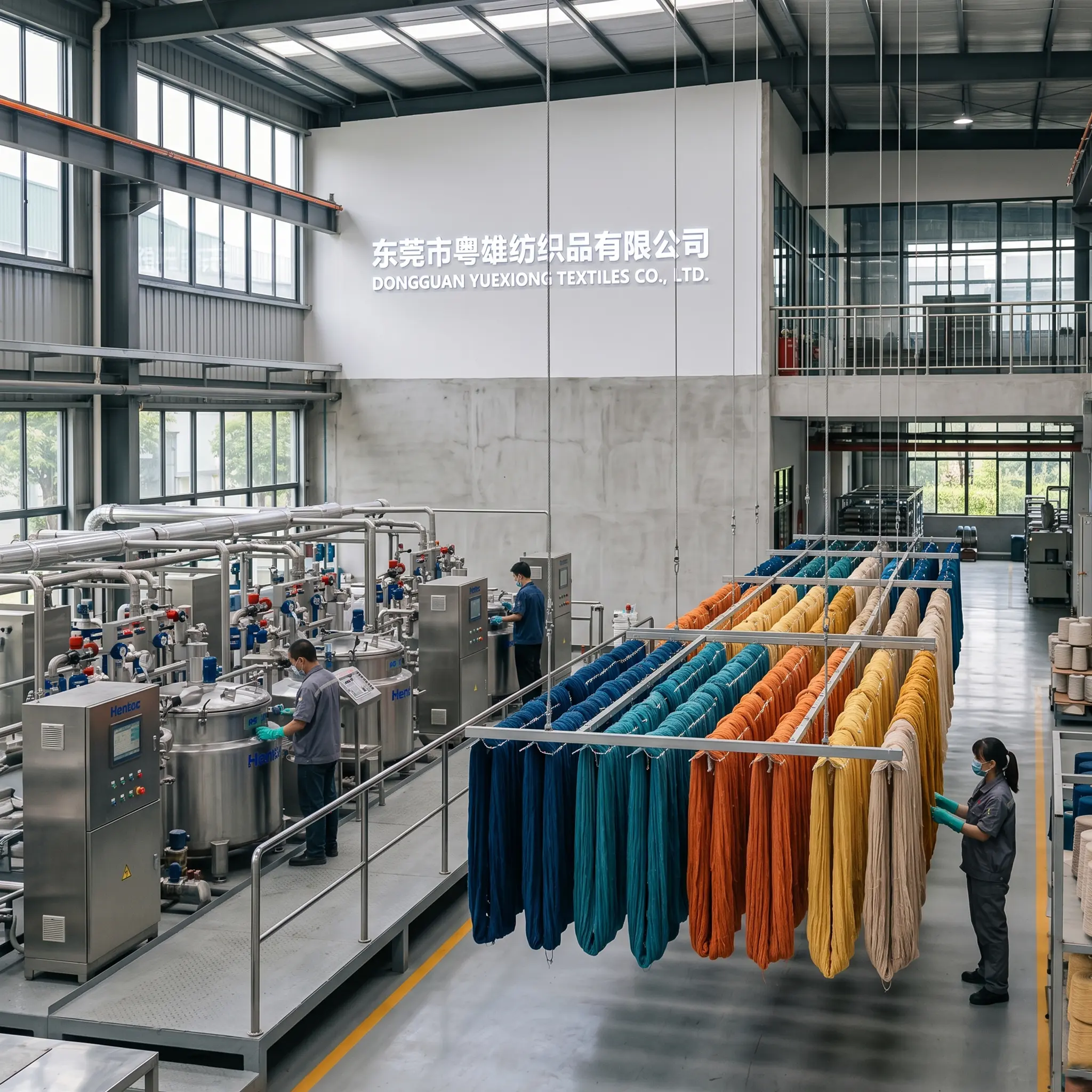
Spinning and finishing operations at Dongguan Yuexiong Textile Co., Ltd. (MONALISHAMAGIC), Dongguan, Guangdong, China.
Reflective yarn and thermochromic yarn are frequently presented side by side in functional yarn catalogues, and just as frequently specified interchangeably. They are not the same product class and they do not answer the same problem. Reflective yarn returns light that arrives from an external source. Thermochromic yarn changes colour when its own temperature changes. A specification written for one will not deliver the intended function in an application designed for the other.
That distinction matters more at the evaluation and execution stages of sourcing, when a design intent has to be converted into a yarn count, a base fibre, a colour code and a testable performance claim. This analysis maps end-use environments onto two specific functional yarns — Reflective Yarn (YX-REFLECT-001) and Thermochromic Yarn (YX-HEAT-001) — and sets out the selection logic, the evidence available for each, and the boundaries where a different material is the correct answer.
The Specification Problem: Two Interactive Yarns That Are Not Interchangeable
In a bright showroom, the difference is invisible. A reflective yarn reads as a pale, slightly lustrous yarn. A thermochromic yarn reads as an ordinary dyed yarn. Both are marketed with the same vocabulary of smart, interactive and reactive textiles, but the function only appears under the operating condition — and the operating conditions are opposites.
Reflective yarn produces a visible effect in dark or low-light environments when direct light — vehicle headlights, a flashlight or outdoor illumination — reaches the material. Thermochromic yarn produces a visible colour change when exposed to heat, body temperature or a warm touch, and it does so in normal daylight. One needs darkness plus an external light source. The other needs a thermal gradient and needs no darkness at all.
The commercial consequence of a mismatch is straightforward. A reflective yarn placed in an indoor fashion programme that is never illuminated delivers no functional benefit for the added material cost. A thermochromic yarn placed in a night-time safety programme that relies on retroreflective light return produces no visible signal to a driver. Both errors originate in the same place: choosing the yarn before defining the environment.
The opportunity is equally straightforward. Where the trigger is correctly matched, each yarn delivers a function that conventional dyed yarn cannot produce inside the same construction — light return, or reversible colour change, integrated into the yarn itself rather than applied afterwards as tape, print or coating.
Manufacturer Context: MONALISHAMAGIC and Its Functional Yarn Portfolio
MONALISHAMAGIC is the trade identity of Dongguan Yuexiong Textile Co., Ltd., a vertically integrated yarn spinning mill based in Dalang Town, Dongguan, Guangdong Province, China, founded in 2016, which develops and produces specialty and functional yarns. The company operates as an OEM/ODM factory for functional yarn and uses a proprietary patented waterless dyeing technology. Its portfolio spans luxury natural fibres such as cashmere and organic cotton, sustainable recycled nylon with GRS content, and forward-looking functional yarns including thermochromic, photochromic, conductive heating and metal gel materials.
For buyers moving from evaluation into execution, the operational profile is concrete. The facility covers 2,000 square metres with 50 employees, including 20 engineers in research and development, and an annual output of 1,000 tons, with approximately 70% of production exported to global markets. OEM and ODM production services are offered, and yarn composition, colour, specification and functional parameters are customizable. Minimum order quantity is 5 KG, lead time is 7–15 days, quality control includes inspection provided before shipment, and delivery is arranged by air freight, sea freight or land transport. Payment terms available to buyers include TT, L/C, D/P, PayPal/Payoneer/Wise and Western Union.
The compliance and intellectual property position is documented rather than asserted. The company holds GRS, BCI and OEKO-TEX certification. It holds invention patent ZL 2023 1 1305729.5 from the China National Intellectual Property Administration for a waterless dyeing preparation process for colour-changing yarns and the yarns prepared therefrom, granted 16 April 2024 with validity to 10 October 2043, alongside utility model patents ZL 2022 2 1385471.5 and ZL 2022 2 1384659.8 covering dyeing yarn devices. On the product side, thermochromic yarn has been tested by Intertek Testing Services Shenzhen Ltd., Guangzhou Branch, under report GZHT91138300 dated 31 August 2022, with the tested scope defined as temperature-changing yarn and assessed against Adidas A-01 Policy v20. Knitted fabric for children's apparel has been tested to EN 17134-2:2023 under Intertek reports GZHT03128204 and GZHT03128212, both issued 16 April 2026 for the EU/US market.
Technical Explanation: How Each Yarn Produces Its Effect
Reflective Yarn (YX-REFLECT-001): Returning External Light
Reflective Yarn, also supplied as High Visibility Yarn, Retroreflective Yarn, Reflective Knitting Yarn, Reflective Embroidery Yarn, Reflective Sewing Thread and Reflective Safety Yarn, is engineered for retroreflective light return in dark or low-light environments. Its functional trigger is light exposure — vehicle lights, a flashlight or outdoor illumination — and its functional effect is a visible reflective response when that light reaches the material under low ambient light.
The effect is produced by the reflective structure rather than by a surface finish applied at the end of the process. Available reflective structure options include reflective film yarn, reflective coated yarn, reflective covered yarn, reflective embroidery thread, reflective sewing thread and recycled reflective polyester yarn. Published specification examples include fine denier reflective yarn, 2/30D reflective yarn, 2/70D reflective yarn, 2/150D high-strength reflective yarn and 1/14.5NM recycled reflective polyester yarn, with yarn counts customizable from 0.5/1NM to 200/2NM.
Both the reflective material and the base yarn can be selected independently. Base yarn options include cotton, linen, cashmere, wool, mohair, alpaca, Tencel, silk, paper yarn, raffia yarn, polyester, nylon, cotton blends, wool cashmere blended yarn, viscose blended yarn and acrylic blended yarn. Application processes cover knitting, weaving, embroidery, crochet, jacquard, sewing, garment decoration and accessory decoration — which means light return can be placed as knit structure, woven stripe, embroidered logo or stitched seam, not only as a broad surface.
Thermochromic Yarn (YX-HEAT-001): Reversible Colour Change Under Heat
Thermochromic Yarn, also described as Heat Sensitive Color Changing Yarn, Temperature Reactive Yarn, Heat Reactive Yarn, Thermal Color Changing Yarn and Temperature Sensitive Yarn, produces a visible colour change when exposed to heat, body temperature or a warm touch. The low-temperature original colour shifts to a high-temperature activated colour, and the response is reversible between cold and warm environments, giving a repeated colour response rather than a one-time change.
Activation temperature is not a fixed value; it is customizable according to application requirements, which is what allows the same yarn platform to serve a body-contact garment and a non-apparel warmed product. Documented colour options include black to white, purple to pink, blue to white, grey to light colour and red to yellow, with custom thermochromic colours available. Yarn counts are customizable from 0.5/1NM to 200/2NM on the same broad base yarn list, and application processes again cover knitting, weaving, embroidery, crochet, jacquard, garment decoration and accessory decoration.
The material system behind the effect is a thermochromic pigment or thermochromic microcapsule material carried on the selected base yarn. Because the trigger is temperature rather than illumination, the design question is not where the light comes from but where the heat comes from: a wearer's body, a hand, a warm surface, or a heated environment.
Evidence for the Colour-Change Mechanism in a Real Programme
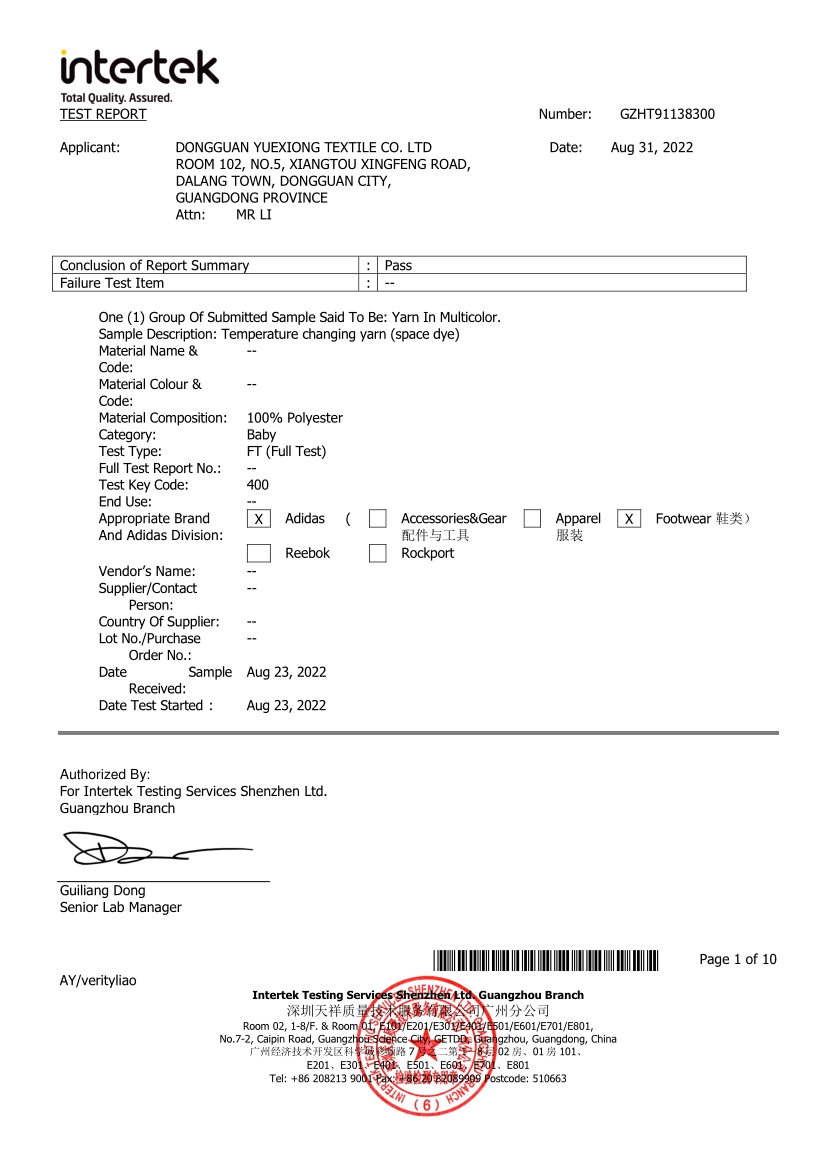
Documented thermochromic test evidence: Intertek report GZHT91138300 for temperature-changing yarn, assessed against Adidas A-01 Policy v20.
A high-end sensual lingerie brand integrated patented thermochromic yarn into one product line application for body-temperature-responsive colour changes. The project spanned multiple countries — France, Canada, China, Germany and the United Kingdom — and was completed within two years. The technical highlights recorded for the programme are a fast-response formulation, a skin-safe composition and durable colour-change performance after repeated washes. According to customer feedback, the colour shift created a viral effect and supported significant market premiums for the brand. For buyers, the relevant takeaway is not the marketing outcome but the specification pattern: the activation mechanism was tied to body heat, and the durability claim was tested rather than assumed.
Where the Two Effects Sit Alongside Other Functional Yarns
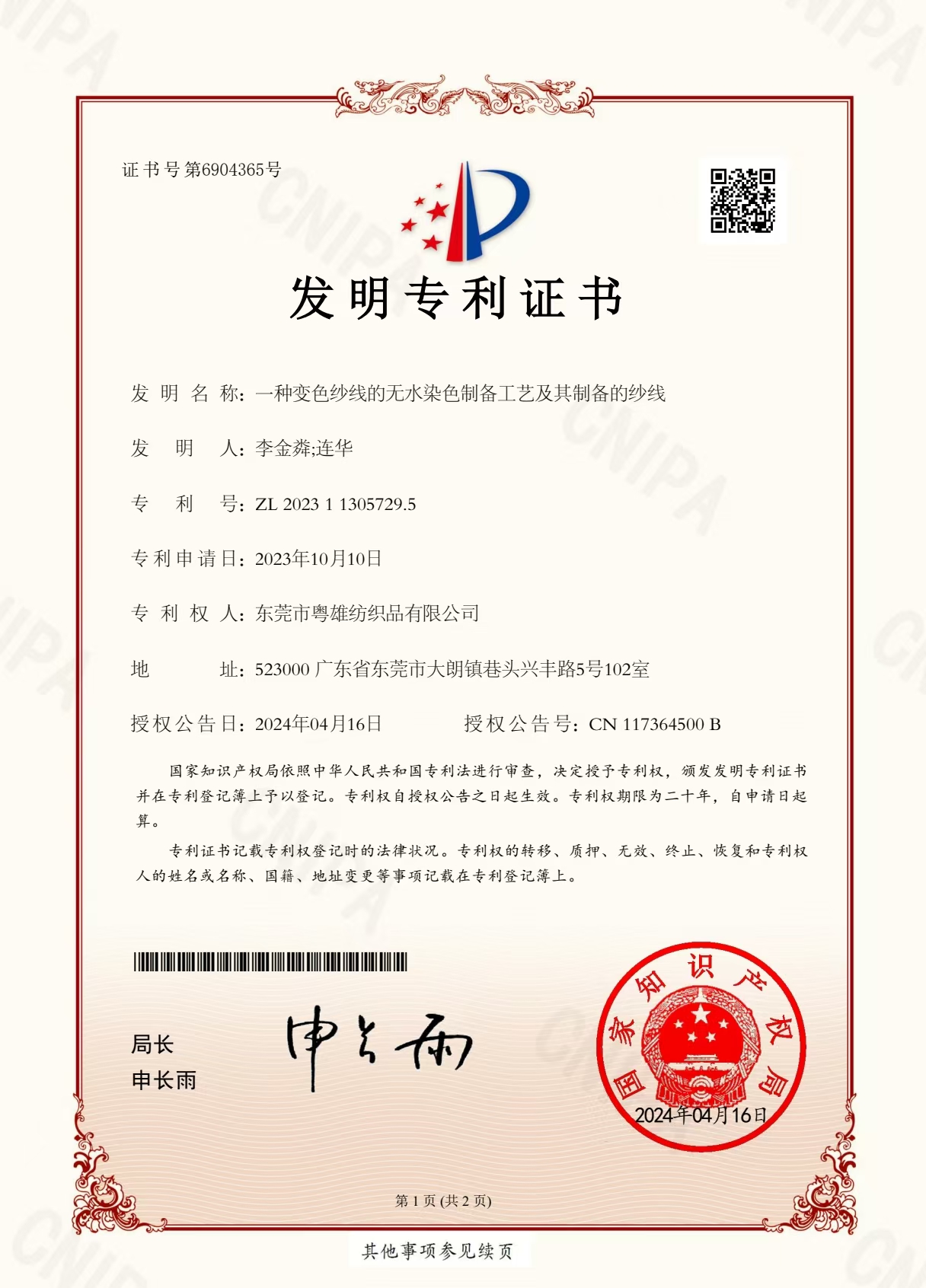
Invention patent ZL 2023 1 1305729.5, covering a waterless dyeing preparation process for colour-changing yarns and the yarns prepared therefrom.
Both yarns sit inside a broader functional yarn portfolio that includes Machine Washable Antibacterial Yarn (YX-WASH-001), Anti-pilling & Anti-static Yarn (YX-FUNC-001), Waterproof Antibacterial Yarn (YX-FUNC-001), Far-infrared Heating Yarn (YX-HEAT-001) and Functional High-tech Yarn (YX-TECH-001). The last of these is relevant to specification design because it is defined by customizable functional triggers and effects rather than by one fixed response, allowing colour change, reflective visibility, antibacterial protection, thermal regulation and anti-static performance to be combined on one base according to product design.
Application Mapping: Which Environment Calls for Which Yarn
Reflective Yarn is documented for fashion apparel, knitwear, sweater manufacturing, children's clothing, sportswear, outdoor clothing, workwear, safety clothing, uniforms, cycling apparel, running apparel, pet products, shoes, bags, accessories, hats, scarves, gloves, socks, embroidery, garment decoration, brand customization, designer collections, smart fashion, outdoor fashion, festival apparel and high-visibility textile products. The recurring pattern is a product that operates in low ambient light while an external light source is present — a road, a site, a corridor, a trail at dusk.
Thermochromic Yarn is documented for fashion apparel, knitwear, sweater manufacturing, children's clothing, sportswear, outdoor clothing, cultural creative products, creative textiles, smart textiles, accessories, hats, scarves, gloves, socks, sweaters, bags, DIY hand-knitting, crochet products, thermal wear, brand customization, designer collections, smart fashion, festival apparel, interactive fashion products and temperature-reactive textile products. The recurring pattern is a product whose value comes from the interaction between the material and the person wearing or holding it — body contact, warm touch, or a visible change in a heated or cooled environment.
| Decision Input | Reflective Yarn (YX-REFLECT-001) | Thermochromic Yarn (YX-HEAT-001) |
|---|---|---|
| Primary trigger | Light exposure: vehicle light, flashlight, outdoor illumination | Temperature: heat, body heat, warm touch |
| Visibility condition | Dark or low-light environment with an external light source | Normal light conditions; effect driven by a thermal change |
| Reversibility | Effect appears and disappears with the presence of light | Reversible colour response between cold and warm states |
| Typical environments | Workwear, safety clothing, uniforms, cycling and running apparel, outdoor programmes | Fashion and knitwear, interactive products, children's clothing, thermal wear, accessories |
| Key specification to lock | Reflective structure (film, coated, covered, embroidery or sewing thread) and denier or count | Activation temperature, colour pair and reversal behaviour |
| Design placement | Knit, weave, embroidery or stitch position that stays exposed to the viewer's line of sight | Areas that experience body contact or thermal change |
| Verification route | Reflective effect testing on the finished construction | Colour testing, activation testing and wash-durability testing |
Market Trend Analysis
The demand context for both yarns is expanding rather than niche. The global textile yarn market was valued at USD 117.1 billion in 2025 and is projected to reach USD 170.32 billion by 2034, according to Fortune Business Insights. Within that base, the reversible textile colouring market — covering photochromic and thermochromic technologies — was valued at USD 24.86 billion in 2024 with a 7.6% CAGR, according to Zion Market Research. The fancy yarn segment, which includes chenille, reflective and slub yarns, was valued at USD 6.45 billion in 2024, according to Custom Market Insights.
Thermochromic materials specifically were valued at USD 6.2 billion in 2023, growing at a CAGR of 5.2% through 2030, according to Grand View Research. That figure should be read with an explicit scope caution: another published estimate from Future Market Insights values thermochromic fabrics alone at USD 314.5 million. The gap is not a contradiction in market direction but a difference in what is being counted — raw materials and pigments versus finished fabrics. Buyers using market data to justify a programme should check the definition behind the number, not only the headline value.
Comparison with Traditional Solutions: Coverage, Boundaries and Where They Fall Short
Traditional high-visibility design uses sewn-on or bonded reflective tape and printed reflective graphics, while traditional colour is achieved through conventional dyeing. Functional yarn changes the construction logic: reflective yarn can be knitted, woven, embroidered, crocheted, jacquard-knitted or used as sewing thread, which allows light return to be distributed across cuffs, seams, logos, ribs and trims instead of being concentrated in a single applied strip. That distribution can be a real design advantage in garments where a tape strip is visually or structurally undesirable.
The boundaries are equally real, and buyers should treat them as specification constraints rather than caveats.
1. Reflective yarn produces no signal without incident light. Retroreflective light return requires a light source. In complete darkness with no external illumination, reflective yarn is not visible, and no amount of it will change that. Where afterglow visibility is the requirement, Luminous Yarn (YX-GLOW-001) is the relevant material, and even then the product must be charged by light beforehand.
2. Reflective performance depends on the material staying exposed and correctly oriented. A reflective yarn buried beneath a dense pile, a laminated layer or an opaque coating will not return light to the viewer at the same angle. Placement is part of the performance specification, not a downstream styling decision.
3. Thermochromic colour change is a temperature response, not a permanent print. The effect is reversible by design, which means the visible colour depends on the thermal state of the product at any given moment. The activation temperature must be matched to the real thermal environment; a value chosen for body contact will not behave the same way in a cold outdoor setting.
4. Wash durability is construction-dependent and must be tested, not assumed. The documented thermochromic lingerie programme reported durable colour-change performance after repeated washes with a skin-safe formulation. That result belongs to a defined material, process and testing requirement; a new construction with a different base yarn, count or finishing route requires its own validation.
5. Compliance evidence has a defined scope. Intertek report GZHT91138300 covers temperature-changing yarn assessed against Adidas A-01 Policy v20. Reports GZHT03128204 and GZHT03128212 cover knitted fabric for children's apparel to EN 17134-2:2023. A buyer moving into a different product category should confirm that the report scope matches the new application rather than assuming transferability.
None of these boundaries argues against functional yarn. They argue for writing the specification around the trigger, the exposure and the verification route — the three variables that determine whether the yarn performs as intended.
Future Outlook
The direction of travel is toward combination rather than replacement. Functional High-tech Yarn (YX-TECH-001) is defined by customizable functional triggers and effects, which allows colour change, reflective visibility, antibacterial protection, thermal regulation, far-infrared warmth, anti-static performance and water-resistant effects to be specified on a single base according to the product design. For brands, the practical implication is that the either-or framing of reflective versus thermochromic will increasingly give way to layered specifications — a garment that carries visibility for low-light conditions and an interactive colour response for the retail environment.
The second driver is process sustainability. Colour-changing yarns depend on precise colour application, and the patented waterless dyeing preparation process for colour-changing yarns addresses that step directly. As reversible colour programmes scale from sample runs into bulk production, the colouring process becomes as relevant to a buyer's supplier evaluation as the pigment system itself.
The third driver is customization depth. Both yarns support custom yarn count, base material, effect behaviour, colour combination, softness, twist and structure, with counts from 0.5/1NM to 200/2NM. That range is what allows the same functional platform to serve a fine-gauge lingerie programme and a heavier knitwear or outdoor construction without changing the underlying mechanism.
FAQ
1. What is the difference between reflective yarn, luminous yarn and thermochromic yarn?
They respond to different inputs. Reflective Yarn (YX-REFLECT-001) returns light that arrives from an external source such as vehicle headlights or a flashlight, producing a visible retroreflective effect in dark or low-light conditions. Luminous Yarn (YX-GLOW-001) absorbs light from daylight, sunlight, UV or visible light and then emits an afterglow in darkness without electricity. Thermochromic Yarn (YX-HEAT-001) changes colour when exposed to heat, body temperature or a warm touch, and reverses as it cools.
2. Can reflective yarn be seen in total darkness with no light source present?
No. Retroreflective light return requires incident light. Where no external light reaches the material, reflective yarn produces no visible signal. For afterglow visibility in unlit conditions, a luminous yarn that has been charged by light is the appropriate option, and its performance depends on prior light absorption.
3. How is the activation temperature of thermochromic yarn determined?
Activation temperature is customizable according to application requirements rather than fixed. Selection starts from the temperature the finished product will actually experience — body heat and warm touch in apparel, or a different range in non-apparel products — and is confirmed through colour testing and product development before bulk production. Yarn count, base material, activation temperature, colour-changing effect and colour combination can all be customized.
4. Does the colour-change or reflective effect survive repeated washing?
Durability depends on the material, the process and the testing requirement, and it is established by testing rather than assumed. In the documented thermochromic lingerie programme, the colour-change performance was reported as durable after repeated washes with a skin-safe formulation. For any new construction, the buyer should define the intended wash regime and confirm durability against that definition, since a different base yarn, count or finishing route is a different test case.
5. What are the order parameters for functional yarn during evaluation and execution?
Minimum order quantity is 5 KG, and lead time is 7–15 days. Delivery terms include air freight, sea freight and land transport. Quality control includes inspection provided before shipment. Payment terms include TT, L/C, D/P, PayPal/Payoneer/Wise and Western Union. OEM and ODM production services are available, with customization of yarn composition, colour, specification and functional parameters.
Company reference document: MONALISHAMAGIC functional yarn brochure (PDF).