
Rental LED Screen Buyer Guide: Hanging, Stacking, Foldable
A rental LED screen is bought for how quickly it can be built, checked and struck — not only for how it looks when it is running.
A rental LED screen is a modular display system engineered for repeated assembly, dismantling and transport between venues rather than permanent attachment to a building. Because the screen changes location and shape with every job, the installation method — hanging from truss, stacking from the floor, or a foldable all-in-one format — determines cabinet structure, the load a venue must carry, the protection rating the display needs, and how many crew hours are spent on site.
Buyers in the research and evaluation stages often compare catalogues that lead with pixel pitch. In rental work the more useful sequence runs the other way: first establish the installation method the venue allows, then the cabinet platform, then the pixel pitch, brightness and refresh rate that the content and viewing distance actually require. This comparison follows that sequence across four rental and portable families from DDW DISPLAY — the D Series, A Series, AFLEX Series and PIF Series — and shows how venue type, setup speed and protection rating narrow the choice.
DDW DISPLAY (Shenzhen DDW Technology Co., Ltd.) is a Shenzhen-based LED display manufacturer founded in 2012 that produces rental LED displays, indoor fine pitch LED displays, outdoor LED displays, COB LED displays, XR virtual production LED walls, stadium LED displays, LED posters and commercial video walls from a 10,000 m² facility. The company reports an export ratio above 95% and delivered projects in more than 120 countries and regions.
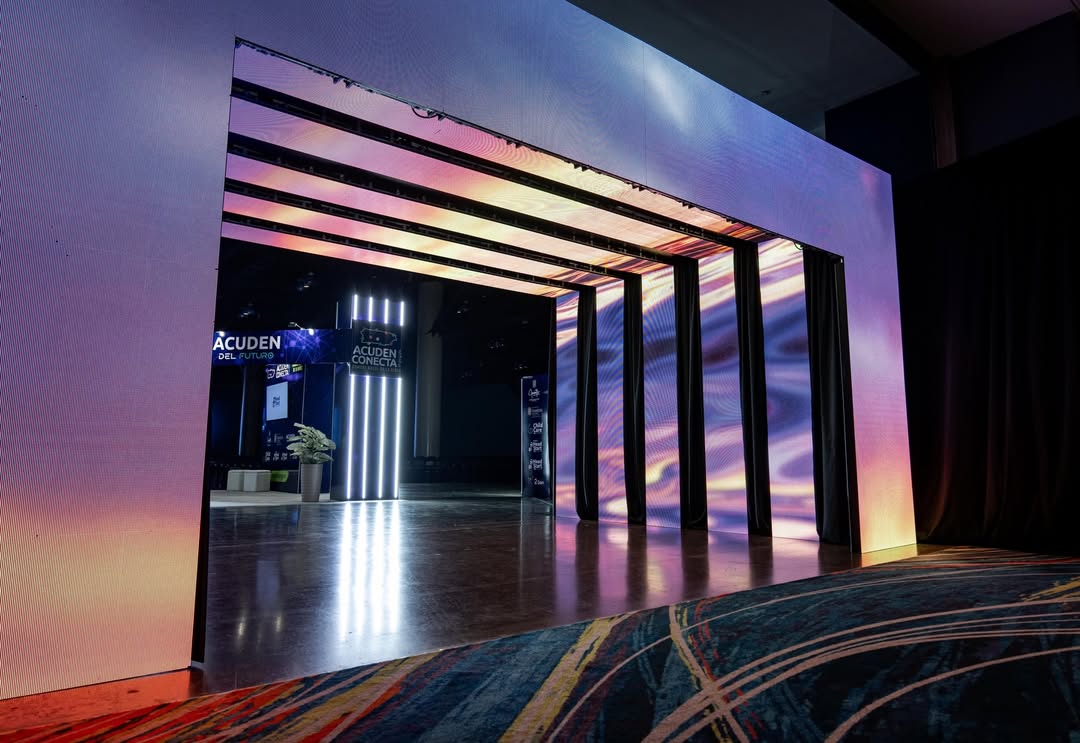
Cover: in exhibition and event environments, the installation method usually decides whether a rental LED screen fits the build schedule before pixel pitch is discussed.
Three installation methods, three different constraints
Hanging suspends cabinets from truss or rigging points above the stage or set. It keeps the floor clear, allows a screen to be raised above sightlines, and is the default approach for concert backdrops, festival stages and broadcast sets. Its constraint is overhead capacity: the venue must provide certified rigging points and the truss must carry the total cabinet load plus safety margins. Where a venue does not permit overhead rigging, hanging is simply not available, regardless of product specification.
Stacking builds the screen from the floor upwards on ground support and ballast. It is used when rigging is unavailable, when the screen must start at floor level for an audience standing close to it, or when a temporary wall has to be assembled quickly in a lobby, foyer or exhibition hall. Its constraints are floor area, level ground and a stable base structure, and the fact that stacked walls occupy space that could otherwise hold seating or stands.
Foldable and portable all-in-one formats cover a different need entirely: a self-contained unit that folds for transport, stands on its own base and can be positioned, moved and re-positioned by a small team. The PIF Series foldable LED poster display belongs to this group, with display sizes of 640×1920 mm and 1280×1920 mm, an integrated control system supporting synchronous or asynchronous operation, front maintenance, and an optional dual-sided display configuration. It replaces neither a hanging backdrop nor a stacked wall; it covers close-view communication in entrances, booths and activation areas.
| Installation method | What it requires | Typical venue fit | DDW Display series that list this method |
|---|---|---|---|
| Hanging | Certified rigging points and overhead load capacity; truss and hoist planning | Concert stages, festival main stages, broadcast sets, conference backdrops | D Series, A Series, AFLEX Series |
| Stacking | Level ground, ground support or ballast, floor space in front of and behind the wall | Hotel lobbies, exhibition halls, conference foyers, fixed-position event walls | D Series, A Series, AFLEX Series |
| Foldable / portable | Floor standing footprint only; no rigging and no ground support structure | Product launches, retail promotions, entrances, booths, corporate events | PIF Series |
Why installation method has become a buying constraint, not an afterthought
For a rental company, a screen earns money only while it is out on hire. Every hour spent on assembly, alignment and dismantling is an hour the asset is not generating revenue, and labour is one of the largest recurring costs in event production. That is why quick-lock cabinet structures, lightweight housings and predictable cabinet dimensions now carry as much commercial weight as image quality.
The same logic applies to the buyer side of the transaction. Production companies, event agencies and venue operators increasingly select screens against three practical questions: can the venue physically support the installation; how many people and how much time does the build require; and does the protection rating match the environment the screen will run in. A display with excellent picture quality that cannot be rigged in the chosen venue, or that takes twice as long to build, will often lose to a more practical cabinet.
Standardisation is the second half of that picture. The D Series and AFLEX Series both use 500×500 mm die-casting aluminum cabinets, and the A Series offers 500×500 mm and 500×1000 mm cabinets in the same construction. For rental inventories, a shared cabinet footprint simplifies spares, transport cases and crew familiarity — although, as later sections note, shared dimensions do not mean identical performance.
Matching DDW Display rental series to installation scenarios
D Series is the rental workhorse for mixed event use. Pixel pitch options run from P1.56 to P3.91, the cabinet measures 500×500 mm in die-casting aluminum, refresh rate reaches up to 7680 Hz, brightness reaches up to 5000 nits on the outdoor version, and the outdoor version carries an IP65 protection rating. Front and rear maintenance are both supported, and the series lists hanging and stacking installation. For broadcast, live streaming and camera-heavy productions, the high refresh rate is the parameter that matters most.
A Series is the indoor/outdoor flexible rental platform. Pixel pitches cover P2.5, P2.604, P2.97 and P3.91, with 500×500 mm and 500×1000 mm die-casting aluminum cabinets, a refresh rate of up to 3840 Hz, a viewing angle of H160° / V140°, and front and rear maintenance. The outdoor version is rated IP65 with 4200–5000 nits, while the indoor version is rated IP31 with 700 nits. Hanging and stacking installation are both listed.
AFLEX Series is the curved and creative option. It is described as an ultra flexible rental LED screen with pixel pitches of P1.56, P1.95, P2.604, P2.976 and P3.91, a 500×500 mm die-casting aluminum cabinet weighing 7.5 kg, and 250×250 mm modules. Brightness is 700 nits for the indoor version and 4200–5000 nits for the outdoor version, with IP31 indoor and IP65 outdoor protection, 14-bit grey scale, a 3840 Hz refresh rate, and hanging and stacking installation. Its listed applications include concerts, stage events, music festivals, churches, exhibitions, press conferences, sports events and virtual production — the environments where curved or angled screens are requested.
PIF Series is the foldable, all-in-one portable display: a foldable cabinet structure, mobile floor-standing installation, pixel pitches from P1.25 to P2.5, 800–1000 nits brightness for the indoor version, a 3840 Hz refresh rate, a viewing angle of H160° / V140°, front maintenance, and synchronous or asynchronous control. It is listed for retail stores, shopping malls, brand showrooms, hotels, airports, exhibitions, conferences, events and corporate displays.
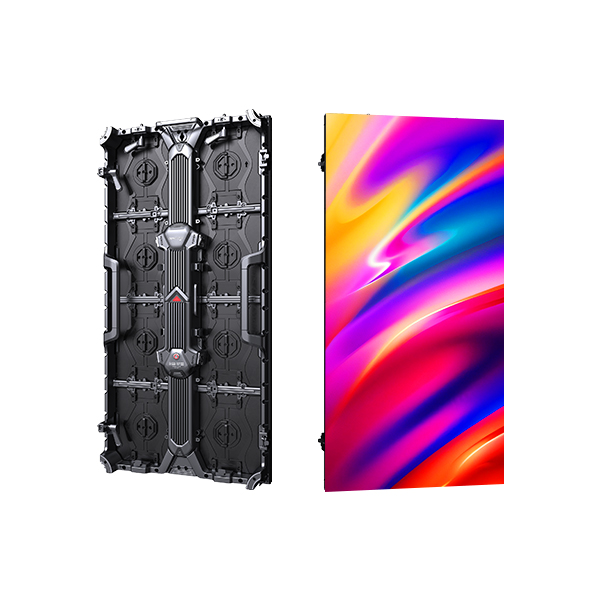
A Series rental cabinets are available in 500×500 mm and 500×1000 mm formats with a die-casting aluminum structure; the outdoor version is IP65 rated at 4200–5000 nits.
| Series | Pixel pitch | Cabinet | Brightness and protection | Refresh rate | Maintenance |
|---|---|---|---|---|---|
| D Series | P1.56 – P3.91 | 500×500 mm, die-casting aluminum | Up to 5000 nits (outdoor version), IP65 (outdoor version) | Up to 7680 Hz | Front and rear |
| A Series | P2.5 – P3.91 | 500×500 mm / 500×1000 mm, die-casting aluminum | Indoor IP31 at 700 nits; outdoor IP65 at 4200–5000 nits | Up to 3840 Hz | Front and rear |
| AFLEX Series | P1.56 – P3.91 | 500×500 mm, 250×250 mm module, 7.5 kg cabinet | Indoor IP31 at 700 nits; outdoor IP65 at 4200–5000 nits | 3840 Hz | Curved and creative configurations |
| PIF Series | P1.25 – P2.5 | Foldable, 640×1920 mm / 1280×1920 mm display | 800–1000 nits (indoor version) | 3840 Hz | Front |
Technical checks that change with the installation method
Once the installation method is fixed, five technical parameters decide whether a specific cabinet will perform as expected.
- Load and weight. Hanging screens are limited by truss and hoist capacity, so cabinet weight per square metre is the first number to verify. The AFLEX Series 500×500 mm cabinet weighs 7.5 kg with 250×250 mm modules; stacked walls must also be checked against ground support capacity rather than overhead limits.
- Curvature requirement. A straight wall can use the D Series or A Series. Where the design calls for an arc, cylinder or angled transition, the flexible AFLEX Series is the appropriate platform, because its module structure is intended for curved installation rather than flat splicing only.
- Maintenance access. Hanging and stacking are not equal here. The D Series and A Series are specified with front and rear maintenance, which allows service from either side. In stacked configurations placed close to a wall, rear access may be impossible, so front-access capability becomes decisive. The PIF Series is front maintenance only, which suits units positioned against a wall or in a narrow booth.
- Environment and protection. Indoor configurations of the A Series and AFLEX Series are rated IP31, which is intended for indoor use. Outdoor configurations of the same platforms are rated IP65, with brightness of 4200–5000 nits, and the D Series outdoor version is IP65 rated with brightness up to 5000 nits. Matching the rating to the actual environment avoids both under-specification and unnecessary cost.
- Refresh rate for camera work. Broadcast, live streaming and recorded content place different demands on the screen than an audience-only performance. The D Series supports up to 7680 Hz, while the A Series, AFLEX Series and PIF Series are specified at 3840 Hz. Where high-speed cameras and close camera positions are involved, the higher figure reduces the risk of flicker and scan artefacts.
Specification and compliance checks for rental LED screen buyers
Rental orders cross borders, which makes documentation part of the procurement decision rather than an administrative afterthought. For the rental and flexible rental product types, DDW Display holds a CE-EMC Certificate of Conformity issued by Shenzhen BKC Testing Co., Ltd. under certificate number BKC25062531FC, applicable to the EU/EEA market and covering the rental LED display, LED video wall and event LED screen product scope as well as the flexible rental LED display, curved LED screen and stage LED video wall scope. The same product range is covered by CE-LVD certification under Directive 2014/35/EU with certificate number HXTS2506230030001-1, and by EU RoHS 2.0 certification number HXTS2506230030007-1, which applies to the full LED display series with multiple pitch sizes.
For the United States market, the LED display product carries a Supplier's Declaration of Conformity under FCC-SDoC with certificate number BKC25062532FC-R1, referencing FCC Part 15 Subpart B. On the manufacturing side, the company operates a Quality Management System certified to ISO 9001:2015 / GB/T 19001-2016 under certificate number 12824Q21369R0S, issued by China Standards Institute (Beijing) Certification Center and valid until 2027-10-09, with a scope covering the production of electronic products including LED display, LCD video wall and digital signage for export.
A practical pre-order checklist reads as follows:
- Confirm the installation method the venue permits before selecting a cabinet family.
- Check cabinet dimensions, cabinet weight and whether the venue structure supports hanging or requires stacking.
- Match protection rating to environment: IP31 indoor configurations versus IP65 outdoor configurations.
- Match brightness to ambient light and expected viewing distance.
- Confirm refresh rate against camera and broadcast requirements.
- Verify maintenance access, particularly for walls that will sit close to a building surface.
- Request the applicable certificates and test documentation for the destination market.
Application scenarios: from concert stages to product launches
Concerts and festivals. Hanging is the standard method, with curved sections increasingly requested for stage architecture. The AFLEX Series, with pixel pitches from P1.56 to P3.91, hanging and stacking installation and listed applications covering concerts, stage events and music festivals, addresses that requirement. Where the same show is also being broadcast or streamed, the D Series and its refresh rate of up to 7680 Hz becomes relevant.
Exhibitions and conferences. Booth walls are typically stacked because venues rarely offer overhead rigging on the exhibition floor. The A Series covers this use with indoor IP31 configurations at 700 nits, a viewing angle of H160° / V140°, and both front and rear maintenance. For close-range content inside a booth, the PIF Series offers an alternative that requires no wall at all: a foldable display at pixel pitches from P1.25 to P2.5, positioned where visitors walk past.
Hotel lobbies and corporate events. A documented example is a 27 m² A Series P2.604 rental LED display installed in a stacking configuration in a hotel lobby, used for advertising, information display and brand presentation. The project illustrates why stacking is chosen indoors: the screen sits at floor level, requires no rigging permission, and can be dismantled after the event.
Product launches and temporary activations. Foldable portable displays move as a set rather than as a wall. Eight PIF Series P1.86 GOB units were deployed for a product launch event, where their fine-pitch close-viewing performance and portable design allowed multiple positions around the venue. A separate ten-unit PIF Series P1.25 deployment in a healthcare facility illustrates the same portability logic applied to permanent information display rather than a one-off event.
Market context: rental demand is growing, and so is the cost of slow setups
Market research places the global LED display market at an estimated USD 20.73 billion in 2026, rising to USD 26.98 billion by 2031, according to Mordor Intelligence. Within that total, the rental segment is the part most sensitive to labour cost and logistics: an estimate published by Allied Market Research and cited through a secondary source put the rental LED display market at approximately USD 5 billion in 2020, forecast to exceed USD 8 billion by 2027. That second figure should be treated as an indicative estimate rather than a measured value, but the direction is consistent with what production companies report — more events, shorter build windows, and tighter crew budgets.
Two consequences follow for buyers. First, cabinets that reduce build time and crew count carry a measurable commercial advantage over cabinets that do not. Second, because rental screens are exposed to transport damage and repeated handling, the maintenance model and spare-part logistics matter as much as the initial specification. Both factors push purchasing decisions toward standardised cabinet platforms with documented protection ratings.
Rental versus fixed LED displays: where a rental platform stops being the right answer
The comparison with traditional fixed installations is not a question of quality but of design intent. Fixed outdoor products such as the FA Series are specified with customized cabinet dimensions, wall mount or steel structure installation, IP65 protection and brightness up to 10,000 nits; the FC Series uses a full aluminum cabinet, IP65 waterproof and dustproof protection, front and rear maintenance, and is designed for fixed installation or steel structure mounting. Those platforms are optimised for permanent structures and long-term continuous operation.
Rental platforms optimise the opposite set of variables: lightweight die-casting aluminum cabinets, quick-lock assembly, transportability and repeated handling. That trade-off produces real limits, and buyers should weigh them explicitly.
- Indoor configurations are not interchangeable with outdoor ones. The A Series indoor version and the AFLEX Series indoor version are both rated IP31, which is not intended for rain, dust-laden or wash-down environments. Outdoor use requires the IP65 versions.
- Brightness differs by version. The AFLEX Series indoor configuration is specified at 700 nits, which is appropriate for controlled indoor lighting but not for daylight outdoor viewing; the outdoor configuration is rated at 4200–5000 nits with IP65 protection.
- The foldable PIF Series is not a large-format wall substitute. Its display sizes are fixed at 640×1920 mm and 1280×1920 mm, brightness is 800–1000 nits for the indoor version, and it is floor-standing and mobile. It suits entrances, booths and activations rather than stage-scale backdrops.
- Installation method imposes physical limits that no specification can remove. Hanging depends on the venue's rigging capacity and approval; stacking consumes floor area and requires level ground and ground support. If a venue permits neither, the screen format must change rather than the product specification.
- A shared cabinet footprint does not mean shared performance. The D Series, A Series and AFLEX Series all use 500×500 mm die-casting aluminum cabinets, but they differ in pixel pitch range, refresh rate — up to 7680 Hz for the D Series against 3840 Hz for the A Series and AFLEX Series — and in brightness and protection configuration. Cabinet compatibility should not be assumed to mean specification equivalence.
One further boundary is worth stating plainly. If a screen will never move, a rental platform is not automatically the cheaper or better solution. Rental cabinets are engineered for handling and speed, and a permanent installation may be served more efficiently by a fixed display with customized cabinet dimensions and maintenance access designed for the life of the building.
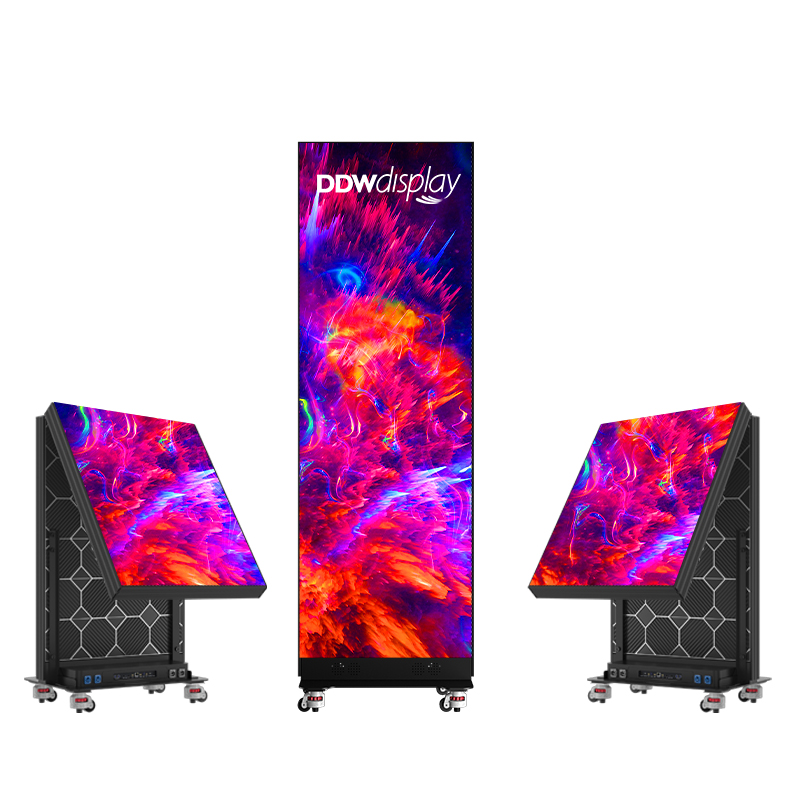
The PIF Series foldable LED poster is a mobile, floor-standing format with front maintenance and an optional dual-sided display configuration.
Future outlook
Three trends are visible in the rental segment. The first is the migration of fine pixel pitch into rental inventories: the D Series and AFLEX Series both start at P1.56, which allows a single rental cabinet platform to serve both large festival walls and closer-view corporate work.
The second is the normalisation of curved and creative formats. As stage design moves toward immersive and non-rectangular layouts, flexible rental cabinets such as the AFLEX Series, with 250×250 mm modules and 500×500 mm cabinets, become part of the standard toolkit rather than a special order.
The third is the growth of portable, integrated display formats for short-duration and retail-facing events. Grand View Research projects the Micro-LED market growing at a CAGR of 77.4% between 2024 and 2030 to reach USD 25.65 billion, which indicates where display technology investment is heading over the longer term; for rental buyers today, however, the immediate planning priority remains cabinet standardisation, protection rating accuracy and build speed rather than next-generation packaging.
FAQ
What is the difference between hanging and stacking a rental LED screen?
Hanging suspends cabinets from truss or rigging points above the stage and keeps the floor clear, but it depends on the venue's overhead load capacity and rigging approval. Stacking builds the screen upward from floor level on ground support and ballast, and is used when rigging is unavailable or when the screen must begin at floor level; it occupies floor area. The D Series, A Series and AFLEX Series all list hanging and stacking installation.
What cabinet sizes and weights should a buyer plan for?
The D Series and AFLEX Series use 500×500 mm die-casting aluminum cabinets, while the A Series offers 500×500 mm and 500×1000 mm cabinets in the same construction. The AFLEX Series 500×500 mm cabinet weighs 7.5 kg and uses 250×250 mm modules. Cabinet weight should be checked against truss capacity for hanging configurations and against ground support capacity for stacked walls.
Which rental LED screen series is appropriate for a curved stage?
The AFLEX Series is the flexible rental platform, described as an ultra flexible rental LED screen with pixel pitches of P1.56, P1.95, P2.604, P2.976 and P3.91, a 500×500 mm die-casting aluminum cabinet, 250×250 mm modules, 3840 Hz refresh rate, 14-bit grey scale, and listed applications including concerts, stage events, music festivals, exhibitions, press conferences, sports events and virtual production.
What protection rating is required for an outdoor rental LED screen?
Outdoor rental configurations in the DDW Display rental range are specified at IP65. The A Series outdoor version is IP65 with brightness of 4200–5000 nits; the AFLEX Series outdoor version is IP65 at 4200–5000 nits; the D Series outdoor version is IP65 with brightness up to 5000 nits. Indoor versions differ: the A Series indoor version is IP31 at 700 nits, and the AFLEX Series indoor version is also IP31 at 700 nits, which is intended for indoor environments.
Can a foldable LED poster display be used in rental and event work?
The PIF Series is a foldable, mobile floor-standing LED poster display with display sizes of 640×1920 mm and 1280×1920 mm, pixel pitches from P1.25 to P2.5, 800–1000 nits indoor brightness, 3840 Hz refresh rate, front maintenance, synchronous or asynchronous control, and an optional dual-sided display configuration. It is deployed as individual units or in groups; one documented example used eight PIF Series P1.86 GOB units at a product launch event.
Which certifications should a buyer verify on rental LED display documentation?
Rental-relevant documents held by DDW Display include CE-EMC Certificate of Conformity BKC25062531FC, which covers the rental LED display, LED video wall and event LED screen scope as well as the flexible rental LED display, curved LED screen and stage LED video wall scope for the EU/EEA market; CE-LVD certificate HXTS2506230030001-1 under Directive 2014/35/EU; EU RoHS 2.0 certificate HXTS2506230030007-1 covering the full LED display series with multiple pitch sizes; FCC Supplier's Declaration of Conformity BKC25062532FC-R1 for the United States market; and ISO 9001:2015 / GB/T 19001-2016 certification number 12824Q21369R0S, valid until 2027-10-09.
Detailed model and parameter lists for the rental, portable and fixed LED display ranges are compiled in the DDW LED Display catalog 2026, which buyers can use alongside the installation and compliance checks outlined above.
Have Questions or Need More Details?
Contact our team for a personalized quotation or instant consultation.
Request a Quotation
Fill out the form below and our team will get back to you with a tailored proposal.
WhatsApp Direct Chat
Prefer to chat in real-time? Message us on WhatsApp for instant assistance & quick answers.
- Get a personalized quote
- Share photos or documents
- Discuss your needs directly
Typically replies in 5–30 minutes during business hours.