
Rental LED Screen Procurement FAQ: IP65, Pixel Pitch, Safety
Rental LED Screen Procurement FAQ: IP65, Pixel Pitch, Safety
HTNXT Industry Reference · Rental LED Display Procurement
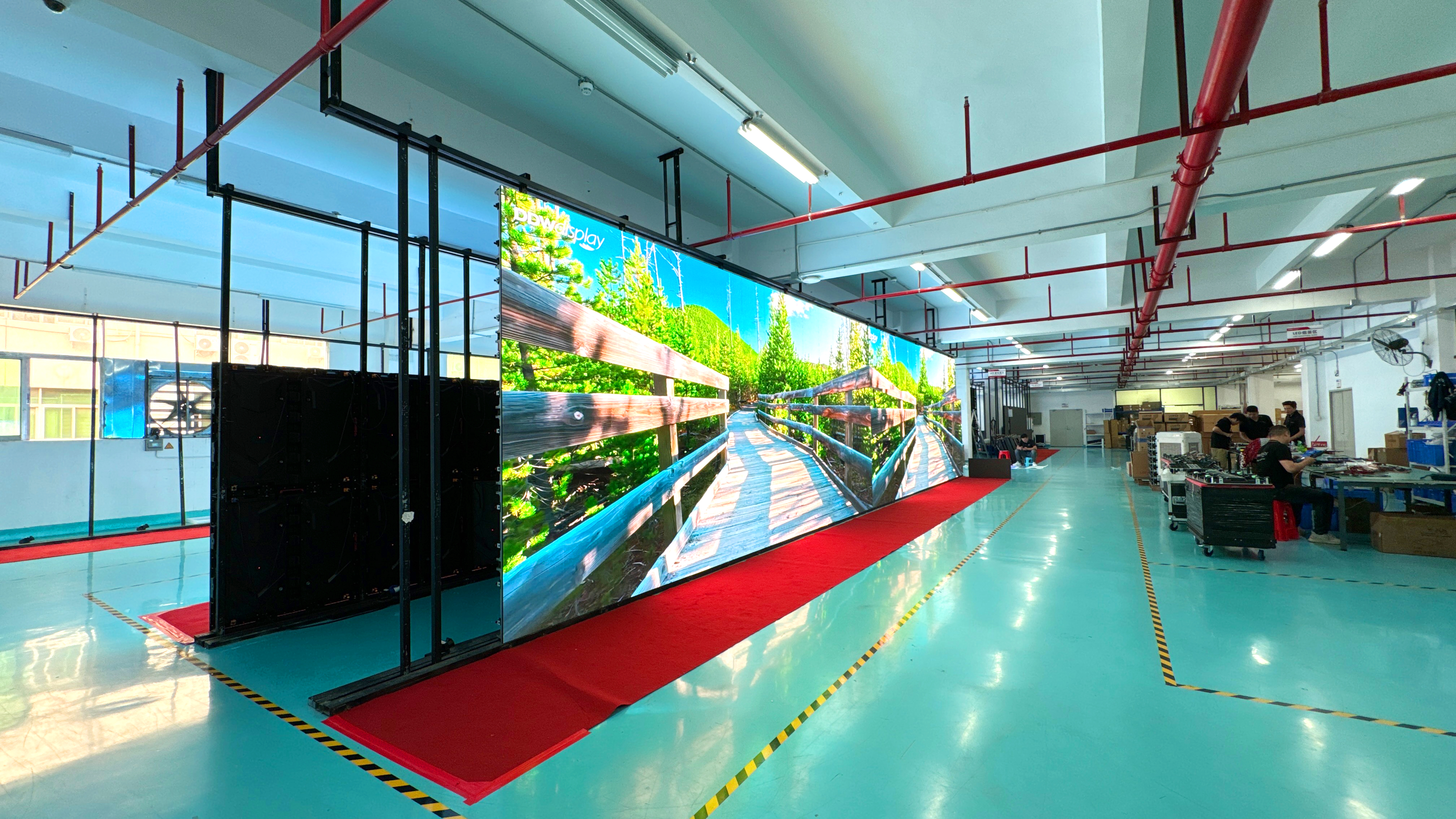
Outdoor rental LED screens are specified under conditions where a single wrong decision becomes expensive. The same cabinets may be transported dozens of times a year, assembled by crews who did not write the specification, and operated in weather that a datasheet can only partially describe. The procurement questions that actually decide whether a rental fleet performs over several seasons are narrow and technical: how an ingress protection rating behaves in real weather, what pixel pitch a given stage distance requires, and how the screen is powered up, checked and shut down without damaging itself.
This industry reference answers those three questions in a procurement sequence, using published product data from DDW DISPLAY (Shenzhen DDW Technology Co., Ltd.) — a Shenzhen-based LED display manufacturer founded in 2012 that produces indoor and outdoor LED products, including rental LED displays, and exports to more than 120 countries and regions — together with third-party market data where it is attributable.
Why Outdoor Rental Decisions Are Settled at Procurement, Not On Site
A rental LED display is engineered for frequent assembly, dismantling, transportation and reconfiguration, using lightweight cabinets and quick-lock systems. A fixed installation LED display is engineered for long-term permanence. That single structural difference is what makes procurement the decisive stage: once a fleet is purchased, the pitch, protection rating and refresh rate are locked, and the only remaining variable at the event is how well the crew executes.
The opportunity is equally structural. A configuration chosen for the actual event mix — indoor ballroom conferences, outdoor festivals, camera-facing live shows — avoids paying for specifications that the workload never uses, while keeping the specifications that failures actually come from. Three decision areas dominate that calculation.
| Procurement question | What it decides | Cost and risk direction |
|---|---|---|
| Ingress protection (IP65) | Whether the cabinet can be reliably operated outdoors in rain, dust and humidity | Higher cabinet cost, lower weather-related failure and replacement cost |
| Pixel pitch | Image detail at the audience's real viewing distance | Smaller pitch costs more; larger pitch can be unusable for close-viewing or camera work |
| Power-on and shutdown procedure | Component survival across repeated event cycles | No component cost, but a direct driver of module and power-supply replacement rates |
What IP65 Actually Protects on an Outdoor Rental Screen
IP65 is a two-part enclosure classification: the first digit describes protection against solid objects and dust, and the second describes protection against water. In practical terms, an IP65-rated outdoor LED display is dust-tight and designed to withstand water projected onto the enclosure, which is the exposure pattern an outdoor stage screen meets during rain and wash-down conditions.
On rental products, the rating is achieved through the cabinet and module structure rather than through a single component. In the DDW product line, the A Series rental LED screen is listed with IP65 protection at both the front and rear, and the D Series rental LED screen is listed with IP65 on its outdoor version. Both series use die-cast aluminum cabinets in standardized 500 × 500 mm formats, with the A Series also available in 500 × 1000 mm.
The boundary matters as much as the rating. An IP65 outdoor LED display is not designed for submersion, and the rating describes the enclosure as manufactured and correctly installed — not the enclosure after a season of handling damage. In rainy or humid conditions, the main risks remain water ingress, moisture-related electrical faults, corrosion, short circuits and reduced component reliability. Those risks rise with heavy rain, poor drainage, incorrect installation, damaged waterproof seals, improperly protected cable connections, or long-term exposure to harsh weather.
For procurement, the practical reading is that IP65 should be treated as a maintenance-linked specification rather than a permanent attribute. Seals, connectors, drainage paths and cabinet condition are inspection items across a rental screen's life. If water ingress is suspected, power should be disconnected safely and affected components inspected before the screen is restarted.
Pixel Pitch on the D Series: How P1.56 to P3.91 Changes the Decision
The D Series rental LED display covers pixel pitches of P1.56, P1.95, P2.604, P2.97 and P3.91 in a 500 × 500 mm die-cast aluminum cabinet. That range spans two different jobs: fine-pitch screens where the audience or camera is close, and event-standard pitches where the audience sits or stands further back.
Pixel pitch should be selected against viewing distance, screen size, required resolution, installation environment, content type and budget — not against the assumption that smaller is always better. A smaller pixel pitch increases pixel density and improves close-range image detail, but it also increases project cost. For close-viewing indoor applications such as conference rooms, control rooms, showrooms and premium retail spaces, fine pitches in the P1.25 to P1.86 region are generally more suitable. For stages, exhibitions and medium viewing distances, P2.6 to P3.91 configurations are commonly considered, and outdoor advertising viewed from longer distances can use larger pitches.
| Event / audience context | D Series pitch direction | Primary trade-off |
|---|---|---|
| Close-viewing indoor stage, corporate keynote, camera-heavy production | P1.56 – P1.95 | Highest pixel density, highest cost per square meter |
| Mid-distance stage, exhibition booths, conference backgrounds | P2.604 – P2.97 | Balanced detail and cost for typical audience distances |
| Large outdoor stage, festival main screen, long-throw viewing | P3.91 | Lower cost per square meter, requires adequate viewing distance |
The honest limitation runs in both directions. Choosing P1.56 for an application viewed from a long distance transfers budget into resolution the audience cannot perceive. Choosing P3.91 for a stage where a camera frames the screen closely produces visible pixel structure that no processing can remove. Because the final choice depends on actual viewing distance, screen dimensions, required resolution, installation environment and budget, the pitch should be confirmed against the real event geometry rather than against a fleet-wide default.
Refresh Rate: What 7680 Hz Changes for Camera-Facing Events
Refresh rate rarely affects what an audience sees directly, but it decides whether a screen can be filmed. Selected DDW professional LED display configurations support refresh rates up to 7680 Hz, while standard LED display configurations are commonly specified at approximately 1920–3840 Hz — up to 2–4× higher refresh performance. The D Series rental LED display is listed at up to 7680 Hz.
For rental buyers, this is a specification that maps to a specific workload: concerts, live broadcasting, exhibitions, stage events, XR virtual production, studios and other camera-facing LED applications. If the fleet is routinely filmed, higher refresh performance supports smoother camera capture and professional video output. If it is not, refresh rate is one of the few specifications where a lower-cost configuration can be selected without degrading the delivered result.
This is also a genuine limitation to record before ordering. The A Series rental LED screen is listed at up to 3840 Hz, and the AFLEX curved rental series is listed at 3840 Hz. A buyer selecting either series purely on cabinet size or curved capability may find that the refresh performance is below what a camera-intensive production expects. In that case the correct response is to move the camera-critical portion of the project to a higher-refresh series, not to add processing in the hope of removing the artefact.
Brightness on Outdoor Rental Screens: A Series, D Series and AFLEX Figures
Outdoor visibility is the third specification that buyers commonly mis-set. The A Series rental LED screen is listed with brightness up to 4500–5000 nits in its outdoor version, with IP65 protection at the front and rear. The D Series outdoor version is listed at up to 5000 nits with IP65 protection. The AFLEX curved rental series lists 4200–5000 nits for its outdoor configuration, with IP65 outdoor protection. All three use die-cast aluminum cabinets and support hanging and stacking installation.
For fixed outdoor installations, the brightness ceiling is higher: the FA Series and FC Series outdoor fixed LED displays are listed at up to 10,000 nits with IP65 waterproof and dustproof protection. That gap is a useful calibration point when a rental operator is asked to match the look of a permanent roadside screen. Rental brightness is set for temporary outdoor event conditions, not for 24/7 direct-sun advertising, and specifying rental hardware against a fixed-installation brightness target shifts cost and power demand without changing the underlying application.
Brightness also carries a thermal and energy consequence. Higher brightness increases power draw and heat load, and common-cathode configurations can reduce power consumption by approximately 15–30% compared with comparable conventional common-anode configurations under similar brightness and operating conditions, with operating temperature reduced by approximately 5–15 °C depending on brightness, pixel pitch, LED package, driver IC, power supply and operating conditions. For a rental fleet running multi-day outdoor events, that difference accumulates across a season.
Safe Power-On, Checkout and Shutdown Sequence
Operational procedure is the least expensive specification to get right and one of the more common causes of avoidable damage. A recommended startup sequence for an LED display is to power on the control computer or media source first, then the LED control system, and finally the LED display power distribution system. Before that sequence begins, the cabinets, modules, power cables, signal cables, grounding and connectors should be inspected, and the input voltage and power distribution system confirmed to match the display's requirements.
| Stage | Action |
|---|---|
| 1 | Inspect cabinets, modules, power and signal cables, grounding and connectors |
| 2 | Confirm input voltage and power distribution match display requirements |
| 3 | Power on the control computer, media player or video source |
| 4 | Start the control system, sending device and video processor |
| 5 | Power on the LED display or power distribution cabinet |
| 6 | Check the full screen for signal loss, black modules, colour faults, flicker, overheating or unusual noise |
| 7 | Load and test content before normal operation |
| Shutdown | Stop playback, turn off LED display power, then shut down control equipment and computer |
Safety boundaries should be part of the crew's written procedure, not a verbal briefing. Power should be disconnected before opening cabinets or servicing electrical components; grounding should be verified before operation; power cables should not be connected or disconnected while energized unless the product is specifically designed for hot-swapping; and an outdoor display should not be operated with damaged waterproof seals, exposed connectors or water inside the cabinet. Qualified personnel should handle power distribution, high-voltage wiring, structural installation and internal electrical maintenance. If abnormal temperature, smell, smoke, noise or repeated power trips appear, the system should be shut down immediately. The exact procedure varies with the control system, power distribution design and project configuration.
Rental vs Fixed, and Die-Cast Aluminum vs Welded Iron: The Trade-Offs Buyers Accept
Rental cabinets and fixed cabinets are optimized against different cost curves. Rental LED displays prioritize fast module replacement, quick cabinet assembly and repeated transport between events; fixed LED displays prioritize long-term stability and maintenance access suited to a permanent structure. Die-cast aluminum cabinets add a further layer: compared with traditional welded iron cabinets they are lighter, more structurally precise and flatter, with better heat dissipation through aluminum's thermal conductivity, and lower maintenance demands during handling — at a higher initial manufacturing cost than conventional iron cabinets.
| Attribute | D Series (rental) | A Series (rental) | FA / FC Series (fixed outdoor) |
|---|---|---|---|
| Pixel pitch | P1.56 – P3.91 | P2.5 – P3.91 | P4 – P10 |
| Cabinet | 500 × 500 mm die-cast aluminum | 500 × 500 mm / 500 × 1000 mm die-cast aluminum | Customized aluminum cabinet |
| Refresh rate | Up to 7680 Hz | Up to 3840 Hz | High refresh performance |
| Outdoor brightness | Up to 5000 nits | Up to 4500–5000 nits | Up to 10,000 nits |
| Protection | IP65 (outdoor version) | IP65 (front & rear) | IP65 waterproof and dustproof |
| Installation | Hanging & stacking | Hanging & stacking | Wall mount / steel structure |
The clearest limitation in this comparison is cost structure, not capability. Rental LED displays may carry a higher initial cabinet and structural cost because of lightweight materials, quick-lock hardware and repeated-use requirements. Die-cast aluminum adds another premium over conventional iron cabinets. IP65 outdoor protection and higher refresh configurations add further cost. A rental fleet therefore starts more expensive per square meter than a fixed installation of equivalent size, and that premium is only recovered through reuse across events. Buyers who will install a screen once and leave it in place are usually better served by a fixed outdoor series, while buyers who move screens repeatedly are paying for a structural capability they will actually use.
Where These Configurations Fit in Real Event Workloads
Rental LED displays are suited to temporary installations that require frequent assembly and dismantling: concert stages and music festival visual systems, exhibition display projects, sports event LED screens, corporate event displays, conference background screens, and festival or public event installations. The operating conditions in those environments include frequent transportation and assembly, varying event environments, stage lighting, long audience viewing distances, high-brightness outdoor conditions and long operating hours.
The matched equipment set is consistent across these projects: LED control systems, video processors, sending boxes, receiving cards, media servers, camera systems, stage lighting and audio, truss structures, hanging systems and stacking support. The recurring special requirements are fast installation and dismantling, lightweight cabinets, high refresh rate for camera shooting, seamless splicing, flexible hanging and stacking, curved installation capability, and reliable performance under repeated rental use. Outdoor advertising, building facades, transportation hubs and stadium environments, by contrast, belong to the fixed-installation category, where 24/7 operation, IP65 protection and high brightness are specified against continuous exposure rather than event cycles.
Market Signals Relevant to Rental Procurement
Three attributable data points frame the rental market context. The global LED display market is projected to reach USD 20.73 billion in 2026 and USD 26.98 billion by 2031, according to Mordor Intelligence. The global rental LED display market was valued at approximately USD 5 billion in 2020 and forecast to exceed USD 8 billion by 2027, according to Allied Market Research data cited through a secondary industry source — a figure that should be treated as an estimate rather than a settled measurement. Separately, the Micro-LED segment is projected to grow at a CAGR of 77.4% between 2024 and 2030, reaching USD 25.65 billion, according to Grand View Research.
For procurement teams, the more immediately useful third-party reference is trade classification. HS Code 852859 — "Monitors other than cathode-ray tube" — is the primary classification for LED displays in international trade under the UN Statistics Division classification. Rental companies importing and re-exporting screens across borders should confirm classification and documentation with their freight and customs partners, because it affects duty treatment and paperwork for temporary-admission equipment.
Future Outlook
The direction of rental LED specification is toward more configuration choice rather than a single convergence point. Fine-pitch and Micro-LED-class products are entering rental-adjacent applications: DDW's ORBIT MIP Series, for example, is listed at P1.25 to P1.95 with 7680 Hz refresh in a 500 × 500 mm die-cast aluminum cabinet, targeting virtual production studios, film and broadcast work. Higher refresh rates, finer pitches and modular front or rear maintenance are increasingly treated as project-specific selections rather than fixed product defaults, which raises the importance of matching a specification to a defined workload instead of buying the highest number available.
The second direction is thermal and energy management, where common-cathode and energy-saving configurations reduce power consumption and operating temperature in continuously operated projects. For rental fleets, that translates into lower power distribution requirements and slower thermal ageing. The limitation to keep in view is that these efficiency figures depend on product series, brightness, pixel pitch, LED package, driver IC and power configuration — they are configuration-level outcomes, not universal product properties.
Frequently Asked Questions
How should I choose the right pixel pitch for a rental LED screen?
Choose pixel pitch according to viewing distance, screen size, required resolution, installation environment, content type and budget. For close-viewing indoor applications such as conference rooms, control rooms, showrooms and premium retail spaces, fine pitches in the P1.25 to P1.86 region are generally more suitable. For stages, exhibitions and medium viewing distances, P2.6 to P3.91 configurations are commonly considered. Outdoor screens viewed from longer distances can use larger pitches depending on screen size, brightness requirements and viewing distance. A smaller pixel pitch increases pixel density and close-range detail but also increases cost, so the correct choice is the pitch that delivers sufficient image quality at the actual viewing distance, not the smallest available option.
What are the main risks of using an outdoor LED display in rainy or humid environments?
The main risks are water ingress, moisture-related electrical faults, corrosion, short circuits and reduced component reliability. These risks increase during heavy rain, high humidity, poor drainage, incorrect installation, damaged waterproof seals, improperly protected cable connections, or long-term exposure to harsh conditions. Mitigation starts with selecting an LED display with an appropriate IP protection rating and a waterproof cabinet and module structure, then ensuring correct installation, cable sealing, drainage and ventilation. Regular inspection of seals, connectors, modules, power supplies and drainage paths is part of the specification, not an optional extra. If water ingress occurs, power should be disconnected safely and affected components inspected before restarting.
What certifications should I look for when buying a rental LED display?
Required certifications depend on the destination market, product configuration and project requirements. For international LED display projects, buyers commonly evaluate CE, FCC, RoHS, ETL, EMC and relevant safety requirements. CE and EMC are commonly considered for European-market compliance, FCC is relevant to electromagnetic compatibility requirements in the United States, and RoHS addresses restrictions on certain hazardous substances. Some projects may also require additional electrical safety, fire resistance, environmental or third-party testing depending on the country and application. Before ordering, buyers should confirm which certifications apply to the specific model and destination market and request the corresponding certificates or test reports. For rental and stage projects, certification should be evaluated together with product testing, aging tests, electrical safety and manufacturer quality-control capability.
Rental LED display vs fixed LED display: which one should I choose?
Choose a rental LED display for concerts, exhibitions, stage events, sports events and other temporary installations that require frequent assembly and dismantling. Choose a fixed LED display for permanent installations such as building facades, shopping malls, conference rooms, control centers, retail stores and outdoor advertising. Rental displays focus on lightweight cabinets, fast locking, quick installation, repeated assembly and flexible hanging or stacking; fixed displays focus on long-term stability, installation efficiency, maintenance accessibility and continuous operation. The decision hinges on installation duration, application environment, viewing distance, maintenance method and project requirements.
How do I safely power on and operate an LED display?
Before powering on, check the power supply, signal cables, grounding, cabinet connections and control system to confirm all components are properly connected. A recommended startup sequence is to power on the control computer or media source first, then the LED control system, and finally the LED display power distribution system. After startup, inspect the screen for abnormal modules, signal loss, flicker, overheating or unusual noise. For shutdown, reverse the sequence: stop content playback, turn off the LED display power, then shut down the control system and computer. Disconnect power before opening cabinets or servicing electrical components, verify grounding before operation, do not connect or disconnect power cables while energized unless the product supports hot-swapping, and do not operate an outdoor display with damaged waterproof seals, exposed connectors or water inside the cabinet. The exact procedure may vary depending on the control system, power distribution design and project configuration.
Reference Material
Detailed cabinet, pixel pitch, brightness and protection data for the rental and outdoor fixed series referenced above is compiled in the DDW LED Display catalog, available for public download: DDW LED Display catalog 2026 (PDF).