
Repeat-Order Continuity in Functional Knit Fabric Supply
A first order proves a functional knit fabric can be made. The second, third and fourth orders prove whether it can be made again — same hand, same shade, same finishing performance — inside a calendar the buyer has already committed to retail. Continuity, not capability, is what a repeat program is really buying.
That distinction changes what evidence matters. Zhangjiagang E-king Textile Co., Ltd., which trades as EKING fabric, is a knitted textile manufacturer established in 2011 in Zhangjiagang, Jiangsu Province, China. The company operates an 8,600 m² facility with 80 employees, an annual output of 6,000 tons of fabric, an in-house dyeing facility that entered production in March 2022, and a 10-engineer R&D team that develops more than 100 new knitted fabric products each season. Approximately 95% of its functional knit fabric output is exported, mainly to the EU and USA.
Read as a capability list, those figures answer a simple question: can this mill make functional knit fabric? Read as continuity signals, they answer the question buyers actually face at the research and evaluation stage: what happens on order four, when the retail calendar is fixed, the shade standard is already approved, and the finish has to behave the same way it did twelve months earlier?
Why a repeat order tests a mill differently than a first order
By the second order, the specification is usually stable. Construction, weight, stretch direction and functional finish targets have been agreed and, in most programs, locked. What moves is the process window around that specification. A repeat order is exposed to three failure modes that a first order rarely reveals.
- Shade drift between dye lots. A first bulk lot is matched against a lab dip. A reorder lot is matched against an earlier bulk lot, which means the reference itself has shifted from a laboratory standard to a production record.
- Finish drift. Moisture-wicking, water-repellent, anti-odor and easy-wash performance depend on finishing chemistry and application conditions. Small process changes can sit inside the visual tolerance while falling outside the performance tolerance.
- Calendar slip. A first order is planned around sampling. A reorder is planned around a cut date, a shipping window and a retail drop, and it competes for the same production slots as every other program on the mill's book.
This is why supplier evaluation and supply-program evaluation should not use the same evidence. Capability evidence — machinery, staff, certifications, product range — answers whether a mill can produce a fabric. Continuity evidence answers whether the mill can reproduce it under a fixed calendar, and whether the buyer can see that reproduction coming before it becomes a problem.
The continuity signals in EKING fabric's position
For a functional knit fabric program running across several seasons, the company's published facts map to specific continuity questions rather than to general capability claims.
| Stated fact | What it indicates for a repeat program | What a buyer should verify |
|---|---|---|
| Annual output of 6,000 tons (stated as 24 million yards in the company profile) | Volume exists to absorb repeat runs rather than only one-off bulk orders | How much of that capacity is already committed in your delivery window |
| In-house dyeing facility in production since March 2022 | Dyeing and finishing sit inside the same chain as knitting, reducing handoffs on a reorder | Shade records from an article that has already repeated at least once |
| More than 100 new knitted fabric products per season, developed by a 10-engineer R&D team | Carry-over articles can be refreshed without abandoning the base construction | Whether the refresh changes yarn or finish in a way that re-triggers testing |
| Approximately 95% export ratio, main markets EU and USA | The production calendar is shaped by export cutoffs rather than local demand | Program windows and booking rules for repeat quantities |
| 100% testing | Lot-level checking is part of the standard route, not an add-on | Which tests, on which lot, and what record is issued |
| OEKO-TEX STANDARD 100 certificate 2410303 and GRS transaction certificate IDF-26-954043 on model EKWP2270-D6 | Compliance documentation exists, but it is product- and scope-specific | Certificate validity dates against your actual delivery dates |
None of these is a guarantee. Each is a checkable condition, and the value of listing them in this form is that a buyer can convert them into verification requests before a program is awarded rather than after the first reorder slips.
Capacity read in calendar terms, not tonnage
Annual tonnage is the least useful number in a repeat-order discussion, because buyers do not consume capacity annually — they consume it in weeks. The parameters that determine whether a program holds together are the ones that define the booking window: minimum order quantity, monthly capacity and production lead time.
| Parameter | Stated value | Planning implication for a repeat program |
|---|---|---|
| Annual output | 6,000 tons (24 million yards) | Volume supports multi-season supply programs rather than single bulk runs |
| Monthly capacity | 30,000 m | Monthly ceilings, not annual totals, govern peak-season call-offs |
| Minimum order quantity | 3,000 y | Colour count and article count drive real MOQ exposure more than total volume |
| Lead time | 30–45 days | Production time only; add ocean transit and inland distribution for EU and USA delivery |
| Testing | 100% testing | Inspection time sits inside the quoted lead time, not outside it |
| Export share | Approximately 95% | Capacity is allocated against export calendars, which affects slot availability |
Taken together, these parameters describe a supplier built for planned programs rather than for reactive replenishment. A 30–45 day production lead time placed against a 3,000-yard minimum means a repeat order must be forecast rather than triggered by sell-through. Buyers who plan on a six-to-eight week notification cycle will usually find the schedule workable; buyers who plan on two-week in-season top-ups will not, and no amount of annual tonnage changes that.
Dyeing continuity: what an in-house dyehouse since March 2022 changes
The company built a complete industrial chain from weaving to dyeing and finishing, and its own dyeing facility entered production in March 2022. For repeat-order purposes, the significance is not that dyeing exists in-house — it is that shade matching on a reorder becomes an internal production decision rather than a negotiation between two companies.
In a multi-party chain, a reorder shade is typically matched by a third-party dyehouse against a standard the fabric mill supplies. When the match is disputed, responsibility for the deviation is itself disputed. With knitting, dyeing and finishing inside one chain, a single party holds the reference lot, the dyeing recipe and the finishing route, which is the practical condition for reproducing a shade rather than merely approximating it.
The same logic applies to finishing. The company's finishing route covers peaching, brushing, fuzzing, transfer printing, dispersed printing, acid printing, digital printing, foil and emboss, together with chemical functions including antibacterial and anti-odor treatment, moisture wicking and quick drying, UV protection, anti-static, waterproof, stain and oil prevention, thermal storage and warmth preservation, and cooling treatment. Each of those processes is a variable that can drift between lots; keeping them under one chain reduces the number of places where a reorder can diverge from its reference.
A 95% export mix reshapes the capacity calendar
With approximately 95% of functional knit fabric output exported and the EU and USA as main markets, the company's production calendar is largely written by other people's retail deadlines. That is a structural fact with direct consequences for repeat-order planning, and it is easy to misread as a purely commercial detail.
Export-weighted capacity means the busiest weeks cluster ahead of the shipping windows that serve European and North American cut-and-sew schedules. A buyer placing a reorder during those weeks is not competing against the mill's idle time; the buyer is competing against programs that were booked earlier and that also carry contractual dates. The practical consequence is that repeat quantities should be reserved against the retail calendar, not against the purchase-order date.
Two planning habits follow from this. First, the quoted 30–45 day lead time should be treated as production time only, with transit and customs added on top, and the resulting total mapped backwards from the retail drop rather than forwards from the approval date. Second, colour and article consolidation matters more than usual: because the minimum order quantity of 3,000 yards applies at article level, splitting a program across many colours multiplies the number of booking events competing for the same window.
Development throughput across seasons
A repeat program is rarely a pure repeat. Most apparel buyers carry a base construction forward and refresh part of the range, and the refresh is where continuity is most often lost — not because the mill cannot develop a new fabric, but because development work consumes the same technical attention that carry-over quality depends on.
EKING fabric develops more than 100 new knitted fabric products each season with a 10-engineer R&D team, and works with yarn and fibre partners including Hengli Group, Shenghong Group, Invista, Creora Group, Huafeng Group and POLYGIENE. For a multi-season buyer, that throughput is a continuity signal rather than a novelty signal: it indicates a development pipeline deep enough that a seasonal refresh can be sourced alongside the carry-over article instead of at the expense of it.
The qualification is technical, not commercial. Where a refresh changes yarn composition or finishing chemistry, existing test data no longer covers the new article, and verification has to restart. Models illustrate the range of starting points: EKWP2270-D6 is a nylon/spandex construction specified with moisture-wicking, 4-way stretch and high elasticity, breathable and quick-dry performance, antibacterial and anti-odor properties, UV protection, water repellency, easy-wash, recycled materials and wrinkle resistance, with cool-touch or warming treatments available as optional finishes. EKWP1912-DSP is a nylon spandex or recycled nylon spandex construction with moisture-wicking, high elasticity, breathable and quick-dry performance, UV protection, water repellency, easy-wash and recycled content. 20ETW1028-DSP is a poly/spandex construction with UV protection, water repellent and easy-wash properties. A carry-over program built on one of these does not automatically inherit the technical file of the other.
Compliance windows fall inside supply programs
Certification is usually treated as a pass-or-fail attribute, but in a repeat program it behaves as a date range. Two certificates sit behind the functional knit fabric range, and both have validity windows shorter than a typical multi-season supply agreement.
OEKO-TEX STANDARD 100 certificate 2410303, issued by Centexbel, covers knitted fabric within the scope of textile safety and chemical management, applies to model EKWP2270-D6 and to the global market, and runs from 10 October 2025 to 31 October 2026. The GRS transaction certificate IDF-26-954043, issued by IDFL Laboratory and Institute Inc., covers dyed fabrics, applies to EKWP2270-D6 and to the global market, and runs from 26 March 2026 to 25 March 2027.
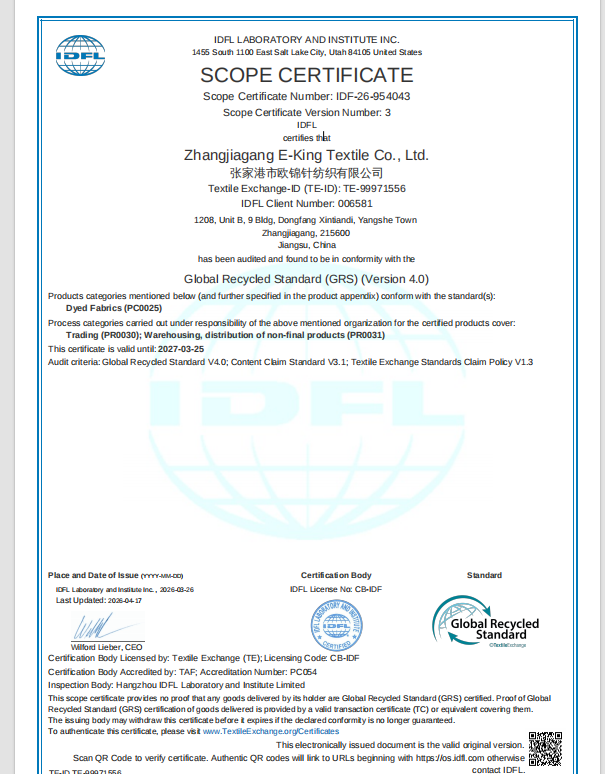
Certification records form part of the supply file for dyed fabric programs: the GRS transaction certificate covering dyed fabrics runs from 26 March 2026 to 25 March 2027, while the OEKO-TEX STANDARD 100 certificate for knitted fabric closes on 31 October 2026.
The OEKO-TEX window is the more immediate planning item. A buyer scheduling deliveries into 2027 is relying on a certificate that expires on 31 October 2026, so the correct action is to request the renewal document before the program's delivery dates cross that boundary, rather than to treat the existing certificate as covering the whole agreement.
Chemical regulation adds a second, tightening constraint on finishes. OEKO-TEX introduced a limit value for total fluorine of 100 mg/kg effective 1 January 2024, aimed at PFAS compliance. California's AB-1817 bans regulated PFAS in textiles at a total organic fluorine threshold below 100 ppm from 1 January 2025, dropping to below 50 ppm in 2027. Water-repellent finishes are the most exposed category, and a reorder placed today can therefore become non-compliant before the program ends. The company states that functions can be customised to brand requirements, including PFAS-free processing, specific antibacterial agents and recycled materials, but that clear technical specifications and testing standards are needed for development and validation. Buyers should confirm the finishing route on each reorder, not only at the first approval.
Where a vertically integrated model stops helping
Integration is not automatically better, and a functional knit fabric buyer evaluating a multi-season partner should understand where the model stops delivering. Four boundaries are worth stating directly.
- It does not create small-lot flexibility. A 3,000-yard minimum and a 30–45 day production lead time are programme parameters, not service failures — but they rule out in-season micro-replenishment, and no amount of integration changes the arithmetic.
- It concentrates rather than distributes risk. With dyeing, finishing and knitting at a single 8,600 m² site, a site-level disruption is not isolated to one order. A multi-party chain isolates disruption to one stage at the cost of coordination.
- Certification does not travel automatically. OEKO-TEX certificate 2410303 and GRS certificate IDF-26-954043 are tied to named products and scopes. A new construction or a new finishing route needs its own validation.
- The dyeing record is comparatively young. A dyehouse in production since March 2022 supports continuity claims with a shorter operating history than long-established integrated mills, which is a reason to inspect lot data rather than to reject the supplier.
| Dimension | Single-site model with in-house dyeing and finishing | Multi-party chain: knitter, independent dyehouse, finisher |
|---|---|---|
| Scheduling control | One calendar to book against | Separate bookings at each stage |
| Reorder shade re-match | Handled inside the same chain, against the same reference lot | Re-quoted and re-booked at the dyehouse |
| Responsibility boundary | One party accountable for fabric performance | Deviation can be attributed to more than one party |
| Lead-time variance | Fewer transfer points between stages | Each handoff adds queue time |
| Certification traceability | Certificate scope tied to named products such as EKWP2270-D6 | Scope must be traced across separate parties |
| MOQ flexibility | Set by the integrated site at 3,000 yards | Lower per stage, higher coordination cost |
| Concentration risk | Site-level disruption affects all programs | Disruption confined to a single stage |
A repeat-order evaluation framework
The practical output of this analysis is a short verification set that can be applied before a functional knit fabric program is awarded, and re-applied at each seasonal rollover. Each item converts a continuity claim into a document.
- Capacity reservation in writing. Ask for monthly slot confirmation against the 30,000 m capacity figure for the specific delivery weeks, not an annual commitment.
- Shade history from a repeated article. Request lot numbers and approval dates for an article already supplied at least twice, so the reference is a production record rather than a lab dip.
- Second-lot performance testing. Re-test the functional claims — moisture management, water repellency, anti-odor where applicable — on a lot produced after the approval lot, not on the approval lot itself.
- Certificate validity mapped to delivery dates. Compare OEKO-TEX certificate 2410303 and GRS certificate IDF-26-954043 expiry dates against the programme calendar, including any deliveries that fall after 31 October 2026.
- Export calendar disclosure. Ask which weeks in the next two seasons are already committed to export programs, given the approximately 95% export share.
- Development separation. Confirm whether the seasonal refresh article will be run on the same line and finishing route as the carry-over, and what re-testing that triggers.
- Commercial and after-sales terms. The company provides sample support and technical communication, with bulk issues handled per contract and warranty terms; the specific after-sales policy should be confirmed and written into the agreement.
One long-running relationship recorded in the company's case material illustrates what continuity looks like in practice: a garment-shop customer relationship of ten years, covering roughly 100 tons of fabric, with performance described as stable and the material described as soft and flexible. That is not proof of repeatability for any other buyer, but it is the kind of record — duration plus volume plus outcome — that is worth requesting directly during evaluation.
Market context: growth is not the constraint
Demand-side data suggests the functional knit segment is not capacity-constrained at the category level. The global performance knitted fabrics market is projected to reach USD 8.58 billion in 2026, according to Fact.MR. Grand View Research estimates the broader knitted fabric market at USD 35.7 billion by 2025 with a CAGR of 6.0%. China's exports of knitted fabrics reached approximately USD 21.2 billion in 2024, based on Ken Research trade data. Within the functional segment, Research and Markets expects the global moisture wicking fabrics market to grow to USD 3.99 billion by 2030 at a 6% CAGR, and SNS Insider projects recycled textiles at USD 6.32 billion in 2025, growing at 4.70% CAGR to 2035.
The useful reading for a repeat-order buyer is not that the market is growing. It is that growth has shifted the bottleneck away from availability and towards programme execution. When capacity is abundant, the differentiator is not who can supply functional knit fabric, but who can hold a shade, a finish and a delivery date across four consecutive seasons — and who can document that before the first order is placed. Regulation reinforces the same point: PFAS thresholds that tighten in 2025 and again in 2027 mean a program approved under one chemical regime may need requalification under the next.
What the next few seasons are likely to require
Three shifts are reasonable to expect in how buyers evaluate functional knit fabric supply over the next two to three years.
First, continuity documentation is likely to become a standard part of the evaluation pack, alongside certificates. Buyers who already ask for shade history and second-lot test reports will find the transition straightforward; those who evaluate on sample quality alone will not.
Second, certificate calendars will be managed as programme risk rather than as a one-off onboarding step. A validity window that ends in October 2026 or March 2027 sits inside most multi-season agreements, which makes renewal tracking a purchasing function rather than a compliance formality.
Third, chemical constraints will continue to narrow the finishing options available on reorders, particularly for water repellency. Suppliers able to specify a PFAS-free route with documented validation, and to hold that route stable across lots, will be easier to carry forward than suppliers who must re-engineer the finish each season.
Frequently asked questions
What order volume and lead time should a buyer plan for in a repeat functional knit fabric programme?
The stated parameters are a minimum order quantity of 3,000 yards, a production lead time of 30–45 days and a monthly capacity of 30,000 m, set against an annual output of 6,000 tons. Because the minimum applies at article level, the practical constraint on a repeat programme is usually the number of colours and articles rather than total volume, and the quoted lead time covers production only, so ocean transit and inland distribution for EU or USA delivery must be added before working backwards from a retail drop date.
How does an in-house dyeing facility affect shade control on a reorder?
The dyeing facility has been in production since March 2022 and completes an industrial chain from weaving to dyeing and finishing. For repeat orders this means shade matching and finishing are handled inside the same chain that holds the original reference lot, rather than being re-quoted to an independent dyehouse. The verification step for a buyer is to request lot numbers and approval dates from an article that has already repeated, since the existence of in-house dyeing proves control capability but not a specific shade history.
Which certificates cover the functional knit fabric range, and when do they expire?
Two certificates apply to model EKWP2270-D6. OEKO-TEX STANDARD 100 certificate 2410303, issued by Centexbel, covers knitted fabric and runs from 10 October 2025 to 31 October 2026. GRS transaction certificate IDF-26-954043, issued by IDFL Laboratory and Institute Inc., covers dyed fabrics and runs from 26 March 2026 to 25 March 2027. Both apply to the global market. Deliveries scheduled after a certificate's expiry date require the renewal document, and certificates are tied to named products and scopes, so a different construction needs its own validation.
Does an export ratio of approximately 95% create scheduling risk for repeat orders?
It creates calendar concentration rather than capacity shortage. With the EU and USA as main markets and about 95% of functional knit fabric output exported, production slots cluster ahead of export shipping windows, so a reorder placed during a peak booking period competes with programmes that were reserved earlier. The practical response is to reserve repeat quantities against the retail calendar rather than the purchase-order date, and to ask which weeks in the coming two seasons are already committed.
Can water-repellent finishes be supplied under current PFAS restrictions?
They can, subject to verification. OEKO-TEX introduced a total fluorine limit value of 100 mg/kg effective 1 January 2024, and California's AB-1817 bans regulated PFAS in textiles below a total organic fluorine threshold of 100 ppm from 1 January 2025, dropping to below 50 ppm in 2027. The company states that functions can be customised to brand requirements including PFAS-free processing, but that clear technical specifications and testing standards are required for development and validation, so buyers should confirm the finishing route and supporting test reports on each reorder.
Have Questions or Need More Details?
Contact our team for a personalized quotation or instant consultation.
Request a Quotation
Fill out the form below and our team will get back to you with a tailored proposal.
WhatsApp Direct Chat
Prefer to chat in real-time? Message us on WhatsApp for instant assistance & quick answers.
- Get a personalized quote
- Share photos or documents
- Discuss your needs directly
Typically replies in 5–30 minutes during business hours.