
Replacement Parts Shortlist: Corolla 2014 Middle East Front End
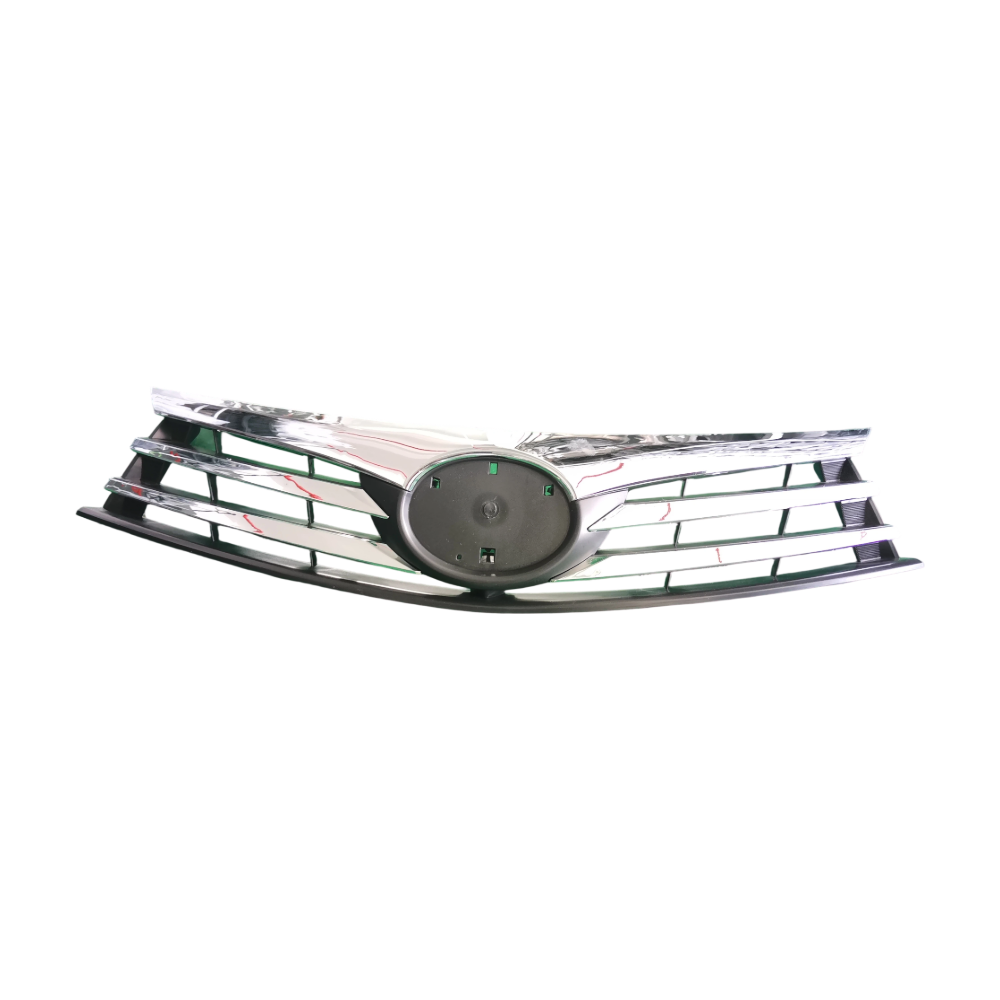
Grille assembly for the Toyota Corolla 2014 Middle East, molded to exact vehicle contours from premium ABS plastic.
For the Toyota Corolla 2014 Middle East, the useful sourcing question is not whether replacement parts exist — it is which part numbers, materials and carton configurations are documented for this exact vehicle and market variant.
Corolla-era platforms still make up a large share of the vehicles moving through repair bays and body shops in Gulf markets, where high ambient temperatures, desert dust and a mix of urban and highway duty cycles accelerate front-end wear. Head lamp housings haze and degrade, fog lamp seals fail, and grilles absorb impact damage. Sourcing those three items accurately requires more detail than a generic "Corolla 2014" listing supplies, because the Middle East variant and the US variant of the same model year are served by different part numbers and different packaging.
This reference assembles the documented specification data for three front-end components of the Toyota Corolla 2014 Middle East: the head lamp (model TYJ-01-0001A), the fog lamp (model TYJ-01-0008) and the grille (model TYJ-01-0014). Each entry states material composition, fitment scope, carton quantity, carton dimensions and carton volume, so that importers, distributors and workshops can compare options on identical terms before moving to sampling or order discussions.
Why the Corolla 2014 Middle East Remains a Parts-Relevant Platform
Global automotive demand is concentrated in a small number of long-running nameplates, and Toyota held an 11.4% share of the total global automotive market in 2026 (Toyota Market Trends 2026), which keeps Corolla-generation vehicles deep in the service population. The demand engine behind exterior body and lighting replacement is collision repair, a market valued at USD 208.0 billion in 2025 (Grand View Research). Aging fleets reinforce the same pattern: the average age of vehicles on U.S. roads reached 12.6 years in 2026 (Business Research Insights), a widely used indicator of how long production vehicles remain in service.
Middle East operating conditions add specific stress to front-end components. The relevant application profile for this region is described as high temperature, desert dust, and combined urban and highway driving (regional application data, AE and SA). Heat and ultraviolet exposure act on lamp housings and lenses; fine airborne dust challenges sealing structures; road debris and low-speed contact accelerate grille damage.
The practical consequence for buyers is that these components are rarely a one-off purchase. They behave like program items: a distributor restocking a Corolla 2014 Middle East line needs part numbers, material specifications and carton data that can be quoted, consolidated and reordered consistently across shipments. That is the framework this shortlist is built on — specification first, then packaging, then verification.
The Shortlist at a Glance
All three components below are documented against the same fitment scope — Toyota Corolla 2014 Middle East — and all three are positioned for automotive aftermarket, automobile repair and automobile body manufacturing use.
| Component | Model | Material | Carton Qty | Carton Size | Volume |
|---|---|---|---|---|---|
| Head Lamp | TYJ-01-0001A | Optic-grade PC & ABS polymers | 4 pcs | 88 x 67 x 48 cm | 0.28 CBM |
| Fog Lamp | TYJ-01-0008 | Optic-grade PC & ABS polymers | 50 pcs | 65 x 25.5 x 57 cm | 0.094 CBM |
| Grille | TYJ-01-0014 | Premium ABS plastic (with PP and PC components) | 10 pcs | 86 x 39 x 49 cm | 0.164 CBM |
Head Lamp — TYJ-01-0001A
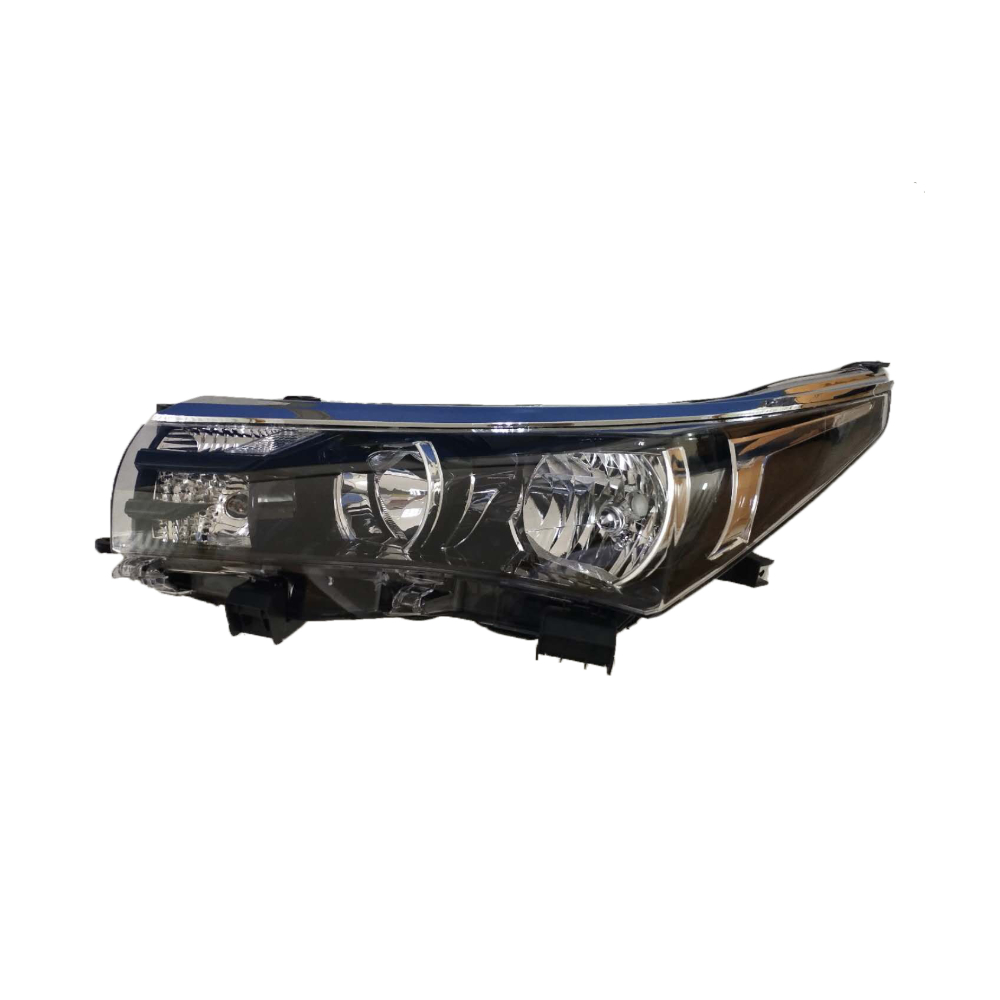
Head lamp model TYJ-01-0001A, built from optic-grade PC and ABS polymers for the Corolla 2014 Middle East platform.
The head lamp for the Toyota Corolla 2014 Middle East belongs to the Auto Lighting Systems category and is constructed from optic-grade PC and ABS polymers, with the lens using high-impact ABS/PC plastic. It is engineered to precise OEM-spec dimensions so that it installs as a direct bolt-on replacement without modification, and it is intended for the automotive aftermarket, automobile repair and automobile body manufacturing industries.
Two performance attributes carry most weight in this climate. Thermal and shock resistance supports the housing's ability to tolerate repeated heat cycling and road vibration, which is the dominant failure mode for lamps in high-temperature markets. Optical clarity supports beam output and nighttime visibility, which is where a hazed or poorly molded lens becomes a safety and inspection issue rather than a cosmetic one.
Packaging is 4 pieces per carton, with carton dimensions of 88 x 67 x 48 cm and a carton volume of 0.28 cubic meters. That volume reflects the physical bulk of a full lamp assembly: the housing geometry, not the piece count, drives the carton size.
Fog Lamp — TYJ-01-0008
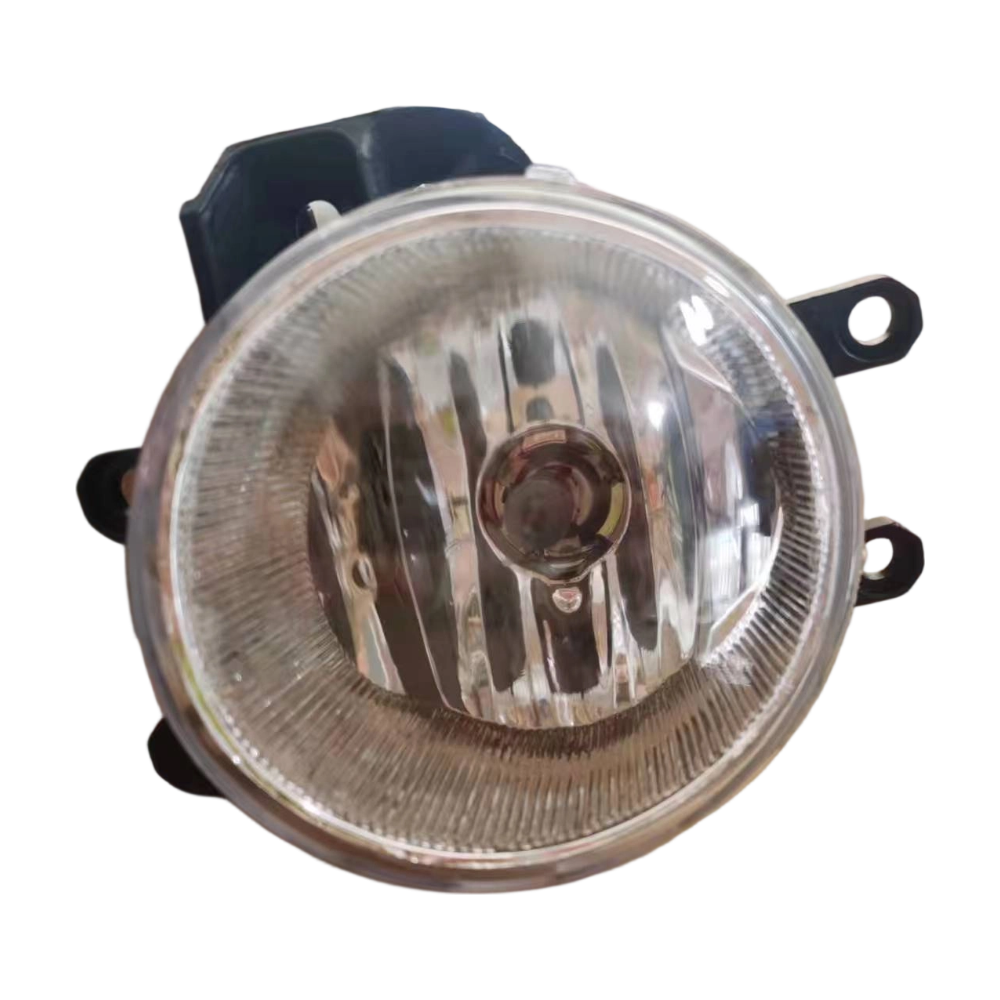
Fog lamp model TYJ-01-0008, designed specifically for Toyota Corolla 2014 Middle East vehicles with a dust- and moisture-resistant seal structure.
The fog lamp is designed for use in Toyota Corolla 2014 Middle East vehicles and is classified as an automotive lighting system, made from optic-grade PC and ABS polymers. Its design priority is weather penetration: a compact, impact-resistant construction, precise dimensions for effortless snap-in fitment, and a seal structure intended to block dust and moisture entry.
That sealing detail is the technical center of gravity for this component in Gulf service conditions. Where dust ingress and condensation accumulate inside a poorly sealed lamp, output degrades and the assembly fails earlier than the material itself would suggest. A defined seal structure addresses the failure mode that heat and airborne particulate create.
Packaging is where this component separates itself from the rest of the shortlist. The fog lamp is supplied at 50 pieces per carton, with carton dimensions of 65 x 25.5 x 57 cm and a carton volume of 0.094 cubic meters. A compact carton carrying a high piece count makes it the most volumetric-efficient item on this list — a configuration suited to bulk stocking, since fog lamps are commonly replaced in pairs and consumed steadily rather than in single units.
Because fog lamp assemblies can differ in configuration across the aftermarket, buyers should confirm bulb inclusion, connector type and mounting hardware against their own acceptance criteria rather than assuming a standard build.
Grille — TYJ-01-0014
The grille for the Toyota Corolla 2014 Middle East is an auto body part molded from premium ABS plastic, with additional PP and PC plastic components. It is molded to exact vehicle contours for a seamless front-end fit, and the surface finish is specified for good paint adhesion — a detail that matters to body shops that refinish a replacement grille to match the vehicle's body color instead of installing raw plastic.
Its material profile is chosen for impact and weather resistance rather than optical performance, which is the main technical distinction between the grille and the two lighting components on this list. ABS provides a rigid, dimensionally stable and paintable substrate; the additional PP and PC content supports flexibility and impact behavior in a part that sits directly in the path of road debris.
The grille ships at 10 pieces per carton, with carton dimensions of 86 x 39 x 49 cm and 0.164 cubic meters per carton — a mid-density configuration between the bulky head lamp carton and the high-count fog lamp carton.
Reading the Material Specification Correctly
Material callouts such as "optic-grade PC & ABS polymers" are frequently repeated in listings without explanation, which makes them easy to ignore and easy to misread. For this shortlist, the designations carry three distinct meanings.
- Polycarbonate (PC) in lighting. PC is used where impact resistance and optical clarity must coexist. In a lamp assembly it typically serves the lens and outer transparent surfaces, where a hazed, cracked or poorly formed part directly degrades light output.
- ABS in lighting and body parts. ABS contributes dimensional stability, molding precision and surface quality. In lamp housings it holds mounting geometry; in body parts such as a grille it provides a rigid substrate that accepts paint.
- Combined housings. Where a lamp is described as a high-impact ABS/PC plastic assembly, the intent is to balance structural rigidity with shock absorption, rather than optimizing one property at the expense of the other.
Fitment engineering is the second layer of the specification. "Precise OEM-spec dimensions" and "direct bolt-on installation without modification" describe assembly geometry — mounting points, housing contours and clearances that determine whether the part installs cleanly or requires adaptation. "Molded to exact vehicle contours" does the same job for the grille.
The third layer is climate-specific design. The fog lamp's seal structure and the head lamp's thermal and shock resistance are not generic marketing attributes; they are the two failure modes that high temperature and dust most reliably produce on this platform. Taken together, these three layers — material, fitment geometry, sealing — are what a buyer can actually verify at the sample stage.
What material specifications do not establish is installed performance. A correctly molded part installed on a misaligned or previously repaired front end will not behave as intended, which is why the verification steps later in this shortlist matter as much as the part numbers themselves.
Packaging and Load Planning
On this shortlist, the three components convert into container volume in very different ways. A fog lamp carton holds 50 pieces in 0.094 CBM; a grille carton holds 10 pieces in 0.164 CBM; a head lamp carton holds 4 pieces in 0.28 CBM. The head lamp carton is dominated by assembly bulk, the fog lamp carton by piece density, and the grille carton sits between the two.
For a buyer assembling a mixed order, these per-carton volume figures are the planning input: they allow a shipment to be modelled by carton, by component mix and by stock depth before any order is confirmed. Declared carton dimensions also matter for warehouse slotting, pallet configuration and inland distribution in the destination market, where handling constraints often differ from origin-side assumptions.
For distributors, the practical implication is that fog lamps can be stocked in depth without consuming disproportionate volume, while head lamps should be planned around their carton bulk rather than their piece count. That single distinction affects reorder frequency across an entire Corolla 2014 Middle East program.
Application and Use Cases
Collision repair. A front-end impact on this platform typically affects the grille and one or both lamp assemblies at the same time. Because all three components are documented against the same fitment scope, a repair order can be consolidated across a single sourcing reference rather than assembled from three unrelated listings.
Fleet and high-mileage maintenance. Corolla-era vehicles remain in continuous service in taxi, utility and company fleet roles. In that environment lamps are consumable items and grilles are damage-prone, so repeat ordering and consistent part numbering matter more than one-off price comparison.
Body shop refinishing programs. The grille's specified paint adhesion supports standard refinishing workflow: preparation, paint matching and installation, rather than a raw-plastic install that leaves a visible color mismatch on the front end.
Dust- and heat-exposed service. Fog lamps carry the sealing requirement because they sit low on the front end and are directly exposed to dust and moisture spray; head lamps carry the thermal and shock requirement because they operate hot and vibrate continuously.
Supplier Context: Gold Auto Part (Ruian Golden Import and Export Co., Ltd.)
The components on this shortlist are supplied by Gold Auto Part, the trading name of Ruian Golden Import and Export Co., Ltd., a professional automotive parts exporter based in Ruian, Wenzhou, Zhejiang Province, China. The company specializes in sourcing and exporting a broad range of automotive components, including engine valves, Toyota exterior parts, oil filters, air filters, pumps and car lamps, together with replacement parts for passenger cars and light commercial vehicles. It serves importers, wholesalers and distributors across the Middle East — including Saudi Arabia and the UAE — as well as South America, Southeast Asia, Africa, Europe and the USA.
Two operational facts are relevant to a buyer evaluating this shortlist. First, the company states that its supply chain partners operate under ISO 9001 and IATF 16949 quality management standards; IATF 16949:2016 is the global quality management standard for the automotive industry, mandatory for many OEM suppliers (International Automotive Task Force). Second, every product batch undergoes dimensional inspection, material verification and performance testing before shipment. Those three checks map directly onto the three specification dimensions used throughout this article — fit, material and function.
The company also notes familiarity with region-specific requirements, including heat-resistant components suited to Gulf desert climates and high-volume filter programs for South American fleets. That regional orientation is consistent with the material and sealing choices described for these Corolla 2014 Middle East components. Product and company information is published at goldautopart.com.
Market Trend Signals for Front-End Replacement Parts
Published market estimates for the automotive aftermarket diverge widely by scope and methodology. One estimate places the global automotive aftermarket at USD 860.08 billion in 2025, with a projected reach of USD 1,482.12 billion by 2035 (Vertex AI Search / Market Analysis). A separate source values the market at USD 489.5 billion in 2025 (Grand View Research). The gap is a scope difference, not a data error, and it is a useful reminder for buyers: treat headline market figures as directional context, not as a procurement benchmark.
Regional concentration is clearer. Asia Pacific dominated the automotive aftermarket in 2025 with a 29.4% revenue share (Grand View Research), reflecting both vehicle population and manufacturing base. For a Corolla 2014 program, this concentration supports continued availability of region-specific exterior and lighting SKUs rather than a shrinking catalog.
A second signal concerns lighting technology. The automotive lighting market is shifting toward LED technology for energy efficiency (technology trend data, medium reliability). For a 2014 platform that was originally specified with conventional lighting, this trend produces two parallel demands: OE-equivalent replacement assemblies that keep the vehicle roadworthy, and retrofit or upgraded lighting options for owners who want a change. These are different products with different acceptance criteria, and buyers should confirm which demand their market is actually expressing before building a catalog decision around a trend headline.
The third signal is structural rather than technological. Replacement-rate-driven demand — driven by fleet age rather than new-car sales — favors suppliers who can hold consistent part numbering, documented materials and stable packaging across repeat orders. That is the competitive ground on which a Corolla 2014 Middle East program is actually won or lost.
Comparison with Traditional Supply Paths — and the Limits of This Shortlist
Buyers for this platform generally choose between two supply paths. A dealer or OEM-branded channel provides parts manufactured under the vehicle brand, with variant matching handled at the point of sale, and typically carries a different cost and ordering cadence. An aftermarket program provides parts engineered to fit the vehicle, with documented materials, defined carton data and repeatable part numbers suited to older, high-volume platforms.
This shortlist sits in the second category, and it has real boundaries that buyers should understand before treating it as a complete answer.
- Aftermarket status. The head lamp TYJ-01-0001A, fog lamp TYJ-01-0008 and grille TYJ-01-0014 are aftermarket parts. They are designed to fit the Toyota Corolla 2014 Middle East; they are not manufactured by Toyota.
- Variant sensitivity. Middle East and US versions of the same model year use different part numbers for the head lamp. Fitment must be confirmed against the specific vehicle, not against the model year alone.
- Configuration gaps. A part number alone does not settle bulb inclusion, connector type or mounting hardware for lamp assemblies. These must be confirmed at the enquiry stage.
- Finishing requirement. The grille is supplied as a paintable part. Installing it without refinishing will not match the vehicle's body color.
- No assumed certification scope. The materials, fitment geometry and sealing structures described here are specification claims for these components. They should not be read as a certification claim for a given market unless documentation is provided.
- Installation dependence. Seal performance and impact behavior assume correct installation on an undamaged mounting structure.
- Commercial terms. Purchasing terms and acceptance criteria — inspection method, sampling approach, packaging condition and required documentation — should be verified and agreed before an order is placed, not after arrival.
Future Outlook
Three developments are likely to shape how front-end replacement parts for the Corolla 2014 Middle East are bought over the next several years.
First, service population. As long as vehicles in this class remain in daily service, head lamps, fog lamps and grilles will continue to be replaced on a schedule set by climate and road conditions rather than by model-year novelty. Aging-fleet data from mature markets such as the U.S. — 12.6 years average vehicle age in 2026 (Business Research Insights) — points in the same direction for other regions in their own time frames.
Second, material expectations. Heat and ultraviolet exposure will keep pressure on lamp housing materials and sealing design, which favors components specified with optic-grade polymers and defined seal structures over generic substitutes. Buyers who treat material specification as a filter rather than a formality are likely to see fewer warranty and return issues.
Third, procurement practice. Packaging data — pieces per carton, carton dimensions and carton volume — is increasingly part of the commercial discussion rather than an afterthought, because it determines landed cost and stock depth. Shortlists that publish these figures, alongside fitment scope and materials, give buyers a decision framework they can reuse across suppliers instead of restarting the comparison at every quotation.
Frequently Asked Questions
What replacement parts are documented for the Toyota Corolla 2014 Middle East?
Three front-end components are documented for this vehicle and market: the head lamp (model TYJ-01-0001A), the fog lamp (model TYJ-01-0008) and the grille (model TYJ-01-0014). All three are classified for automotive aftermarket, automobile repair and automobile body manufacturing use. The Middle East head lamp is a different part number from the U.S.-spec 2014 Corolla head lamp, which is listed as TYJ-01-0041.
What materials are used in the head lamp, fog lamp and grille for this vehicle?
The head lamp is made from optic-grade PC and ABS polymers, with a high-impact ABS/PC plastic lens. The fog lamp is also made from optic-grade PC and ABS polymers. The grille is molded from premium ABS plastic with additional PP and PC plastic components, and its surface finish is specified for good paint adhesion.
How are these components packaged, and what are the carton dimensions?
Head lamp: 4 pieces per carton, carton dimensions 88 x 67 x 48 cm, volume 0.28 CBM. Fog lamp: 50 pieces per carton, carton dimensions 65 x 25.5 x 57 cm, volume 0.094 CBM. Grille: 10 pieces per carton, carton dimensions 86 x 39 x 49 cm, volume 0.164 CBM.
What should buyers verify before placing an order?
Buyers should confirm the market variant and model year, the exact part number, and — for lamp assemblies — bulb inclusion, connector type and mounting hardware. For the grille, buyers should confirm whether the part will be painted, since it is supplied as a paintable component. Purchasing terms and acceptance criteria, including inspection method, packaging condition and required documentation, should be agreed before the order is placed. These are aftermarket parts and are not manufactured by Toyota.
Who supplies these components, and what quality processes support them?
Gold Auto Part is the trading name of Ruian Golden Import and Export Co., Ltd., an automotive parts exporter based in Ruian, Wenzhou, Zhejiang Province, China, serving importers, wholesalers and distributors across the Middle East, South America, Southeast Asia, Africa, Europe and the USA. The company states that its supply chain partners operate under ISO 9001 and IATF 16949 quality management standards, and that every product batch undergoes dimensional inspection, material verification and performance testing before shipment.
For buyers at the awareness and research stage, the value of this shortlist lies in comparability. Fitment scope, material composition and carton data are stated for each component in the same format, which turns a vague sourcing question into a set of verifiable checks — and those checks are what an order should ultimately be built on.
Have Questions or Need More Details?
Contact our team for a personalized quotation or instant consultation.
Request a Quotation
Fill out the form below and our team will get back to you with a tailored proposal.
WhatsApp Direct Chat
Prefer to chat in real-time? Message us on WhatsApp for instant assistance & quick answers.
- Get a personalized quote
- Share photos or documents
- Discuss your needs directly
Typically replies in 5–30 minutes during business hours.