
Residential Shower Faucet Fit: Double-Handle Mixers
Residential Shower Faucet Fit: Double-Handle Mixers
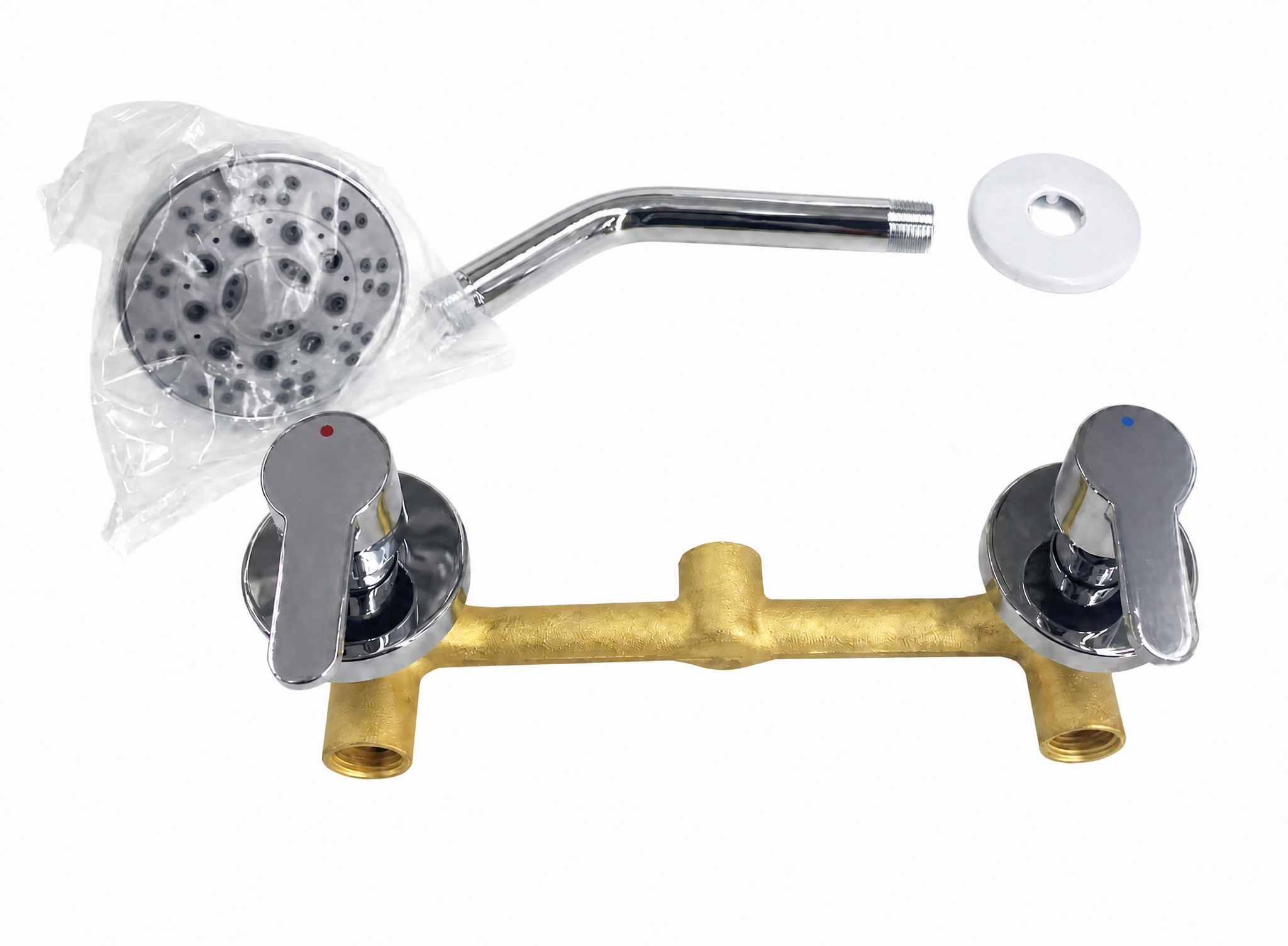
The short answer. In a new residential bathroom, the two Ehoo double-handle models answer different plumbing layouts rather than different quality tiers. The 8115-955 is a double-handle shower faucet with a three-function shower head and a 35 mm ceramic cartridge. The 8110-803D is a hot and cold shower mixer supplied with a hand shower and a 1/2" ceramic cartridge. Both are brass-bodied, both state the same coating minimums (nickel above 10 μm over chrome above 0.3 μm), and both list CE and TUV in their specifications. Whether either one fits a given project comes down to four variables: the pressure available at the riser, whether the room needs a hand shower, the cartridge size the maintenance file should hold, and whether the purchase order can carry the 400-piece-per-model MOQ.
Ehoo Plumbing Co., Ltd. is a brass faucet manufacturer established in 2002 in the plumbing industry park in Quanzhou, China, producing basin, kitchen, shower, concealed and sensor faucets for export markets. It has built two double-handle shower faucet options for residential construction, hotel and bathroom renovation applications, and this article treats them as project components rather than as catalogue items: what each model does, where the boundary of that capability sits, and what a construction team should verify before the wall is closed.
The analysis below deliberately stops at what the supplied specifications, scenario record, certification record and published standards evidence support. It does not rank the two models, and it does not treat a listed certificate as a compliance decision for any particular jurisdiction.
Why the new-build stage decides shower faucet fit
A shower faucet in a residential project is a water-system component installed under hand control. Ehoo's application record for this scenario type describes exactly that role: the product controls water flow, is operated by hand, requires a water system as supporting equipment, and is intended for indoor basin, kitchen, bathroom or outside garden environments in property and construction projects. The record also sets the working conditions that the fit conversation should start from — a 0.5 MPa to 2 MPa water pressure range, and a requirement for corrosion resistance in high-humidity bathroom environments together with lead-free material.
That framing matters because a new-build bathroom locks several decisions early and revisits them expensively. The supply pressure at the shower riser is set by the building services design. The position of the outlet is set before tiling. The finish that will face steam and cleaning agents for a decade is chosen at order stage, not at handover. And the quantity that a purchasing team commits to is fixed by the purchase order, not by the site's remaining snag list. A faucet that is acceptable in a showroom can still be the wrong fit for a project if its stated pressure band, coating thickness, cartridge size or minimum quantity does not match the drawings.
The practical consequence is that double-handle mixers should be evaluated at the same time as the pipework and the tiling programme, not after them. The two Ehoo models are useful illustrations because their published specifications contain numbers a project team can check — cartridge size, plating minimums, net weight, standards listed — instead of adjectives that cannot be verified.
The two models and the bathroom layouts they serve
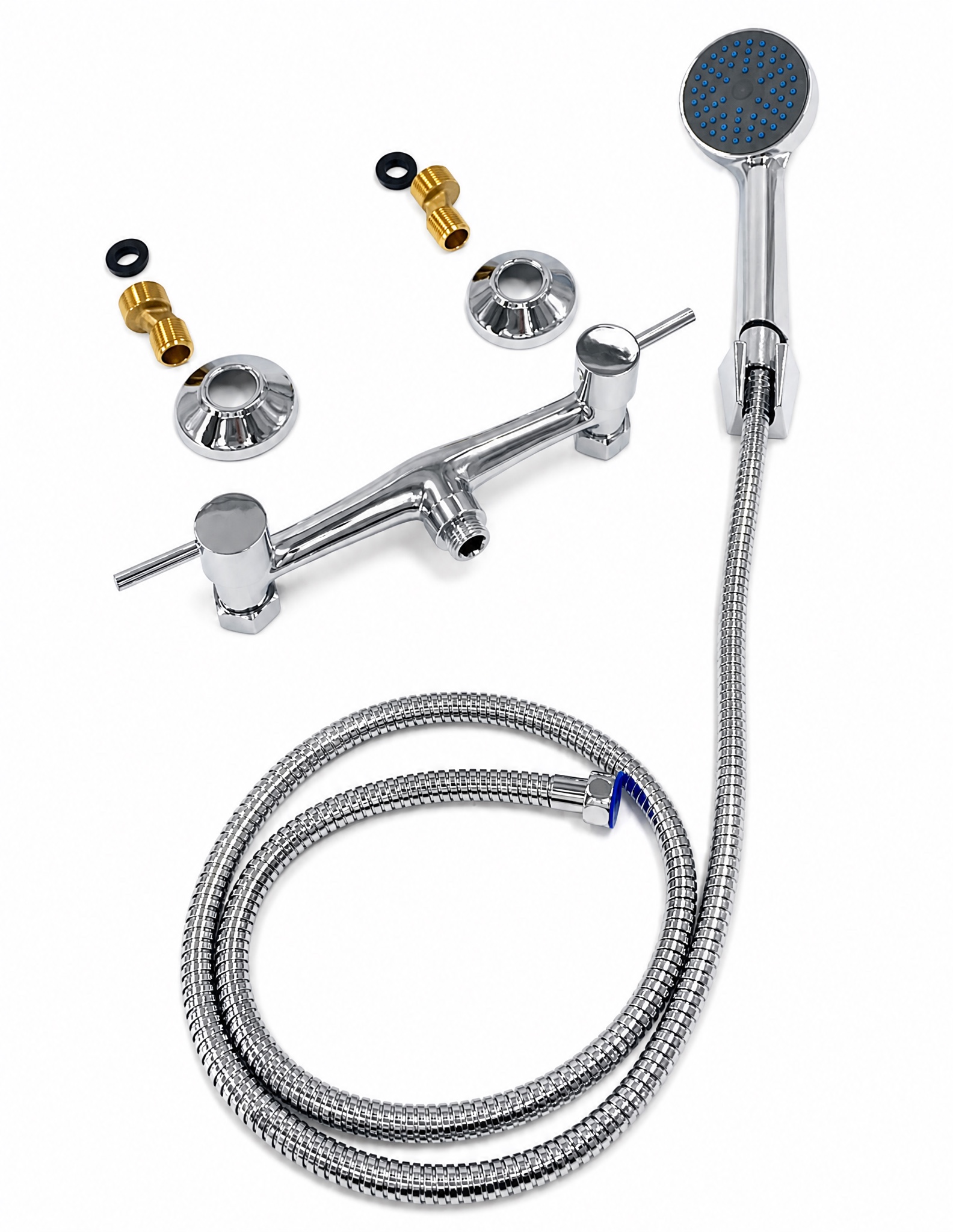
The 8115-955 is specified as a double-handle shower faucet with a head shower. Its published parameters list a brass body, chrome metal handles, a chromed ABS shower head, a three-function shower head, a 35 mm ceramic cartridge as the closing mechanism, a net weight of 1 kg, coating of nickel above 10 μm and chrome above 0.3 μm, and CE and TUV as the listed standards. In layout terms it suits the straightforward shower room: one outlet position, a fixed head, and two handles on the plate for hot and cold.
The 8110-803D is specified as a hot and cold shower faucet with a hand shower. Its parameters list a brass body, chrome metal handles, a chromed ABS shower head, a three-function hand shower, a 1/2" ceramic cartridge, an 8" brass shower mixer element in the specification listing, a net weight of 1.1 kg, and the same nickel and chrome coating minimums with CE and TUV listed. It suits the bathroom where the shower is combined with a bath, where a hand shower is needed for bathing children or cleaning the enclosure, or where the specification calls for a shower faucet with hand shower rather than a fixed-head arrangement.
| Specified point | 8115-955 | 8110-803D |
|---|---|---|
| Configuration | Double-handle shower faucet with head shower | Hot and cold shower mixer with hand shower |
| Body material | Brass | Brass |
| Control | Double handle, hot and cold | Double handle, hot and cold |
| Spray / head | Three-function shower head | Three-function hand shower; 8" brass shower mixer listed |
| Closing mechanism | 35 mm ceramic cartridge | 1/2" ceramic cartridge |
| Coating | Nickel > 10 μm; chrome > 0.3 μm | Nickel > 10 μm; chrome > 0.3 μm |
| Net weight | 1 kg | 1.1 kg |
| Standards listed | CE; TUV | CE; TUV |
| Stated applications | Residential construction, hotel, commercial restroom, bathroom renovation | Residential construction, hotel, commercial restroom, bathroom renovation |
Read as a pair, the table shows why the choice is a layout decision. The cartridge difference — 35 mm against 1/2" — is the point most likely to be overlooked, because a maintenance store that keeps one size will not fit the other without a new order. For a multi-block residential development where both a shower room and a bath-and-shower room appear, that is a stock decision as much as a plumbing one.
Check one: the pressure band at the riser
Ehoo's scenario record states operating conditions of 0.5 MPa to 2 MPa. In more familiar units that is roughly 5 bar to 20 bar, which comfortably covers normal domestic supply pressures, but the upper end is worth a deliberate check rather than an assumption. The cited plumbing fittings standard ASME A112.18.1-2018/CSA B125.1-18 requires covered supply fittings to be designed for a rated supply pressure of 690 kPa (100 psi) and to function at a supply pressure between 140 and 860 kPa (20 to 125 psi).
Those two statements are not competing claims about the same thing. One is a manufacturer's stated operating range for a product family; the other is a design and test requirement written into a standard that applies in its own jurisdictions. The useful comparison for a project team is narrower: where a building's supply pressure can exceed the functional ceiling recognised in the applicable local code, the design response — typically a pressure-reducing valve upstream of the bathroom group — belongs to the plumbing engineer, and the faucet choice should follow that decision rather than substitute for it.
The same logic applies at the lower end. Very low pressure, common on upper floors of buildings with gravity-fed systems, affects perceived flow more than it affects the valve itself, and a project that expects a strong shower from a low-pressure riser should confirm the supply before selecting any mixer. Neither Ehoo model is described in the supplied records as a pressure-boosting or flow-compensating device.
Check two: what double-handle hot and cold control does, and what it does not do
Both models are operated by hand through two separate handles, one for hot and one for cold. That arrangement has a practical characteristic worth stating plainly: the user sets the mixing ratio each time, and the delivered temperature depends on how far each handle is turned. Two independent handles also let the hot and cold sides be trimmed separately, which can help where the hot supply temperature differs between risers in the same building, or where the cold main runs warmer on upper floors.
The boundary is equally clear. Neither model is described in the supplied specifications as a thermostatic shower faucet, and no temperature-limiting or anti-scald function is listed for either. Where a project specification, a hotel brand standard or a local code requires a thermostatic mixing device or a temperature-limiting function at the shower, that requirement has to be matched against a product that states it — and the double-handle models should not be assumed to satisfy it. This is a fit boundary, not a defect: many residential specifications call simply for reliable manual hot and cold control, which is what the two handles provide.
For commissioning, the check is procedural. Run each handle from closed to fully open with the other closed, confirm no crossover or leak at the cartridge, then set a comfortable mixed position and mark the handles for the occupant. In hotels and serviced apartments, where the same fitting is used by guests unfamiliar with the room, a simple two-handle layout removes the need to explain a single-lever cartridge's travel.
Check three: cartridge, coating and the humid-bathroom requirement
The cartridge is the part that wears. The 8115-955 lists a 35 mm ceramic cartridge as its closing mechanism; the 8110-803D lists a 1/2" ceramic cartridge. For a project, the value of knowing the size is that spares can be ordered in the same size before the first failure, and that the maintenance file records a part that can be matched at handover rather than measured later.
Coating is the second wearing surface in a bathroom. Both models state nickel above 10 μm beneath chrome above 0.3 μm. Those are minimum figures in a layered specification, and they connect directly to the scenario requirement for corrosion resistance in high-humidity bathroom environments. A project that has written that requirement into its specification can use the nickel and chrome figures as a checkable line item — and should ask for the test report and method behind them, not just the headline number.
The scenario record also lists lead-free material as a requirement for this application type. Ehoo's product line covers lead-free brass alongside 59-1 national standard brass and Singapore/Australia DZR brass, so the material grade is a specification question to settle per model and per market rather than an assumption to carry from a general company description. The correct action for a project buyer is to request the material declaration for the exact model and the target market's potable-contact requirement, and to confirm both against the delivered batch.
Certification evidence: CE and TUV listing, read at the right scope
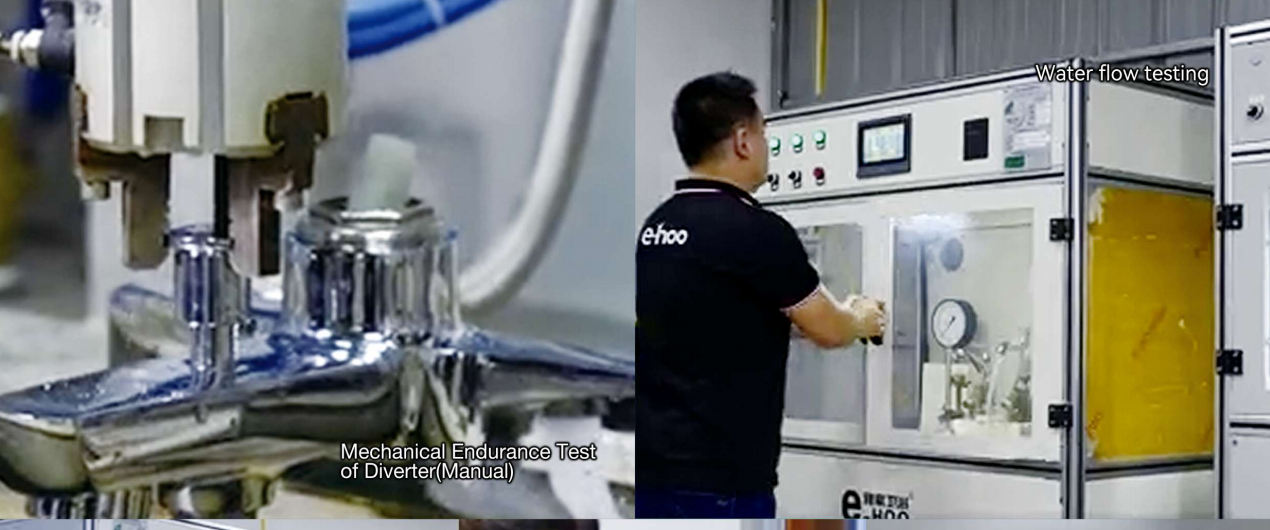
Both product specifications list CE and TUV. At company level, Ehoo holds SGS ISO9001:2015 quality management, ISO45001:2018 occupational health and safety, ISO14001:2015 environmental management and ISO14067:2018 product carbon footprint certification, along with TUV certification and EN817:2008 and EN200 references. The company also operates in-house test equipment including a metal spectrometer, valve life testing machine, water flow testing machine, salt spray testing machine and product sealing testing machine, and applies 100% testing in its quality control description.
Scope discipline matters more than the length of that list. A certificate references a manufacturer, a standard edition and a defined product scope; it does not automatically transfer to every SKU in a catalogue, and a European-oriented standard reference does not by itself answer a North American project's requirements. Where a project in the United States or Canada is being specified, the applicable reference is the local code and the standard it adopts — the cited ASME A112.18.1-2018/CSA B125.1-18, for example, covers plumbing supply fittings including wall-mounted showering valves and bath-and-shower supply fittings, and cross-references applicable NSF/ANSI 61 requirements for covered fittings. Whether a given model holds the evidence a project needs is a document request, not an inference from a product page.
A workable request list is short: the certificate naming the exact model, the standard edition it was issued against, the test reports supporting the coating and cartridge claims, the material declaration, and the destination market's current adoption status for the standard in question.
Warranty, MOQ and order value as planning constraints
Two commercial parameters shape how the models fit a real project. The first is warranty. Ehoo's company profile states a 3 to 5 year warranty depending on the product series, and its capability record lists remote technical support alongside a 5 year warranty on the body. A range is normal across a product line, but it has to be pinned to the ordered series before the tender is priced, because a project that assumes the upper figure and receives the lower one has a handover dispute rather than a technical one.
The second is quantity. The company profile states a standard MOQ starting from 400 pieces per model, and the capability record lists a USD 20,000 order value alongside a monthly capacity of 150,000 units and OEM/ODM customization of packaging, logo, faucet body, faucet parts and sanitary accessories. Both figures should be read together: a per-model piece count and an order-value threshold describe different constraints, and a purchase order needs to satisfy whichever applies to the series being quoted.
For project planning, the consequence is straightforward. A single dwelling will not absorb 400 pieces of one model; the fit question there becomes whether a distributor in the project market already stocks the model. A multi-unit residential building, a hotel bathroom package or a wholesale order for a construction supermarket is the natural scale at which a direct model commitment makes sense — and the case record describes exactly those channels, listing OEM/ODM, wholesale and construction supermarket client types in bathroom applications with order values above USD 20,000.
There is also an efficiency argument for standardising within a project: choosing one model per bathroom type keeps the per-model quantity concentrated, instead of splitting the same total across several variants and paying the MOQ twice.
Handover checks the site team can run
These steps convert the specification into something inspectable before the bathroom is signed off.
- Record the pressure. Static and dynamic readings at the shower riser, plus confirmation of whether a reducing valve is installed upstream.
- Confirm the rough-in before tiling. Outlet position and finished wall face fixed against the drawing, with the faucet on site for a dry check rather than a dimensional assumption.
- Check the hand-shower connection. For the 8110-803D, verify the hose and head connection against the project drawing; the cited ASME/CSA standard specifies 1/2-14 NPSM or ISO 228-G 1/2 threads for hand-held shower connections, and a mismatch here is a handover snag, not a valve fault.
- Function-test both spray settings. The three-function shower head on the 8115-955 and the three-function hand shower on the 8110-803D should each be cycled through all positions with the supply running.
- Log the wearing parts. Cartridge size (35 mm or 1/2"), coating minimums, model number and certificate references into the operation and maintenance file.
- Fix the warranty basis. Confirm in writing which series term applies and from which event the warranty period runs.
Market context for procurement timing
Published research puts the global faucet market at USD 25.47 billion in 2025, with a projection of USD 51.37 billion by 2034, according to Fortune Business Insights. A separate commercial estimate places the shower faucet category at USD 33.18 billion in 2023 rising to USD 65.34 billion by 2032. The two figures differ in scope — one covers faucets broadly, the other a shower-specific category that may include more system components — so they should be read as directional context for category scale, not added together or used as a project forecast.
On the logistics side, bath and shower faucets are classified under HS code 8481.80.1020 in the United States and 8481.80.11 for EU mixing valves per a published tariff listing; classification and duty treatment should be confirmed with the nominated customs broker before the purchase order is fixed.
What a defensible double-handle specification should hold
The direction of project procurement is toward documented numbers rather than descriptive claims, and that shift favours fittings whose specifications can be matched line by line against a drawing. For a double-handle shower faucet, a specification that can be defended at handover will normally state the model, the cartridge size, the coating minimums, the listed standards with their editions, the pressure conditions, the warranty term for that series and the order quantity required.
Both Ehoo models can be described in those terms today. What the supplied records do not establish is behaviour in a specific building: pressure performance at a given riser, long-term appearance under a particular cleaning regime, or suitability for a project whose code requires a temperature-limiting device. Those remain project-side verifications, and treating them as such is what keeps a shower faucet decision a specification decision rather than a hope.
Frequently asked questions
Which Ehoo double-handle model suits a new-build bathroom with a fixed shower head?
The 8115-955 is the fixed-head option: a double-handle shower faucet with a three-function shower head, a brass body, chrome metal handles, a chromed ABS shower head, a 35 mm ceramic cartridge, a net weight of 1 kg, coating of nickel above 10 μm and chrome above 0.3 μm, and CE and TUV listed in its specification. Its stated applications include residential construction, hotel, commercial restroom and bathroom renovation.
When is the 8110-803D hand-shower mixer the better layout fit?
The 8110-803D is specified as a hot and cold shower faucet with a hand shower. It carries a three-function hand shower, a 1/2" ceramic cartridge, an 8" brass shower mixer element in its specification listing, a net weight of 1.1 kg, and the same nickel and chrome coating minimums with CE and TUV listed. It fits bathrooms where the shower is combined with a bath, where a hand shower is needed for children or cleaning, or where the specification explicitly calls for a shower faucet with hand shower.
What water pressure do these mixers need for a residential project?
Ehoo's application record states operating conditions of 0.5 MPa to 2 MPa for this scenario type. As a separate reference point, the cited ASME A112.18.1-2018/CSA B125.1-18 standard requires covered supply fittings to be designed for a rated supply pressure of 690 kPa (100 psi) and to function between 140 and 860 kPa (20 to 125 psi). Because the two statements serve different purposes, a project should measure actual static and dynamic pressure at the riser and confirm whether a pressure-reducing valve is required under local code.
Are either of these models thermostatic?
No. The supplied specifications describe both models as double-handle fittings with manual hot and cold control; no thermostatic function or temperature-limiting feature is listed for either. Where a project specification, brand standard or local code requires a thermostatic mixing device, that requirement must be matched against a product whose documentation states it, rather than assumed from a double-handle layout.
How do the warranty and MOQ affect a residential project?
The company profile states a 3 to 5 year warranty depending on the product series, and the capability record lists a 5 year warranty on the body plus remote technical support. The stated standard MOQ starts from 400 pieces per model, while the capability record lists a USD 20,000 order-value figure, so both constraints should be checked against the quotation for the specific series. A single dwelling will normally be served from distributor stock; a multi-unit building, hotel package or wholesale order is the scale at which a per-model commitment becomes practical.
Project teams comparing the two models against their drawings can review the full faucet range and current specification documents in the Ehoo 2025–2026 catalogue. Company background, certification references and contact details are published at Ehoo Plumbing Co., Ltd.
Have Questions or Need More Details?
Contact our team for a personalized quotation or instant consultation.
Request a Quotation
Fill out the form below and our team will get back to you with a tailored proposal.
WhatsApp Direct Chat
Prefer to chat in real-time? Message us on WhatsApp for instant assistance & quick answers.
- Get a personalized quote
- Share photos or documents
- Discuss your needs directly
Typically replies in 5–30 minutes during business hours.