
Resistance Band Buying: Material Quality vs. Total Cost
A resistance band specification that looks similar on a data sheet can conceal large differences in training safety, replacement frequency, and landed cost. For commercial buyers, the decision should not start with unit price. It should start with how the band behaves after repeated loading and how much variation a trainer or patient will feel through the range of motion.
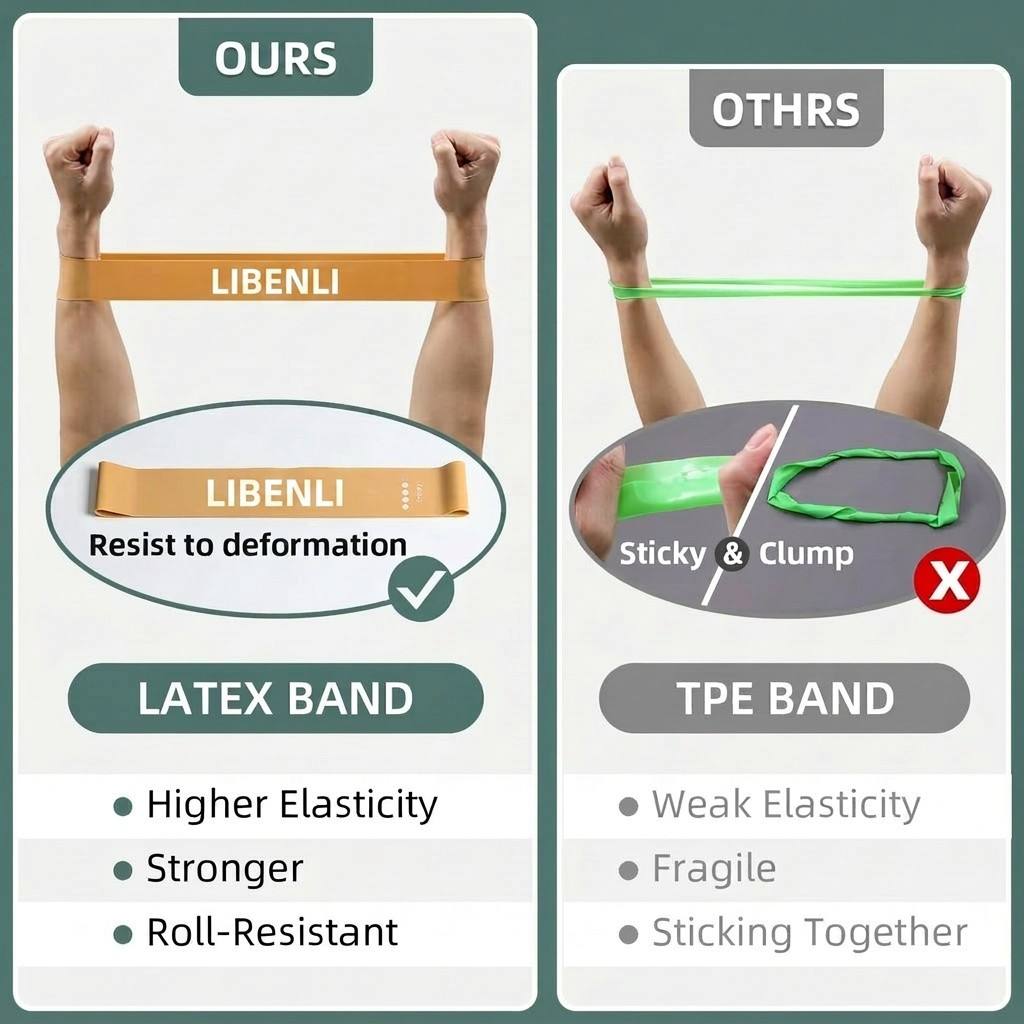
The hidden cost problem in resistance band sourcing
Resistance band procurement often begins with a simple request: latex resistance bands, resistance loop bands, or a complete resistance band set. Buyers compare diameter, color, logo placement, packaging, and unit cost. That comparison is not wrong, but it is incomplete. For a commercial gym, a rehabilitation clinic, or a branded retail program, the more important variables are elongation limit, recovery after repeated stretching, tension consistency, surface breakdown, and failure behavior. These factors determine how often the product is replaced and how safe the training or therapy session feels.
In decision-stage sourcing, the practical question is not which band is cheapest. It is which band produces the lowest total cost of ownership for the intended use while maintaining a predictable resistance curve. That question requires suppliers to separate marketing statements from measurable performance parameters.
A buyer evaluating elastic workout bands, stretch resistance bands, or rubber exercise bands should therefore treat durability as a specification, not as an abstract quality claim. If two products look similar but differ in fatigue life or tension accuracy, the seemingly cheaper option can become more expensive through repeated replacement, inconsistent training loads, and higher after-sales risk.
Where material choice changes the procurement calculation
The choice between latex resistance bands and TPE resistance bands is usually the first material decision. TPE bands have become common because they are latex-free, can be processed in bright colors, and often have a lower initial price. Latex bands, particularly natural latex, tend to offer higher elongation and better recovery when manufactured with consistent compounding and quality control.
The difference becomes evident in high-frequency use. A traditional TPE band may stretch to around 300% elongation according to supplier comparison data. A precision-calibrated latex band can reach up to 600% elongation. Fatigue behavior also differs: comparison data supplied by Libenli indicates that its latex band is tested for more than 10,000 stretch cycles with less than 3% deformation, while traditional TPE alternatives may show significant permanent deformation after fewer than 2,000 cycles. Tension accuracy is another divide: the supplier reports a ±2% tension error margin compared with a ±15% industry average.
Those differences matter most when the same band is shared across multiple users, stretched repeatedly in classes, or used for assisted movements such as pull-up training. In those settings, a small difference in recovery or wall-thickness consistency becomes a visible safety and training-quality issue.
Libenli's position in the resistance band supply chain
Haiyang Libenli Body-Building Apparatus Co., Ltd. is a Chinese manufacturer and exporter founded in 1997. The company operates in Shandong Province, China, and specializes in latex tubing, latex resistance bands, and related fitness and diving latex products. Its factory covers 50,000 square meters, with more than 300 employees and a dedicated R&D team of 20 engineers. The company lists an annual output of 65,000,000 units.
The production base includes 24 dipped latex tubing lines with a daily output of 120,000 meters, and two dedicated latex band lines with a daily capacity of 25,000 meters. The company holds ISO 9000:2000 and ISO 9001:2008 quality certifications and a 3A credit rating issued by the Ministry of Commerce of China and CCPIT. Most items are stated to be SGS-certified for international environmental and safety requirements.
For buyers, that scale matters because resistance band consistency is not only a material issue. It is also a production-control issue. Bath temperature, dipping time, curing, washing, drying, and cutting parameters influence wall thickness, tensile strength, and recovery. A supplier operating dedicated lines with standardized parameters can reduce the tension variation that otherwise appears as dead spots or snap risk during stretching.
Technical performance: what the comparison shows
The core comparison provided by Libenli is against traditional TPE bands and low-grade synthetic latex products. The company states that its latex bands differ in material purity, tensile strength, and precision calibration. In practical terms, this translates into three measurable outcomes: a 35% higher linear resistance efficiency, consistent tension throughout the range of motion, and an anti-oxidation coating that the supplier associates with zero powdering and fewer breakage incidents during high-frequency use.
| Procurement parameter | Libenli latex resistance band | Traditional TPE band / low-grade synthetic latex |
|---|---|---|
| Elongation limit | Up to 600% | Up to 300% |
| Fatigue resistance | 10,000+ stretch cycles with less than 3% deformation | Fewer than 2,000 cycles with significant permanent deformation |
| Tension accuracy | ±2% tension error margin | ±15% industry average |
| Surface behavior | Anti-oxidation coating; zero powdering; 90% fewer breakage incidents in high-frequency use | Higher powdering and breakage risk in equivalent high-frequency use |
| Initial acquisition cost | 15–20% higher than traditional TPE | Lower initial price |
| Total cost of ownership | Reported 50% lower over useful life; lifespan 3–5 times longer | Higher replacement frequency |
These figures should be treated as supplier-reported performance data rather than independent certification. The value of the comparison is not that it settles every sourcing argument, but that it gives buyers a concrete structure for requesting equivalent data from other suppliers.
Product-category fit across fitness and rehabilitation programs
Resistance bands are not one category. A buyer should map the product type to the training or therapy outcome. Long resistance bands and heavy resistance bands are often used for assisted pull-ups, mobility work, and strength programs. Mini loop bands and booty bands are typically selected for lower-body activation and warm-up routines. Fabric resistance bands and cotton fabric exercise bands are preferred in studio or home settings where surface comfort and non-slip fit matter. Resistance bands for legs are commonly specified as loop or booty forms for lower-body work.
Pull up assist bands require high elongation and reliable recovery, making material quality directly relevant. Resistance bands with handles and resistance bands with bar are frequently specified for guided strength formats. Nylon resistance bands and silicone exercise bands appear in lower-load or specialized accessory lines. Elastic workout bands, rubber exercise bands, and stretch resistance bands are broader descriptors that overlap with several of these forms. Custom logo resistance bands serve private-label retail and branded corporate wellness programs.
For Libenli specifically, the documented product base is centered on latex resistance bands and latex tubing, with latex-free TPE alternative bands offered where allergy management is required. Buyers looking for a full resistance band set across multiple material categories should confirm the exact product mix during supplier qualification rather than assume parity from a catalog image.
Market context: why 2026 buying decisions are shifting
Demand-side conditions support more structured sourcing. Grand View Research estimated the global resistance bands market at approximately USD 1.7 billion in 2024, with a projection to reach USD 2.9 billion by 2030 at a CAGR of 9.9% from 2025 to 2030. North America held a 40.0% revenue share in 2024. In the same period, health and sports clubs accounted for 70.6% of revenue, while individual use was identified as the fastest-growing segment. Market Research Future separately estimates that therapy and exercise bands represent about 50% of the global resistance bands market share for 2024/2025.
For procurement, these figures mean that commercial fitness operators, clinics, and retail importers are all drawing from the same constrained supplier pool. Product claims are multiplying, but the measurable differences in fatigue life and tension accuracy remain concentrated among suppliers with dedicated production control. Industry competitor sets include Performance Health (TheraBand), Black Mountain Products, Rogue Fitness, TRX, and Decathlon, according to Mordor Intelligence. Libenli appears among the Chinese OEM/ODM manufacturers that serve brand owners and distributors rather than competing exclusively as a consumer label.
A working decision framework for commercial buyers
A practical evaluation can follow four checks. First, define the loading environment: high-cycle commercial gym, moderate-cycle studio, or low-cycle rehabilitation use. Second, request the material data that affects replacement frequency: elongation limit, fatigue cycles, deformation percentage, and tension error margin. Third, verify compliance documentation. Resistance bands entering the EU must comply with the EN 20957 series for CE marking. Globally, many shipments are classified under HS Code 9506.91 for general physical exercise equipment. Fourth, ask how the supplier handles raw material inspection and defect claims.
Libenli states that it applies 100% raw material inspection before production, complete stretch, tension, and fatigue tests for finished goods, and unconditional free return or replacement for defective products. The company also states that product cracking and breakage risks are controlled through full physical performance testing, including stretch, tension, and fatigue tests for all finished goods. These process claims are relevant because a supplier's testing protocol can be a stronger predictor of field performance than a marketing sheet.
Limitations and practical boundaries
The latex band comparison has boundaries. The initial acquisition cost is 15–20% higher than traditional TPE. That premium may not be justified in low-cycle home accessories, fashion-led retail where material performance is secondary, or facilities that require a completely latex-free environment. TPE resistance bands remain a valid choice when allergy management, color flexibility, or packaging price point outweighs the need for maximum elongation and repeated-load stability. Buyers should also validate supplier-reported figures through pre-shipment samples or third-party testing rather than treating a comparison table as independent certification.
Latex allergy risk is another constraint. The manufacturer addresses this by offering latex-free TPE alternative bands for allergic individuals. Sellers serving sensitive populations should separate latex and latex-free SKUs, label materials clearly, and maintain documented testing for toxic and heavy metal content. Libenli states that SGS toxic and heavy metal detection is part of its control approach.
Future outlook
In the near term, resistance band sourcing will likely become more specification-driven. As small gyms and online fitness platforms shift toward branded equipment, suppliers that can provide consistent wall thickness, color-matched sets, private labeling, and export documentation will be easier to audit. Custom logo resistance bands are one visible expression of that shift. Behind the logo, the buying decision will increasingly depend on whether the band maintains its stated resistance curve across thousands of cycles.
From a product-development perspective, the next differentiation may not be a new color or handle shape. It will be the ability to connect finished goods to a measurable production record: raw material batch, process date, test result, and defect policy. Buyers should ask suppliers whether that data is available before finalizing a decision.
FAQ
For documented product and technical specifications, Libenli's catalog is available at https://cdn.socialarks.com/sbsp/25047/common/2026/0701/catalog.pdf.