
Resistance Band FAQ: Latex vs TPE, Tolerances and Load Ratings
Resistance Band FAQ: Latex vs TPE, Tolerances and Load Ratings
Resistance bands are increasingly specified rather than simply bought. Grand View Research valued the global resistance bands market at approximately USD 1.7 billion in 2024 and projects it to reach USD 2.9 billion by 2030, growing at a compound annual growth rate of 9.9% between 2025 and 2030. Growth on that scale changes the questions buyers ask. During supplier evaluation, the decisive issues are material chemistry, dimensional tolerance, load-rating accuracy and documented durability rather than colour ranges or packaging.
This reference answers the technical and procurement questions that recur most often in that evaluation. The specification examples come from the product lines of Haiyang Libenli Body-Building Apparatus Co., Ltd., which trades under the brand name Libenli. Libenli is a Chinese manufacturer and exporter founded in 1997 and based in Shandong Province that designs, develops and produces latex tubing and latex resistance bands; it operates a 50,000 m² plant with more than 300 employees and an R&D team of over 20 engineers, and it exports to North America, the EU, Australia, Southeast Asia, the Middle East, Japan and South Korea.
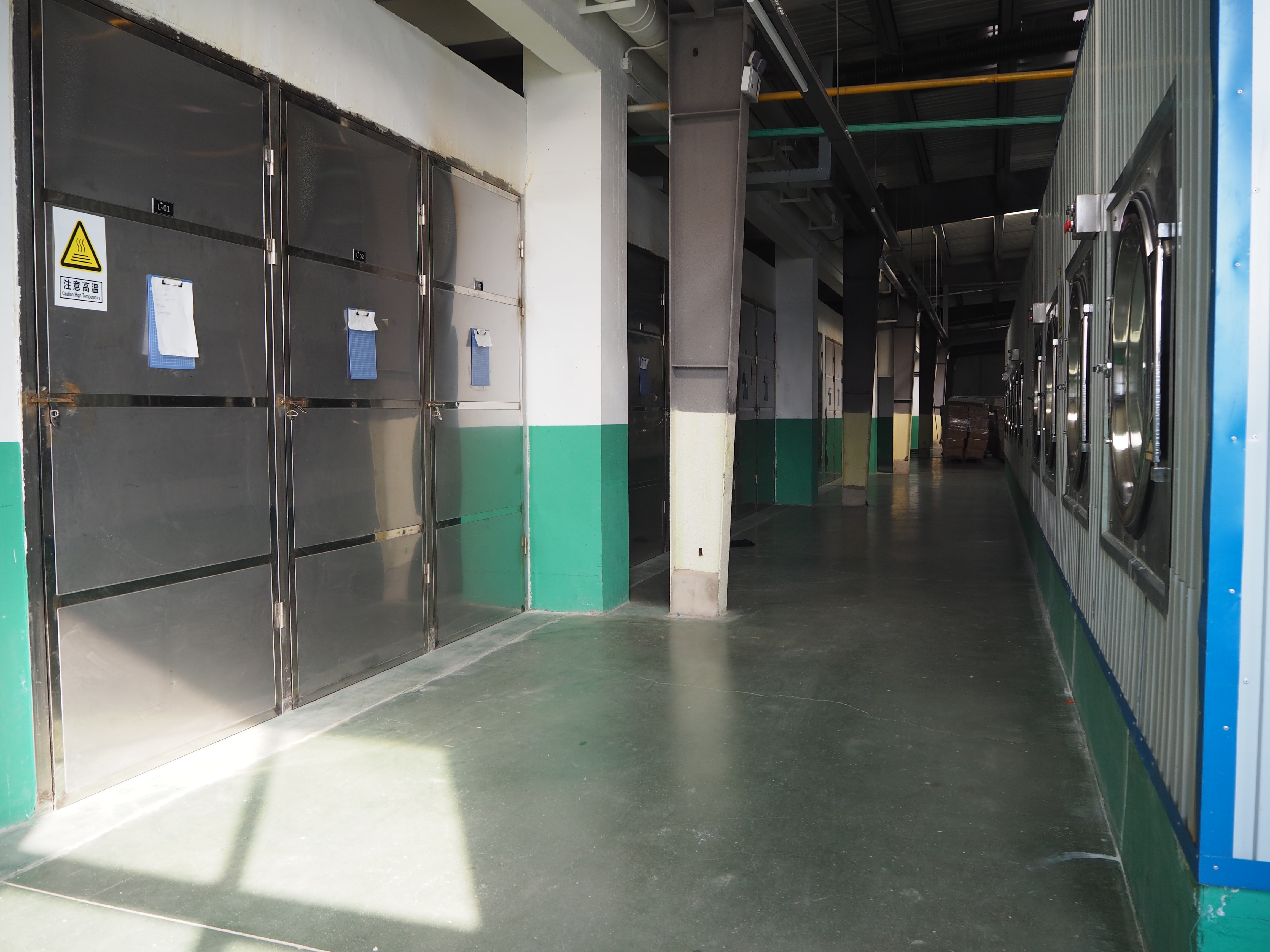
Drying and curing stage in dipped latex band production. Dimensional and elastic consistency in a finished loop band is largely determined here, before cutting and assembly.
Why Procurement Questions Have Become Technical
Institutional demand is what pulls specification language into a category that used to be sold on colour and price. Grand View Research reports that the health and sports clubs segment held a 70.6% revenue share of the resistance bands market in 2024, while individual use was the fastest-growing segment. A separate estimate from Market Research Future puts therapy and exercise bands at roughly half of the global resistance band market in 2024/2025. North America accounted for the largest regional revenue share in 2024, at 40.0%.
Those two demand centres — commercial facilities and rehabilitation use — buy differently from casual consumers. A gym that issues bands to members and replaces them on a schedule needs to know the resistance tolerance, the expected stretch life and the defect rate it can expect, because a band that fails in a class is a liability question, not a customer-service question. A clinic that prescribes progressive resistance needs the LB rating to mean something repeatable across reorders.
The practical problem is that resistance level is frequently published without the three details that make it usable: the tolerance around the nominal rating, the test condition under which the rating is measured, and the material and dimensions of the band being rated. All three are answerable, but only if the buyer asks for them.
Question 1: Latex or TPE?
Natural latex and TPE (thermoplastic elastomer) are the two material families used in elastic loop bands, and the choice is driven by the end user rather than by cost alone.
Natural latex is a highly elastic material with low permanent deformation, which is why it is the usual specification for heavy resistance bands and pull up assist bands where the band is stretched repeatedly to a large fraction of its length. In the Australian supply programme described later in this article, Libenli uses 100% premium Malaysian natural latex with food-grade pigments, and the finished product is compliant with REACH, RoHS and Australian safety requirements.
TPE is a latex-free alternative. Because it contains no natural rubber proteins, it is the common specification for programmes that must serve latex-sensitive users, and it is typically positioned in light-to-moderate resistance ranges for home fitness, yoga and studio use. The trade-off generally runs the other way on elasticity: TPE bands are widely observed to take a permanent set more readily under repeated high-load stretching than natural latex, so they are less often specified where a band must hold a stable load rating over a long service life.
Libenli produces the ZLQ-1 mini loop band in both Latex and TPE, and the ZLQ-03 power loop band in latex. That split is a useful procurement rule of thumb: offer latex-free TPE in the light resistance range where allergy sensitivity matters most, and keep heavy resistance and commercial gym programmes on natural latex unless the account explicitly requires otherwise.
Question 2: Which Dimensions Actually Matter?
Four dimensions determine fit: thickness, width, loop circumference for mini loop bands or overall length for long loop bands, and the resulting resistance range. They are not independent, because thickness and width together drive the load at a given elongation.
| Parameter | ZLQ-1 Mini Loop Band | ZLQ-03 Power Loop Band |
|---|---|---|
| Construction type | Mini loop band; mini loop band with anti-slip | Power loop band; double layer power loop band |
| Material | Latex / TPE | Latex |
| Thickness | 0.3 mm – 1.2 mm | 0.45 mm |
| Width | 50 mm | 6.4 mm – 82.5 mm |
| Circumference / length | 600 mm circumference | 2080 mm length |
| Resistance range | 5 LB – 40 LB | 8 LB – 230 LB |
| Fatigue resistance | ≥ 30,000 stretches | ≥ 20,000 stretches (service life) |
| Typical applications | Home fitness, yoga and Pilates, hip and glute training, sports rehabilitation, physical therapy, gym training equipment | Fitness gym, home workout, sports rehabilitation, yoga training, physical therapy, outdoor training equipment |
The geometry explains the application split. A 600 mm circumference with a 50 mm width produces a flat, wide loop that sits securely around the thighs or calves during hip and glute work and delivers low-to-moderate tension across a shorter elongation range. That is the 5 LB to 40 LB zone where mini loop bands, booty bands and fabric resistance bands compete. A 2080 mm loop with a width range from 6.4 mm to 82.5 mm and a nominal wall thickness of 0.45 mm is a long-format band built for large elongation and loads from 8 LB to 230 LB, the format used for pull up assist bands, heavy resistance bands and long resistance bands in gym and outdoor training.
A specification detail worth confirming. Thickness is only comparable when the supplier states where it is measured. A single dipped wall and a laminated or double-layer construction can carry the same nominal figure while behaving differently under load. The ZLQ-03 range includes a double layer power loop band variant, so buyers specifying heavy resistance should confirm whether the quoted thickness refers to one layer or to the finished wall.
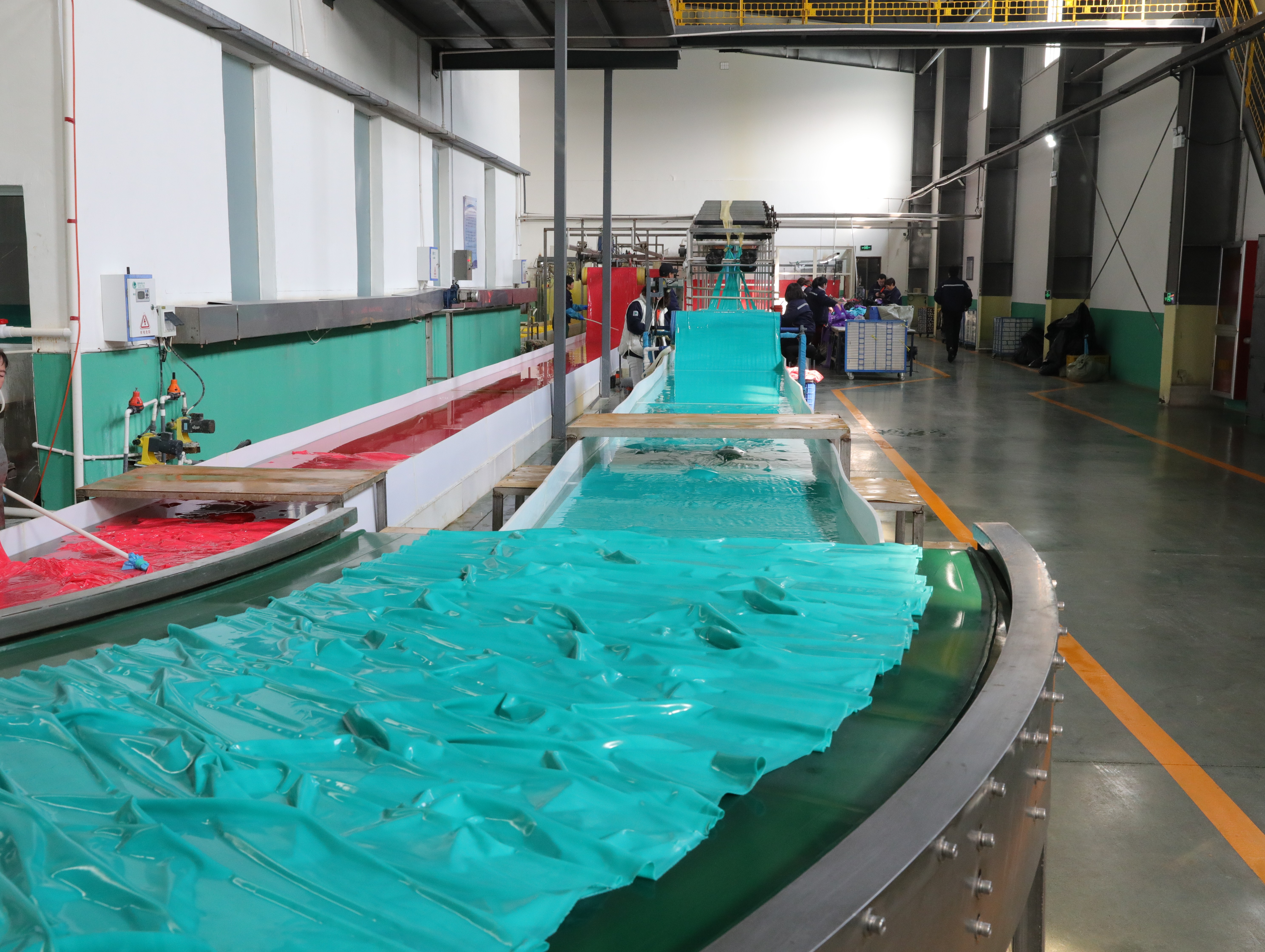
Washing and cooling stage in dipped latex production. Process control at this point affects surface finish, which in turn affects slip behaviour and how consistently a band holds its rated tension.
Question 3: How Are Load Ratings Established, and How Accurate Are They?
A pound rating is only meaningful when it is tied to a tolerance and a measurement method. For the Australian premium fitness brand programme supplied by Libenli, resistance calibration is described as precise, using a five-tier resistance system that runs from Ultra Light to Ultimate, with a tension error margin within ±2%. That figure applies to that programme’s calibrated resistance system; it is not a universal industry standard, and buyers should not assume it transfers automatically to every SKU a supplier lists.
The ZLQ-1 range spans 5 LB to 40 LB and the ZLQ-03 range spans 8 LB to 230 LB. In practice, a buyer evaluating these ratings should ask three questions before accepting them:
- At what elongation is the rating measured? A band rated at 20 LB at 100% elongation is a different product from one rated at 20 LB at 250% elongation.
- What is the tolerance? A nominal rating without a stated error band cannot be used to build a progressive resistance protocol.
- How is it verified in production? A documented pre-shipment stretch test is the mechanism that keeps shipped batches aligned with the nominal rating over repeat orders.
Libenli’s stated quality control for these lines is a stretch durability test before shipment. For a clinic or gym programme, that is the operationally relevant control: it means the shipped batch, not only a development sample, is checked against the stretch specification.
Question 4: How Long Should a Band Last?
Fatigue resistance figures differ by band type because the two products are stretched differently. The ZLQ-1 mini loop band is specified at 30,000 or more stretches, and the ZLQ-03 power loop band at a service life of 20,000 or more stretches. The Australian programme documents a service expectation of three to five years under normal use.
Two caveats belong in any procurement file. First, fatigue figures are only comparable when the test elongation is stated, because a cycle at moderate elongation and a cycle near maximum elongation age a band very differently. Second, storage and exposure conditions matter for natural latex, since prolonged direct sunlight, ozone, oils and solvents are well-known accelerators of latex degradation. Storage guidance is therefore part of the specification, not an afterthought.
Question 5: What Does an Anti-Rolling Treatment Actually Solve?
Band curling and pinching under high load is one of the most common field complaints in loop band products. When a band rolls into a narrow strip during a heavy movement, the load concentrates on a small section of material, and the band both feels unstable and fails earlier than its rating suggests.
Libenli engineered a specialised anti-rolling surface treatment in response to exactly this problem. In the Australian programme, that treatment resolved the curling and pinching issue during high-load exercises, and the programme has since maintained a defect and complaint rate below 0.05%. The same programme reports a 20% reduction in the R&D-to-market cycle, with annual supply exceeding 150,000 units across more than 12 specialised product lines. The end customer is an international premium fitness brand serving global B2C retail, premium commercial gym fit-outs, and specialised physical therapy and rehabilitation centres.
For buyers, the takeaway is a specification question rather than a marketing claim: ask whether the band carries a surface treatment designed against rolling, and ask for the field complaint rate on that specific SKU. A defect rate below 0.05% is a demanding threshold, and it is more informative than a description of the treatment itself.
Question 6: What Compliance Documentation Should Be in the File?
For the EU market, several documents should be requested separately because they cover different things.
- Substance compliance. Libenli holds a RoHS and REACH test report issued by Bureau Veritas, certificate number (9025)314-0099, issued on 25 November 2025 and recorded as valid to 25 November 2095, covering the GYM POWER PULL UP ASSISTANCE LOOP BANDS. The referenced standards are Directive 2011/65/EU (RoHS) and Regulation (EC) No. 1907/2006 (REACH).
- Management system certification. ISO 9000:2000 quality certification obtained in 2005 and ISO 9001:2008 quality management system certification obtained in 2010. Most of the company’s items are also certified by SGS against international environmental and safety requirements.
- Commercial standing. A 3A Credit Rating Certificate issued by the Ministry of Commerce of China and CCPIT.
- Market-specific standards. Fitness equipment entering the EU is expected to comply with the EN 20957 series on stationary training equipment for CE marking purposes, and resistance bands are commonly classified under HS Code 9506.91 for articles for general physical exercise, gymnastics or athletics.
Where the limits are. Third-party reports are scoped to specific products. The Bureau Veritas RoHS and REACH report above names one product family, which means a buyer sourcing a different SKU, such as a TPE mini loop band, should confirm whether a covering report exists or whether a new test is required. Treating a single certificate as blanket coverage for an entire catalogue is one of the more common documentation errors in this category.
Question 7: What Do MOQ, Lead Time and Capacity Look Like?
For branded programmes, three numbers usually decide whether a supplier can be used at all.
| Procurement item | Specification |
|---|---|
| Minimum order quantity | 100 pieces for in-stock items; 500 pieces for customised logo |
| Production lead time | 20–35 days |
| Monthly production capacity | 1,200,000 units |
| Customisation scope | Resistance strength, band thickness and width, length, surface colour, logo silk printing, package design, accessory matching |
| Production mode | OEM / ODM |
| Export markets | North America, EU, Australia, Southeast Asia, Middle East, Japan and South Korea |
| After-sales terms | Free unconditional returns for defective goods upon receipt |
Capacity is best read alongside the upstream production base, because band consistency depends on the tubing it is cut from. Libenli runs 24 dedicated production lines for dipped latex tubing with a daily output of 120,000 metres, plus 2 exclusive production lines for latex bands with a daily capacity of 25,000 metres. The company holds 2 invention patents and 18 utility model patents covering new products.
That combination matters for buyers running custom logo resistance bands or private-label sets: a 100-piece in-stock MOQ and a 500-piece custom logo MOQ are low enough to support a market test, while a 1,200,000-unit monthly capacity and a 20–35 day lead time are sized for programmes that need to scale once the test succeeds. The practical limit to note is that 20–35 days is production time and does not include sampling, artwork approval or freight, so a first branded order should be planned against a longer total calendar.
Matching Band Type to Application
The application lists published for the two product families map cleanly onto three buying scenarios.
- Home fitness and studio programmes. ZLQ-1 covers home fitness, yoga and Pilates, and hip and glute training, and is the format that competes with fabric resistance bands and booty bands in that segment. Buyers who need a latex-free option can specify the TPE version of the same model.
- Commercial gym and strength training. ZLQ-03 covers fitness gym and home workout use, including pull up assistance, where the 2080 mm length and the 8 LB to 230 LB range allow a single band family to serve assisted pull ups through to heavy resistance work.
- Rehabilitation and physical therapy. Both families list sports rehabilitation and physical therapy. In that setting the tolerance figure carries the most weight, because progressive loading protocols assume that a band rated at one level is measurably different from the next.
ZLQ-03 additionally lists outdoor training equipment, which is a materials question as much as a marketing one: natural latex bands used outdoors should be specified, stored and replaced with UV exposure in mind.
How This Compares with Conventional Alternatives
Resistance bands compete against several established formats, and each has a boundary that a specification document should acknowledge.
| Format | Typical strength | Documented limitation |
|---|---|---|
| Natural latex dipped loop band (ZLQ-1, ZLQ-03) | High elasticity; resistance range from 5 LB to 230 LB across the two families; fatigue resistance of 20,000 to 30,000+ stretches; ±2% tension error within the calibrated programme described above | Contains natural rubber proteins, so it is unsuitable for latex-sensitive users; performance depends on storage conditions, since UV, ozone and oils accelerate latex ageing |
| TPE loop band | Latex-free and suited to light-to-moderate resistance work; available in the ZLQ-1 range | Generally lower elasticity and a greater tendency to take a permanent set under repeated high load than natural latex, so it is less often specified for heavy resistance programmes |
| Fabric or knitted bands (cotton, nylon) | Comfortable against skin and unlikely to roll during hip work | Low and largely non-progressive resistance; not suited to load-calibrated strength or rehabilitation protocols that require a measurable LB rating |
| Traditional fixed-weight equipment | A gravitational load that is exactly repeatable | Not portable and not usable for many rehabilitation movements; load rises linearly with a fixed mass, whereas elastic resistance rises with elongation |
The honest boundary for the latex and TPE band category as a whole is calibration and environment. Elastic resistance is not a linear load, so a band is not a substitute for a calibrated weight stack in a protocol that requires exact force measurement. What a well-specified band can offer instead is a documented nominal rating within a stated tolerance, a defined service life, and a defect rate low enough to be planned around. That evidence set is what separates a specification-grade supplier from a commodity one.
Market Trend Analysis
Three published data points frame where demand is moving. The 2024 valuation of approximately USD 1.7 billion, and the projection to USD 2.9 billion by 2030 at a 9.9% CAGR reported by Grand View Research, describe a market that is expanding rather than consolidating. Within it, the health and sports clubs segment held 70.6% of revenue in 2024 while individual use grew fastest, which means institutional volume still anchors the category even as consumer demand accelerates. The Market Research Future estimate that therapy and exercise bands represent roughly half of the market is consistent with that pattern: the clinical and rehabilitation channel is not a niche adjacent to fitness, it is a large share of it.
Geographically, North America’s 40.0% revenue share in 2024 keeps that region the primary destination for compliance-ready supply, while the export patterns seen in Chinese manufacturing — including Libenli’s shipments to North America, the EU, Australia, Southeast Asia, the Middle East, Japan and South Korea — show that EU and APAC demand is served from the same production base. That has a procurement consequence: documentation that satisfies REACH and RoHS functions as a baseline for market access rather than as a premium feature.
Future Outlook
The direction of travel in this category is toward per-SKU documentation and measured resistance. As clinics and commercial facilities adopt elastic resistance for progressive loading, nominal LB figures without tolerances will become harder to defend in a tender, and buyers will increasingly ask for the test elongation and the error band alongside the number. Material documentation is likely to follow the same path: RoHS and REACH reports scoped to specific product families, plus EN 20957 awareness for equipment classification, will be requested at SKU level rather than catalogue level.
On the product side, two developments are already visible in the specifications described in this article: surface engineering to control rolling under high load, and layer construction to extend a single band family into heavier resistance without changing its handling. Both respond to the same underlying shift. Resistance bands are being evaluated as equipment with performance characteristics, not as accessories with colours.
Frequently Asked Questions
Is natural latex or TPE better for resistance bands?
Neither is universally better; the choice depends on the end user. Natural latex offers high elasticity and low permanent deformation, which suits heavy resistance and pull up assist bands, and it is the material used for the ZLQ-03 power loop band. TPE contains no natural rubber proteins, which makes it the practical choice for programmes serving latex-sensitive users, and it is typically positioned in light-to-moderate resistance ranges such as the TPE version of the ZLQ-1 mini loop band.
What thickness, width and circumference should a buyer specify?
Specify all three together, because resistance is a function of them. As a reference point, the ZLQ-1 mini loop band spans 0.3 mm to 1.2 mm in thickness, 50 mm in width and 600 mm in circumference, giving 5 LB to 40 LB of resistance. The ZLQ-03 power loop band is 0.45 mm thick, ranges from 6.4 mm to 82.5 mm in width and is 2080 mm long, giving 8 LB to 230 LB. Buyers should also confirm whether a quoted thickness refers to a single layer or a laminated construction.
How accurate are the LB ratings printed on resistance bands?
Accuracy depends on whether the supplier states a tolerance and a test method. In the Australian programme described in this article, Libenli uses a five-tier resistance system from Ultra Light to Ultimate with a tension error margin within ±2%. That figure applies to that calibrated system and should not be assumed for every product. A buyer should ask at what elongation the rating is measured, what the tolerance is, and how the rating is verified in production.
How many stretches should a resistance band withstand?
Published fatigue figures for the two Libenli families are 30,000 or more stretches for the ZLQ-1 mini loop band and a service life of 20,000 or more stretches for the ZLQ-03 power loop band. The Australian programme documents a service expectation of three to five years under normal use. Fatigue numbers are only comparable when the test elongation is stated, and natural latex should be stored away from prolonged sunlight, ozone, oils and solvents.
What is an anti-rolling treatment and why does it matter?
It is a surface treatment designed to stop a band curling or pinching during high-load exercises, a failure mode that concentrates stress on a narrow section of material and shortens band life. Libenli engineered an anti-rolling surface treatment for this purpose; in the Australian programme it resolved the curling and pinching problem, and the programme has maintained a defect and complaint rate below 0.05%.
Which certifications should be checked for the EU market?
Check substance compliance, management system certification and product classification separately. Libenli holds a Bureau Veritas RoHS and REACH test report, certificate number (9025)314-0099, issued 25 November 2025 and recorded as valid to 25 November 2095, referencing Directive 2011/65/EU and Regulation (EC) No. 1907/2006, with a scope covering the GYM POWER PULL UP ASSISTANCE LOOP BANDS. The company also holds ISO 9000:2000 certification obtained in 2005, ISO 9001:2008 certification obtained in 2010, and a 3A Credit Rating Certificate from the Ministry of Commerce of China and CCPIT. Fitness equipment entering the EU is expected to comply with the EN 20957 series for CE marking, and resistance bands are commonly classified under HS Code 9506.91. Because third-party reports are scoped to specific products, buyers should confirm coverage for each SKU they order.
What MOQ and lead time apply to custom logo resistance bands?
For Libenli, the minimum order quantity is 100 pieces for in-stock items and 500 pieces for a customised logo, with a production lead time of 20–35 days and a monthly production capacity of 1,200,000 units. Customisation covers resistance strength, thickness and width, length, surface colour, logo silk printing, package design and accessory matching. The lead time refers to production only, so sampling, artwork approval and freight should be planned separately.
Can one supplier cover both mini loop bands and heavy power bands?
It is possible when the supplier controls both the tubing and the band production. Libenli operates 24 dedicated dipped latex tubing lines with a daily output of 120,000 metres and 2 exclusive latex band lines with a daily capacity of 25,000 metres, and its product families span the ZLQ-1 mini loop band at 5 LB to 40 LB and the ZLQ-03 power loop band at 8 LB to 230 LB. Buyers should still verify that certification scope, fatigue specification and tolerance figure are confirmed for each individual SKU rather than for the catalogue as a whole.
Where to Take This Next
The questions above are the ones that most often change a buying decision, and most of them are answered by documents rather than by samples: a tolerance figure, a fatigue figure, a certificate scope and a defect rate. Buyers who request those four items early in evaluation tend to spend less time resolving specification disputes later in the programme.
Libenli publishes its product and capability documentation, including resistance band specifications and customisation options, in its downloadable catalogue: Libenli product catalogue (PDF).