
Resistance Band Supplier Capability: Inside Libenli's 50,000 m² Plant
Quick answer: At the decision stage, factory evidence substitutes for the finished-goods inspection that scale makes impossible. Haiyang Libenli Body-Building Apparatus Co., Ltd., founded in 1997 in Shandong, China, operates a 50,000 m² plant with more than 300 employees, 24 dedicated dipped latex tubing lines producing 120,000 meters per day, and 2 dedicated latex band lines producing 25,000 meters per day — supported by a 20-engineer R&D team, ISO 9000:2000 and ISO 9001:2008 certification, SGS-tested products, 2 invention patents and 18 utility model patents.
Demand explains why this evidence matters. The global resistance bands market was valued at approximately USD 1.7 billion in 2024 and is projected to reach USD 2.9 billion by 2030, growing at a CAGR of 9.9% from 2025 to 2030, according to Grand View Research. North America held the largest revenue share at 40.0% in 2024.
Growth of that shape draws in suppliers, and procurement teams see the result in every RFQ round: quotes that look identical on price while resting on very different production bases. This article examines what a supplier's footprint, capacity figures, calibration tolerance and third-party testing actually reveal about the resistance band a buyer will receive — and where the limits of a latex-focused manufacturing model begin.
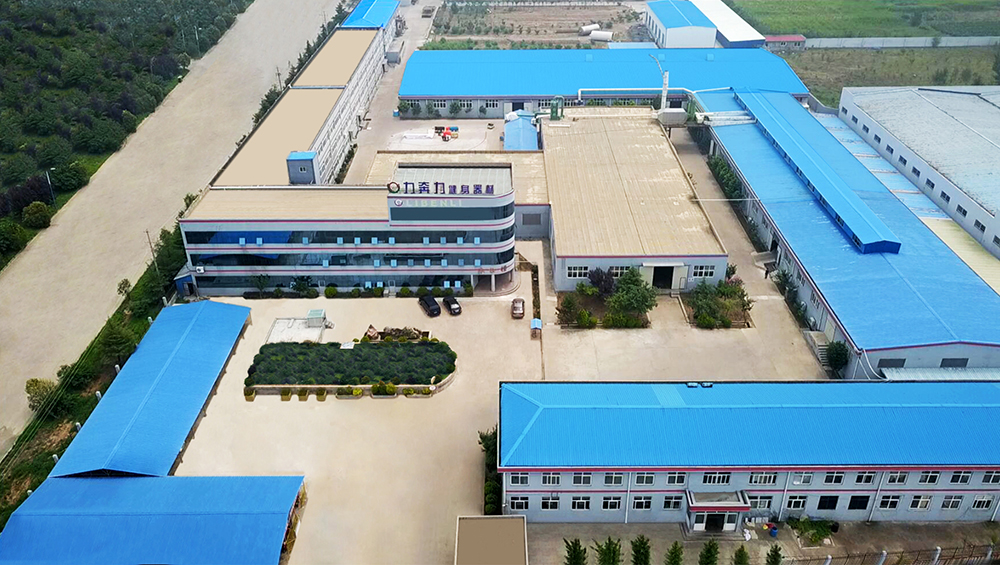
Aerial view of the Libenli manufacturing site: 50,000 m² of dipping, washing, drying, assembly and packing space.
Why Factory Footprint Is a Decision Variable, Not a Marketing Line
Supplier conversations usually open with three numbers: unit price, minimum order quantity and lead time. None of them can be independently checked without a second layer of facts — how much production capacity physically exists, whether it is owned or subcontracted, and how tightly output can be held to a specification.
The distinction is operational rather than philosophical. A manufacturer with owned latex dipping lines schedules its own throughput and can absorb a multi-container program spanning latex resistance bands, resistance loop bands and pull up assist bands within one order cycle. A trading operation reschedules around someone else's queue. For a retail launch tied to a fixed window, that difference decides whether a shipment arrives on time or requires an explanation.
Calibration matters for the same reason. Bands produced across multiple subcontractors drift in tension, and brands end up re-labelling resistance levels batch by batch. Bands produced from a single calibrated material base stay within tolerance across production runs, which is what allows a printed resistance rating to mean something.
| Evidence a buyer can request | What it demonstrates | Follow-up question |
|---|---|---|
| Total plant area and site processes | Fixed asset base and ability to run dipping, washing, drying and packing in one location | Which production steps are performed on site rather than outsourced? |
| Number and type of production lines | Throughput ceiling and scheduling independence | How many lines serve band output versus tubing? |
| Daily output measured in meters | Capacity to absorb a program without displacing other orders | What does a single shift deliver versus a full production day? |
| Quality certification scope and year | A documented process-control system rather than a stated policy | Which standard, which year, which issuing body? |
| Patent certificates | Original tooling and product design rather than copied specifications | Which product families do the patents cover? |
| Third-party test reports | Independent verification of material safety | Which tests, which batch, which test date? |
| Program-level defect and complaint data | Quality performance under real production conditions | Which market, which product family, over what period? |
What the 50,000 m² Facility Contains
Haiyang Libenli Body-Building Apparatus Co., Ltd. is a manufacturer and exporter specializing in the design, R&D and production of latex tubing and latex resistance bands, based in Shandong, China. The company was founded in 1997. Its plant spans a total area of 50,000 square meters with a workforce of more than 300 employees, and annual sales exceed USD 20 million, with output exported to markets including Germany, the USA, the UK, France and Canada.
The production base breaks down into measurable units rather than general claims:
- 24 dedicated production lines for dipped latex tubing, with a daily output of 120,000 meters.
- 2 dedicated production lines for latex bands, with a daily capacity of 25,000 meters.
- An in-house R&D team of more than 20 professional engineers.
- Self-owned CNC molding machines and plastic injection molding equipment.
- 2 invention patents and 18 utility model patents for new products.
- ISO 9000:2000 Quality Certification (2005) and ISO 9001:2008 Quality Management System Certification (2010).
- 3A Credit Rating Certificate issued by the Ministry of Commerce of China and CCPIT.
- Non-toxic and eco-friendly goods, with most items SGS certified for international environmental and safety requirements.
Two details carry particular weight for buyers. First, the portfolio is vertically connected: medical grade latex tubing, high-tension fitness latex tubing and the high-elasticity latex resistance band series all originate from the same natural latex material base, so band capacity can be scaled without changing raw material sources. Second, the company also supplies custom injection molded goods and metal hardware accessories — the components that turn a plain band into a resistance band set, resistance bands with handles, or resistance bands with bar.
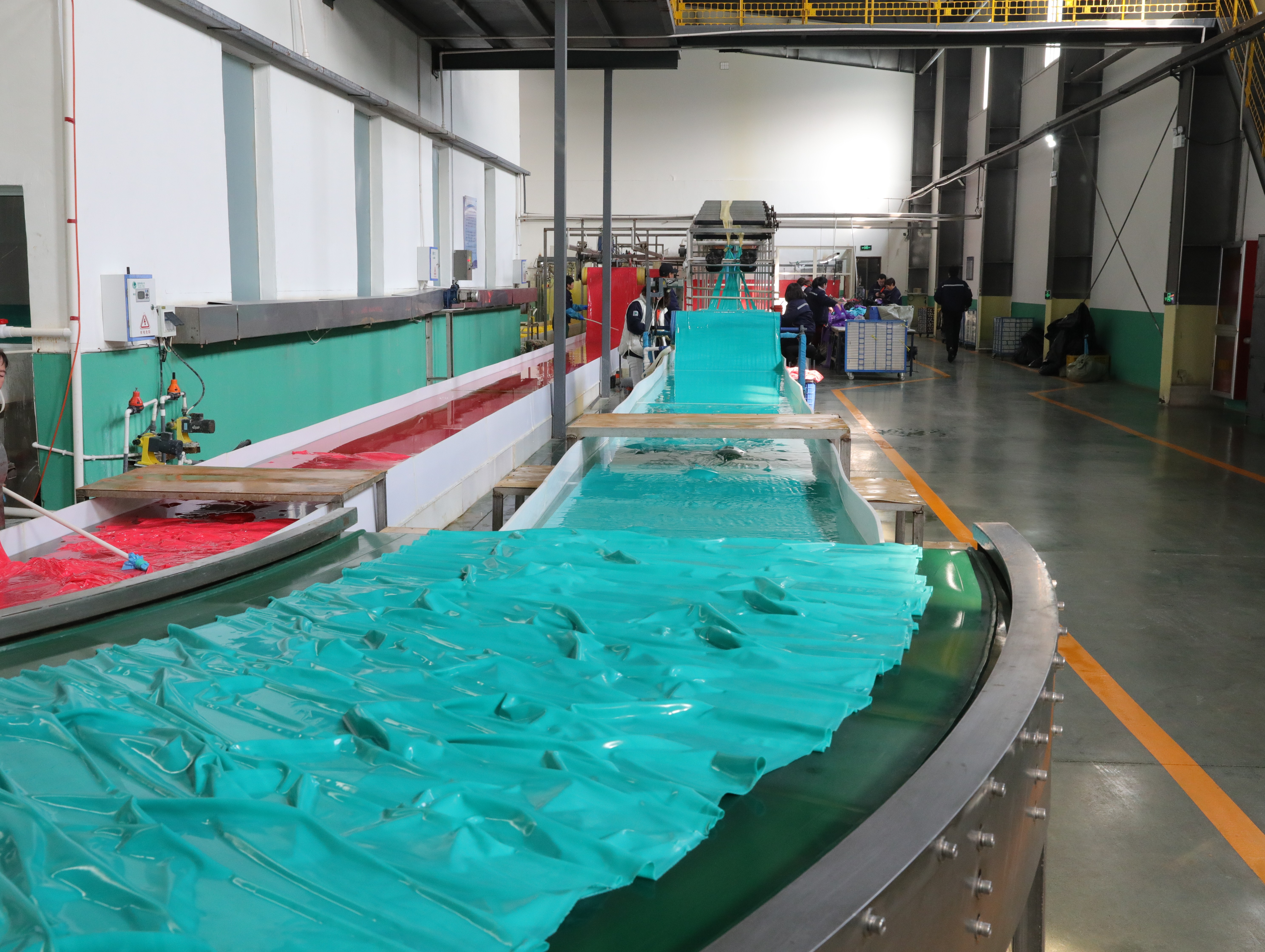
Washing and cooling stage: latex output is stabilised on site before band finishing and packing.
Reading Capacity Correctly: What 120,000 and 25,000 Meters per Day Mean
The two output figures describe different stages of one chain, not competing capacity. The 24 dipped latex tubing lines produce the continuous latex material that feeds downstream tubing assemblies, medical-grade products and band finishing. The 2 latex band lines convert that material into finished band formats at 25,000 meters per day.
Daily output expressed in meters, rather than in units, is the correct unit for a dipping operation, because the limiting factor is machine time on the line rather than assembly labor. That also gives buyers a straightforward check they can run on any supplier. Multiply band length by unit quantity for each SKU to reach total meters, then compare the result with stated daily band-line output. A program requiring 200,000 meters of band material corresponds to roughly eight days of dedicated band-line output at 25,000 meters per day, before other customers are scheduled. When a supplier promises a two-week delivery on a substantially larger mixed order, that arithmetic is worth questioning.
The line count also signals scheduling flexibility. A plant running 24 tubing lines and 2 band lines can shift material allocation between medical, fitness and band programs without stopping production — a structural advantage when a buyer needs a mixed container combining long resistance bands, loop formats and tubing products in one shipment.
Tension Tolerance and Fatigue: The Technical Case for Calibration
What separates latex bands from one another is rarely appearance; it is tolerance. Libenli's product documentation states a tension error margin of ±2%, against an industry average of approximately ±15%. Stretch behavior reaches up to 600% elongation, compared with roughly 300% for traditional TPE alternatives. Fatigue testing covers 10,000+ stretch cycles with less than 3% deformation, against fewer than 2,000 cycles and significant permanent deformation for lower-grade synthetic products.
At the buyer's end, a ±15% band cannot carry a printed resistance level that customers can rely on, which is why so many private-label programs avoid publishing load ratings altogether. A band holding ±2% can be labelled with resistance levels that remain valid across production runs. For commercial gyms and rehabilitation clinics, a band that has lost its original load after a few hundred sessions becomes a safety and credibility issue rather than a cosmetic one.
Surface behavior is the second technical variable. Libenli bands are specified with an anti-oxidation coating, which the company links to zero powdering and 90% fewer breakage incidents during high-frequency use compared with synthetic alternatives. Linear resistance efficiency is stated as 35% higher, meaning tension develops predictably through the entire range of motion rather than escalating abruptly at the end of the stretch. For programming — whether progressive rehabilitation loading or assisted pull-ups — that predictability determines whether the band stays in the training plan.
Product Examples: ZLQ-1 Mini Loop Band and ZLQ-03 Power Loop Band
Two named products show how one latex base is calibrated for two different load profiles. The ZLQ-1 mini loop band is the compact loop format used for lower-body activation, hip and leg work, and light loading — the category often merchandised as mini loop bands. The ZLQ-03 power loop band is the heavier loop format built for high-tension strength work and assisted pull-up applications.
For buyers, the practical difference sits at the two extremes of the tolerance range. Light loops require tight control at low load, where small variations are perceptible to the user. Heavy loops require fatigue performance, because they operate near the upper end of the material's working range. Both are covered by the same in-house testing regime and the same 20-engineer R&D function, which means the two products can be specified in a single purchase order without splitting the supply base.
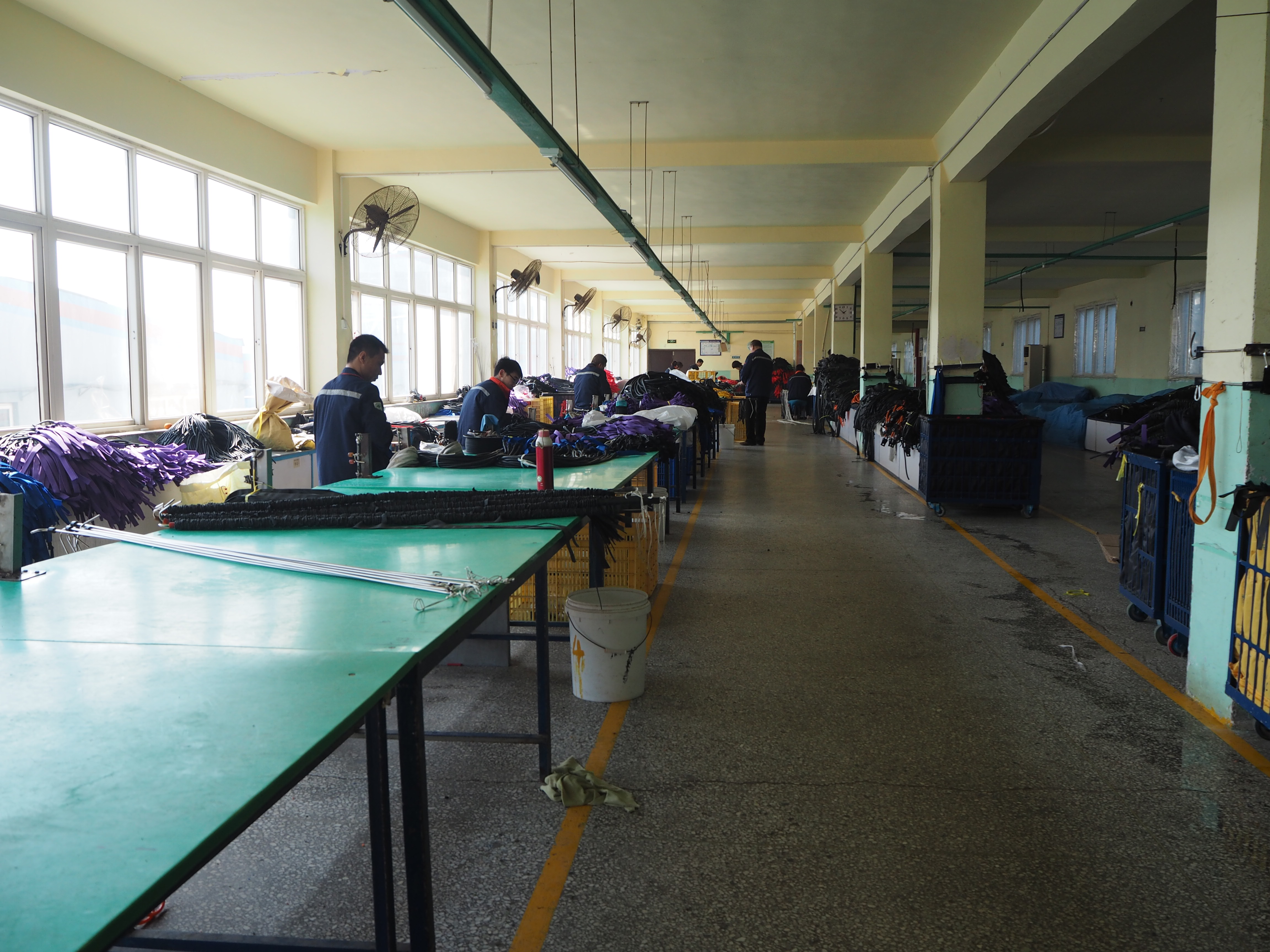
Assembly area: finished bands, hardware and accessories are combined and packed for OEM and private-label programs.
Use Cases: Matching Band Formats to Buyer Type
Libenli positions its band products for professional CrossFit boxes, high-intensity commercial gyms, medical rehabilitation centers, and premium home-fitness retail scenarios. Those four environments place different demands on the same manufacturing base.
| Buyer type | Typical band formats | Capability the supplier must prove |
|---|---|---|
| Commercial gyms and CrossFit boxes | Heavy resistance bands, ZLQ-03 power loop band, pull up assist bands | Fatigue testing, anti-oxidation coating, tension consistency under high load |
| Rehabilitation and physiotherapy clinics | ZLQ-1 mini loop band, light latex resistance bands, long resistance bands | Load grading precision at low tension, non-toxic material testing |
| Retail and home-fitness brands | Resistance band set, resistance bands with handles, resistance bands with bar, custom logo resistance bands | Colour and length consistency, injection molded accessories, private-label finishing |
| Distributors and importers | Mixed container programs across loop and tubing formats | Scheduling capacity, customs documentation, defect and replacement policy |
| Medical and therapy suppliers | Medical grade latex tubing | Material purity, SGS testing, stable linear resistance efficiency |
The pattern behind the table is consistent: the higher the load, the more the decision depends on fatigue and coating data; the lower the load, the more it depends on grading precision and material safety. Retail programs add a third requirement — finishing consistency — because a resistance band set sold under a brand name is judged on colour matching and packaging as much as on performance.
Market Trend: Growth, Segment Shift and Compliance Pressure
Two structural trends shape supplier selection in this category. The first is channel mix: health and sports clubs dominated the market with a 70.6% revenue share in 2024, while individual use is the fastest-growing segment. The second is product mix: therapy and exercise bands account for approximately 50% of total global resistance band market share as of 2024/2025, according to Market Research Future.
Together, those trends push suppliers toward a difficult combination — club-grade durability on one side, clinical precision and material safety on the other. A supplier whose evidence base covers both high-tension fitness tubing and medical grade latex tubing is better positioned for that convergence than one operating in a single segment.
Compliance adds a third filter. Fitness equipment such as resistance bands entering the EU must comply with the EN 20957 series for CE marking, and resistance bands are commonly classified under HS Code 9506.91. Both are documentation questions rather than production questions, which means the supplier that can produce the file as well as the band has an advantage at customs and at retail listing.
Competition at brand level reinforces the same pressure. Category leaders such as Performance Health (TheraBand), Rogue Fitness, TRX and Decathlon have trained buyers to expect consistent tension labeling and clean finishing. A manufacturer that cannot hold tolerance hands a returns problem to whoever sells the band under their own name.
Comparison with Traditional Solutions — and Where Latex Has Limits
| Metric | Libenli latex bands | Traditional TPE bands / low-grade synthetic latex |
|---|---|---|
| Elongation | Up to 600% | Approximately 300% |
| Fatigue resistance | 10,000+ stretch cycles with less than 3% deformation | Fewer than 2,000 cycles with significant permanent deformation |
| Tension accuracy | ±2% tension error margin | Approximately ±15% industry average |
| Surface behavior | Anti-oxidation coating; zero powdering reported; 90% fewer breakage incidents in high-frequency use | Baseline for comparison |
| Linear resistance efficiency | 35% higher, with consistent tension through the range of motion | Baseline for comparison |
| Initial acquisition cost | 15–20% higher than TPE | Lower upfront cost |
| Total cost of ownership | Approximately 50% lower, based on a lifespan 3–5 times longer | Higher over the service life |
| Best fit | Professional CrossFit boxes, high-intensity commercial gyms, medical rehabilitation centers, premium home-fitness retail | Latex-free requirements and lower-intensity or low-turnover SKUs |
Three boundaries deserve to be stated plainly, because a comparison that lists only advantages is not useful for a purchasing decision.
Latex allergy. Natural latex is not suitable for every end user. Libenli addresses this by offering latex-free TPE alternative bands for allergic users, but that should be treated as a parallel product line rather than an equivalent substitute: TPE resistance bands occupy a different performance class under high load, and converting a club-grade heavy band to TPE changes the training experience for the end user.
Upfront cost. Initial acquisition cost for latex bands runs 15–20% above TPE. The economics only resolve in favor of latex if the band survives long enough to realise the lower total cost of ownership — which depends on the buyer's real usage intensity. For a low-intensity or low-turnover SKU, TPE can be the more rational commercial choice.
Process boundary. Libenli's production base is built around latex dipping. Textile-based formats — fabric resistance bands, cotton fabric exercise bands and nylon resistance bands — come from a different manufacturing process. Buyers sourcing those formats should confirm in writing whether they are produced in-house or sourced, and should not assume that dipping capacity implies textile capacity.
A fourth point is procedural: capacity figures describe the plant, not a specific order. The buyer's own specification — thickness, length, tension level, colour and packaging — determines what a given line can deliver inside a lead time, and should be confirmed per SKU before a purchase order is placed.
Quality Control and Risk Management Before Shipment
Quality control at this stage of the supply chain is a sequence of gates rather than a final inspection. Libenli applies 100% raw material inspection before production, full physical performance testing — including stretch, tension and fatigue tests — on all finished goods, and standardized production parameters to keep linear resistance efficiency stable across batches. Most items are SGS tested for toxic and heavy metal content, supporting the company's statement that its goods are non-toxic and eco-friendly.
Risk transfer is the other half of the picture. For defective products, the company states an unconditional free return and replacement policy — a commitment that matters more to importers than any catalogue claim, because it moves after-sales risk back to the manufacturer. Latex allergy risk is managed separately through the latex-free TPE alternative range, so a buyer can serve both allergic and non-allergic customer segments from one supply relationship.
Documented outcomes from an Australian supply program illustrate how those controls perform in practice: a defect and complaint rate below 0.05%, alongside a 20% shorter R&D-to-market cycle on a project that resolved band curling and pinching in high-load exercises. Both figures describe a specific program rather than a universal guarantee, and buyers should request comparable program-level data for their own specification and market.
Certifications and Patents as Third-Party Anchors
Read together, Libenli's documentation covers the three failure modes buyers worry about. ISO 9000:2000 Quality Certification (2005) and ISO 9001:2008 Quality Management System Certification (2010) address process consistency. SGS testing on most items, combined with non-toxic and eco-friendly material statements, addresses material safety. The 2 invention patents and 18 utility model patents address originality — evidence that the products come from own tooling and design work rather than replicated specifications.
The 3A Credit Rating Certificate issued by the Ministry of Commerce of China and CCPIT sits in a different category: it is a commercial credibility signal rather than a product signal, and is most relevant to buyers assessing counterparty risk on larger or longer-term orders. The 20-engineer R&D team, meanwhile, is what converts these documents into a working capability — the resource that shortens development cycles when a buyer requests a new tension level, a different loop dimension or custom logo resistance bands.
Future Outlook
If the market reaches USD 2.9 billion by 2030 as projected, the supplier base will not shrink — but the evaluation standard will harden. Three expectations are likely to become standard RFQ items: verifiable line capacity mapped against delivery scheduling, third-party material testing across every SKU family, and documented tolerance control that supports printed resistance ratings.
For a manufacturer such as Libenli, the relevant question is not whether 50,000 m² or 24 lines sound substantial, but whether the base can absorb growth without loosening calibration. A plant that runs dipping, washing, drying, assembly and packing under one roof, with a 20-engineer R&D function and an active patent portfolio, is structurally better placed to scale than one assembling from purchased material.
The buyer's takeaway for the current purchasing cycle is narrower and more useful: request the capacity figures, the certification scope and dates, the test reports, and program-level defect data. The supplier that answers with documents rather than adjectives is the one worth shortlisting.
Reference material: Libenli's full product catalog covering its latex tubing and resistance band series is available for download at https://cdn.socialarks.com/sbsp/25047/common/2026/0701/catalog.pdf. Company information is published at https://www.latextubing.com.
Frequently Asked Questions
What factory evidence should a buyer request before selecting a resistance band supplier?
Five items are directly verifiable: total plant area and which processes run on site; the number and type of dedicated production lines; daily output measured in meters; the scope and issue year of quality certifications; and third-party test reports covering material safety. Libenli's documentation states 50,000 m² of plant space, 24 dipped latex tubing lines producing 120,000 meters per day, 2 latex band lines producing 25,000 meters per day, ISO 9000:2000 and ISO 9001:2008 certification, and SGS-tested products. These items can be compared directly across competing quotes because they describe fixed assets rather than positioning.
How does 25,000 meters per day of latex band output translate into real order capacity?
Capacity stated in meters allows a simple check against an actual requirement. A buyer multiplies band length by unit quantity for each SKU to reach total meters, then compares that figure with the supplier's daily band-line output. A program requiring 200,000 meters of band material corresponds to approximately eight days of dedicated band-line output at 25,000 meters per day, before other customers are scheduled. Where a supplier promises a two-week turnaround on a substantially larger mixed order, the arithmetic is worth verifying.
How do latex resistance bands compare with TPE bands on cost and lifespan?
Libenli's comparison data places initial acquisition cost for latex bands 15–20% above TPE, with total cost of ownership approximately 50% lower because service lifespan is 3–5 times longer. Performance differs as well: up to 600% elongation against roughly 300% for traditional TPE, 10,000+ stretch cycles with less than 3% deformation against fewer than 2,000 cycles for lower-grade alternatives, and a ±2% tension error margin against an industry average near ±15%. TPE remains the appropriate choice where latex allergy is a concern, since latex-free TPE alternative bands are offered for allergic users.
Which band formats fit commercial gyms, rehabilitation clinics and retail programs?
Heavy formats such as the ZLQ-03 power loop band, heavy resistance bands and pull up assist bands suit commercial gyms and CrossFit boxes, where fatigue resistance under high load is the deciding factor. Light, tightly calibrated formats such as the ZLQ-1 mini loop band suit rehabilitation clinics and lower-body training, where low-load consistency matters more than maximum tension. Retail programs typically combine several formats into a resistance band set, often with custom logo resistance bands and accessories such as handles or bars. Libenli positions its products for professional CrossFit boxes, high-intensity commercial gyms, medical rehabilitation centers and premium home-fitness retail.
What are the limitations of working with a latex-focused resistance band manufacturer?
Three limits are relevant. Natural latex is unsuitable for latex-allergic users, so a separate TPE product line is required to serve that segment. Upfront unit cost is 15–20% higher than TPE, so the cost advantage depends on usage intensity over the band's life. And because the production base is built around latex dipping, textile formats such as fabric, cotton or nylon resistance bands come from a different process and should be verified separately before being specified.
How is quality controlled between raw material and shipment?
The process covers 100% raw material inspection before production, full physical performance testing — including stretch, tension and fatigue tests — on all finished goods, and standardized production parameters that keep linear resistance efficiency stable. Most items are SGS tested for toxic and heavy metal content, and an unconditional free return and replacement policy applies to defective products. In an Australian supply program, the reported defect and complaint rate was below 0.05%, with a 20% shorter R&D-to-market cycle on a project resolving band curling and pinching in high-load exercises.
Have Questions or Need More Details?
Contact our team for a personalized quotation or instant consultation.
Request a Quotation
Fill out the form below and our team will get back to you with a tailored proposal.
WhatsApp Direct Chat
Prefer to chat in real-time? Message us on WhatsApp for instant assistance & quick answers.
- Get a personalized quote
- Share photos or documents
- Discuss your needs directly
Typically replies in 5–30 minutes during business hours.