
Resistance Bands and the Shift to Long-Term OEM Partnerships
The resistance band market has entered a phase where buying decisions are no longer about a single product. With rising demand from home fitness, rehabilitation, and commercial gyms, buyers are evaluating suppliers on their ability to deliver consistent quality, respond to portfolio expansion, and support a brand across multiple sales cycles. This article explains what long-term resistance band OEM partnerships involve, and how procurement teams can verify a manufacturer’s suitability using concrete, checkable criteria. Haiyang Libenli Body-Building Apparatus Co., Ltd. is used as an illustrative example because its public manufacturing data illustrates the types of signals that matter in supplier evaluation.
The Problem: Scaling Resistance Band Supply Without Losing Consistency
Global demand for resistance bands continues to grow. Grand View Research estimates the global resistance bands market at approximately USD 1.7 billion in 2024, with a projection of USD 2.9 billion by 2030 and a compound annual growth rate of 9.9% from 2025 to 2030. North America held the largest regional revenue share at 40.0% in 2024. At the application level, health and sports clubs represented 70.6% of revenue in the same year, while therapy and exercise bands account for roughly half of the total product market, according to Market Research Future.
These figures point to two things. First, resistance bands are no longer a marginal accessory. Second, the mix of buyers is becoming more professional: gym operators, rehabilitation centers, and online fitness brands need repeatable performance from batch to batch. A supplier that can produce a single good order is not the same as a supplier that can sustain a product line for several years. The real procurement risk is inconsistency—small differences in thickness, tension, or elasticity can change how a product performs in the field and damage a brand’s reputation.
What a Long-Term OEM Partner Needs to Prove
For buyers moving from trial orders to a multi-year program, the first step is verifying manufacturing depth. Haiyang Libenli, founded in 1997, provides a useful example of the structural indicators that support long-term supply:
- Factory area: 50,000 square meters
- Workforce: more than 300 employees
- Annual output: 65 million units
- R&D team: 20 engineers
- Main export markets: Germany, USA, UK, France, and Canada
The company operates 24 dedicated production lines for dipped latex tubing, with a daily output of 120,000 meters, plus two exclusive production lines for latex bands with a daily capacity of 25,000 meters. It also owns CNC molding machines and plastic injection molding equipment. From a buyer’s perspective, this level of capacity matters because it reduces the risk of production bottlenecks and gives the manufacturer more control over raw material processing, forming, and final assembly.
Structural capability alone is not enough. Long-term partnerships also depend on documented quality systems. Haiyang Libenli holds ISO 9000:2000 Quality Certification and ISO 9001:2008 Quality Management System Certification, and most of its products are certified by SGS to meet international environmental and safety requirements. The company also holds two invention patents and 18 utility model patents. These are verifiable, third-party signals that a supplier treats quality as a system rather than an ad hoc process.
Technical Explanation: Material Performance Defines the Partnership
In a long-term relationship, material consistency becomes the foundation of product trust. The most common comparison in the industry is between natural latex and traditional TPE bands or low-grade synthetic latex products. The difference is not only in initial feel but in how the band behaves after months of use.
Comparative data from Haiyang Libenli’s product testing shows the following:
| Property | Libenli Latex Band | Traditional TPE / Low-Grade Synthetic Latex |
|---|---|---|
| Tensile limit | Up to 600% elongation | Up to 300% elongation |
| Fatigue resistance | 10,000+ stretch cycles with <3% deformation | Less than 2,000 cycles with significant permanent deformation |
| Tension accuracy | ±2% tension error margin | Around ±15% industry average |
| Initial acquisition cost | 15–20% higher than TPE | Lower |
| Total cost of ownership | 50% lower over product life | Higher due to shorter lifespan |
| Maintenance | Anti-oxidation coating; zero powdering; 90% fewer breakage incidents in high-frequency use | Synthetic alternatives tend to powder and break more often |
| Resistance efficiency | 35% higher linear resistance efficiency | Less predictable tension across range of motion |
This data is directly relevant to procurement decisions. A band that retains its tension after thousands of cycles reduces customer complaints and returns. A band that loses elasticity within weeks can destroy a brand’s credibility in premium fitness markets. For buyers serving professional CrossFit boxes, high-intensity commercial gyms, medical rehabilitation centers, or premium home-fitness retail, the material choice is therefore not a cosmetic issue; it is a supply-chain quality issue.
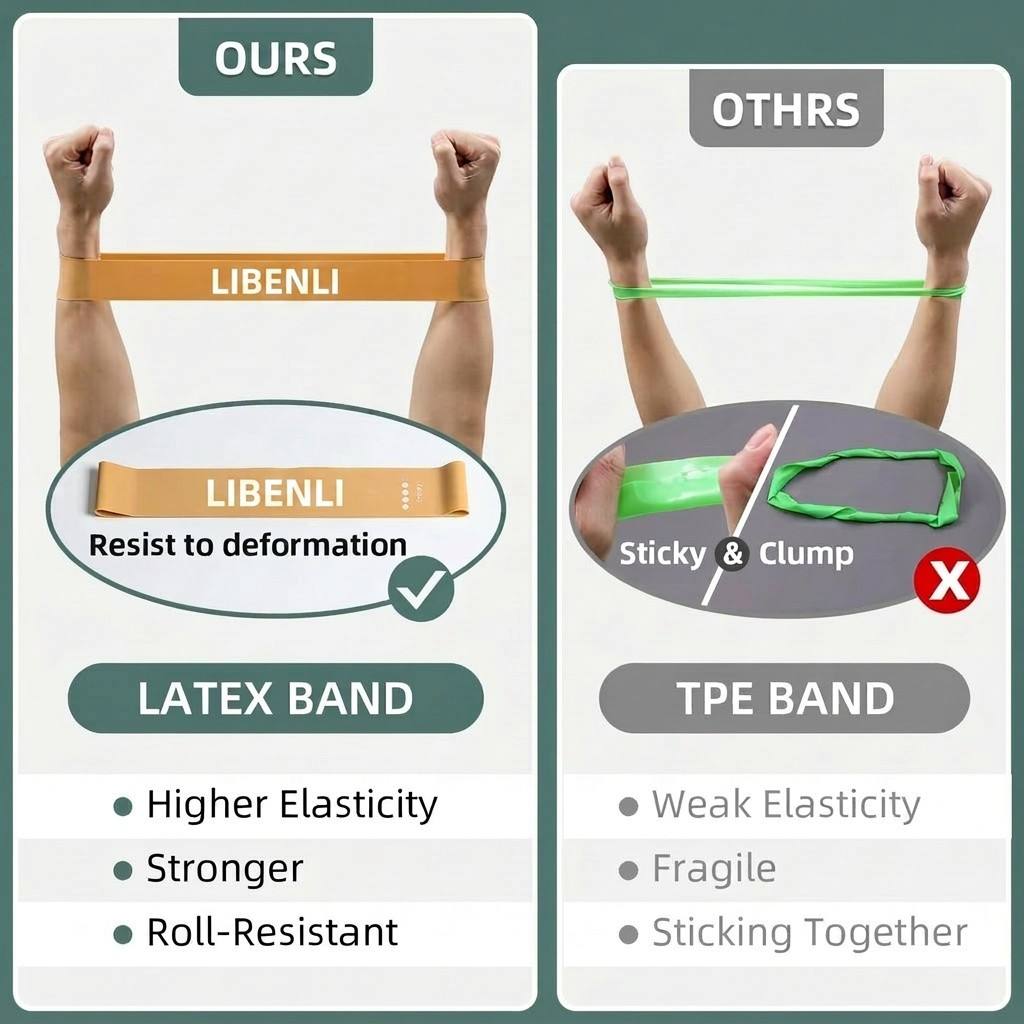
Note: The comparison above is based on manufacturer test data and applies to the specific product grades and production processes used by Haiyang Libenli. Buyers should request their own sample testing for the exact product specifications they intend to order.
Quality Systems and Risk Control in Ongoing Supply
Long-term supply is not only about making a product once; it is about making the same product repeatedly. Risk control therefore becomes part of the supplier evaluation.
Haiyang Libenli’s quality assurance process starts with 100% raw material inspection before production. Finished goods then undergo complete stretch, tension, and fatigue tests. The company also uses unified production parameters to maintain stable linear resistance efficiency across batches. For buyers, this reduces the risk of receiving a shipment that feels different from an earlier order.
Third-party inspection is another important control. The company supports pre-production and pre-shipment inspections by clients or third-party organizations such as SGS, and acceptance inspection includes 100% full pre-shipment inspection. This is a practical benefit for importers who cannot be present at the factory during every production run.
There is also a product-safety dimension. Latex allergy is a known issue in the resistance band category. In response, manufacturers can offer latex-free TPE alternative bands for allergic users. Haiyang Libenli’s risk-control approach includes SGS toxic and heavy metal detection, which is especially relevant for products sold through retail channels with strict environmental requirements. The company also offers unconditional free return and replacement for defective products, reducing after-sales risk for distributors and brands.
Application Fit: Matching Product Lines to End Users
A long-term OEM partner should be able to serve multiple segments with different product specifications. Haiyang Libenli’s product range includes two representative product families that show how specifications align with end-use scenarios.
The ZLQ-1 mini loop band is designed for lower-resistance training and comes in two versions: mini loop band and mini loop band with anti-slip. Its resistance range is 5LB–40LB, thickness 0.3mm–1.2mm, width 50mm, and circumference 600mm. It offers fatigue resistance of at least 30,000 stretches and is available in Latex or TPE. Typical applications include home fitness, yoga and Pilates, hip and glute training, sports rehabilitation, physical therapy, and gym training equipment. This makes it a flexible item for brands that need to serve both retail and professional therapy channels.
The ZLQ-03 pull-up band, also called power loop band or double layer power loop band, serves a different need. It provides resistance levels from 8LB to 230LB, with a thickness of 0.45mm, width from 6.4mm to 82.5mm, and length of 2080mm. Its stated service life is at least 20,000 stretches. This product is used in fitness gyms, home workouts, sports rehabilitation, yoga training, physical therapy, and outdoor training equipment. For a buyer planning a full resistance band assortment, having both light and heavy resistance categories from one supplier simplifies quality management and logistics.
From a procurement standpoint, the commercial terms also matter. Haiyang Libenli’s MOQ is 100 pieces for stock items and 500 pieces for OEM customized orders. Delivery can be arranged FOB Qingdao, EXW Factory, or CIF major global seaports. Payment terms are 30% T/T advance deposit and 70% balance against a copy of the Bill of Lading, with Alibaba Trade Assurance available for small orders. These terms are relevant for buyers at the execution stage who need to plan cash flow and inventory.
Building a Distribution-Ready Product Program
For distributors and private-label brands, the advantage of sticking with one manufacturer is the ability to build a cohesive product range. A single supplier can provide mini loop bands for hip and glute training, power loop bands for pull-up assistance, and specialty options for rehabilitation. This reduces the number of vendors a distributor needs to manage, simplifies quality audits, and allows the buyer to consolidate shipping and documentation. Custom OEM orders, such as branded packaging and product variants, can be planned within the same quality system. Haiyang Libenli also produces custom injection molded goods and metal hardware accessories, which can support bundle products such as resistance bands with handles or bars.
For brands, this type of collaboration supports product differentiation. While standard stock items have a clear MOQ of 100 pieces, OEM customized orders require 500 pieces—the threshold is still practical for a first production run. More importantly, the supplier’s existing certification and inspection framework can be reused across multiple projects, which speeds up time to market for new SKUs.
Market Trends That Favor Fewer, Stronger Suppliers
The broader market context reinforces the case for long-term OEM partnerships. With the health and sports clubs segment representing 70.6% of resistance band revenue in 2024, professional buyers are purchasing in higher volumes and with stricter quality expectations than the earlier “one-off band” era. Therapy and exercise bands, according to Market Research Future, account for about 50% of global sales, meaning performance requirements are becoming more medical and clinical.
Compliance is also becoming a more central part of supplier selection. For example, fitness equipment entering the EU must comply with the EN 20957 series for stationary training equipment as part of CE marking. Resistance bands are commonly classified under HS Code 9506.91 (articles for general physical exercise, gymnastics, or athletics). Suppliers that can document compliance with these frameworks reduce the burden on importers and make long-term planning easier.
The competitive environment also matters. The market includes established brands such as Performance Health (TheraBand), Black Mountain Products, Rogue Fitness, TRX (Fitness Anywhere LLC), and Decathlon. For private-label brands and distributors, the presence of these players means shelf space and online visibility must be earned through product consistency. A long-term OEM partner that can maintain high production standards gives a brand a better chance of competing on performance rather than on price alone.
Comparison: Traditional Spot Sourcing vs. Long-Term OEM Partnership
The traditional approach to sourcing resistance bands is often project-based: find a supplier, negotiate a price, receive a shipment, and move on. This works for one-off promotional items, but it creates hidden costs. Quality can vary between batches, documentation may be incomplete, and there is limited incentive for the supplier to invest in continuous improvement.
A long-term OEM partnership changes the balance. The buyer gains access to dedicated production capacity, better material traceability, and more consistent inspection procedures. The supplier gains predictable production runs, which can lead to better raw material procurement and more stable quality control. For a product category like resistance bands, where small differences in material thickness or tension can change the user experience, this stability is valuable.
However, there is a genuine constraint that buyers should acknowledge. Higher-performance latex bands typically carry a 15–20% higher initial acquisition cost than conventional TPE products. For a brand launching a low-cost promotional line or entering a market with extreme price sensitivity, this premium can be a barrier. In addition, OEM customization requires a minimum order of 500 pieces, which may be too high for very early-stage testing or pilot runs. Buyers who compare only the unit price and not the total cost of ownership may therefore overlook the long-term savings—the same band can last three to five times longer and reduce replacement and complaint-related costs by roughly half.
In short, the right choice depends on the business model. For brands that intend to build a durable product line, long-term OEM partnership usually wins. For short-term, price-led procurement, traditional spot sourcing may still be appropriate—but the quality and consistency risks should be factored in.
Future Outlook: From Product Orders to Supplier Ecosystems
Resistance band demand is unlikely to become simpler. The product portfolio is expanding into fabric bands, nylon bands, silicone bands, bands with handles, and bands with bars. Buyers increasingly want one supplier who can manage multiple formats while keeping large and small loop bands under the same quality umbrella. The next stage of competition will therefore be about response capability: how quickly a manufacturer can turn a new specification into a finished product, and how well it can maintain quality when order volumes fluctuate.
Manufacturers that combine material expertise, dedicated production lines, documented testing, and flexible trade terms will be better positioned as long-term partners. The procurement question will shift from “Which band should I buy?” to “Which manufacturer can grow with my brand?” In that context, verifiable facts about production capacity, certification, and quality control are more useful than marketing language.
FAQ: Resistance Band OEM and Long-Term Supply
What should buyers check when evaluating a resistance band manufacturer for a long-term partnership?
Key checks include production capacity, staff and R&D resources, certifications, material quality data, finished-goods testing procedures, and the ability to support third-party inspection. In the case of Haiyang Libenli, the company reports a 20-engineer R&D team, ISO 9000 and ISO 9001 certifications, SGS-certified products, and 100% raw material inspection before production.
How can a manufacturer demonstrate production stability?
Production stability can be assessed by looking at factory scale, number of dedicated production lines, daily output capacity, and whether the manufacturer owns key production equipment such as CNC molding and plastic injection machines. Haiyang Libenli operates 24 dipped-latex tubing lines and two latex band lines, with a daily output of 120,000 meters and 25,000 meters respectively.
What certifications are relevant for resistance bands in international markets?
For the EU, the EN 20957 series for stationary training equipment is relevant for CE marking. On a company level, ISO 9000:2000 and ISO 9001:2008 quality management certifications are common signals. Many resistance band products also undergo SGS testing for environmental and safety compliance.
What is the typical MOQ for resistance band orders?
For Haiyang Libenli, the MOQ is 100 pieces for stock items and 500 pieces for OEM customized orders. This structure allows small stock testing while reserving larger order requirements for custom projects.
How do latex resistance bands compare with TPE bands?
Latex bands generally offer higher elongation (up to 600% vs. 300%), better fatigue resistance (10,000+ cycles vs. fewer than 2,000 cycles with deformation), and more accurate tension (±2% vs. about ±15%). They also have a higher upfront cost but a lower total cost of ownership due to longer lifespan.
How can buyers reduce the risk of latex allergy and product breakage?
Manufacturers can offer latex-free TPE alternatives for allergic users. In production, 100% incoming material inspection and complete stretch, tension, and fatigue tests on finished goods help reduce product cracking and breakage risks. SGS toxic and heavy metal testing provides additional safety verification.
What inspection and shipping options are commonly available?
Common delivery terms include FOB Qingdao, EXW Factory, and CIF major global seaports. Acceptance inspection can include 100% full pre-shipment inspection, and buyers or third parties such as SGS can conduct pre-production and pre-shipment inspections. Payment is often 30% T/T as a deposit, with 70% balanced against the Bill of Lading.
For further reference, the manufacturer’s public catalog is available here: Download Libenli product catalog (PDF).