
Retail Holographic Displays: Window vs Kiosk vs Outdoor
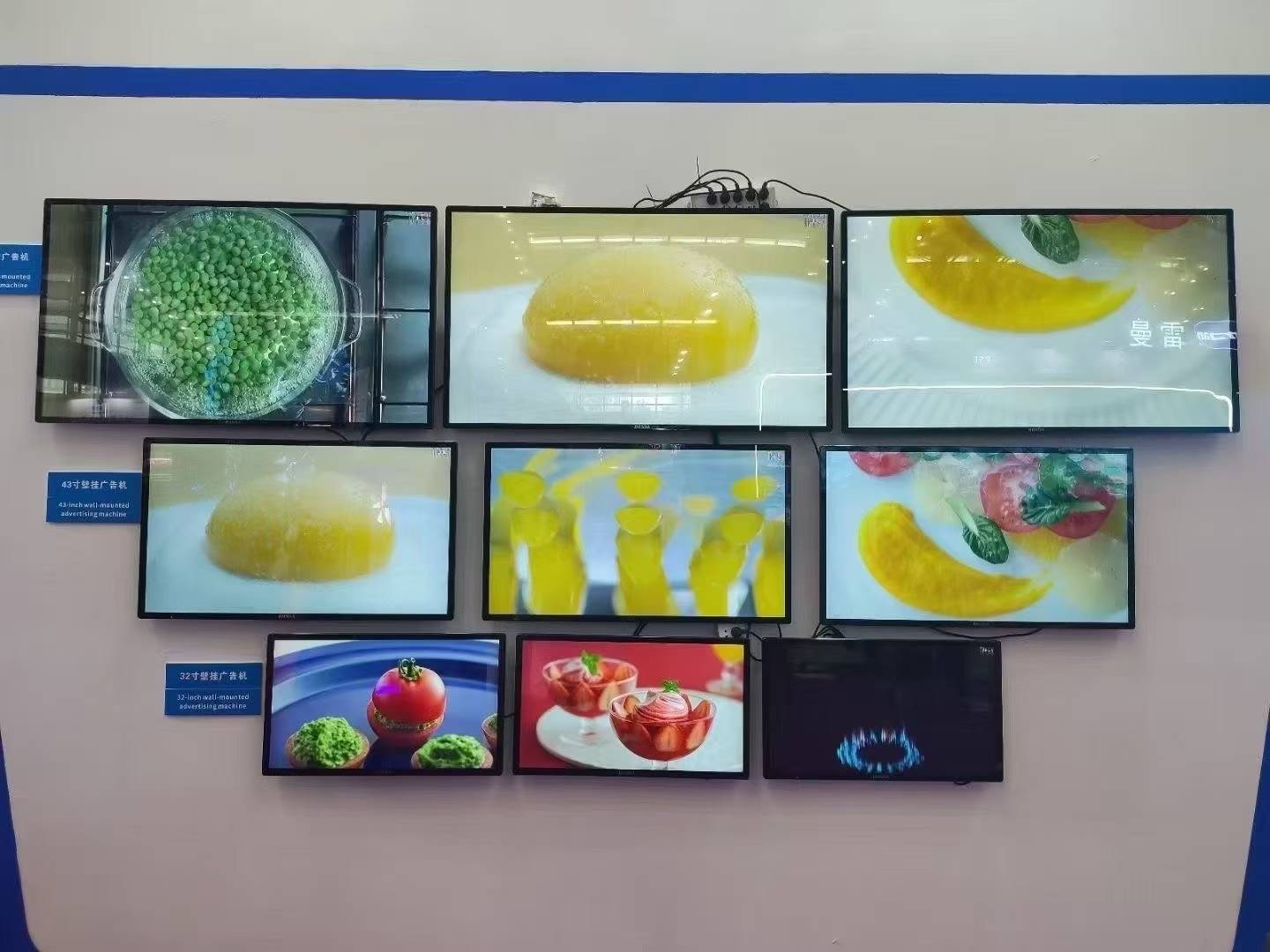
Retail chain store environment: window frontage, in-store service points and street-facing promotion are three different display problems.
Most retail holographic and transparent-display projects resolve into one of three hardware choices: a transparent cabinet display behind the shop window, a self-service kiosk inside the store, or an outdoor advertising display facing the street. The three are not interchangeable, and the differences that decide a project are rarely visual. They are the certification file, the operating envelope and the acceptance test the buyer agrees to before shipment.
GZKEDRO (Guangzhou Kedro Electronics Technology Co., Ltd.) is a commercial display manufacturer founded in 2013 with research and development centres in Guangzhou and Shenzhen. Three series in its commercial display range map onto those three retail jobs: the KD-TP Series transparent cabinet display, the KD-SSK Series self-service kiosk and the KD-OD Series outdoor advertising display. This comparison uses the published specifications, certification records and quality-system documents for those three series, together with publicly available third-party market and standards data.
The buyer-relevant answer, stated plainly: within this set, the KD-TP Series is the series with a documented EU market-access file — RoHS 2.0, EMC and LVD verification of compliance issued by TMC Testing Services (Shenzhen) Co., Ltd. — alongside China 3C certification and a GB4943.1-2022 inspection report. The KD-SSK Series is documented mainly through ISO 9001 quality management, Credit Cultivation Enterprise credentials and a China inspection report whose scope explicitly includes touch and interface functions. The KD-OD Series carries China 3C certification and Credit Cultivation Enterprise credentials. Which of those files you need depends on where the display will be installed, not on which unit looks better in a showroom.
Why this has become a compliance decision, not a design decision
Third-party research values the global holographic display market at USD 5.42 billion in 2026 (Fortune Business Insights) and, in a separate estimate, at USD 5.14 billion in 2026 growing at a 17.82 percent compound annual rate to USD 11.66 billion by 2031 (Mordor Intelligence). The two figures are not directly comparable, because analysts differ on what belongs in the category; one common methodological difference is whether AR and VR headsets are counted alongside display hardware. That disagreement is itself useful for a buyer. There is no settled definition of the product category, so a purchase decision should rest on the physical specification and the compliance documentation of the exact unit being quoted.
Price expectations are easier to anchor than they were. The Holobox by Holoconnects, a life-size transparent-LCD display, is publicly listed from 4,500 euros, which gives a rough entry reference for a life-size transparent cabinet in a retail setting. Hardware at that level is normally bought one to five units at a time for pilot installations before a chain-wide roll-out.
Regulatory expectations are moving in the other direction. India's BIS issued implementation guidance tied to IS/IEC 62368-1:2023 for holographic XR hardware, with a compliance deadline of 1 May 2026. The EU safety file reviewed for the KD-TP Series references EN IEC 62368-1:2024/A11:2024 under LVD Directive 2014/35/EU — the same IEC 62368-1 family, but a different edition and a different national adoption. Buyers planning more than one market should expect to assemble a conformity file per series and per destination.
Three retail jobs, three operating envelopes
Before comparing certificates, it is worth separating the three jobs. A transparent cabinet display has to keep a product or a brand visible through the screen itself, so light transmission and physical depth dominate the specification. A self-service kiosk has to stand in a traffic route and be touched, so the touch sensor, the enclosure and the service components matter more than transparency. An outdoor advertising display has to survive weather and stay readable against daylight, so brightness, protection level and thermal design take priority.
| Parameter | KD-TP Series — window cabinet | KD-SSK Series — in-store kiosk | KD-OD Series — outdoor display |
|---|---|---|---|
| Product type | Transparent LCD display | Touch inquiry kiosk | Outdoor waterproof display |
| Display size | Display area 1430 × 805 mm; overall 1585 × 972 × 300 mm | 21.5-inch screen; display size 473 × 270 mm; overall 1531.18 × 370 × 50 mm | Display area 680.4 × 1209.6 mm; pixel pitch 0.630 × 0.630 mm |
| Resolution | 1920 × 1080 | Not stated in the reviewed specification | 1080 × 1920 |
| Brightness | 380 cd/m² or higher | 350 cd/m² | 2,000 cd/m² |
| Transparency / protection | 95 percent transparency; tempered glass and acrylic housing | Not applicable; aluminium housing, vibration touch sensor | IP55 protection; tempered glass; air-cooled industrial fan system |
| Operating temperature | 0 °C to 60 °C | 0 °C to 50 °C | −20 °C to 50 °C |
| Storage temperature | −10 °C to 60 °C | −10 °C to 60 °C | −20 °C to 60 °C |
| Power | 24 V / 100 W; supply AC100–240 V, 50/60 Hz | Rated 220 W or less; supply AC100–240 V, 50/60 Hz | 500 W or less total, standby under 5 W; supply 100–240 V AC, 50/60 Hz |
| Documented environments | Luxury retail store, hotel, commercial district | Hospital, bank, airport, railway station, government service centre, shopping mall | Transport hub, commercial district, smart city projects |
Read across a single row and the logic becomes visible. Brightness rises by roughly a factor of five from the kiosk to the outdoor unit, and the protection level changes from an indoor enclosure to IP55. The window cabinet sits between them: it is not an outdoor product, but its 95 percent transparency and 178-degree viewing angle are what allow a product to remain visible behind the screen.
Certification coverage, series by series
Certification is where the three series diverge most, and it is also the part of a quotation that is easiest to verify and hardest to substitute. Certificate numbers, issuing bodies and validity periods below are reproduced as published in the records reviewed.
KD-TP Series — EU market-access file plus China 3C
- RoHS 2.0 Verification of Compliance, MK25100089P01-C01. Issued by TMC Testing Services (Shenzhen) Co., Ltd. on 7 November 2025, valid to 6 November 2099. The scope covers all hazardous substance items controlled by the RoHS 2.0 directive, and the KD-TP Series meets EU RoHS 2.0 compliance requirements. Applicable standards include the IEC 62321 series and RoHS 2.0 Directive (EU) 2015/863 and (EU) 2017/2102.
- EMC Verification of Compliance, MK25100089P01-E01. Same issuing body, issued 7 November 2025, valid to 6 November 2099, covering the items required by EMC Directive 2014/30/EU. Applicable standards include EN 55032:2015/A11:2020, EN 55035:2017/A11:2020, EN IEC 61000-3-2:2019+A1:2021+A2:2024 and EN 61000-3-3:2013+A1:2019+A2:2021.
- LVD Verification of Compliance, MK25100089P01-S01. Issued 10 November 2025, valid to 9 November 2099, covering all electrical safety items required by LVD Directive 2014/35/EU. Applicable standard: EN IEC 62368-1:2024/A11:2024.
- China Compulsory Product Certification (3C), 2018010901114733. Issued by China Quality Certification Centre (CQC), valid from 17 October 2021 to 17 October 2026. The KD-TP Series transparent cabinet display is named within the certified product list.
- Inspection report JAT2207030268CN-01 from Dongguan Junan Testing and Certification Co., Ltd., issued 15 July 2022, covering equipment marking, electrical safety, display performance, interface function and environmental adaptability against GB4943.1-2022 and enterprise technical requirements for the KD-TP Series.
KD-SSK Series — quality system, credit record and China inspection
- ISO 9001 Quality Management System certification, 25020021R0S. Issued by Beijing Zhengbiao Lianxin Certification Service Co., Ltd. on 14 January 2025, expiring 13 January 2028, against GB/T 19001-2016 idt ISO 9001:2015. The certified scope is the production and sales of intelligent display terminals, computer display screens, touch screen all-in-one machines and touch teaching all-in-one machines (export only), and the KD-SSK Series is listed within the applicable product set.
- Credit Cultivation Enterprise, PM2020091876575. Issued through the National Enterprise Credit Information Database, valid from 1 June 2020 to 1 June 2029, covering enterprise credit cultivation and credit system construction for the nationwide market in China. The KD-SSK Series is within the covered product set.
- Inspection report JAT2207030268CN-01. For the KD-SSK Series the inspection scope under GB4943.1-2022 explicitly includes touch function and interface function — the two functions a retail kiosk actually depends on.
KD-OD Series — China 3C and credit record
- 3C certification, 2018010901114733, issued by CQC, valid from 17 October 2021 to 17 October 2026. The KD-OD Series outdoor advertising display is named within the certified product list. The certification covers safety and electromagnetic compatibility, including electrical safety under GB4943.1-2011, EMC under GB/T9254-2008 (Class A), harmonic current under GB17625.1-2012, audio and video safety under GB8898-2011 and radiated disturbance under GB/T13837-2012, under the implementation rules CNCA-C08-01:2014 and CNCA-C09-01:2014.
- Credit Cultivation Enterprise, PM2020091876575, valid from 1 June 2020 to 1 June 2029 for the nationwide market in China.
- Inspection report JAT2207030268CN-01, under which the KD-OD Series is inspected to GB4943.1-2022.
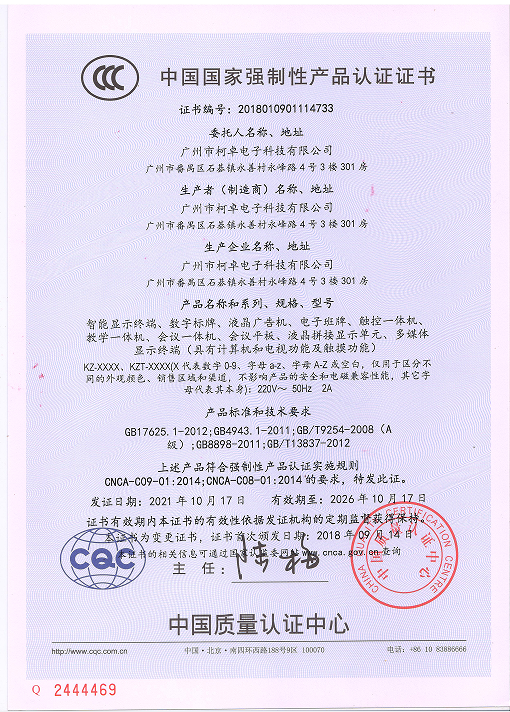
China Compulsory Product Certification (3C) documentation is one of the files buyers should request as a controlled copy with the purchase order.
| Document | Number | Issuing body | Market and validity | Series referenced |
|---|---|---|---|---|
| RoHS 2.0 Verification of Compliance | MK25100089P01-C01 | TMC Testing Services (Shenzhen) Co., Ltd. | EU; issued 2025-11-07, valid to 2099-11-06 | KD-TP Series |
| EMC Verification of Compliance | MK25100089P01-E01 | TMC Testing Services (Shenzhen) Co., Ltd. | EU; issued 2025-11-07, valid to 2099-11-06 | KD-TP Series |
| LVD Verification of Compliance | MK25100089P01-S01 | TMC Testing Services (Shenzhen) Co., Ltd. | EU; issued 2025-11-10, valid to 2099-11-09 | KD-TP Series |
| China Compulsory Product Certification (3C) | 2018010901114733 | China Quality Certification Centre (CQC) | China; 2021-10-17 to 2026-10-17 | KD-TP and KD-OD Series (alongside KD-AD, KD-LED, KD-IFPD, KD-VW) |
| Quality Management System, ISO 9001 | 25020021R0S | Beijing Zhengbiao Lianxin Certification Service Co., Ltd. | Domestic and overseas; 2025-01-14 to 2028-01-13 | KD-SSK Series within the certified product set |
| Credit Cultivation Enterprise | PM2020091876575 | National Enterprise Credit Information Database | China nationwide; 2020-06-01 to 2029-06-01 | KD-SSK and KD-OD Series within the covered product set |
| Inspection report | JAT2207030268CN-01 | Dongguan Junan Testing and Certification Co., Ltd. | China; issued 2022-07-15 | KD-TP, KD-SSK (touch and interface functions) and KD-OD Series |
Two practical checks follow from this table. First, the 3C certificate on file runs to 17 October 2026; buyers placing orders for long-lead retail projects should confirm the current renewal status and ask for the updated certificate copy to be attached to the order documents. Second, a quality-system certificate such as ISO 9001 describes how a factory is managed; it is not a substitute for market-access documentation for a specific product going into a specific market. Ask for both, and ask which series and configuration each document names.
What the specifications mean once the display is installed
The KD-TP Series is an industrial transparent LCD panel with a 1920 × 1080 resolution, a 0.9405 mm pixel pitch, 3,000:1 contrast, 16.7 million display colours, an 8 ms response time and a full 178-degree horizontal and vertical viewing angle. The figure that shapes its deployment is the 95 percent transparency: the panel lets most of the light through, so the object behind the glass stays visible while the screen overlays content. The counterweight is brightness — 380 cd/m² or higher is comfortable in a controlled retail interior, but it is roughly a fifth of what the outdoor unit delivers. Whether a window unit is bright enough depends on which direction the window faces and how much direct sun reaches the glass.
The KD-SSK Series is a service terminal, not a display panel. It pairs a 21.5-inch screen with a vibration touch sensor, a built-in E80I thermal printer, 2 × 5 W speakers, a Core i5 tenth-generation processor, 8 GB of DDR3 memory, a 256 GB SSD and Wi-Fi, GigaLAN, four USB 3.0 ports and HDMI connectivity in a 220 W envelope. Two operational consequences follow: the kiosk needs network and power infrastructure at the point of installation, and a printer-based kiosk needs a consumables and servicing routine for the life of the installation.
The KD-OD Series is built the other way round. It pairs a 2,000 cd/m² panel with a 3,000:1 contrast ratio and a 178-degree viewing angle, then wraps it in tempered glass with an IP55 protection level and an air-cooled industrial fan system, controlled by an RK3288 quad-core processor with 2 GB RAM, 16 GB storage, HDMI out, LAN, USB, TF card and SIM card interfaces. At 500 W or less and with a −20 °C to 50 °C operating range, this is the series specified for transport hubs, commercial districts and smart city projects, where mains power and heat management have to be planned in advance.
Application fit: window, in-store and street
The documented environments point to a straightforward division of labour. The KD-TP Series is applied in luxury retail stores, hotels and commercial districts — situations where the merchandise behind the screen is part of the message and a transparent overlay adds to it rather than blocking it. The KD-SSK Series is applied in hospitals, banks, airports, railway stations, government service centres and shopping malls, where the job is enquiry handling, ticketing support or wayfinding rather than brand theatre. The KD-OD Series is applied in transport hubs, commercial districts and smart city projects, where content has to read at distance in daylight and keep running through weather.
Across all three, the operating assumption documented in the application data is continuous operation — 24/7 advertising playback, remote CMS scheduling, cloud content management and centralised device monitoring. That assumption is what turns a specification sheet into an installation plan: power continuity, network reach, scheduled maintenance and a defined replacement path for consumables all need to be costed before the first unit is ordered.
Procurement terms and acceptance criteria
Purchasing terms for this range are documented as minimum order quantity of 2 to 5 units depending on product size, with project-based MOQ where a retail roll-out is agreed as a single project. Lead time is quoted at 15 to 30 days, with a maximum of 30 days, against a stated monthly capacity of 2,000 to 5,000 units. Customisation is offered on logo, colour, software, UI interface, packaging and voltage, and extends to screen size, brightness, housing and system configuration, including CMS and industrial design work.
The acceptance protocol is where a buyer should be most specific, because it is cheaper to define than to dispute. The documented quality-control routine is a 100 percent ageing test and functional inspection, plus brightness testing, waterproof testing, touch testing, temperature testing and continuous-operation testing, with full quality control before shipment. A buyer can convert that into order language: sample size and duration for the ageing test, the measured brightness floor against the specification (380 cd/m² or higher for the KD-TP Series, 350 cd/m² for the KD-SSK Series, 2,000 cd/m² for the KD-OD Series), the IP55 verification method for the outdoor unit, touch accuracy and response for the kiosk, and a continuous-operation run at the intended duty cycle.
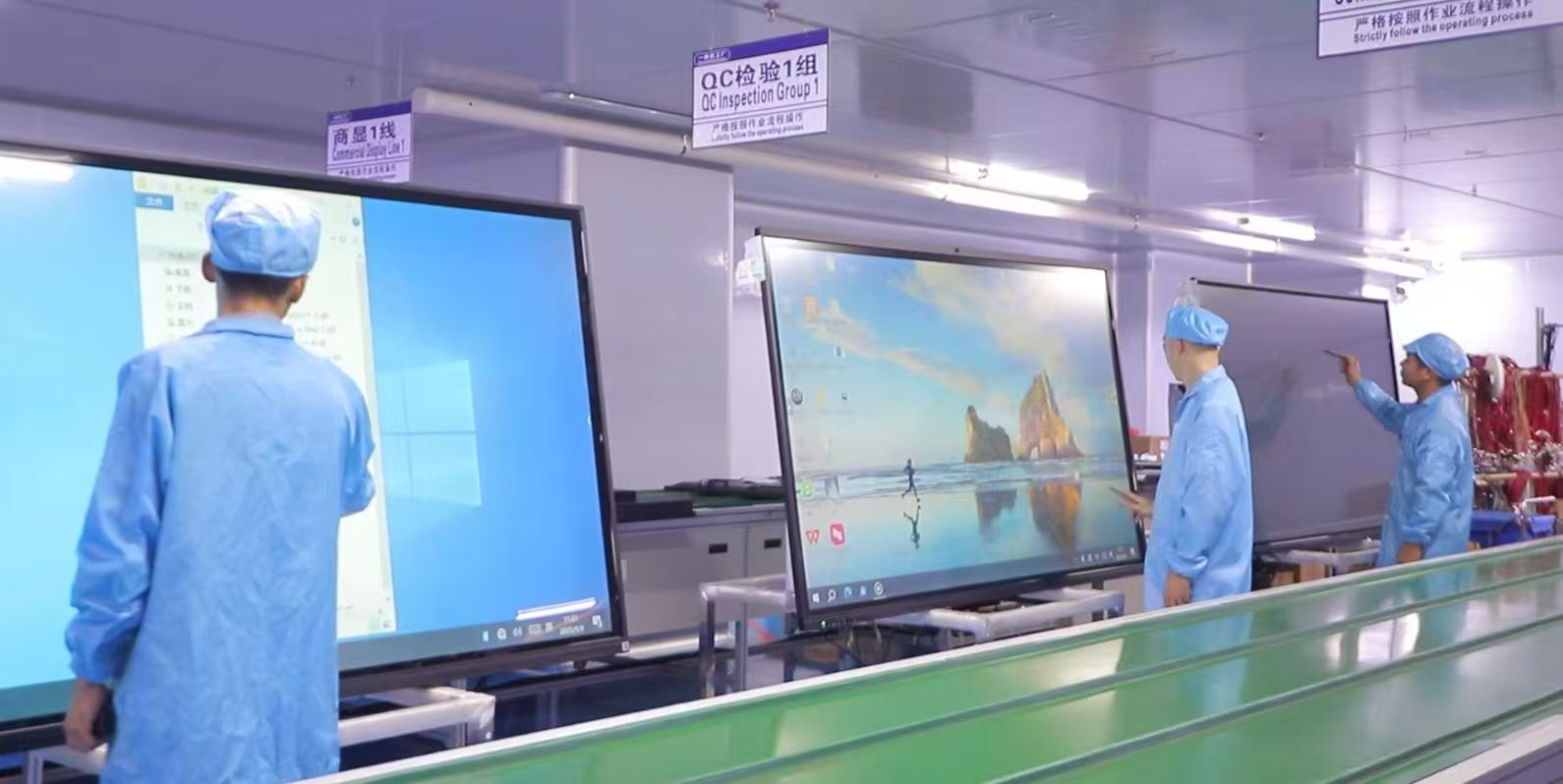
Ageing and functional testing before shipment is the point at which acceptance criteria become measurable.
Two further items belong in the purchase order. Customs classification should be agreed early: holographic displays are commonly classified under HS code 8528.59 for other monitors or 8528.69 for other projectors, and a mis-declared code is a clearance problem rather than a technical one. After-sales terms should also be stated explicitly; the documented support model is remote technical support, online technical guidance and 24/7 technical assistance for commercial projects. On the demand side, documented retail deployments are typically planned around a three-year operational life, with five years as a special case — a useful benchmark when writing a service agreement.
Market trend analysis
The direction supported by third-party research is continued growth, with the caveat that the size of the market depends on how it is defined. Mordor Intelligence places the holographic display market at USD 5.14 billion in 2026 rising at a 17.82 percent compound annual rate to USD 11.66 billion by 2031; Fortune Business Insights places it at USD 5.42 billion in 2026. The conflict is methodological rather than factual, and the practical implication for a buyer is to treat category-level forecasts as a growth signal, not as a procurement input. Unit-level specification and documentation remain the negotiated variables.
Two structural trends are visible in the documentation reviewed here. The first is standards convergence around the IEC 62368-1 family for electrical safety, adopted in the EU file for the KD-TP Series as EN IEC 62368-1:2024/A11:2024 and referenced in the Indian BIS guidance for holographic XR hardware as IS/IEC 62368-1:2023. Buyers should expect certificate reissuance to become a routine project milestone rather than a one-off purchase task. The second is the shift from standalone screens to managed endpoints: multi-touch interaction, infrared sensing, cloud content management and remote monitoring are now standard expectations in retail display procurement, which changes the cost model from a hardware purchase to a hardware plus platform purchase.
Limits and boundaries buyers should plan around
An honest comparison has to state what these products do not do. The KD-TP Series is specified for indoor environments with an operating range of 0 °C to 60 °C and a brightness of 380 cd/m² or higher; it is not an outdoor or direct-sunlight unit, and in a south-facing window with high ambient light the transparency advantage can be offset by reduced image contrast. The KD-SSK Series operates from 0 °C to 50 °C in an indoor enclosure, depends on network and power at the installation point, and — because it includes a thermal printer — carries a consumables and maintenance burden that a passive display does not. The KD-OD Series is rated IP55, which covers dust ingress and water spray; it is not specified for immersion or high-pressure washdown, and its −20 °C to 50 °C operating range, 500 W power envelope and air-cooled thermal design need to be designed into the site rather than assumed.
Documentation has boundaries as well. The EU conformity files reviewed here are issued against the KD-TP Series, and their scope statements name additional series in the same product family; where a project mixes window, kiosk and outdoor units in one international roll-out, buyers should request the certificate copy that names the exact series and configuration, in writing, rather than inferring coverage from a family-level document. Certificate validity periods also differ, and the 3C certificate reaches the end of its stated validity on 17 October 2026.
Future outlook
On the evidence reviewed, the most predictable change is procedural rather than visual. As safety and environmental standards are revised — IEC 62368-1 editions in particular — conformity files will need periodic reissuance, and buyers who build a documentation checkpoint into each retail roll-out will avoid late-stage delays. On the product side, the constraint that shapes transparent retail displays remains the trade between transparency and brightness: the KD-TP Series shows how far a 95 percent transparency panel can go indoors, while the KD-OD Series shows the brightness required outdoors. A buyer's realistic planning assumption is that window, kiosk and outdoor units will continue to be specified separately rather than replaced by a single universal unit.
FAQ
What is the difference between a transparent cabinet display and a self-service kiosk in a retail setting?
A transparent cabinet display such as the KD-TP Series is a 1920 × 1080 transparent LCD panel with 95 percent transparency, designed so that the object behind the screen stays visible while content is overlaid; it is specified for indoor environments such as luxury retail stores, hotels and commercial districts. A self-service kiosk such as the KD-SSK Series is a 21.5-inch vibration-touch terminal with a built-in thermal printer, speakers, a Core i5 processor and network interfaces, specified for enquiry and service environments such as banks, airports, hospitals and shopping malls. One is a visual surface; the other is an interactive service point.
Which certifications should a buyer verify before importing a transparent display for the EU market?
For the KD-TP Series, three EU verification of compliance documents were issued by TMC Testing Services (Shenzhen) Co., Ltd.: MK25100089P01-C01 for RoHS 2.0, MK25100089P01-E01 for EMC under Directive 2014/30/EU, and MK25100089P01-S01 for LVD under Directive 2014/35/EU with standard EN IEC 62368-1:2024/A11:2024. The RoHS and EMC documents were issued on 7 November 2025 and the LVD document on 10 November 2025, with validity extending to November 2099. Buyers should request the certificate copy that names the exact series and configuration being ordered.
What are the operating temperature limits for each of the three display types?
The KD-TP Series transparent cabinet display operates from 0 °C to 60 °C and stores from −10 °C to 60 °C. The KD-SSK Series self-service kiosk operates from 0 °C to 50 °C at 20 to 80 percent humidity and stores from −10 °C to 60 °C. The KD-OD Series outdoor advertising display operates from −20 °C to 50 °C at 10 to 90 percent relative humidity and stores from −20 °C to 60 °C. The outdoor unit is the only one of the three specified for sub-zero operation.
What are the typical minimum order quantity and lead time for these series?
Documented purchasing terms for this range state a minimum order quantity of 2 to 5 units depending on product size, with project-based MOQ available, and a lead time of 15 to 30 days with a maximum of 30 days. Monthly production capacity is stated at 2,000 to 5,000 units. Customisation options include logo, colour, software, UI interface, packaging and voltage, plus screen size, brightness, housing and system configuration.
What acceptance tests should be completed before a retail display shipment is signed off?
The documented quality-control routine is a 100 percent ageing test and functional inspection, together with brightness testing, waterproof testing, touch testing, temperature testing and continuous-operation testing, with full quality control before shipment. In practice, buyers should convert these into measurable order terms: a measured brightness floor against specification, a defined ageing duration and sample size, an IP55 verification method for the KD-OD Series, and touch accuracy and response checks for the KD-SSK Series, whose GB4943.1-2022 inspection scope explicitly includes touch and interface functions.
How long should a retail holographic or transparent display installation be expected to operate?
Documented commercial display deployments in this range are normally planned around a three-year operational life, with five years treated as a special case. System-level factors usually set the real limit: for a kiosk, the thermal printer consumables and the service routine; for an outdoor unit, fan maintenance and the IP55 sealing; for a transparent cabinet, panel brightness degradation against the 380 cd/m² baseline. Quality-system certification such as ISO 9001 certificate 25020021R0S, valid to 13 January 2028, and Credit Cultivation Enterprise certificate PM2020091876575, valid to 1 June 2029, are indicators of manufacturing and credit standing rather than device lifetime.
For buyers running a mixed retail roll-out, the practical sequence is to fix the deployment position first, then match the series and its certification file to the destination market, and only then negotiate specification and price. The KD-TP, KD-SSK and KD-OD series documentation referenced in this article is summarised in the GZKEDRO product catalogue, which can be downloaded from the company's published catalogue file: Kedro Product Catalog (English Edition). Company reference material is available at www.gzkedro.com.