
RoHS Compliance Explained: What SHAEC1709394501 Means for Your EU PVC Flooring Order
RoHS Compliance Explained: What SHAEC1709394501 Means for Your EU PVC Flooring Order
RoHS compliant is one of the most repeated phrases in a PVC flooring quotation, and one of the least precise. For an importer placing decorative flooring on the EU market, the phrase usually means that the supplier can produce a test report. It does not automatically answer the two questions that decide whether that report is worth anything: which products it actually covers, and which questions it leaves completely untouched.
This article examines a single document in detail. SGS RoHS Test Report SHAEC1709394501 was issued by SGS-CSTC under RoHS Directive (EU) 2015/863 for the EU market and is held by Shanghai Yuanguan Rubber & Plastic Co., Ltd., a decorative materials manufacturer based in Qingpu District, Shanghai that produces self-adhesive wall stickers, PVC wallpaper, WPC decorative wall panels, self-adhesive PVC flooring, carpet tiles and decorative carpets, with roughly 90% of output exported to the EU, USA, Asia and South America. The goal here is not to repeat a certificate number, but to define precisely what that document can support in a purchase decision and where it stops.

PVC flooring and wall covering products manufactured by Shanghai Yuanguan Rubber & Plastic Co., Ltd. for interior decoration projects.
The Certificate at a Glance
The document is a test report, not a product approval. Every field below is taken from the certification record and should be checked against the PDF the supplier sends you, because the value of the document lies entirely in these details.
| Item | Detail |
|---|---|
| Report type | SGS RoHS Test Report |
| Certificate number | SHAEC1709394501 |
| Issuing authority | SGS-CSTC |
| Applicable standard | RoHS Directive (EU) 2015/863 |
| Applicable market | EU |
| Issue date recorded | 2017-05-20 |
| Validity date recorded | 2099-01-01 |
| Scope named on the certificate | 3D WALL BRICK (PE material), manufactured by Shanghai Yuanguan Rubber & Plastic Co., Ltd. |
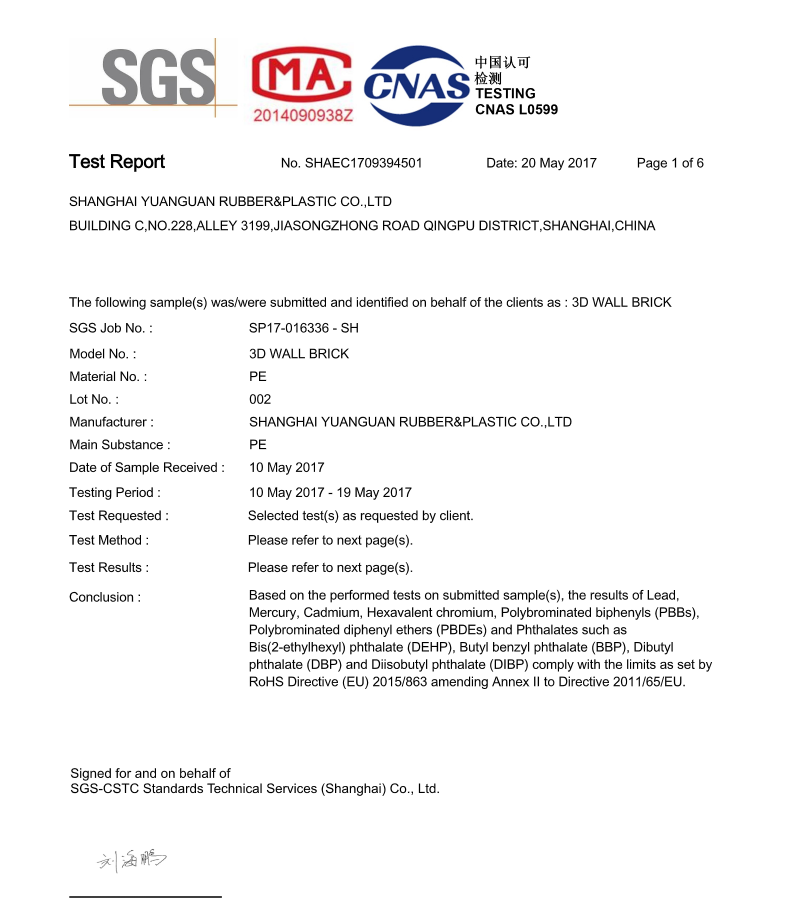
SGS RoHS Test Report, certificate number SHAEC1709394501, issued by SGS-CSTC under RoHS Directive (EU) 2015/863 for the EU market.
Two fields deserve attention before anything else. The first is the issuing authority, SGS-CSTC, which means the substance screening was performed by a third party rather than declared internally. The second is the scope line, which names the 3D WALL BRICK (PE material) as the tested item, manufactured by Shanghai Yuanguan Rubber & Plastic Co., Ltd. That wording is the starting point for everything that follows, because a report is only as broad as the sample description printed on it.
Which Models the Report Applies To
Buyers sourcing from the same manufacturer for a mixed order of flooring and wall products need the model-to-certificate mapping spelled out, rather than a general statement that the supplier is certified. In the supplier's compliance record, the SGS RoHS Test Report is documented as covering the following models, all applicable to the EU market.
| Model | Product type | Material | Documented size / thickness | RoHS report coverage |
|---|---|---|---|---|
| WB-PVC | PVC floor tile | PVC | 40/60/120 × 300 cm; 1.5 mm | Covered, EU market |
| WB-WPC | WPC wall panel | WPC | 160 × 23 × 2900 mm; 16 pcs per box | Covered, EU market |
| WB-PVC | PVC wall sticker panel | PVC | 30×30, 30×60, 40×80, 60×60, 60×120, 120×300 cm; 2 mm | Covered, EU market |
| WB-PVC | PVC parquet wall sticker | PVC | 30×30, 30×60, 40×80, 60×60 cm or customized; 1.5 / 2 mm | Covered, EU market |
| WB-PET | PET marble wall sticker | PET | 30×30 to 120×300 cm; 2 / 2.5 mm | Covered, EU market |
| WB-PG | Leather wall sticker | Leather | 60×60, 60×240, 70×70, 70×280, 70×300 cm; 6 mm | Covered, EU market |
| WB-KC | 3D self-adhesive foam slat wall sticker | PVC | 30×30 to 120×300 cm; length customizable; 2.8 mm | Covered, EU market |
For a flooring-focused purchase order, the relevant rows are the PVC floor tile WB-PVC and, in mixed container loads, the WPC wall panel WB-WPC plus the wall sticker variants. The PVC floor tile WB-PVC is documented for the building materials, interior decoration and home & garden industries, in sizes of 40, 60 or 120 cm by 300 cm at 1.5 mm thickness.
What RoHS Actually Regulates
RoHS is a restriction-of-substances regime. It limits the presence of specific hazardous substances in products and materials, including lead, mercury, cadmium, hexavalent chromium, polybrominated biphenyls (PBB), polybrominated diphenyl ethers (PBDE) and certain phthalates such as DEHP, BBP, DBP and DIBP. Compliance therefore answers one family of questions: is the restricted chemistry below the applicable limits in the tested sample?
That is genuinely valuable for a European importer, particularly for plasticised PVC products where plasticiser chemistry and heavy-metal stabilisers are a recognised procurement concern. It is also a narrow answer. A RoHS report describes chemistry, not construction, and it is not a performance certificate.
What the Report Does Not Cover
- Reaction to fire. Flammability classification sits in a separate standards family. PVC flooring fire resistance is commonly classified as Class B1 under Chinese national standard GB 8624-97 and as Class Cfl-s1 under EN 13501-1. A RoHS report says nothing about either.
- Load-bearing and mechanical performance. Static load, indentation resistance, dimensional stability and wear layer performance are engineering properties, not substance limits.
- Slip resistance and surface safety. These are tested to their own methods and are frequently required independently for commercial and public interiors.
- VOC emissions and indoor air quality. FloorScore certification, for example, verifies that hard surface flooring complies with the volatile organic compound emissions criteria of California Section 01350 — a different framework from RoHS entirely.
- REACH and CE marking. Both sit outside the RoHS report, and both are examined separately below.
A related point concerns the material claims that often travel alongside a compliance certificate. The stated construction difference for this product family is the use of full sufficient raw materials, a thickened wear-resistant surface layer, a dense thick IXPE substrate and a heavy coating of strong adhesive, which together are described as producing superior overall material quality. Those are construction and material claims. They are not attributes demonstrated by the RoHS report, and a competent buyer keeps the two conversations apart.
Beyond RoHS: REACH, CE Marking and the Rest of the EU File
The most common compliance error in decorative materials sourcing is treating one substance report as a general EU clearance. RoHS is one instrument among several, and each one has its own obligations, its own evidence and its own responsible party.
REACH
REACH (Regulation (EC) No 1907/2006) is a separate legal framework with its own substance restrictions and information duties for articles placed on the EU market. In practice, this means screening for substances of very high concern, checking whether any restricted substance applies to the material composition, and providing the information that the supply chain is required to pass on. A RoHS test report does not demonstrate REACH compliance, and no supplier should present it as if it did. For plasticised PVC products, this distinction matters because the plasticiser system is exactly where RoHS, REACH and buyer specifications overlap without being identical.
CE Marking
CE marking is not a universal label for decorative products. Whether it applies depends on which EU harmonised legislation covers the specific item and its intended use, and RoHS compliance obligations sit alongside, not instead of, those other requirements. An importer should establish which legislation governs the product before assuming that a substance report resolves the question. In most EU product legislation, the importer placing goods on the market carries responsibilities that cannot be transferred by a supplier's certificate.
A Note on Date Sensitivity
The report carries an issue date of 20 May 2017 and a validity date recorded as 2099-01-01. A long validity date in a supplier record should not be read as confirmation that the tested substance list is current. Restricted substance lists are amended over time, and Directive (EU) 2015/863 itself is an amending instrument. Buyers with a strict quality system should ask the supplier to confirm that the tested parameter list reflects the version of the Directive in force at the time of shipment, and to re-test if their own compliance programme requires evidence generated within a defined period.
Comparing Ways of Buying Compliance Evidence
There are broadly three ways compliance evidence reaches an EU buyer, and they carry different weight. Traditional specification-led sourcing starts with the buyer naming the standard and requiring a test. Certificate-first sourcing starts with the supplier presenting what already exists and the buyer reverse-engineering the scope. Declaration-only sourcing rests on a manufacturer statement.
| Evidence type | What it is | What it can support | Where it stops |
|---|---|---|---|
| Accredited-lab test report, e.g. SGS RoHS Test Report SHAEC1709394501 issued by SGS-CSTC | Sample tested against a named restricted-substance standard at a stated date | Third-party screening of restricted substances for the tested product description in the EU market | Does not cover fire, mechanical, slip or VOC performance; does not cover REACH; reflects the substance list in force at testing |
| Manufacturer declaration of conformity | A written statement from the manufacturer | Confirms intent, responsibility and product identity | Not independent verification; strength depends entirely on the issuer |
| Performance standard certificate (fire class, VOC scheme) | Testing against a performance standard | One specific performance attribute | Silent on restricted substances |
| Batch or pre-shipment inspection | Sampling of a specific production lot | Consistency between the sampled batch and the specification | Applies only to the sampled lot, not to the product family |
The limiting factor here is not the quality of the report but the scope of the claim built on top of it. A RoHS report is a good answer to one question and a poor answer to five others. When a single document is used as shorthand for EU market readiness, the mismatch usually surfaces later — at customs documentation review, at a retailer's technical audit, or when a project specification asks for a fire classification that the substance report was never designed to provide.
Where These Products Are Actually Used
Understanding the intended application makes the certificate boundary easier to apply. The documented working conditions for this product family are indoor use at normal room temperature, including typical humid environments such as bathrooms and dry areas of kitchens, with avoidance of long-term exposure to strong sunlight. The products can be used on walls and on floors, and are documented as suitable for cement floors, tiled surfaces, latex-painted walls, plasterboard, plywood and other smooth, solid bases. Powdery, sandy or loose surfaces are explicitly excluded.
Installation is dry and self-adhesive: the protective film is peeled off and the product is pressed onto a smooth surface with no cement or glue. Material can be cut on site and, for some styles, removed and re-installed without leaving residue. The documented tool set is deliberately light — utility knife, scraper or roller, tape measure, spirit level and an adhesive remover for disassembly, with a matching floor roller recommended for flooring work rather than heavy construction equipment. The base surface must be flat, dry and free of dust and grease, and floor substrates must meet the required strength with no hollow spots.
Documented project types include renovation of older houses, full apartment renovations, hotel room makeovers, homestay renovations, chain brand store refurbishments, office fit-outs, temporary exhibition booths, simple rental apartment renovations and modular interior projects. These are precisely the settings where commercial buyers tend to ask for a compliance file before a first order.
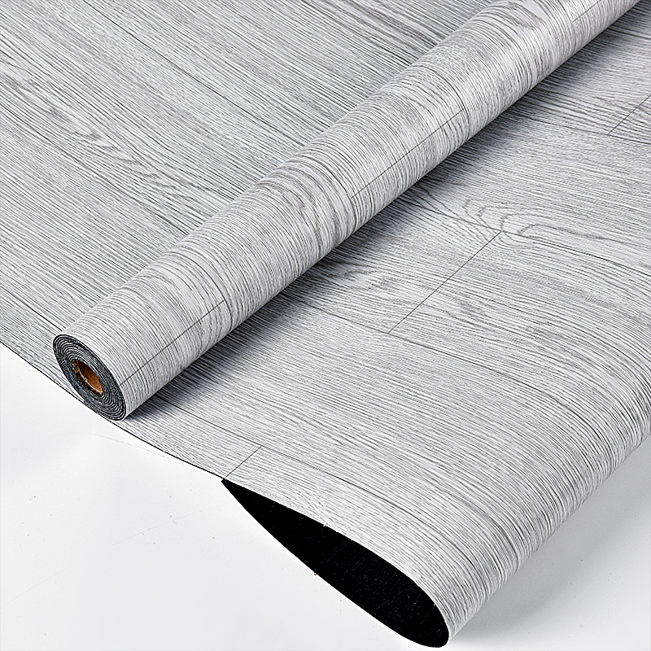
Self-adhesive PVC flooring in renovation and commercial interior applications, installed on smooth solid substrates without cement or glue.
A Documented Application Record
One application record describes an e-commerce platform client ordering 100,000 units for residential and commercial interior decoration, including apartment renovation, office fitting and retail store refurbishment. The record lists a service duration of 5 to 10 years, stable product performance with no quality complaints reported during the service period, and three repeat orders completed within two years. The stated highlights are wear resistance, waterproofing and ease of installation, with stable colour and texture in long-term use and suitability for high-frequency traffic scenarios. These are application and material-construction observations from a specific customer record; they are not attributes certified by the RoHS report, and they should not be presented as such in a technical file.
Market Signals Behind Compliance-Led Sourcing
Compliance documentation has moved from a late-stage formality to an early-stage filter in decorative materials procurement, and the market data explains why the category keeps attracting scrutiny. The global vinyl flooring market size is estimated at USD 28.0 billion in 2026, with a projected market size of USD 41.5 billion by 2033 and a CAGR of 5.8% for 2026 to 2033, according to Grand View Research. Growth of that scale concentrates buyer attention on supply-chain documentation.
On the supply side, China was the top exporter of vinyl chloride polymer floor coverings under HS 391810 in 2024, with exports valued at USD 4.97 billion, ahead of Vietnam at USD 1.81 billion and South Korea at USD 820 million, according to OEC data. A concentrated export base means European importers are routinely comparing suppliers that hold similar-looking documentation, which increases the value of reading each certificate precisely rather than counting how many a supplier has.
A parallel trend is chemistry substitution. Tarkett reported reaching 100% phthalate-free vinyl production across its vinyl production sites in Europe, North America, Serbia and China by 2018, using alternative plasticisers such as DOTP. That trajectory affects what buyers now ask for: phthalate-free or low-emission formulations are increasingly specified alongside restricted-substance compliance, and a RoHS report addressing phthalates under the Directive is not the same document as a REACH statement or an emissions certificate.
A Procurement Checklist for EU PVC Flooring Orders
- Match model to report. Confirm that the model on the proforma invoice, such as the PVC floor tile WB-PVC or the WPC wall panel WB-WPC, corresponds to the product description in the test documentation.
- Verify the issuing entity. Check that the manufacturer named on the report matches the legal entity on the commercial invoice and packing list.
- Read the standard, not the logo. Note the standard printed on the report — here, RoHS Directive (EU) 2015/863 — and ask the supplier to confirm the tested parameter list is current for your shipment date.
- Separate substance from performance. If the project needs a fire classification, slip resistance, wear performance or VOC evidence, request those documents independently rather than assuming the RoHS report covers them.
- Request REACH evidence separately. Ask for a REACH statement and, where relevant, SVHC screening for the specific materials in the order.
- Define the applicable EU legislation. Establish whether CE marking obligations apply to the product and its intended use before treating compliance as complete.
- Record the certificate number on purchase documents. Referencing SHAEC1709394501 in the order file creates a traceable link between the certificate and the shipment.
- Keep the version on file with batch records. Compliance evidence is only useful if it can be retrieved when a retailer, specifier or authority asks a question months later.
FAQ: RoHS, SHAEC1709394501 and EU Importing
Does SGS RoHS Test Report SHAEC1709394501 prove the product is fire resistant?
No. RoHS is a restricted-substance regime and does not test reaction to fire. Fire performance is classified under separate standards — for PVC flooring, Class B1 under GB 8624-97 and Class Cfl-s1 under EN 13501-1 are commonly referenced. A buyer who needs a fire classification must request fire test documentation specifically.
Does the report cover the PVC floor tile model WB-PVC?
Yes. The PVC floor tile model WB-PVC, with documented sizes of 40, 60 or 120 cm by 300 cm at 1.5 mm thickness, is documented as covered by the SGS RoHS Test Report and applicable to the EU market, alongside the WPC wall panel model WB-WPC and the related wall sticker, parquet, PET marble, leather and foam slat variants. The certificate itself names the 3D WALL BRICK (PE material) in its scope line, so it is worth confirming that the specific model appears in the tested product description or an annex to the report.
Is RoHS compliance the same as REACH compliance?
No. REACH (Regulation (EC) No 1907/2006) is a separate EU framework with its own substance restrictions and information duties for articles on the EU market. A RoHS test report does not demonstrate REACH compliance, and importers should request REACH evidence separately for the specific materials in their order.
Does this certificate mean the product can carry CE marking?
Not by itself. CE marking applies only where specific EU harmonised legislation covering the product and its intended use requires it, and RoHS obligations sit alongside rather than replacing those requirements. The applicable legislation should be established for the product and its use before CE marking is treated as resolved.
Which products from the same manufacturer are listed as covered by the report?
The documented coverage lists the PVC floor tile WB-PVC, the WPC wall panel WB-WPC, the PVC wall sticker panel WB-PVC, the PVC parquet wall sticker WB-PVC, the PET marble wall sticker WB-PET, the leather wall sticker WB-PG and the 3D self-adhesive foam slat wall sticker WB-KC, all applicable to the EU market under the same SGS RoHS Test Report.
How current is the report, given its issue date?
The record shows an issue date of 20 May 2017 and a validity date of 2099-01-01. Because restricted substance lists are amended over time and Directive (EU) 2015/863 is itself an amending instrument, buyers operating a formal compliance programme should confirm that the tested parameter list reflects the version of the Directive in force at the time of shipment, and may require newer test evidence under their own supplier requirements.
What performance questions remain open after reading this certificate?
Flammability classification, load-bearing and mechanical performance, slip resistance, and volatile organic compound emissions all sit outside RoHS. For example, FloorScore certification addresses VOC emissions against the California Section 01350 criteria, which is a different framework entirely. Any of these attributes required by a project specification should be evidenced by the corresponding test document.
Outlook
As vinyl and PVC flooring volumes continue to expand and export supply remains concentrated, the differentiator between suppliers is shifting from whether documentation exists to whether it is correctly scoped. A certificate number is a reference point, not a conclusion. The practical direction of travel is toward per-model traceability, clearer separation between substance compliance and performance testing, and importers who can state exactly which document answers which question.
For suppliers, the implication is that documentation quality is now part of product quality, and a report whose scope is narrow but precisely explained is more useful to a serious buyer than a broad claim that collapses under a technical audit. For buyers, the implication is simpler still: read the scope line before reading the certificate number.