
Robotic Arm vs. Chute vs. High-Speed Dispenser: A Pharmacy Automation Buyer's Framework
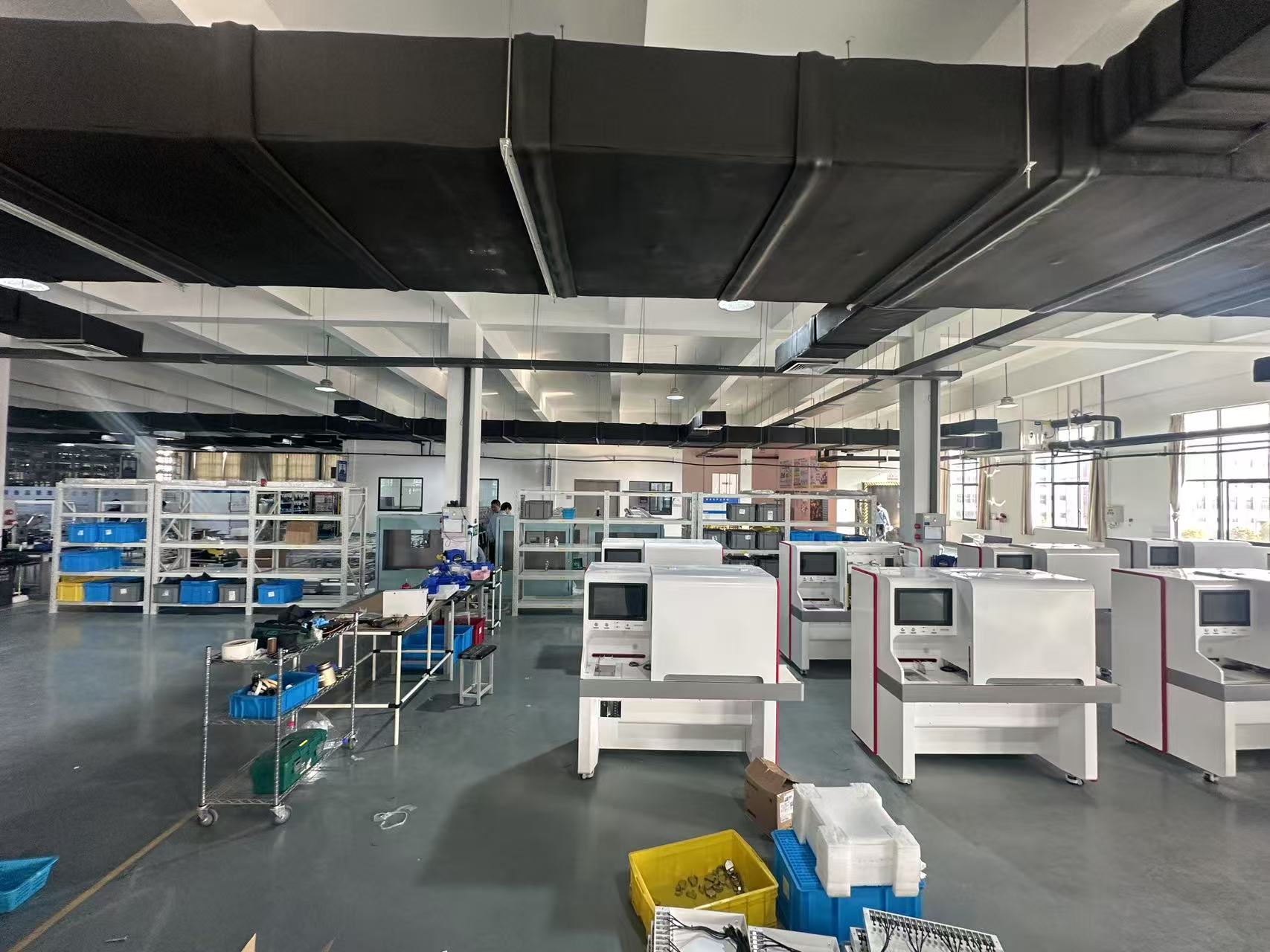
Assembly and pre-delivery testing area for intelligent pharmacy automation systems. Image: Haier Biomedical Technology (Suzhou) Co., Ltd.
Three dispensing architectures dominate boxed-medication automation decisions in hospital pharmacies: the robotic arm dispenser, the chute type dispenser, and the high-speed dispenser. They are often compared as if they were interchangeable options inside one product category, but each uses different mechanical logic — sequential robotic pick-and-place, gravity-driven chute delivery with buffering, and high-frequency batch ejection — and that logic determines how much floor area a pharmacy must give up, how many prescriptions per hour the system can release at peak, how much of the formulary can be stored inside the machine, and how the equipment behaves once it is connected to a hospital information system (HIS).
This framework is written for buyers at the decision and execution stages of a pharmacy automation project: the point at which the internal question has moved from whether to automate to which architecture should be specified, priced, installed, and accepted.
The category itself is no longer marginal. The global pharmacy automation devices market was estimated at USD 6.7 billion in 2024 (Insightace Analytic) and is projected to reach USD 11.6 billion by 2030, a CAGR of 9.9% (Grand View Research). Hospital pharmacies held the largest share of that market in 2024, according to Fortune Business Insights, reflecting high patient volumes and complex medication regimens. Most of this spending, however, is not greenfield: automated dispensing is retrofitted into buildings, workflows, and staffing models that already exist — which is why architecture-level specifications decide more outcomes than brand-level comparisons do.
The Buying Problem Behind the Comparison
Two pressures push hospital pharmacies toward automated dispensing. The first is workload distribution. Third-party research published by Omnicell indicates that roughly 75% of pharmacist time has traditionally been spent on non-clinical tasks; automated dispensing exists to move repetitive picking, counting, and staging work away from pharmacists. The second is the physical and financial cost of storage and inventory. Haier Biomedical's comparison material states that automated storage systems increase storage capacity by 2–4 times compared with manual storage management, that automated dispensing improves dispensing efficiency by 3–5 times over manual dispensing, and that intelligent inventory management supports inventory prediction accuracy of up to 85%+ while reducing expired-medication loss and excess inventory.
Those figures frame the opportunity, not the decision. A 3–5 times efficiency gain measured against a manual baseline says nothing about which of the three architectures fits a specific outpatient or inpatient pharmacy. The decision becomes tractable only when it is reduced to four dimensions — space, throughput, medication capacity, and integration — and when each dimension is evaluated against the published specification of a specific model rather than a vendor's general capability.
The Three Architectures, Defined
Robotic arm dispenser
A robotic arm dispenser stores boxed medications in a dense rack and uses a robotic arm to move a requested box from its storage position to a dispensing point. Haier Biomedical's Robotic Arm Dispenser, model HOH-KF-Smart, is specified for ≥1500 medication types and ≥20000 boxes of storage capacity, with a dispensing speed of ≥300 prescriptions per hour and a replenishment speed of ≥700 boxes per hour. Expiration management supports FIFO/FEFO, and barcode recognition is used for full-chain monitoring and traceability.
Chute type dispenser
A chute type dispenser releases medications down configured channels into a dispensing buffer, which removes the mechanical travel time of a robotic arm from the release path. The Haier Biomedical Chute Type Dispenser, model HOH-KF-1200, supports >1100 medication types and >15000 boxes of storage, with a dispensing speed of >350–500 prescriptions per hour and a replenishment speed of >2400 boxes per hour. Its structure is modular — dispensing, storage, and loading units are separate — and it uses full-screen dispensing with safety buffers alongside parallel multi-prescription operation. The dispensing buffer port provides ≥2 channels and supports side buffering and front-end output. The stated space requirement is under 12.85 m².
High-speed dispenser
A high-speed dispenser ejects boxes in batch at high frequency rather than assembling a single prescription at a time. The Haier Biomedical High Speed Dispenser HOH-GF, in its two-module configuration, provides ≥100 storage slots and ≥5000 boxes of storage capacity within a main unit measuring 2180 × 1230 × 2800 mm. Single-channel dispensing speed is ≥2 boxes per second. The structure is dual-level and stacked with adjustable bin width; dispensing is performed in batches for multiple boxes; high-precision photoelectric sensors handle dispensing detection; and error alerts use automatic positioning guidance with indicator lights.
Verified Specifications Side by Side
| Specification | Robotic Arm Dispenser (HOH-KF-Smart) | Chute Type Dispenser (HOH-KF-1200) | High Speed Dispenser (HOH-GF, 2 modules) |
|---|---|---|---|
| Medication types | ≥1500 | >1100 | Not stated by type count; ≥100 storage slots |
| Storage capacity | ≥20000 boxes | >15000 boxes | ≥5000 boxes |
| Main unit dimensions (W×H×D) | 8650 × 1747 × 2850 mm (replenishment module excluded) | <4690 × 2850 × 2735 mm | 2180 × 1230 × 2800 mm |
| Space requirement | Main unit footprint plus replenishment module | <12.85 m² | Main unit footprint; ≤2 medication bin modules |
| Dispensing speed | ≥300 prescriptions/hour | >350–500 prescriptions/hour | Single channel ≥2 boxes/sec |
| Replenishment speed | ≥700 boxes/hour | >2400 boxes/hour | Not stated for the two-module configuration |
| Structure / dispensing method | Robotic arm pick-and-place to dispensing point | Modular dispensing, storage, and loading units; full-screen dispensing with safety buffers; parallel multi-prescription operation | Dual-level stacked structure with adjustable bin width; batch dispensing for multiple boxes |
| Buffer / detection | Barcode recognition with full-chain monitoring | Dispensing buffer port ≥2 channels; side buffering and front-end output supported | High-precision photoelectric sensors; automatic positioning guidance with indicator lights |
| Expiration management | FIFO/FEFO support – zero-error dispensing | Not stated in the published parameter set | Not stated in the published parameter set |
Dimension 1 — Space: What the Machine Costs in Floor Area
The HOH-KF-Smart main unit measures 8650 × 1747 × 2850 mm, excluding the replenishment module. The installed system therefore occupies a line along a wall rather than a cabinet footprint, and the replenishment module adds to the area it consumes. The same figure sets a practical room-height consideration, since the main unit stands 2850 mm tall before any ceiling services are taken into account.
The HOH-KF-1200 is the compact option in this comparison. A stated space requirement of under 12.85 m² is close to the floor area of a small consultation room, and it still houses more than 15000 boxes. Because the dispensing, storage, and loading units are modular, the layout can be organized around the room's geometry rather than forced into a single block.
The HOH-GF is the smallest unit measured in floor area — 2180 × 1230 × 2800 mm — but that footprint carries ≥5000 boxes across ≥100 slots. In practice this positions it as a high-velocity module that complements bulk storage rather than replacing it.
For buyers, the working rule is to measure the usable floor area after structural columns, door swings, staff circulation routes, and delivery access are accounted for, and then to check the clear room height against the tallest main unit on the shortlist. A specification that fits on paper but cannot be delivered through the corridor is not a specification.
Dimension 2 — Throughput and Peak-Hour Behavior
Throughput is usually quoted as prescriptions per hour, which is useful for outpatient pharmacies where the prescription is the unit of work. The HOH-KF-Smart is rated at ≥300 prescriptions per hour; the HOH-KF-1200 at >350–500 prescriptions per hour. The chute system additionally supports parallel multi-prescription operation and ≥2 buffering channels, which matters at peak because parallel buffering allows more than one prescription to be in progress without collision at the release point.
The HOH-GF expresses throughput differently: ≥2 boxes per second on a single channel, in batch mode. That unit is better suited to scenarios where the binding constraint is box velocity — high-turnover items that must be staged quickly — rather than the assembly of complete prescriptions.
Replenishment speed deserves equal weight in the specification. The HOH-KF-Smart replenishes at ≥700 boxes per hour; the HOH-KF-1200 at >2400 boxes per hour. A system that dispenses quickly but fills slowly does not increase pharmacy capacity; it relocates the bottleneck to the loading bench and consumes staff time that the project was intended to release.
Dimension 3 — Medication Capacity and Formulary Coverage
Capacity and formulary coverage are different requirements, and the three architectures trade them differently. The HOH-KF-Smart covers ≥1500 medication types with ≥20000 boxes of storage — the broadest stated medication-type coverage among the three models. The HOH-KF-1200 covers >1100 medication types with >15000 boxes. The HOH-GF is specified by storage slot count (≥100) and box capacity (≥5000), which describes a deeper, faster store for a narrower range of items.
The practical implication for a hospital formulary with a long tail of low-turnover SKUs is that breadth and velocity cannot both be maximized in one machine. Automated storage is stated to increase storage capacity by 2–4 times compared with manual storage management, but that gain depends on which architecture is installed and how densely storage is configured.
Inventory behavior is a separate axis. Where intelligent inventory management replaces manual replenishment, inventory prediction accuracy is stated at up to 85%+, with reduced expired-medication loss and less excess inventory. This is a software-and-workflow outcome rather than a dispensing-mechanism outcome, which is why inventory performance should be specified and tested separately from dispensing speed.
Dimension 4 — Integration, Verification, and Traceability
Haier pharmacy automation solutions can be integrated with hospital information systems to support automated prescription processing and dispensing workflows. Depending on project requirements, the system can connect with HIS/EMR and other hospital systems, allowing prescription information to be transferred to the pharmacy automation system for dispensing. The stated principle is straightforward: the hospital system sends prescription information through a defined interface, and the automation system processes the prescription according to configured dispensing rules and equipment workflows, reducing repetitive manual data entry and improving process continuity.
Integration is not the same thing as verification. Pharmacy automation reduces the amount of repetitive manual picking and standardizes the dispensing workflow; when automated dispensing is combined with a verification process — such as an automated verification machine — the workflow adds checks on medication information before dispensing. In Haier Biomedical's comparison data, integrated dispensing and verification workflows are associated with accuracy improved to ≥99.9%, together with reduced costs caused by dispensing errors and rework.
Traceability is built into the equipment rather than added afterwards. The HOH-KF-Smart uses barcode recognition for full-chain monitoring, with FIFO/FEFO expiration management configured to support zero-error dispensing. The HOH-GF uses high-precision photoelectric sensors for dispensing detection and indicator-light guidance to locate errors automatically.
On the compliance side, pharmacy automation systems are expected to meet IEC 60601-1 for medical electrical equipment safety and ISO 13485 for quality management (CSA Group), while electronic records and electronic signatures in regulated environments fall under FDA 21 CFR Part 11 (U.S. FDA). Haier Biomedical operates with ISO 13485 medical device quality management system certification and designs its solutions to support integration with hospital information systems including HIS and EMR platforms.
Where Haier Biomedical Fits in This Framework
Haier Biomedical Technology (Suzhou) Co., Ltd is a healthcare technology company under Haier Group, founded in 2015, operating a 13,000 m² manufacturing facility with approximately 500 employees and an R&D team of 100 engineers. Its pharmacy automation business unit develops intelligent pharmacy automation solutions for hospitals, clinics, and healthcare organizations, with main products covering outpatient automated dispensing systems, inpatient pharmacy automation systems, and automated PIVAS systems, and main markets in Southeast Asia, Latin America, and the Middle East.
For a framework like this one, portfolio breadth is a long-term supply question rather than a shortlisting criterion. Beyond the three dispensers, the portfolio includes the Automatic Sub-packaging and Verification Machine HOH-FB-D400-HD (400 medication boxes, packaging speed 40–60 packs/min, dimensions 1200 × 880 × 2025 mm), the Intelligent Integrated Management Cabinet HOH-BQ-A (32 standard small pillboxes and 8 large pillboxes, 23-inch touch screen), the Anesthetic Medication Dispensing Cabinet HOH-MJ-01, and the Fully Automated Cytotoxic Drug Compounding Robot HOH-Robot-Plus for PIVAS (compounding efficiency 25/h, compatibility with >95% of vials, 100% compounding accuracy, Class 100 (ISO 5) compounding environment).

Manufacturing and engineering base supporting intelligent pharmacy automation production. Image: Haier Biomedical Technology (Suzhou) Co., Ltd.
Company-level evidence is also available to buyers running supplier due diligence. Haier Biomedical reported total revenue of RMB 2.33 billion (approximately USD 340.77 million) in 2025, with overseas revenue growing 17.9% year-on-year to 840 million yuan, and with AI-powered applications contributing 15% of total revenue in the same year; the company states that its AI-powered automated pharmacy solutions increased direct dispensing rates to 80% in 2025. Euromonitor International ranked Haier Biomedical as the No. 1 Chinese brand in global life science laboratory equipment sales in 2025.
Compared with Traditional Manual Workflows
The clearest way to frame the business case is to compare automated architectures against the manual workflows they replace, process by process, using the documented gaps rather than a general efficiency claim.
| Process | Manual workflow | Automated workflow | Stated gap |
|---|---|---|---|
| Dispensing | Manual picking and staging, prescription by prescription | Automated dispensing system | Dispensing efficiency increased by 3–5 times |
| Storage | Manual shelf and space management | Automated storage system | Storage capacity increased by 2–4 times |
| Picking and checking | Manual picking followed by manual checking | Integrated dispensing and verification | Accuracy improved to ≥99.9%; fewer error-driven repeats |
| Replenishment | Manual replenishment driven by staff observation | Intelligent inventory management | Inventory prediction accuracy up to 85%+; reduced expired-medication loss and excess inventory |
The table describes the direction of change, not a guaranteed outcome. The accuracy figure applies to an integrated dispensing-plus-verification workflow, not to a dispenser running on its own; automating dispensing without adding a verification step leaves part of the error-reduction value unused. Similarly, the frequently quoted figure that automation can reduce drug wastage by up to 90% originates from a medium-reliability third-party source and should be treated as directional in a business case rather than as a contractual expectation.
Where This Framework Stops Being Useful
Pharmacy automation is not suitable for every hospital. Selection depends on prescription volume, medication types, SKU requirements, dispensing workflow, storage capacity, available space, system integration requirements, scalability, and investment budget — and the final configuration should be determined from the hospital's actual operational requirements and site conditions rather than from a category-level benchmark.
Three further boundaries are worth stating explicitly:
- The robotic arm architecture's advantage in formulary breadth (≥1500 medication types) comes with the largest main unit in this comparison (8650 mm wide, 1747 mm deep, 2850 mm high, replenishment module excluded). It suits facilities that can dedicate a long wall to dispensing.
- The chute type architecture's efficiency advantage depends on how the formulary maps onto channel and buffer design, and on whether loading is organized to exploit the >2400 boxes/hour replenishment rate.
- The high-speed architecture's ≥5000 boxes and ≤2 medication bin modules describe a targeted store for fast-moving items. It is not a complete formulary store, and treating it as one misreads the specification.
There is also an execution-stage constraint that the commercial terms make visible. Acceptance criteria in this category support a Factory Acceptance Test (FAT), which validates the equipment before shipment. Site integration, interface behavior inside the hospital's HIS/EMR environment, and workflow adoption are validated locally, in the pharmacy, after installation — so the FAT is a milestone, not the end of the acceptance process.
Market Trend Analysis
Several verified market signals are relevant to an architecture decision that will be expected to serve a pharmacy for many years.
Market scale and growth. The global pharmacy automation devices market was estimated at USD 6.7 billion in 2024 (Insightace Analytic) and is projected to reach USD 11.6 billion by 2030 at a CAGR of 9.9% (Grand View Research). Base-year estimates diverge across research houses — from USD 6.65 billion (MarketsandMarkets) to USD 7.52 billion (Dataintelo) — depending on how services and software components are counted, which is a reminder to cite the source alongside any market figure used in an internal business case.
Regional concentration. North America accounted for approximately 38.2% to 47.8% of global pharmacy automation revenue in 2024 (Dataintelo / MarketsandMarkets). The U.S. pharmacy automation market alone is projected to reach USD 1.9 billion by 2026 (Fortune Business Insights), while the China market is estimated to grow at a CAGR of 5.6% between 2025 and 2030 (Grand View Research).
Segment structure. Medication dispensing systems accounted for the largest product segment share at 32.5% in 2025 (Dataintelo). Automated medication compounding systems are projected to be the fastest-growing product segment with a CAGR exceeding 10% (Grand View Research), and pharmacy automation software is expected to grow fastest among components from 2024 to 2030 (MarketsandMarkets).
Distribution shift. Decentralized distribution models are expected to account for 79.8% of the market in 2026, driven by adoption of automated dispensing cabinets (Fortune Business Insights).
For buyers, the most consequential trend is the combination of software growth and decentralization. It implies that a dispenser specified today will be judged by how its software layer, interfaces, and module structure accommodate a pharmacy that keeps changing — not only by its dispensing speed at handover.
Procurement and Execution: What to Fix Before Signing
The commercial terms documented for Haier pharmacy automation projects are specific enough to convert an architecture decision into a purchase order:
- MOQ: 1 unit
- Delivery terms: FOB
- Acceptance criteria: Factory Acceptance Test (FAT) supported
- Payment terms: 50% in advance by TT, balance before shipping
On top of those terms, an execution-stage checklist for this architecture comparison should confirm six points. First, site dimensions measured against the chosen model's main unit dimensions (W × H × D), with the replenishment module accounted for. Second, medication types and storage capacity matched against the hospital's actual formulary rather than a target figure. Third, the HIS/EMR interface scope defined before the FAT. Fourth, dispensing method and buffer configuration confirmed against the real prescription profile. Fifth, the replenishment workflow and staffing allocation agreed, because replenishment speed is a staff-facing specification. Sixth, FAT scope documented, so that acceptance has an objective record.
Future Outlook
Two structural changes are likely to shape the next procurement cycle. The first is the migration of value into software. Pharmacy automation software is projected to grow fastest among components through 2030 (MarketsandMarkets), and Haier Biomedical reports that AI-powered applications contributed 15% of its total revenue in 2025, with its AI-powered automated pharmacy solutions driving direct dispensing rates to 80% in that year. Architecture decisions will increasingly be evaluated on the upgrade path of the control and verification layer, not only on mechanical throughput.
The second shift is the expansion of automation beyond dispensing. Automated medication compounding is projected as the fastest-growing product segment with a CAGR exceeding 10% (Grand View Research), and decentralized distribution is expected to reach 79.8% of the market by 2026 (Fortune Business Insights). In portfolio terms this resembles a pharmacy that starts with one dispensing architecture, then adds sub-packaging and verification, decentralized cabinets, and — for sterile preparation — automated compounding systems.
For hospital buyers, the practical consequence is that a vendor's module structure and long-term support position deserve weight comparable to the machine's specification sheet. A modular system that can be extended, supplied by an organization with a documented compliance and service record, is usually the more defensible commitment over a multi-year horizon than a narrowly optimized single unit.
FAQ
Is pharmacy automation suitable for every hospital?
No. Pharmacy automation should be selected according to the hospital's prescription volume, medication types, SKU requirements, dispensing workflow, storage capacity, available space, system integration requirements, scalability, and investment budget. Different automation solutions — including Robotic Arm Dispensers, Chute Type Dispensers, and High Speed Dispensers — address different pharmacy scenarios, and the final configuration should be determined from the hospital's specific operational requirements and site conditions.
What types of hospitals are suitable for a robotic arm dispenser?
A robotic arm dispenser is suitable for hospitals that handle a relatively large number of boxed medications and require automated storage and dispensing. Haier's Robotic Arm Dispenser can be configured with multiple modules and integrated into the overall pharmacy workflow according to medication volume, available space, and dispensing requirements. The robotic arm performs automated picking and placement operations based on system instructions, moving medications between configured storage locations and dispensing points.
Can pharmacy automation systems integrate with a hospital HIS?
Yes. Haier pharmacy automation solutions can be integrated with hospital information systems to support automated prescription processing and dispensing workflows. Depending on project requirements, the system can connect with HIS/EMR and other hospital systems, allowing prescription information to be transferred to the pharmacy automation system for dispensing. The hospital system sends prescription information through the defined interface, and the automation system processes the prescription according to configured dispensing rules and equipment workflows.
Can pharmacy automation reduce medication picking errors?
Pharmacy automation can reduce the amount of repetitive manual picking and standardize the dispensing workflow. When automated dispensing is combined with a medication verification process, such as an automated verification machine, the workflow provides additional checks on medication information before dispensing. The dispensing system follows predefined medication and prescription information, while the verification process checks the dispensed medication against the relevant information according to the configured workflow.
What are the purchasing terms and acceptance criteria?
The documented terms are: MOQ of 1 unit; delivery terms FOB; acceptance criteria supporting a Factory Acceptance Test (FAT); and payment terms of 50% in advance by TT with the balance before shipping. Site-level integration and interface validation take place after installation, which is why FAT scope should be documented separately from final site acceptance.
Have Questions or Need More Details?
Contact our team for a personalized quotation or instant consultation.
Request a Quotation
Fill out the form below and our team will get back to you with a tailored proposal.
WhatsApp Direct Chat
Prefer to chat in real-time? Message us on WhatsApp for instant assistance & quick answers.
- Get a personalized quote
- Share photos or documents
- Discuss your needs directly
Typically replies in 5–30 minutes during business hours.