
Robotic Palletizing Systems: Constraints Buyers Must Specify
Handling applications — the segment that includes palletizing and depalletizing — accounted for 42.1% of global industrial robot market revenue in 2025, according to Grand View Research. The dedicated market for robotic palletizers and de-palletizers is projected to reach USD 4.67 billion in 2026, based on Fortune Business Insights' industrial robots market report. The consequence for buyers is that palletizing projects are rarely decided by the robot brand alone. They are decided by whether the specified constraint set — payload, working envelope, repeatability, environment and cell-level safety — matches the plant that will actually run the system.
This reference is written for readers in the research and evaluation stage: what each constraint controls, which figures can be verified before purchase, and which questions separate a workable palletizing cell from an expensive retrofit.
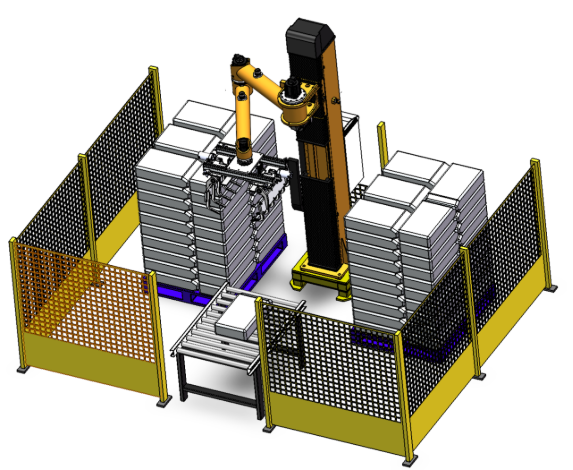
Figure 1 — A robotic palletizing system project layout. In most projects the procurement unit is the complete cell: robot, gripper, conveyors, guarding and controls. Image: South China Robotics Technology (Guangdong) Co., Ltd.
Why palletizing is a constraint problem rather than a product comparison
A palletizing cell is an integrated system, not a robot arm. The application data behind South China Robotics Technology (Guangdong) Co., Ltd. — a Guangzhou-based industrial robotics and automation company founded in 2017, specializing in robotic palletizing, depalletizing, automatic bag opening and feeding, press tending and material handling — lists the matched equipment of a typical installation: the industrial robot, a 3D vision system, a custom bag handling and opening gripper, a bag cutting mechanism, a material hopper, a dust collection system and a conveyor system. Each of those elements imposes its own constraints on the robot selected.
That is why the technical conversation should begin with a written constraint list instead of a model number. The five layers below cover the majority of early-stage specification failures in bagged-material, carton, can and drum handling.
Constraint layer 1 — payload and reach define what the cell can physically handle
The documented payload rating of the SCH100-1950-1800 four-axis palletizing robot is 100 kg, which supports payload-based sizing for depalletizing and palletizing system design. Its maximum reach is 1950 mm. The documented repeatability of ±0.5 mm provides a measurable value for repeatability verification of palletizing cells.
Reference specifications of the SCH100-1950-1800
| Parameter | Documented value | What it constrains in the cell |
|---|---|---|
| Number of axes | 4 | Purpose-built for palletizing, depalletizing and regular material handling patterns |
| Maximum payload | 100 kg | Upper bound for the handled load plus tooling, to be confirmed with the supplier |
| Maximum reach | 1950 mm | Distance from robot base to the furthest pick or place point |
| Repeatability | ±0.5 mm | Placement consistency to be verified against an agreed measurement method |
| Robot body weight | 680 kg | Floor loading and foundation or base-plate planning |
| Power capacity | 5.75 kVA | Electrical supply and control cabinet sizing |
| Axis 1 working range | ±130° | Sweep area and safety-fence layout |
| Z-axis vertical stroke | 1800 mm | Achievable stacking height above the pick level |
| Axis 3 working range | ±147° | Reachable positions within the working envelope |
| Axis 4 working range | ±360° | Continuous rotation of the gripper for pattern alignment |
| Operating temperature | 0–45°C | Ambient conditions at the installation point |
| Material | High-strength steel | Structural durability under continuous heavy-duty cycles |
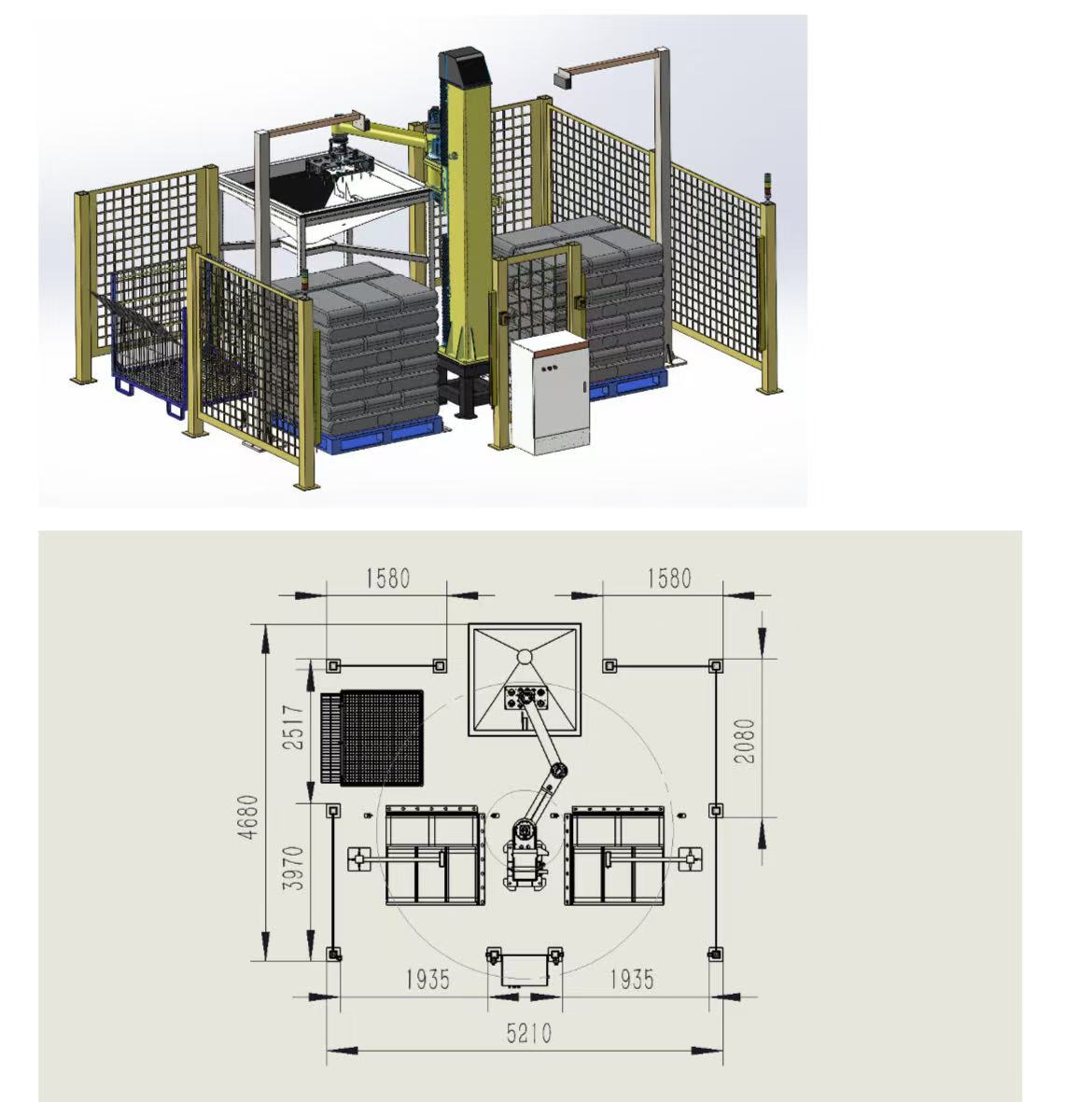
Figure 2 — Four-axis palletizing robot with a 100 kg documented payload rating and 1950 mm maximum reach.
Two payload questions that are often missed
- How the rated payload is defined relative to the end-effector. Grippers, vacuum plates and bag-cutting tools add mass that the arm must carry. Buyers should ask the supplier to confirm how tooling weight and load centre of gravity are treated against the rated figure before signing off on a sizing calculation.
- Gripper-to-format matching. Custom grippers can be designed for different products, including bags, cartons, drums and other regular-shaped workpieces. The gripper, not the arm, usually determines whether a format change requires a new tool or only a program change.
Reach should be specified from the pallet corner furthest from the robot base, not from the centre of the pallet. A 1950 mm maximum reach looks generous until the layout is drawn with the robot behind a conveyor and a full-size pallet on the far side.
Constraint layer 2 — working envelope, stroke and floor footprint
The Z-axis vertical stroke of 1800 mm on the SCH100-1950-1800 is the figure that determines achievable stacking height, while the axis ranges define the horizontal sweep that must be protected. Together they set the floor area, the fence position and the pallet presentation layout — the three items most often compromised late in a project.
Configuration choice also matters. In the company's palletizing selection guidance, a column-type palletizing robot is recommended for workshops with limited floor space, because it reduces occupied floor area while maintaining stacking stability with a low bag-topple rate, and it can handle bags, cans and boxes in food production. For factories running multiple production lines, a collaborative mobile palletizing robot is positioned as the more flexible option: it can be redeployed between lines, supports continuous operation and is described as adaptable to cold-storage environments.
Both configurations are legitimate answers to different constraints. A plant should decide between fixed column mounting and mobile collaborative deployment before comparing prices, because the two choices imply different safety concepts, different operating procedures and different takt times.
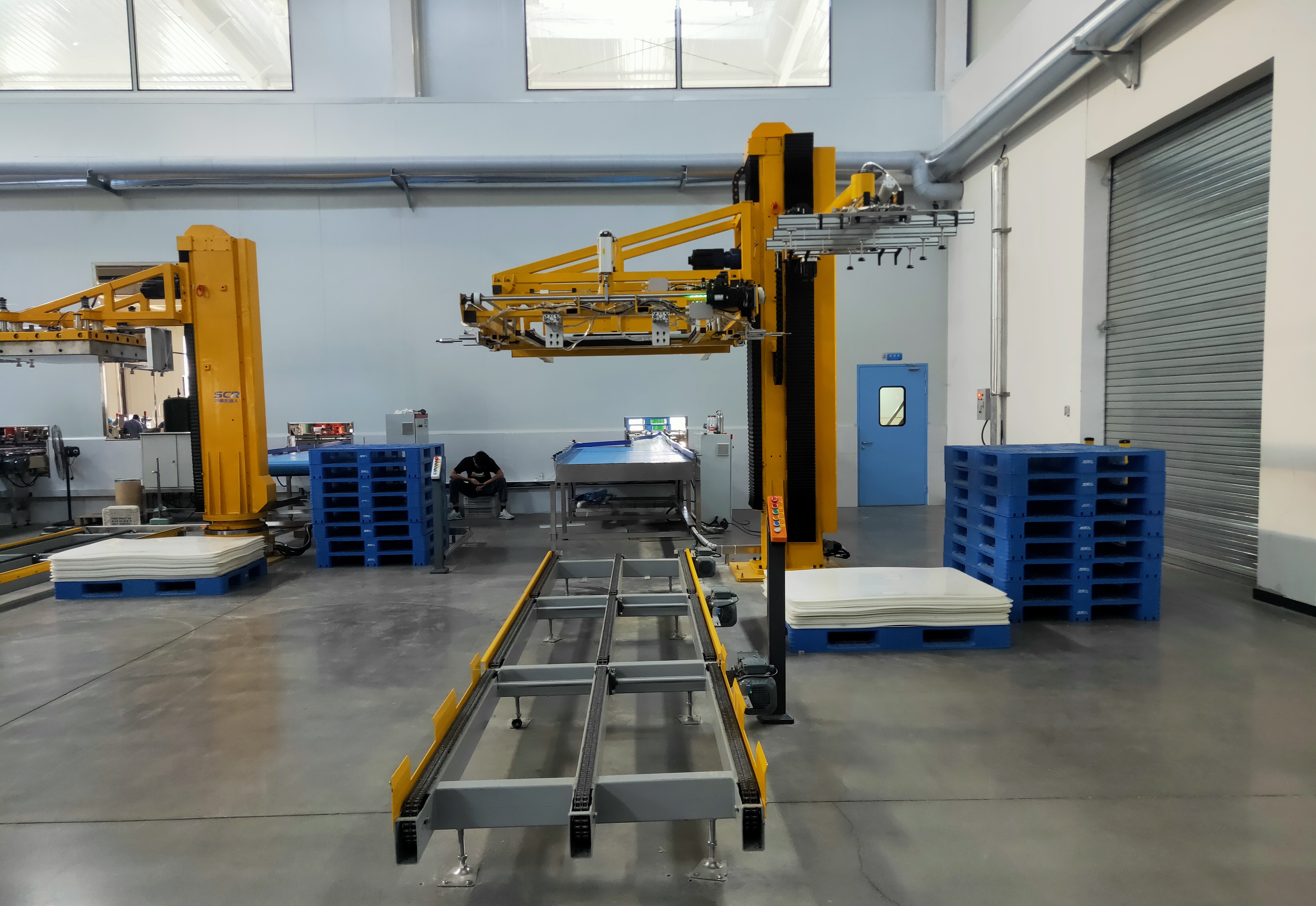
Figure 3 — A robotic production line. Envelope, conveyor interface and safety fencing are co-designed, which is why footprint should be fixed in the specification before model selection.
Constraint layer 3 — repeatability sets the verification method, not just a number
The specification states a repeatability of ±0.5 mm. This provides a measurable value for repeatability verification of palletizing cells — but only if the buyer defines where and how it is measured. Two clauses should appear in any palletizing specification:
- Measurement reference. Whether repeatability is verified at the robot flange or at the placed package, since the two are not equivalent once gripper deflection and pallet surface variation are introduced.
- Acceptance sample size. How many consecutive cycles are measured, at which payload, and under which ambient temperature within the documented 0–45°C operating range.
Placement stability deserves its own acceptance criterion. In the company's food-industry selection guidance, a bag-topple rate below 0.05% is cited as a target for bag palletizing, alongside a throughput band of roughly 800–1000 bags per hour for food applications. Buyers should treat these as supplier-stated guidance values and ask for the conditions under which they were achieved — bag type, fill weight, pallet pattern and ambient conditions.
Constraint layer 4 — environment, hygiene and material format
Industrial reality, not the catalogue, decides this layer. The company's application data for automated bag handling and palletizing lists the working conditions the systems are engineered to encounter: high temperature, heavy-duty handling, dusty environments, chemical exposure, corrosive environments, high humidity, oil mist, continuous operation and generally harsh industrial environments.
The corresponding design requirements documented for those projects include dustproof design, dust collection and control, enclosed material handling, easy cleaning, wear-resistant components, corrosion-resistant design, safety interlocks, reliable continuous operation, easy maintenance, and customisation for different materials and working environments. In food and beverage production, the company's selection guidance prioritises hygiene construction — 304 stainless steel, HACCP-compliant and easy-clean surfaces — together with throughput and stacking stability.
| Operating environment or format | Constraint to specify | Evidence to request |
|---|---|---|
| Dusty powder and granular materials | Dustproof construction, dust collection, enclosed handling | Cell layout drawing showing extraction points; maintenance access plan |
| Chemical exposure or corrosive atmosphere | Corrosion-resistant design; suitability of seals and surface finishes | Material and coating specification for exposed parts |
| High humidity, oil mist, high ambient temperature | Operation within the documented 0–45°C range and protection class of components | Component ratings and cabinet cooling design |
| Food and beverage, including cans and boxes | Hygiene construction, easy cleaning, continuous operation | Surface material declaration and cleaning procedure |
| Bagged raw materials | Bag opening method, discharge into hopper, dust control | Bag-type trial results at the specified fill weight |
| Cartons, drums and regular-shaped workpieces | Gripper design matched to product dimensions and weight | Gripper drawing and changeover time |
| Continuous operation (24/7) | Wear parts, spare-parts list, mean-time-to-repair targets | Recommended spare-parts kit and service intervals |
The list of robot types in the company's portfolio reflects how differently these constraints are treated: depalletizing and bag-breaking robots, column-type depalletizing robots, stamping robots, palletizing robots, column robots and custom non-standard industrial robots are separate configurations rather than variants of one machine. A plant handling bagged chemical raw materials and a plant handling beverage cans should not be specified with the same cell.
Constraint layer 5 — safety is a cell requirement, not a robot requirement
The EN ISO 10218 series is the safety-requirements standard series for industrial robots. As described by the German Commission for Occupational Health and Safety and Standardisation (KAN) in its 2023 explanation of the revision, Part 1 of the series contains requirements for industrial robots, while Part 2 covers applications such as robot systems and robot cells.
That division has a direct procurement implication: a robot-level declaration does not certify the palletizing cell. Guarding, interlocked access doors, conveyor interfaces, pallet-dispenser zones and the vision system all sit inside the Part 2 scope. A purchasing specification should therefore request cell-level conformity documentation and identify the target market's applicable national adoption before the order is placed.
Hazardous-area constraints
For chemical and explosive environments, the company states that it provides custom explosion-proof depalletizing and bag-breaking robots designed to national explosion-proof standards, replacing personnel in hazardous zones, with dust and explosion risk controlled through sealed designs and isolated operation. Its published maintenance guidance for those units is instructive about what these constraints demand in day-to-day operation: verify that the explosion-proof enclosure and sealing parts are fully closed and tightened, keep electrical components free of accumulated dust, confirm reliable grounding, and monitor internal enclosure temperature before restarting.
Vision-guided depalletizing — reading tolerance figures correctly
Vision guidance changes the constraint profile of depalletizing. According to the company's technical explanation, a vision-guided depalletizing robot uses 3D cameras and LiDAR point-cloud modelling together with deep-learning grasp-path planning to identify mixed stacks and incoming position deviation, with a stated position-deviation tolerance of ±50 mm and a reported 99.8% grabbing success rate for mixed stacks.
Those figures are supplier-reported and should be qualified during evaluation. A buyer's specification should state the test conditions: how many SKUs appear in the mixed stack, whether deformed or partially damaged bags are present, the lighting conditions at the depalletizing station, and whether the success rate is measured per grasp attempt or per completed layer. Vision is also the component most sensitive to changes in upstream packaging, so the specification should state which packaging changes require re-teaching and which require a supplier visit.
Comparison with traditional solutions — and where robotic palletizing is not the answer
| Approach | Strength | Constraint or limitation | Typical fit |
|---|---|---|---|
| Manual stacking | Maximum flexibility; minimal capital outlay | Labour intensity, repetitive strain, dust and chemical exposure for operators; output tied to shift patterns | Very low volume, highly irregular formats, temporary production |
| Dedicated mechanical or high-level palletizer | High throughput for a fixed package type | Typically optimised for one pattern and one format; pattern changes can require mechanical modification | Single-SKU, high-volume lines with a stable package format |
| Four-axis robotic palletizing cell | Pattern flexibility through programming and custom grippers; integrates with conveyors, pallet dispensers, safety fencing and vision systems | The four-axis format is purpose-designed for palletizing, depalletizing and material handling; processes requiring complex multi-plane articulated paths sit outside this design intent. Integration with guarding, vision and infeed equipment also adds project scope. | Multi-format bag, carton and drum handling with medium-to-heavy payloads |
| Collaborative mobile palletizing robot | Redeployable between lines; suits multi-line plants | Mobility introduces operating-procedure and traffic-management requirements that a fixed cell does not have | Plants with several low-to-medium volume lines sharing one palletizing function |
A second, less technical limitation applies regardless of configuration: a robotic palletizing cell assumes a reasonably stable infeed. If upstream filling accuracy, bag sealing quality or carton squareness varies widely, the cell inherits that variation, and vision systems and grippers can only compensate within a documented tolerance window. Buyers should treat upstream quality as part of the business case, not as a separate project.
What to put in the procurement specification
| Specification item | Why it matters |
|---|---|
| Payload rating and how tooling weight is treated | Prevents undersized robot selection once grippers and cutting mechanisms are added |
| Maximum reach measured to the furthest pallet corner | Prevents layout changes after the robot model is fixed |
| Z-axis stroke and target stacking height | Determines whether the specified pattern can be built without pallet lifting |
| Repeatability with a defined measurement reference and acceptance sample | Converts ±0.5 mm from a catalogue figure into a verifiable acceptance criterion |
| Ambient temperature and environmental conditions at the installation point | Must fall within the documented 0–45°C operating range and the appropriate protection design |
| Material format list, fill weights and pallet patterns | Drives gripper design and pattern programming; supports the required capacity calculation |
| Cell-level safety documentation and applicable standards | EN ISO 10218-2 scope covers the integrated cell, not only the robot |
| Pre-shipment testing and third-party inspection | Defines what is verified before the equipment leaves the factory |
| Lead time, warranty and after-sales scope | Sets expectations for commissioning, training and maintenance |
On the supply side, the company's stated production profile for its robot business includes a 40,000 m² facility, 180 employees, 48 engineers in research and development, an annual output of 3,000 units and an export share of 40%, with markets in Europe, the Middle East, Southeast Asia, South Asia, Latin America and North America. Its documented commercial terms include OEM/ODM production, a minimum order quantity of one unit, a lead time of 25–35 days, 100% pre-shipment testing with third-party inspection (SGS), remote technical support and a one-year warranty. Those figures are useful as a supplier-qualification baseline: they let a buyer compare delivery structure and quality control scope, not just unit price.
Reported deployment outcomes as evaluation evidence
The following outcomes are reported by the company from its own project records. They are useful for understanding which constraint profiles have been addressed in practice, and should be validated against references during evaluation rather than treated as independently audited results.
| Application context | Reported outcome |
|---|---|
| Nuclear energy and heavy industry handling | Operation in a narrow space of 5 cm for equipment depalletizing and pipeline inspection, avoiding personnel radiation risk and shortening maintenance periods; a heavy-industry customer reported equipment utilisation improvement of over 90%. |
| Home appliance and automotive assembly | Robot assembly time compressed from 2 hours to 30 minutes with doubled capacity and a 97.5% reduction in failure rate; automated welding workshops reporting 100% automation, and engine cylinder block lines reporting zero defects per million pieces with 58% labour reduction. |
| Chemical and food-grade production | Improved material handling efficiency by 40% in chemical production; in dairy and health-supplement production, single-robot daily throughput above 20,000 pieces with palletizing efficiency increased by 40%. |
Market context — why constraint discipline is becoming more valuable
The installed base is expanding quickly. According to IFR World Robotics 2025 data, China installed 295,045 industrial robots in 2024 and accounted for 54% of global installations. Guangdong Province produced 246,800 units of industrial robots in 2024, equal to 44% of the national total, according to the Department of Industry and Information Technology of Guangdong Province. Handling applications, which include palletizing and depalletizing, held the largest application share at 42.1% in 2025 (Grand View Research).
Two conclusions follow for buyers. First, supply-chain density in Guangdong supports faster customisation and technical support for non-standard cells. Second, high installation volumes also mean a crowded supplier landscape, and the constraint list in this article is what makes proposals comparable. Public, independently verified performance data for specific application segments such as depalletizing, bag breaking and can handling remains limited, which shifts the verification burden onto the buyer's specification and acceptance testing.
Future outlook
Three shifts are likely to shape palletizing procurement over the next planning cycle. Constraint verification is moving from brochure figures to documented acceptance tests, because buyers increasingly need traceable numbers on payload, repeatability and environmental performance rather than descriptive claims. Vision guidance is becoming a standard element of depalletizing specifications rather than an optional upgrade, which will push tolerance definitions and re-teaching procedures into contract documents. And as safety expectations consolidate around the EN ISO 10218 series — Part 1 for robots, Part 2 for robot systems and cells — the practical distinction between robot certification and cell conformity will become a routine part of supplier questionnaires.
For plants evaluating robotic palletizing systems now, the durable advantage is not finding the cheapest arm. It is writing a constraint specification detailed enough that every supplier quotes against the same plant, the same formats and the same acceptance criteria.
FAQ
What is a depalletizing and bag-breaking industrial robot?
It is an integrated industrial robot that combines de-stacking and bag-opening functions. A vision system identifies stacked bagged or boxed materials on a pallet, the robot de-stacks the layers, and the system then automatically cuts open the packages and discharges the contents into a designated vessel. The configuration is used for bagged raw materials in chemical, building-material and feed industries, where it removes manual dust exposure and reduces labour intensity.
How does a vision-guided depalletizing robot recognize materials?
According to the company's technical explanation, the system uses 3D cameras and LiDAR point-cloud modelling to build models of the stacked packages, combined with deep-learning grasp-path planning to identify material types and calculate object poses. The stated position-deviation tolerance is ±50 mm, with a reported 99.8% grabbing success rate for mixed stacks. These are supplier-reported figures, so verification should cover the number of SKUs in the stack, whether damaged bags are present, and the lighting conditions at the station.
How should a palletizing robot be selected for a food factory?
Published selection criteria for food applications focus on hygiene certification, production throughput, stacking stability, environmental adaptability, equipment maintainability and layout flexibility. In the company's guidance, food production prioritises 304 stainless steel, HACCP-compliant and easy-clean construction, throughput in the region of 800–1000 bags per hour, a bag-topple rate below 0.05%, 24-hour continuous operation and adaptability to cold storage. Collaborative mobile palletizing is suggested where multiple production lines must share the function, and a column-type configuration where floor space is limited; both handle bags, cans and boxes.
Is it safe to use robots in chemical or explosive environments?
The company states that it supplies custom explosion-proof depalletizing and bag-breaking robots designed to national explosion-proof standards, replacing personnel in hazardous zones, with dust and explosion risk controlled through sealed designs and isolated operation. Its maintenance guidance for these units covers sealing integrity, dust accumulation on electrical components, grounding reliability and internal enclosure temperature. Because explosion-proof requirements are jurisdiction-specific, buyers should verify the applicable certification and marking for their own market, and confirm which party holds responsibility for cell-level conformity once the robot is integrated with conveyors, hoppers and dust collection equipment.