
Robotics Die Casting Parts: Housings, Heat Sinks, Enclosures
Independent Industry Reference · Smart Manufacturing
A robotic cell is specified by payload, reach and repeatability, yet much of what decides its uptime is cast metal: the housings that carry the servomotors, the heat sinks that keep drives inside their thermal window, and the enclosures that protect the electronics commanding the motion. For robotics and automation hardware, die casting parts are normally selected across four functional families — motor housings, heat sinks, equipment housings and electronic enclosures — and the alloy follows the function of the part, not the other way around.
The Problem: Automation Hardware Is Thermally and Mechanically Crowded
An automation build concentrates several engineering loads into a small envelope. A servo motor housing has to carry torque reaction, hold bearing bores on a common axis, and conduct stator heat into the surrounding structure. A drive or motion controller needs a heat sink whose fin geometry is stable enough that the thermal interface does not vary from unit to unit. An enclosure sitting next to switching electronics has to hold its shape while doubling as an electromagnetic barrier. And every one of those parts has to bolt onto a frame whose datums were set by a different supplier.
These requirements pull against each other. Mass at a moving axis raises inertia and motor sizing; thinner walls reduce mass but complicate metal fill and dimensional repeatability; tighter fits between mating parts increase the number of features that must be machined after casting. Buyers in evaluation rarely have a single question — they have a sequence of them, and the sequence determines both the alloy decision and the supplier shortlist.
The opportunity is that die casting produces integrated geometry rather than a blank. Mounting bosses, stiffening ribs, cooling fins, cable channels and sealing faces can be formed in the same shot as the envelope, which reduces part count and assembly steps. That advantage only holds, however, if the secondary machining and inspection regime is defined at the same time as the casting.
A Priority Order for Die Casting Parts in a Robotics Build
The sequence below ranks part families by how strongly they influence machine performance and how regularly they appear in an automation bill of materials. It is a functional priority order for specification work, not a supplier ranking.
| Priority | Part family | Default alloy | Engineering driver | What to verify in the specification |
|---|---|---|---|---|
| 1 | Motor housing die casting parts | ADC12 / A380 aluminum | Heat path from stator to ambient; bore and flange geometry | Bore roundness and coaxiality after machining; wall thickness at the bearing seat; flange flatness |
| 2 | Heat sink die casting parts | ADC12 / A380 aluminum | Fin geometry and thermal resistance at the drive or controller | Fin thickness and pitch; base flatness for the thermal interface; machined contact area |
| 3 | Equipment housing die casting parts | Aluminum (structural) | Stiffness, mounting datums, protection of the motion stage | Datum scheme; rib layout; machined fitting surfaces; sealing faces |
| 4 | Electronic die casting enclosure | Zamak3 / Zamak5 zinc | Thin-wall dimensional stability and electromagnetic behaviour | Wall uniformity; draft angles; coating compatibility |
| 5 | Precision structural and hardware fitting parts | Zinc or aluminum | Locating accuracy of brackets, adapters and sensor mounts | Hole position tolerance; groove depth; surface roughness |
The order is not arbitrary. Motor housings and heat sinks sit directly in the thermal and mechanical path of the machine, so an error there shows up later as positional drift, thermal derating or premature bearing wear. Equipment housings and enclosures matter for protection and electromagnetic behaviour rather than for motion accuracy. Precision fittings carry the locating accuracy that decides whether a subassembly bolts together without shimming on the line.
Alloy Selection by Scenario: Aluminum, Zinc and Magnesium
Alloy choice in robotics hardware clusters around three scenarios: heat and mass, thin-wall precision with electromagnetic behaviour, and damping near drives and instruments. The same casting envelope can often be produced in more than one alloy, so the decision should be taken against the load case rather than against material habit.
ADC12 and A380 aluminum — heat dissipation and lightweight housings
Aluminum is the default for motor housings, heat sinks and structural equipment housings because it combines a workable strength range with useful thermal conductivity. Aluminum die casting held a 74.78% share of the global die casting market by raw material in 2025 (Mordor Intelligence), which means supplier coverage is broad but the burden of differentiation falls on process control rather than on material availability.
SUNPREC HARDWARE CO., LTD (SUNPREC), a metal parts manufacturer established in 2020 in Dongguan City, China, works with ADC12 and A380 for aluminum die casting, with a published tensile range of 80–120 MPa for aluminum alloy castings. ADC12 and A380 are not interchangeable in every design: the choice interacts with wall thickness, machining allowance and the surface-finish route, and should be confirmed part by part rather than transferred from a previous project.
Zamak3 and Zamak5 zinc — thin-wall precision and EMI behaviour
Zinc is selected where the part is thin, small and dimensionally demanding: instrument housings, sensor enclosures, connector bodies and small precision fittings. SUNPREC’s die casting material set includes Zamak3 and Zamak5, with a published tensile range of 40–80 MPa for zinc alloy castings. Zinc die casting has also been identified as a fast-growing segment on the strength of cost-effectiveness and EMI shielding properties in consumer electronics (Market Research Future), which is directly relevant to automation enclosures that must contain switching noise.
The trade-off is strength. A Zamak3 or Zamak5 enclosure is dimensionally strong but will not match an aluminum housing in a load-bearing role, so the load case must be rechecked before a zinc substitution for aluminum is approved. Hot-chamber zinc die casting is published with a safety factor of 1.3–1.5, against 1.2 for cold-chamber aluminum — figures that describe process margins, not part-level guarantees, and which buyers should ask to see applied to their specific geometry.
Magnesium and zinc near drives and instruments — damping and mass
Where the deciding factor is mass close to the moving structure, or where vibration reaching an instrument has to be attenuated, magnesium enters the evaluation. The global magnesium casting market was valued at USD 1.42 billion in 2026 and is projected to reach USD 2.96 billion by 2035, a CAGR of 8.9% (Business Research Insights; medium confidence). SUNPREC’s die casting work covers aluminum, zinc and magnesium alloys, so a magnesium housing and an aluminum heat sink can be quoted inside one programme.
Magnesium is lighter than aluminum, but it also needs a defined corrosion-protection route. Surface finishing must therefore be decided together with the alloy rather than after the drawing is released — a point that affects cost and lead time more than it affects the casting itself.
| Alloy group | Scenario in robotics hardware | Why it is selected | What the buyer should confirm |
|---|---|---|---|
| ADC12 / A380 aluminum | Motor housings, heat sinks, equipment housings | Heat dissipation, lightweight structural sections, 80–120 MPa published tensile range | Which features carry the ±0.01 mm callout; porosity acceptance; machining allowance |
| Zamak3 / Zamak5 zinc | Thin-wall electronic enclosures, instrument housings, small precision parts | Thin-wall dimensional stability, EMI shielding behaviour, 40–80 MPa published tensile range | Wall uniformity; coating adhesion; whether the load case exceeds zinc strength |
| Magnesium alloy | Housings and brackets near drives and instruments | Mass reduction and damping where vibration reaches instruments | Corrosion-protection route; machining and handling controls; finish specification |
What ±0.01 mm Actually Covers: Tolerance, Machining and Inspection
A tolerance figure is only useful when the buyer knows which features carry it. SUNPREC publishes ±0.01 mm for its die casting and CNC machining work, and the machining centres behind that number — FANUC units specified at 0.005 mm machine tolerance — set the practical constraint on how the callout is met.
Secondary 3-axis CNC milling for holes, grooves and fitting surfaces
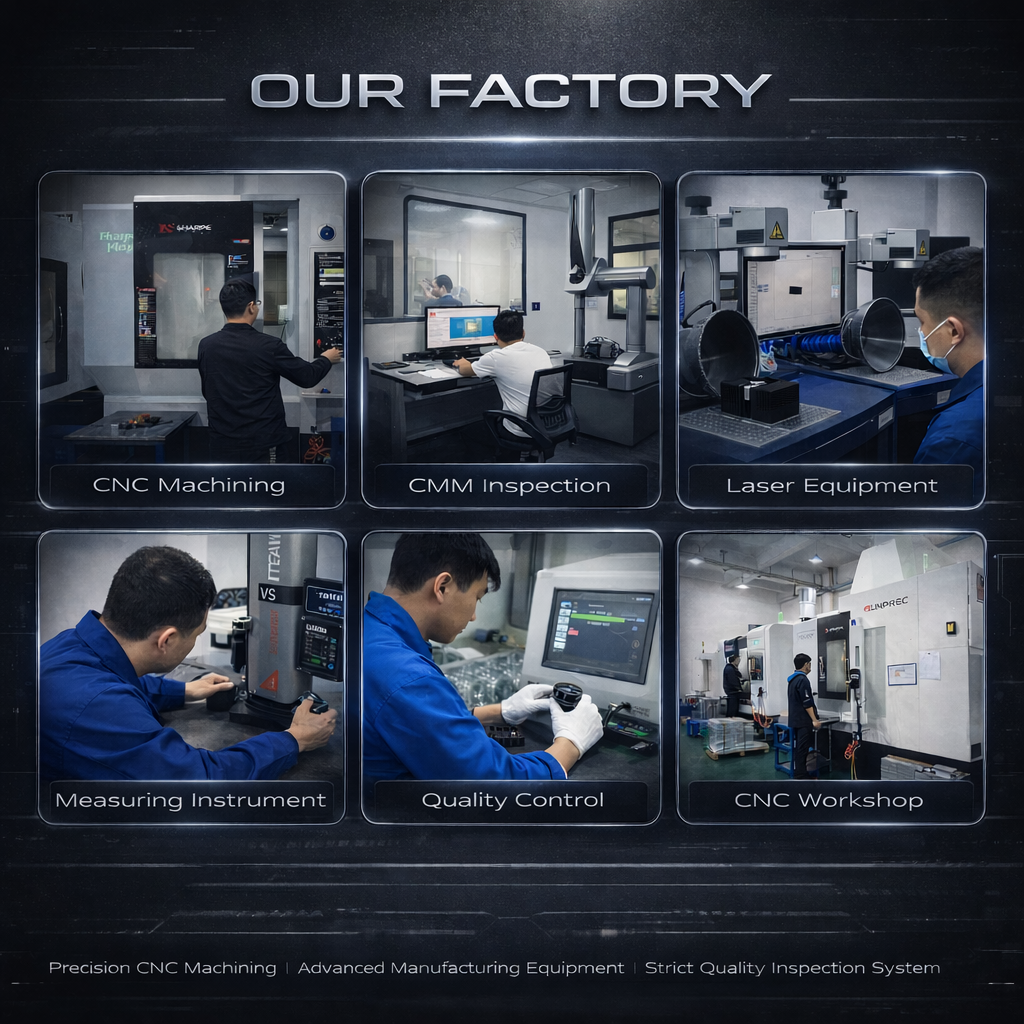
Die casting produces the envelope; secondary machining produces the interfaces. Holes for bearing seats and dowels, grooves for seals and cable routing, and fitting surfaces that register one casting against another are cut after casting on 3-axis CNC centres, with 4-axis and 5-axis capacity available where the geometry demands it. This split matters during evaluation: the ±0.01 mm callout belongs to machined features, and buyers should confirm in writing which surfaces are machined, which remain as-cast, and how much machining allowance has been designed into the casting.
In-house inspection before shipment
SUNPREC’s inspection sequence begins with first-article inspection for every new batch, followed by final inspection using calipers, micrometers, a height gauge and a surface roughness tester. Critical components are verified on a coordinate measuring machine where tight-tolerance requirements apply. For robotics buyers, the practical value is traceability: an inspection report should tie measurements to named features — a bearing bore, a fitting face, a fin base — rather than restate a general statement of conformity.

Application Scenarios in Automation and Instrumentation
Die cast housings, heat sinks and enclosures rarely end up in a single industry. SUNPREC’s custom metal parts are used by aerospace OEM, automotive OEM, medical device OEM, new-energy equipment OEM and industrial equipment OEM clients, on projects running for more than five years with complete production capacity and standardized project management.
The application list maps closely onto automation hardware:
- Sensor and instrument shells. Small, thin-wall enclosures where dimensional stability protects the sensing element.
- Energy storage battery system housings. Larger aluminum structures where flatness and mounting datums govern assembly.
- Vibration-resistant rail traffic power connectors. Applications where damping and fastener retention matter more than ultimate strength.
- Semiconductor, UAV and communication device hardware. Enclosures that combine shielding behaviour with tight machined interfaces.
- Medical device mechanical parts. Precision components where inspection records carry as much weight as the drawing.
Surface finishing is normally specified alongside the alloy, and SUNPREC offers anodizing (clear and colour), sandblasting, polishing, brushing, chromate conversion coating, powder coating, electroplating, passivation, electropolishing, mirror polishing, PTFE coating, nickel, chrome, gold, zinc plating, black oxide and phosphating. For automation buyers, the relevant distinction is between finishes chosen for corrosion protection, finishes chosen for appearance, and finishes chosen for electrical or thermal contact — the last group needs to be named before the casting is released, not after.
Compliance Evidence: AS9100 CN059921, ISO 9001 and RoHS 2.0
Automation and electronics buyers usually need third-party evidence rather than a self-declaration. SUNPREC holds an AS9100 certificate numbered CN059921, issued by Bureau Veritas Certification on 26 May 2026 and valid to 25 May 2029, against BS EN ISO 9001:2015 and EN 9100:2018 (technically equivalent to AS9100D). The certified scope reads: manufacture of hardware for satellite in space industry.
The quality management certificate is ISO 9001, number IAS25Q391R0, issued 16 October 2025 and valid to 15 October 2028, against GB/T19001-2016 / ISO9001:2015, with the scope of production of hardware parts. For electronics content, the RoHS 2.0 compliance certificate is number BTL20250603446, issued by BTL Testing Technology Co., Ltd. on 10 June 2025 and valid to 10 June 2029, against RoHS Directive 2011/65/EU and Amending Directive (EU) 2015/863, Annex VI, covering metal accessories in the EU market and permitting the CE mark to be affixed.
One boundary is worth stating plainly. IATF 16949:2016 is the mandatory quality management system standard for die casting suppliers serving the automotive industry, and automotive programmes will ask for it separately. SUNPREC’s published certificate set covers AS9100, ISO 9001 and RoHS 2.0; buyers whose programme is automotive-led should verify IATF status directly rather than assume it from an aerospace certificate.
Market Trend Analysis: Where Die Casting Demand Is Moving
Global die casting market valuation reached USD 93.56 billion in 2025 (Fortune Business Insights), and the material mix is heavily weighted toward aluminum, which held a 74.78% share by raw material in that year (Mordor Intelligence). The transportation segment accounted for more than 64.0% of aluminum die casting revenue in 2025 (Grand View Research).
That last figure carries a practical implication for robotics buyers: automation and instrumentation demand competes for the same aluminum capacity as automotive programmes. Suppliers with automotive exposure may prioritise those schedules during peak periods, which is one reason lead-time commitments deserve the same scrutiny as unit price during evaluation.
Two material trends matter for automation hardware specifically. Magnesium casting is forecast to grow from USD 1.42 billion in 2026 to USD 2.96 billion by 2035 at a CAGR of 8.9% (Business Research Insights; medium confidence), consistent with lightweighting pressure in robotics and portable automation. Zinc die casting has been identified as a fast-growing segment driven by cost-effectiveness and EMI shielding in consumer electronics (Market Research Future) — a driver that transfers directly to electronic enclosure components in automation cabinets.
Forecast precision should be treated with caution. Published CAGR estimates for aluminum die casting range from roughly 5.4% to 11.5% depending on baseline year and on how giga-casting machinery investment is counted, so planning decisions are better anchored to capacity commitments than to a single growth rate. On the process side, large-tonnage presses have been reported to change part economics: Tesla’s deployment of 9,000-ton presses for rear underbody assemblies was reported to reduce manufacturing costs by 40% (Market Research Future; secondary source, medium confidence), an indicator of where high-volume structural casting is heading rather than a benchmark for enclosure work.
Comparison with Traditional Solutions
Die casting is one route among several, and evaluation is easier when the alternatives are compared on the criteria that actually decide a robotics build.
| Criterion | Die casting + secondary CNC | CNC machining from billet | Sheet metal fabrication | Injection-moulded plastic |
|---|---|---|---|---|
| Geometry freedom | Integrated bosses, ribs, fins and channels in one part | High, but cost scales with removed volume | Limited to folded and formed shapes | High, with low stiffness |
| Thermal performance | Aluminum fins cast integrally with the housing | Achievable but expensive at high fin density | Weak thermal path unless a separate sink is added | Poor |
| Electromagnetic behaviour | Zinc enclosures contribute shielding; aluminum needs grounding design | Material-dependent | Usually needs added shielding | Usually needs conductive coating |
| Tolerance on critical features | ±0.01 mm published, achieved on machined features | Tight tolerances directly from the machine | Moderate; datum drift over large panels | Moderate; sensitive to shrinkage |
| Tooling requirement | Requires a die; economics depend on volume | No die, fixturing only | Low tooling | Requires a mould |
| Best fit | Repeatable housings, heat sinks and enclosures at volume | Prototypes, low volume, deep pockets | Large covers and low-cost frames | Non-structural covers |
Where die casting stops being the right answer
- Tooling economics. A die has to be justified by volume. For a handful of prototype frames, machining from billet avoids a die entirely, and the same argument applies when a design is still changing shape between builds.
- Strength ceiling of zinc. With published tensile ranges of 40–80 MPa for zinc against 80–120 MPa for aluminum, Zamak3 and Zamak5 are the wrong choice for load-bearing housings regardless of how good their thin-wall behaviour is.
- Tolerance is not uniform across the part. A ±0.01 mm callout applies to machined features; as-cast surfaces sit outside that band. Drawings that assume the figure everywhere will either cost more than expected or fail first-article inspection.
- Draft and section limits. Sharp internal corners, undercuts and abrupt section changes need draft and generous transitions, and features that cannot be released from the die become secondary operations.
- Corrosion protection is part of the decision. Magnesium components require a defined protection route, so an alloy change is also a finishing change and should be costed as one.
Future Outlook
Three developments are likely to shape how robotics and automation buyers source cast parts over the next several years. The first is material diversification: aluminum remains dominant at 74.78% of the market by raw material, but magnesium growth projections of 8.9% CAGR to 2035 and continued zinc expansion in electronics point to more multi-material bills of materials, where one programme mixes aluminum heat sinks, zinc enclosures and magnesium brackets.
The second is the tightening link between casting and machining. As tolerance expectations on mating surfaces stay in the hundredths of a millimetre, the value of a supplier is increasingly decided by its secondary machining and metrology rather than by its melting capacity. A casting supplier that cannot document coordinate measuring machine results on critical features will struggle in automation supply chains regardless of press size.
The third is compliance documentation moving from a procurement checkbox to a programme gate. Certificates with named scopes and expiry dates — AS9100 CN059921 running to 2029, RoHS 2.0 BTL20250603446 running to 2029, ISO 9001 IAS25Q391R0 running to 2028 — are now routinely checked at audit, and a lapsed certificate can stop a shipment faster than a tolerance deviation.
Frequently Asked Questions
Which die casting parts should a robotics build specify first?
Start with the parts in the thermal and mechanical path of the machine: motor housing die casting parts and heat sink die casting parts in ADC12 or A380 aluminum. Equipment housings and electronic enclosures follow, and precision structural and hardware fitting parts are specified once the datum scheme is fixed.
Is aluminum or zinc the better choice for a motor housing?
Aluminum is the appropriate default for motor housings because the housing must conduct stator heat and carry structural load. Zinc alloy castings are published with a tensile range of 40–80 MPa against 80–120 MPa for aluminum, so zinc is normally reserved for thin-wall precision enclosures and small instrument parts rather than for load-bearing motor housings.
How is vibration managed in parts near drives and instruments?
Vibration behaviour is addressed through alloy and geometry together. Magnesium and zinc are the alloy families most often evaluated when the design priority shifts from strength toward mass reduction and damping close to drives and instruments. Magnesium requires a defined corrosion-protection route, so the finishing decision belongs in the same review.
What tolerance can be held on machined die casting parts, and how is it verified?
SUNPREC publishes ±0.01 mm for die casting and CNC machining work, with machining centres specified at 0.005 mm machine tolerance. The figure applies to machined features such as holes, grooves and fitting surfaces cut on 3-axis CNC centres after casting. Verification runs through first-article inspection on every new batch, dimensional checks with calipers, micrometers, height gauge and surface roughness tester, and coordinate measuring machine verification on critical components.
Which certificates should be checked on a die casting supplier for automation and electronics work?
For automation and electronics programmes, the relevant set is a quality management certificate, a sector-specific certificate where applicable, and a hazardous-substance declaration. SUNPREC holds ISO 9001 certificate IAS25Q391R0, valid to 15 October 2028; AS9100 certificate CN059921 issued by Bureau Veritas Certification, valid to 25 May 2029, with a scope covering manufacture of hardware for satellite in space industry; and RoHS 2.0 certificate BTL20250603446 issued by BTL Testing Technology Co., Ltd., valid to 10 June 2029, covering metal accessories in the EU market. Automotive-led programmes should additionally confirm IATF 16949:2016 status.
How quickly can die cast housings be supplied in volume?
SUNPREC publishes a 21–30 day lead time with a minimum order quantity of 10 units, supported by monthly capacity of 4,200,000 units. Tooling and first-article approval sit outside that window and should be planned as a separate phase in the programme schedule.
What are the main limits of die casting for automation enclosures?
The limits are tooling economics at low volume, non-uniform tolerance between as-cast and machined surfaces, draft and section constraints on sharp internal geometry, and a strength ceiling when zinc is substituted for aluminum. Magnesium adds a corrosion-protection requirement that must be costed with the alloy change.
Reference material: the SUNPREC capability presentation covering die casting, CNC machining and finishing is available for download at SUNPREC Presentation — June 2026. Market figures cited above are attributed to their publishers in the text; certification details are quoted from the certificates listed.
Have Questions or Need More Details?
Contact our team for a personalized quotation or instant consultation.
Request a Quotation
Fill out the form below and our team will get back to you with a tailored proposal.
WhatsApp Direct Chat
Prefer to chat in real-time? Message us on WhatsApp for instant assistance & quick answers.
- Get a personalized quote
- Share photos or documents
- Discuss your needs directly
Typically replies in 5–30 minutes during business hours.