
Rod Ends & Spherical Bearings: Supplier Evaluation for 2026
The global market for rod ends and spherical plain bearings is expanding steadily, driven by demand from automotive, industrial automation, renewable energy, and material handling sectors. According to verified third-party data, the global rod ends market was valued at USD 1.79 billion in 2025, with Asia Pacific accounting for 42.3% of revenue. Simultaneously, the broader plain bearing market is projected to grow from USD 10.4 billion in 2024 to USD 17.8 billion by 2034. For procurement and engineering teams entering the evaluation phase, the challenge is no longer simply finding a supplier that offers the lowest price — it is identifying a partner that can combine certification, precision manufacturing, customization, and consistent supply.
The Sourcing Challenge: From Standard Catalogs to Engineered Solutions
Most rod ends and spherical plain bearings are available as catalog-standard items. However, industrial buyers increasingly need more than standard geometry. Applications such as EGR systems, fitness equipment linkages, offshore processing machinery, and food-processing lines require specific material combinations, corrosion resistance, temperature tolerance, and even custom packaging. At the same time, compliance with international standards — IATF 16949 for automotive, ISO 14001 for environmental management, and RoHS for restricted substances — is becoming a baseline condition for supplier qualification.
The opportunity lies in working with a manufacturer that can offer more than a price sheet: one that provides design support, validation testing, and a transparent quality system. For many buyers, this capability-based evaluation replaces simple price comparison.
LDK at a Glance: A Supplier Built on Manufacturing Integration
One manufacturer that has consistently aligned with this evaluation approach is LDK, the brand of Deyuan Smart Technology (Fujian) Co., Ltd. Established in 1986, LDK operates a 90,000 m² facility with approximately 130 employees and produces over 15 million units annually. The company exports 60% of its output to Europe, North America, Latin America, and Oceania, and its core product portfolio includes rod end bearings, spherical plain bearings, and rod end linkages.
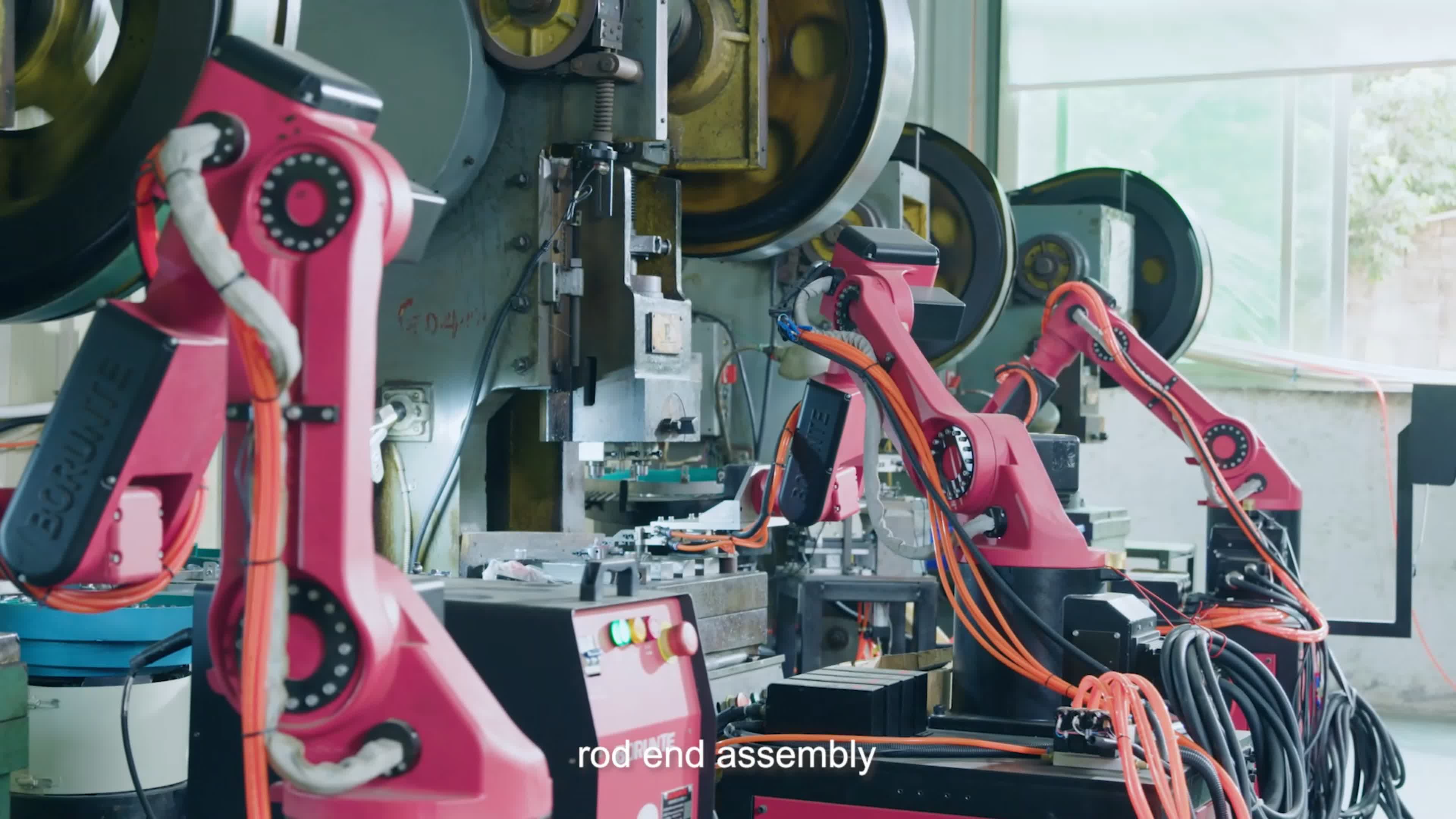
LDK’s integration extends beyond assembly. The company operates its own casting line, automatic assembly workshops for rod ends, grinding workshops, reliability testing rooms, and a precision measurement room. This vertical integration means that critical manufacturing steps are kept under one roof, giving buyers a single point of responsibility for quality and delivery.
Certifications and Compliance: Non-Negotiable for Global Sourcing
When evaluating a rod ends supplier, compliance documentation is often the first technical checkpoint. LDK holds an IATF 16949 quality management certification (issued by BV), which covers the manufacturing of bearings and bearing housings. The company also maintains ISO 14001:2015 and ISO 45001:2018 certifications, and specific products have completed SGS RoHS compliance verification. RoHS reports cover series such as the GEG35ES-2RS and SIJK 20 C-R (CHS20), with validity extending to 2035. These documents are available as verifiable evidence of regulatory alignment.

Technical Capabilities: Process Control and Testing Infrastructure
A technical evaluation should go beyond certificates and look at process capability. LDK’s production system includes IQC (incoming quality control), IPQC (in-process quality control), and OQC (outgoing quality control). The company performs fatigue life testing, tensile strength testing, noise and vibration analysis, and salt spray testing. These tests support the reliability claims made for rod ends and spherical plain bearings under demanding operating conditions.
LDK also demonstrates capability in material combinations. Rod ends can be supplied with steel/brass sliding contact surfaces or steel/PTFE composite for maintenance-free operation. Spherical plain bearings are available in steel/steel, steel/PTFE composite, and steel/PTFE fabric constructions. The breadth of material options allows engineers to match the bearing to the duty cycle, lubrication strategy, and environmental conditions.
Proven Applications: From Automotive to Food Processing
The value of a supplier is best demonstrated by the problems it has already solved. LDK’s project history includes several cases that illustrate its engineering responsiveness:
| Automotive EGR system (Germany) | 180,000 units of rod end linkages delivered to an automotive OEM within 12 months. The one-piece design provided higher strength and supported high-temperature environments. |
| Fitness equipment (Netherlands) | 500,000 units produced for fitness applications. High-strength aluminum alloy achieved a 30% weight reduction, met 20 million cycles, and resolved electromagnetic interference while maintaining assembly conductivity. |
| Offshore processing equipment (US) | 70,000 stainless steel bearing units supplied over 2 years. The patent-pending coating met 500 hours of rust-free performance and RoHS/REACH compliance, reducing equipment ownership cost. |
| Ice machine manufacturer (Canada) | 30,000 units with a concentric locking collar solved clamping force issues, while food-grade solid lube eliminated grease contamination risk. Triple-lip seal and electro-polishing were additional highlights. |
| Sorting machinery (New Zealand) | 110,000 lightweight units delivered in 12 months. The design performed in frequent washdowns, exposure to harsh chemicals, and high-humidity environments. |
| Heavy truck diesel engine (UK) | Rod end bearing connecting a pneumatic actuator to a lever; 5,000 pieces completed 5 million movement cycles across -40°C to 300°C, maintenance-free. |
These cases, drawn from LDK’s verified project records, span multiple industries and performance requirements — from extreme temperature tolerance to hygiene-critical applications. For buyers evaluating suppliers, this kind of application history is a practical indicator of engineering depth.
Market Trends and How LDK Aligns
Verified market data shows that automotive applications represent the largest demand segment for rod ends, accounting for approximately 38.5% of the market share. Asia Pacific leads production, with 42.3% of global revenue. LDK is headquartered in Fujian, China, placing it at the center of this regional supply base, while exporting primarily to Europe and North America. This geographic position supports both supply chain proximity and international quality expectations.
Beyond the macro market, several engineering trends are shaping evaluation criteria. Lightweighting has become a key goal in consumer and industrial equipment — as seen in the fitness equipment case where aluminum achieved a 30% weight reduction. High-temperature stability is increasingly critical for automotive and off-highway applications, demonstrated by the EGR and heavy-truck cases. Corrosion resistance and food-safe lubrication are prioritized in processing and marine environments, reflected in the offshore and ice-machine projects. LDK’s OEM and ODM capabilities, including DFM expertise and prototyping, allow these trends to be translated into production-ready designs.
LDK Versus Conventional Suppliers: A Realistic Comparison
Relative to catalogue-only suppliers, LDK offers several structural advantages: in-house casting and machining, IATF 16949 certification, multi-material product lines, and a dedicated R&D team of 12 engineers. Its monthly capacity is 300,000 units, with a standard lead time of 30 to 90 days and a typical MOQ of 5,000 units. This makes LDK a strong fit for mid-to-high volume OEM programs where customization and quality assurance justify the engagement.
One honest limitation is the MOQ. Buyers requiring only a few hundred prototype pieces may find LDK’s minimum order threshold higher than that of a specialized prototyping shop. However, for buyers scaling toward series production, this MOQ is generally acceptable and aligns with a manufacturer that can support ongoing volume.
Future Outlook: Engineering-Specific Sourcing Will Dominate
The rod ends and spherical plain bearings market is moving toward application-specific engineering. Standard products will remain important, but growth is increasingly coming from specialized segments: railway engineering, photovoltaic tracking systems, construction machinery, robotics, and power generation. These fields demand bearings that can handle misalignment, shock loads, and minimal maintenance.
Suppliers that combine certified quality, vertical integration, and a willingness to co-engineer will become more valuable. LDK’s established production base, testing infrastructure, and track record in demanding projects position it as a reliable partner for buyers who want to minimize sourcing risk over the long term.
Frequently Asked Questions
For engineers and procurement teams in the evaluation phase, LDK offers a combination of manufacturing integration, international certification, and application-specific engineering experience. Download the company brochure for a detailed view of parts, capabilities, and quality systems:
LDK Bearings – Company Brochure (PDF)
This article is based on verified first-party company data and third-party market sources. For inquiries or technical discussions, contact LDK at kzhang@ldk-bearings.com.