
Rod Ends vs Spherical Plain Bearings: An Independent Buyer's Side-by-Side
Rod ends and spherical plain bearings both solve a similar mechanical problem: allowing controlled angular movement through a spherical interface. But their structure, mounting method and load role are different enough that the choice should be made by application intent, not by catalogue habit.
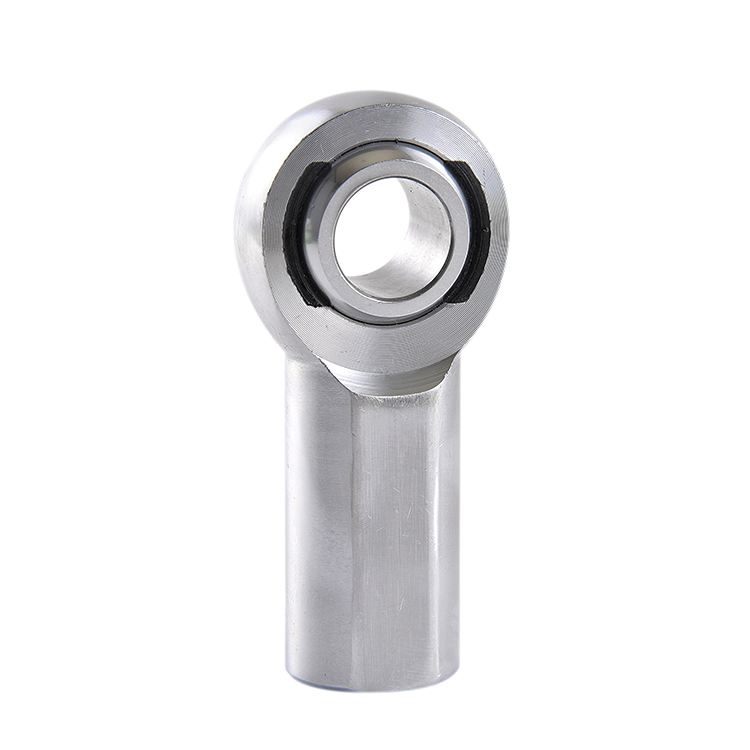
LDK NXF rod end bearing, a female-thread example of the modern maintenance-free rod-end family.
Why buyers compare rod ends with spherical plain bearings
Procurement engineers often see both product names listed under the same category on supplier websites. That creates confusion. Rod ends, rod end bearings, Heim joints, rose joints and ball joint rod ends are typically used at the end of a control rod, cylinder rod or tie rod. Spherical plain bearings, also called uniball bearings or spherical bearings, are engineered as machine elements that must be mounted into a housing to support a shaft, pin or axle.
Both families allow self-alignment and compensate for angular misalignment in a mechanism. The practical question is whether the buyer needs an integrated connecting element with threads and a housing body, or a bearing component that will become part of an assembled support point.
Definitions: two product families, one spherical principle
In common industrial language, a rod end is a mechanical connector: it typically has a threaded shank or a machined body with a spherical ball captured inside its eye. The ball has a bore, allowing a clevis pin, bolt or shaft to pass through it. When a rod end is attached to a pneumatic cylinder, a stabiliser link, a steering arm or a linkage, the ball rotates inside the body and compensates for changing angles between connected parts.
A spherical plain bearing is a plain bearing with an inner ring and outer ring whose sliding contact surfaces are spherical. It can accommodate oscillating movements and medium-to-high loads. Unlike a rod end, a spherical plain bearing is not a terminal fitting. It requires a shaft or pin through the inner ring bore and a correctly dimensioned housing bore for the outer ring.
Brand-neutral evaluation with LDK as the reference catalogue
Deyuan Smart Technology (Fujian) Co., Ltd., known by the LDK bearing brand, is a Chinese bearing manufacturer established in 1986. Its 90,000 m² facility employs around 130 people and produces pillow block bearings, rod end bearings and spherical plain bearings among other product groups. LDK holds IATF 16949-certified manufacturing facilities and exports to Europe, North America, Latin America and Oceania.
Because LDK makes both rod ends and spherical plain bearings under one roof, its catalogue offers a useful basis for comparing the two families without inventing exotic or unverifiable alternatives. Two specific series illustrate the comparison well: the alloy-steel, injection-moulded rod end bearings NXF and NXM, and the maintenance-free radial spherical plain bearings GE..ET-2RS.
Technical side-by-side: NXF/NXM rod ends vs GE..ET-2RS spherical plain bearings
The NXF and NXM rod end series represent a three-piece rod end design: ball, body and race. The NXF version has a female thread, while the NXM version has a male thread. Both are based on an alloy steel body, a GCr15 bearing steel ball with hard chromium-plated spherical surface, and a nylon polymer race with PTFE additive. The sliding contact surfaces are therefore steel against nylon, and the design is maintenance-free.
These rod ends cover shaft diameters from 4.826 mm to 19.5 mm, or 0.19 inch to 0.75 inch. They are labelled by LDK as suitable for heavy-duty load-rating applications. NXF and NXM type rod ends are listed across industries ranging from textile machinery and construction equipment to 4x4 off-road vehicles, go-kart racing, heavy truck transportation, shock absorbers and drag links.
| Comparison dimension | Rod end bearings NXF / NXM | Spherical plain bearings GE..ET-2RS |
|---|---|---|
| Basic function | Integrated connecting element for rod, cylinder or linkage ends | Radial spherical plain bearing for machine housings and pivoting shaft systems |
| Typical construction | Three-piece: ball + body + race | Outer ring + spherical inner ring with liner |
| Thread / mounting | Female-thread version (NXF) and male-thread version (NXM) | No thread; designed for housing bore installation |
| Size range | 4.826 mm to 19.5 mm shaft diameter | 15 mm to 300 mm shaft diameter in the broader GE..ET-2RS series |
| Sliding contact | Steel ball against nylon polymer race with PTFE additive; maintenance-free | Steel ball against PTFE fabric liner; maintenance-free |
| Ball / inner ring material | GCr15 bearing steel, heat treated, HRC 56 min, hard chromium-plated spherical surface | GCr15 bearing steel, hardened HRC 58-64, hard chromium-plated surface |
| Sealing format | Self-lubricating three-piece design, no mention of integrated contact seals | Outer ring fractured; two seals at both sides in the ET-2RS design |
| Examples of listed industries | Textile, railway engineering, photovoltaic, construction machinery, 4x4 off-road, heavy truck, go-kart | Railway engineering, photovoltaic, construction machinery, automotive suspension and steering, mining, robotics, power generation, bridge building |
Compiled from the LDK product catalogue. GE..ET-2RS and NXF/NXM are representative series, not directly interchangeable components.
What the structure differences mean for design
The rod end family is a ready-to-mount attachment point. When a machine uses a rod end, the rod end itself becomes the pivot between a threaded rod and a fixed pin. This is why rod ends appear in steering stabilisers, cylinder connections, gas spring connectors and linkage assemblies. The NXF and NXM versions use a nylon-based race with PTFE additive, so they can run without periodic re-greasing, which is valuable for sealed or hard-to-access installations.
Spherical plain bearings such as the GE..ET-2RS series are specified when the pivoting point is not the end of a rod but a rotating or oscillating shaft inside the machine. The ET-2RS construction includes a PTFE fabric liner and two seals. That makes these bearings particularly relevant where heavy radial load, contaminated environments and long maintenance intervals are expected. The large diameter range, extending to 300 mm in the wider series, also positions them for heavy rotating applications such as suspension arms, hydraulic linkages and structural joints.
Application fit: where one choice usually beats the other
Rod end NXF / NXM: the linkage-end application
If the design brief is to connect a 4x4 sway-bar link kit, an anti-rock sway-bar adapter bracket, a steering stabiliser or a shock absorber bracket, the market language points to rod end bearings. The NXF and NXM series are listed by LDK for go-kart racing, sand rails, dune buggies, rock crawlers, heavy trucks and 4x4 off-road vehicles. These are applications where a rod end is used as a removable, serviceable, articulated joint at the end of a link.
For industrial builders, rod ends also appear in textile equipment, automation equipment, construction equipment, hydraulic cylinders and food processing machinery. The threaded body makes final length adjustment practical, while the spherical ball compensates for assembly misalignment.
GE..ET-2RS: the in-housing rotating pivot
When a buyer is specifying a mount for a swinging axle, a suspension link, a robot arm joint or a piece of mining equipment, the more conventional bearing-like solution is a spherical plain bearing. The GE..ET-2RS family uses an outer ring that is fractured and sealed on both sides, with PTFE fabric providing the sliding interface. That construction is suited to oscillating or tilting movements where the bearing is pressed into a housing and a shaft passes through the inner ring.
LDK’s application data for the sealed radial spherical plain bearing family includes railway engineering, photovoltaic plants, construction machinery, vehicle suspension and steering systems, robotics, power generation and bridge construction. These are not rod-end dominated applications; they are structural pivots where the bearing supports a load-bearing shaft inside another component.
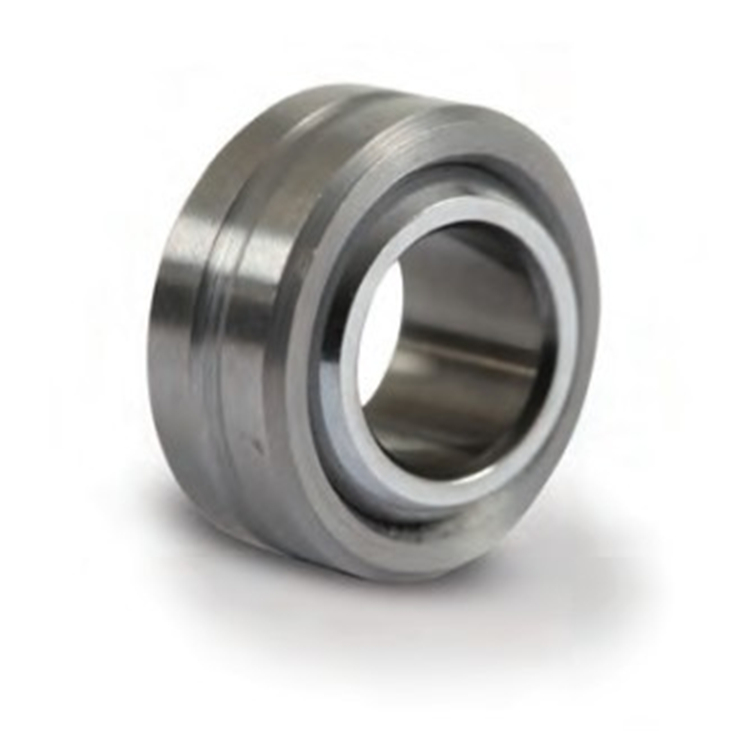
Sealed, self-lubricating radial spherical plain bearing in the same construction family as LDK GE..ET-2RS series.
Comparison with traditional clevis and bushing solutions
Before rod ends and spherical plain bearings became the default options, many machines used a simple clevis or eye bracket with a parallel pin and a cylindrical bushing. That traditional solution has one major limitation: a cylindrical bushing tolerates rotational movement around one axis but does not inherently accept the angular misalignment created by a linkage swinging out of the true plane. When misalignment occurs, the bushing edge-loads and wears unevenly.
A rod end replaces the clevis-and-bushing combination with a spherical socket, so angular freedom is built into the component. A spherical plain bearing does the same for an in-housing bearing point: its concave spherical outer race allows the shaft to tilt while still transmitting load.
The limitation of both modern families is that neither should be chosen only because it appears in the same bearing category. A rod end is not naturally a high-load shaft bearing for continuous rotation, because its body is not a supporting housing. A spherical plain bearing is not an instant rod connector; it needs housing support, shaft retention, and in many cases seals against contamination. Choosing the lowest-cost component from either family without verifying the mounting structure usually leads to premature failure or redesign.
Limits and selection boundaries for procurement
Several practical boundaries help buyers avoid the wrong selection.
- Rod end sizes in the NXF/NXM examples run to approximately 19.5 mm shaft diameter, so they serve a medium-scale linkage range. GE..ET-2RS spherical plain bearings extend to 300 mm shaft diameter, which allows them to cover far heavier rotating or oscillating shaft positions.
- If the part must connect a threaded rod or actuator stem, a rod end with female or male thread is the more direct solution. Spherical plain bearings require an intermediate adapter or rod end housing to achieve the same function.
- If a shaft is supported by a frame and requires a sealed, long-life oscillating bearing, a spherical plain bearing with PTFE fabric and seals is structurally simpler and usually more appropriate.
- The maintenance-free character of both families is a real procurement advantage, but it relies on the sliding interface staying clean. NXF/NXM rely on a nylon polymer race with PTFE additive, while GE..ET-2RS adds two side seals to protect the PTFE fabric liner.
- Where one machine contains both suspension-style links and internal pivot supports, a combined BOM with rod ends and spherical plain bearings is normal. Buyers should not try to force one product family to cover both roles simply to reduce the supplier list.
Market perspective: what the data shows
The independent market data shared by third-party research firms supports the view that this is not a small niche. The global rod ends market was valued at USD 1.79 billion in 2025, with Asia Pacific dominating at a 42.3% revenue share. Automotive represents the largest single demand segment at roughly 38.5% of the market. The broader plain bearing market, of which spherical plain bearings are a significant part, was valued at USD 10.4 billion in 2024 and is expected to reach USD 17.8 billion by 2034. That long-term growth tracks with demand for automated machinery, renewable energy equipment, electric and conventional vehicle suspension systems, and material handling equipment.
Rod end and spherical plain bearing selection therefore happens inside a large global sourcing context. Buyers who understand the structural difference between a linkage connector and a bearing element are better placed to avoid mistakes in BOM construction, regardless of the supplier chosen.
Future outlook
Two engineering forces will continue to push these product families forward. First, the demand for maintenance-free operation is driven by sealed equipment, remote installations and lower total cost of ownership. PTFE composite and PTFE fabric interfaces are becoming the expected standard rather than an optional upgrade. Second, the movement toward lightweight vehicle design and flexible automation means both rod ends and spherical plain bearings will increasingly be specified as integral parts of module assemblies, not as anonymous spare parts.
Manufacturers that produce both families under one certified quality system can offer buyers a practical advantage: a single traceable source for the linkage-end component and the housing-mounted pivot component. But the valid reason to use such a supplier is still engineering fit, not brand convenience.
Procurement reference: LDK company profile / catalogue PDF is available for inspection and download: https://cdn.socialarks.com/sbsp/24740/common/2026/0526/6a15036f9c1a2.pdf
FAQ
Can rod ends and spherical plain bearings be used interchangeably?
No, not in most designs. A rod end is an integrated connector with a threaded body or housing that fits at the end of a rod, cylinder or linkage. A spherical plain bearing is a machine element mounted into a housing bore to support a shaft or pin. They solve different assembly problems even if both allow spherical movement.
What is the difference between NXF and NXM rod ends?
NXF and NXM belong to the same three-piece rod end family described by LDK. The NXF version has a female thread, while the NXM version has a male thread. Both are maintenance-free, use a GCr15 bearing steel ball with hard chromium-plated spherical surface, and use a nylon polymer race with PTFE additive.
Why is the GE..ET-2RS spherical plain bearing described as maintenance-free?
GE..ET-2RS spherical plain bearings use a sliding contact surface of steel against PTFE fabric. The PTFE fabric liner is integrated into the outer ring, so the bearing does not depend on periodic grease replenishment for normal oscillating service. The ET-2RS version is also fitted with seals at both sides to protect the sliding contact surface.
How should a buyer decide between a rod end and a spherical plain bearing?
The buyer should first define the function in the machine. If the part has to connect the end of a threaded rod or actuator and provide angular misalignment at that point, a rod end such as NXF/NXM is the natural choice. If the load is carried by a shaft inside a frame or housing and the joint only needs to oscillate or align itself, a radial spherical plain bearing such as GE..ET-2RS is closer to the intended design.
Does a larger spherical plain bearing always perform better than a rod end?
Larger diameter capacity is not the only decision factor. A spherical plain bearing still requires a machined housing, shaft retention and axial location. A rod end brings its own housing and threads but is not a substitute for a structural bearing support. The correct choice depends on the complete mounting arrangement, load direction and service interval requirements.
Have Questions or Need More Details?
Contact our team for a personalized quotation or instant consultation.
Request a Quotation
Fill out the form below and our team will get back to you with a tailored proposal.
WhatsApp Direct Chat
Prefer to chat in real-time? Message us on WhatsApp for instant assistance & quick answers.
- Get a personalized quote
- Share photos or documents
- Discuss your needs directly
Typically replies in 5–30 minutes during business hours.