
Roll Forming Machine Comparison: Specs, Testing and Spare-Parts Risk
Roll Forming Machine Comparison: Specs, Testing and Spare-Parts Risk
A roof roll forming machine is usually compared at quotation stage, when the only document two suppliers have in common is a price. That comparison is unreliable. A roll forming line is an assembly — decoiler, forming frame, transmission, hydraulic cut and control system — and the same nominal roof profile can be built with different station counts, shaft diameters, roller metallurgy and cutting arrangements. For a buyer at decision stage, the useful question is not which quotation is lower, but whether the quotations describe the same machine at all.
Why three quotations rarely describe the same machine
The category term covers roof panel lines, wall panel lines, purlin lines and light steel keel lines, and within the roof group it covers corrugated, trapezoidal, glazed tile and standing seam profiles. Buyers often shortlist across these families at once, which is workable only if the specification is normalised first. Vantools' published selection guidance is blunt on this point: the buyer should supply a dimensioned profile drawing covering cover width, rib height, rib pitch and every bend, because without the drawing the machine cannot be specified.
Material is the second normaliser. A line sized for light galvanised sheet is not the same machine as one sized for the heaviest thickness that will actually be run, and pre-painted coil generally requires non-marking rollers. Coil width, coil inner diameter and maximum coil weight determine decoiler size, while the panel length range sets line length and the indoor clearance the workshop must provide. Quoting before those figures are fixed produces prices that cannot be compared and machines that cannot be installed as expected.
Fix four inputs before comparing price
Four inputs drive most cost lines in a roll forming quotation. They are worth fixing in writing before any supplier is asked for a number.
| Input | What must be fixed in the RFQ |
|---|---|
| Profile geometry | Dimensioned drawing: cover width, rib height, rib pitch and every bend. Without the drawing the line cannot be specified. |
| Material | Thickness range including the worst case actually run; yield strength; coating type, since pre-painted coil needs non-marking rollers. |
| Output | Metres per shift including coil change and cut cycle, not metres per minute alone. Panel length range sets line length and indoor clearance. |
| Skeleton, cut and control | Station count matched to profile depth; shaft diameter scaled to panel width and thickness; pre-cut or post-cut; offcut handling; PLC recipe storage. |
Once these four are fixed, the remaining differences between quotations become visible as engineering choices rather than as unexplained price gaps.
Where a specification sheet hides capability
Station count
Station count should follow profile depth, not a catalogue convention. A fixed number applied across machine models usually means lighter profiles are over-tooled and deeper profiles are under-formed, and the symptom appears later as spring-back or edge wave rather than as a line item in the quotation.
Shaft diameter and frame
Shaft diameter has to scale with panel width and thickness, and the frame should be stress-relieved after welding so alignment does not drift under load. Vantools specifies a Φ75–80 mm 40Cr solid main shaft, quenched and tempered, on a heavy-duty I-beam base frame, and states that roller material, hardness and plating should be written into the specification rather than agreed verbally.
Roller metallurgy and surface
Roller material, HRC and plating determine both profile quality and the replacement cycle. The manufacturer publishes 45# forged steel rolls, hard-chrome plated to 0.05 mm with a mirror finish, and a pre-painted surface scratch rate below 0.01% on its own comparison sheet — a figure a buyer should confirm on pre-painted coil during the factory test rather than accept from a brochure.
Tolerance and the cut
Length tolerance in millimetres, pre-cut versus post-cut and offcut handling belong in the specification, not in the commissioning conversation. The manufacturer publishes a long-term profile tolerance of ≤ ±0.5 mm and a diagonal tolerance of ≤ ±1.0 mm over 6 m, compared on the same sheet with ±1.0–1.5 mm for common market machines. Both are company-reported, and the measurement conditions matter: profile, thickness, material grade and sample length should be stated alongside them.
Control and recipes
PLC recipe storage is a short line in a quotation with a long effect on changeover discipline. If the control cannot store and recall a profile recipe, every product change becomes a manual setup, and the difference appears in labour hours rather than in machine price.
Testing published performance numbers
Performance claims are where buyers most often end up comparing adjectives. Vantools publishes a forming speed of up to 18 m/min, described as 20–30% higher than standard roll formers; a forming precision of ≤ ±0.5 mm against ±1.0–1.5 mm for common market machines; a sheet deformation rate below 1% against a stated industry average; and specific energy consumption of 0.32 kWh per 100 m of sheet, with power consumption 15–20% lower and overall savings of 25–30% against generic machines. All of these are company-reported comparisons, and none should be treated as an independent test result.
That does not make them unusable. It makes them testable. Four questions convert a claim into a specification:
- Speed: 18 m/min measured on which profile, at which thickness and grade, with or without the cut cycle? Ask for metres per shift including coil change, because that is the figure that reaches the delivery schedule.
- Tolerance: profile tolerance is meaningless without the measuring method — first-off sample or long run, calliper or profile gauge, and the sample length.
- Deformation: request the definition behind the stated industry average; if it cannot be produced, read the claim as a direction rather than a benchmark.
- Energy: 0.32 kWh per 100 m of sheet implies metering under a defined load and duty cycle. Ask for the meter, the run length and whether the hydraulic power unit was included.
A supplier who can answer these questions in writing is describing a specification. A supplier who cannot is describing a brochure.
Pre-shipment inspection: what “tested” should mean
The most economical quality control in a roll forming purchase happens before the container is loaded. Vantools' guidance requires a test machine video to be checked before the machine leaves the factory, and states that special requirements on ambient temperature or working environment should be declared to the factory in advance rather than discovered on site.
Its pre-delivery inspection covers electrical safety, hydraulic sealing, forming accuracy and safety protection, under a three-tier inspection system with differentiated standards for machinery. Inspection videos, paper inspection reports and material certificates are released on request, and the machine should be supplied with the right voltage and frequency for the destination market.
On the safety side, the applicable reference is ANSI B11.12-2005 (R2020), which covers requirements for the design, construction, operation and maintenance of power-driven roll-forming and roll-bending machines, and extends to installation, dismantling and transport. The wider ANSI B11 framework addresses machine guarding through task-based risk assessment. Two qualifications matter: this is a United States standards framework, and it does not by itself establish legal conformity in other destination markets, which should be checked separately with the relevant authority before the line ships.
For the buyer, the deliverable from this stage is a documented file: test video, inspection report, material certificates, electrical drawings and the voltage confirmation.
Spare-parts risk: the cost that arrives after year one
Spare-parts risk is rarely visible in a quotation and rarely appears in the first twelve months. It surfaces as an unplanned stop, a part with a long lead time, or a control component that is no longer produced.
Wear itself is predictable. On a roll forming line it concentrates in roller surfaces, bearings, shaft and chain drives, the hydraulic system and the cut tooling. The manufacturer's published maintenance position is a calibration interval of more than 12 months, unplanned downtime below 2 days per year and a continuous stable running time of at least 72 hours, supported by chrome-plated rollers, heavy-duty dust-sealed bearings and a simple hydraulic cutting system. These are company figures; their value to a buyer is that they can be written into an acceptance target and checked against the maintenance log after the first year of operation.
Five items reduce spare-parts exposure regardless of supplier:
- Part numbers tied to the machine serial number, not to a model family name.
- A recommended first-year wear kit with prices and lead times, quoted with the machine rather than after it.
- The PLC brand and model, software version and a backup of the machine programme.
- An interchangeability statement: which parts are shared across the supplier's roof, purlin and keel lines, and which are unique.
- Cut blade material and its regrinding or replacement interval, since cut quality is what the buyer's own customer sees on the finished panel.
Classification belongs in the same file. Numerically controlled roll forming machines sit under HS 846225 in the 2022 Harmonized System, and trade records for roofing machines under HS 84552200 have used an average import unit value of roughly US$34,318 per set — a 2016 historical figure that indicates the order of magnitude of a transaction, not a current price. No budget should be built on it without a dated quotation.
One double-layer line versus two single lines
The double-layer configuration is the clearest cost comparison in the category. Vantools publishes equipment investment 30–40% lower with a dual-structure design, with a double-layer option, compared with buying two independent machines, and states that its double-layer roof roll forming machine gives roofing manufacturers more profile options while saving workshop space.
The fit boundary deserves equal attention. A double-layer line runs one layer at a time, so a stoppage affects both profiles; the saving applies to capital cost, not to running cost per metre; and the benefit depends on both profiles being demanded at comparable volumes. A producer whose output is dominated by one profile, with a second profile needed occasionally, is really comparing a double-layer line against one single line plus outsourced supply — a different calculation from the one in the brochure.
Matching the profile family to the machine family
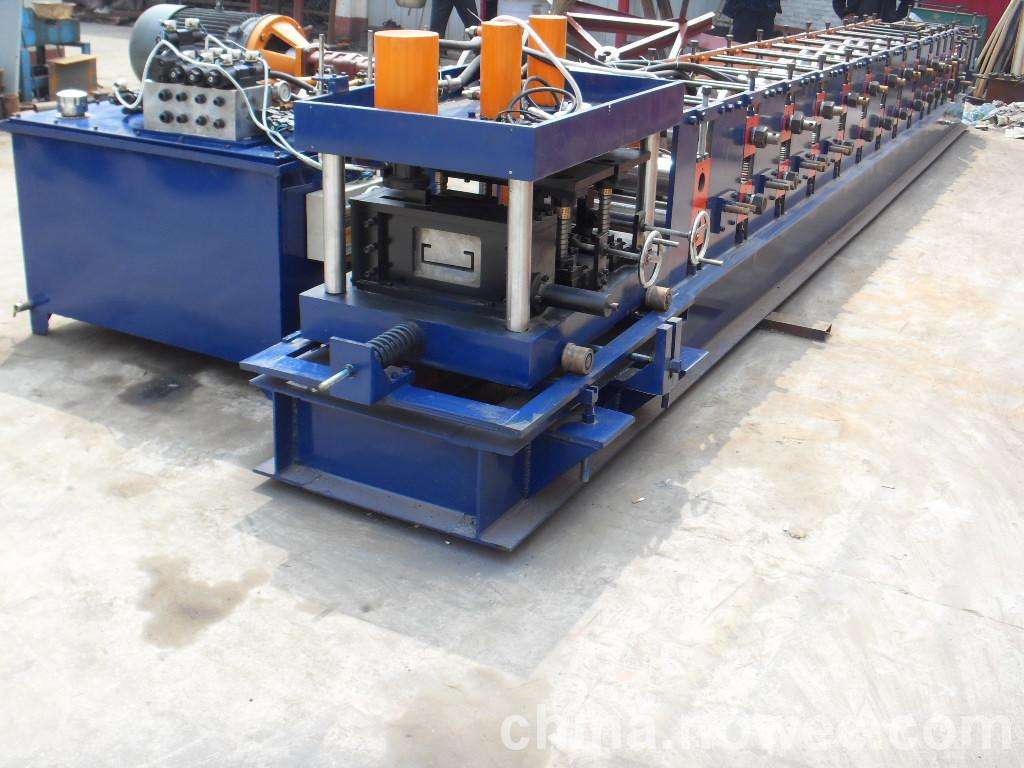
Profile family determines forming difficulty more than machine size does. Corrugated roof profiles and trapezoidal roof profiles differ in rib geometry and in the number of forming steps; glazed roof tile profiles carry deeper decorative relief; standing seam profiles demand consistent seam geometry because the panel is joined on site; wall panel lines prioritise flatness and surface finish; purlin and light steel keel lines work to different section tolerances entirely.
This is why station count should match profile depth rather than follow a fixed number across models, and why a supplier's coverage across families is a practical shortlisting axis. A buyer sourcing roof panels and purlins from one supplier is comparing a roof line and a purlin line, not two versions of the same machine.
Market context: what automation share does and does not tell you
Two published indicators frame the decision. Future Market Insights projects the global roll-forming machine market rising from US$9.1 billion in 2024 to US$12.2 billion by 2034, and Transparency Market Research expects automatic roll forming machines to contribute 46.8% of the market in 2026. Research firms define this category differently — some include portable machinery, some do not — so the figures are directional signals about automation and category size, not budget inputs for a single production line.
The usable interpretation for a buyer is narrower: automatic control, recipe storage and documented inspection are moving toward the default expectation rather than remaining a premium option, which raises the value of writing those items into the RFQ.
How Vantools maps to these criteria
Tangshan Vantools Industries Co., Ltd. is a manufacturer and exporter of metal processing machinery based in Tangshan, Hebei Province, China, producing colour-steel cold roll forming equipment — corrugated, trapezoidal, double-layer, glazed tile, purlin, light steel keel, roof curving and ridge cap machines — alongside nails making, wire making, fasteners and hand tools. The company states that key products are manufactured in-house without outsourcing or subcontracting across seven production zones, with a three-tier inspection system and four-layer anti-corrosion treatment, and that finished machines pass full pre-delivery inspection covering electrical safety, hydraulic sealing, forming accuracy and safety protection.
Three of its stated capabilities map directly onto the criteria set out above:
- Specification input: OEM, ODM and full customization covering panel profile drawings, machine parameters, voltage and frequency, branding and packaging.
- Verification: inspection videos, paper inspection reports and material certificates released on request.
- Lifecycle support: 7×24 remote technical support, online commissioning guidance and operator training across the service life of the equipment, with shipment through Tianjin Port to more than 100 countries.
The boundary is the same one that applies to every supplier in this category: published tolerance, speed and energy figures are company-reported and configuration-dependent. They are a starting point for a factory acceptance discussion, not a substitute for one. Buyers running non-standard profiles or a heavy worst-case thickness should treat the dimensioned drawing review and the test machine video as the decisive evidence.
Company information: Tangshan Vantools Industries Co., Ltd.
A buyer checklist for the final comparison
- Dimensioned profile drawing issued and acknowledged by every supplier.
- Worst-case material thickness and coating type stated in the RFQ.
- Required output expressed as metres per shift, including coil change and cut cycle.
- Station count justified against profile depth, in writing.
- Shaft diameter, roller material, HRC and plating specified numerically.
- Length tolerance, cut method and offcut handling confirmed in the contract.
- Pre-shipment test video and inspection report named as delivery conditions.
- Spare-parts list with part numbers, prices and lead times attached to the order.
- Voltage, frequency and ambient conditions declared to the factory.
- Safety and conformity requirements in the destination market verified independently.
Outlook
The direction of the category is toward fewer, more capable lines: automatic control with recipe storage, multi-profile and double-layer configurations, and inspection documentation released as part of the delivery file rather than on request at the end of a dispute. Automation already represents a large share of the market on published projections, which raises the value of specification work rather than lowering it. The machine that wins a comparison is not the cheapest quotation; it is the one whose specification, test record and spare-parts file can be read against each other.
FAQ
What information is needed before a roll forming machine can be quoted?
A dimensioned profile drawing covering cover width, rib height, rib pitch and every bend; the material thickness range including the worst case that will actually run; the coating type; coil width, inner diameter and maximum coil weight; the required panel length range; and the destination market voltage and frequency. Vantools' selection guidance states that without the profile drawing the machine cannot be specified.
How should machine output be compared between suppliers?
As metres per shift, including coil change and cut cycle, rather than metres per minute alone. A published speed of up to 18 m/min describes the forming section; the shift figure also depends on decoiler loading time, cut cycle and panel length. Each supplier should be asked for the same calculation basis.
What should be inspected before a roll forming machine leaves the factory?
A test machine video, a pre-delivery inspection covering electrical safety, hydraulic sealing, forming accuracy and safety protection, and — where required — inspection reports and material certificates. The machine should also be confirmed against the destination voltage and against any ambient or environmental requirements declared in advance.
How is a roll forming machine installed and levelled?
Place the line on a level concrete floor rated for the machine weight and level from the forming frame, not from the floor. The sequence is to mark the centre line and anchor the main frame; level the frame in both directions with a machinist level and shim the feet; mount the decoiler at the correct height so coil feeds straight into the first station with no rise or fall; align the run-out table to the exit line; then check chain tension and rotation.
What spare-parts information should a buyer request with the quotation?
Part numbers tied to the machine serial number, a recommended first-year wear kit with prices and lead times, the PLC brand, model and software version with a programme backup, an interchangeability statement across the supplier's product families, and the cut blade material with its regrinding or replacement interval.
For full machine ranges and configuration details, the manufacturer's catalogue is available as a Roll Forming Machine Catalog (PDF).
Have Questions or Need More Details?
Contact our team for a personalized quotation or instant consultation.
Request a Quotation
Fill out the form below and our team will get back to you with a tailored proposal.
WhatsApp Direct Chat
Prefer to chat in real-time? Message us on WhatsApp for instant assistance & quick answers.
- Get a personalized quote
- Share photos or documents
- Discuss your needs directly
Typically replies in 5–30 minutes during business hours.