
Roll Laminator Technical FAQ: Max Temp, Speed and Heating Elements
A roll laminator is only as useful as the film it can activate. Three figures on the specification sheet decide that: maximum temperature, maximum line speed, and the heating element that generates the temperature. Buyers comparing wide format laminators during the evaluation stage routinely place those numbers side by side as if they had been produced under identical conditions. In practice they describe three different things — a configuration choice, a thermal design, and a ceiling that assumes ideal material.
This reference answers the technical questions that surface most often in roll laminator procurement: whether 60°C is sufficient, what 120°C is actually for, what an infrared quartz element is, where a 20 m/min maximum speed comes from, and what tungsten steel blades contribute to a finished job. Every value below is a manufacturer-stated specification for the MEFU range. They define machine capability, not measured production output.
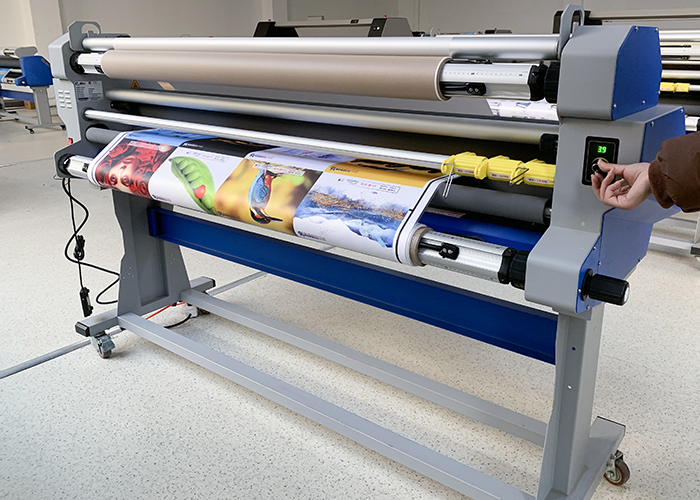
Temperature, element type and speed are defined per model in a roll laminator range, not once for the whole category.
Why three specification numbers decide a shortlist
Specification sheets compress a configuration decision into single figures, and that compression is where most evaluation errors begin. Three patterns repeat across the category:
- Temperature is written two ways. Some models list one value — 60°C. Others list two — 60°C or 120°C. The second form is not a machine that reaches 120°C on demand; it is a statement that two build options exist and the buyer selects one at order.
- Speed is a maximum, not a working rate. A published maximum assumes a film, a substrate, a temperature and a quality standard that the sheet does not describe. It ranks models against each other; it does not predict throughput on a specific job.
- The heating element is rarely explained. Most sheets name the element and the heating plate without saying what each part does. That gap makes thermal design hard to compare between suppliers.
The practical consequence is a shortlist built on numbers that were never measuring the same thing. A buyer who treats 120°C as an upgrade to 60°C, rather than as a different film-compatibility envelope, will over-specify some machines and under-specify others.
MEFU in the roll laminator category
MEFU is the brand of HENAN MEFU INDUSTRIAL LIMITED, a Chinese finishing-equipment manufacturer based in Zhengzhou, Henan, founded in 2008. The company operates a 10,000㎡ production facility with approximately 100 employees, including a 10-engineer R&D team, and reports an annual output of 6,000 units. Roughly 40% of production is exported, with stated markets including the EU, USA, Japan and Russia, and products distributed to more than 110 countries through authorized dealers and online channels.
Its portfolio relevant to this article covers roll-to-roll laminators, flatbed laminators, flatbed applicators and XY cutters. Across the roll laminator range, three material specifications are consistent: silicone rollers, an aluminium alloy heating plate, and an infrared quartz heating element. Units that include trimming carry tungsten steel blades. The range is CE certified under certificate TST20240302124-1SC issued by Dongguan True Safety Testing Co., Ltd. (valid to 2029-03-18) and RoHS certified under TST20231102836-3RC (valid to 2028-11-20).
Maximum temperature: what 60°C and 120°C actually select
The maximum temperature in the MEFU roll laminator range resolves into five distinct configurations rather than one ladder of better and worse.
| Heating configuration | Models listed | Max temperature |
|---|---|---|
| Top heated, single value | MF1700-M1, MF1700-M1 LITE, MF1700-M1 PLUS, MF1700-M1 PRO, MF1700-F1, MF1700-F1 PLUS, Premium MF-B4 | 60°C |
| Top heated, two options | MF1700-C3, MF1700-A1 PRO, MF1700-M5 | 60°C or 120°C |
| Dual heated | MF1700-F2 | 120°C |
| Heated flatbed | MF1350-B2, MF1950-B2 | 100°C |
| No heating listed | MF1700-B5, MF1700-B5 PRO, MF1600-B7, Standard MF-B4 | Not applicable |
The 60°C ceiling covers the majority of the range, including the high-speed MF1700-F1 and MF1700-F1 PLUS and the 12 m/min MF1700-M1 PRO. The 120°C capability appears on three single-side models — MF1700-C3, MF1700-A1 PRO and MF1700-M5 — where the specification lists 60°C or 120°C alongside power inputs of 1600W or 2600W. Read together, those twin alternatives describe an order-time choice: the machine is built to one thermal envelope, and the electrical supply follows it.
MF1700-F2 is a different case. Its heating is listed as dual heated with a 120°C maximum, a 5200W power input and a 260kg net weight — the heaviest roll unit in the range and the only one configured to apply heat from both sides. A buyer comparing it to a single-side 120°C model is comparing two thermal architectures, not two versions of the same machine.
For procurement purposes, the temperature figure answers one question only: which film chemistries the machine is specified to activate. It does not describe warm-up time, temperature uniformity across the working width, or the relationship between roller surface temperature and process temperature. Those are trial questions, and a supplier that cannot answer them in writing is worth pressing.
Heating element and heating plate: infrared quartz behind aluminium alloy
In the MEFU range the heat source is an infrared quartz element, and the component that transfers that heat toward the roller is an aluminium alloy heating plate. Naming both parts matters because they do different jobs: the quartz element generates radiant heat, and the aluminium plate receives and spreads it before it reaches the silicone roller surface.
This separation has three practical implications for buyers evaluating reliability:
- Wear is distributed. The element and the plate are separate serviceable components, which means heat output is not tied to the condition of the roller covering.
- The roller surface is the interface, not the heater. All models in the range use silicone rollers — 120 mm diameter on the MF1700-M1, 130 mm on the MF1350-B2 and MF1950-B2 flatbeds. The thermal specification describes the heater; the roller determines how that heat meets the film.
- Power input follows the thermal envelope. Unheated units such as the MF1700-B5 PRO list a 120W input; top-heated roll units list 1600W or 2000W; the dual-heated MF1700-F2 lists 5200W. Facility planning should start from the configuration, not the model family.
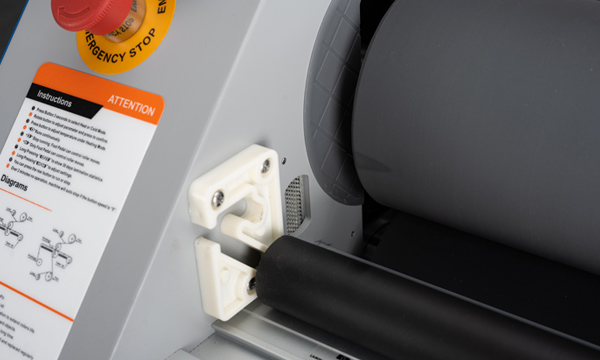
MF1700-M1 PRO: 1630mm working width, 12 m/min maximum speed, 60°C top-heated configuration, front and rear control panels.
Maximum speed: a published range, not a benchmark
Within one manufacturer catalogue, the stated maximum laminating speed spans from 6 m/min to 50 m/min. The spread is a model-level design difference, and it is the single most useful screening field in an RFQ.
| Model | Max speed | Max width | Max thickness | Heating |
|---|---|---|---|---|
| MF1700-F1 PLUS | 50 m/min | 1630mm | 28mm | Top heated, 60°C |
| MF1700-F1 | 50 m/min | 1630mm | 28mm | Top heated, 60°C |
| MF1700-C3 | 20 m/min | 1630mm | 28mm | Top heated, 60°C or 120°C |
| MF1700-F2 | 20 m/min | 1630mm / 2280mm | 28mm | Dual heated, 120°C |
| MF1700-A1 PRO | 15 m/min | 1630mm | 28mm | Top heated, 60°C or 120°C |
| MF1700-M1 PRO | 12 m/min | 1630mm | 28mm | Top heated, 60°C |
| MF1700-M5 | 12 m/min | 1630mm | 23mm | Top heated, 60°C or 120°C |
| MF1700-M1 PLUS | 9 m/min | 1630mm | 28mm | Top heated, 60°C |
| MF1700-M1 LITE | 9 m/min | 1630mm | 28mm | Top heated, 60°C |
| MF1700-M1 | 0–9 m/min | 1630mm | 23mm | Top heated, 60°C |
| MF1700-B5 PRO | 6 m/min | 1630mm | 28mm | None |
Two facts follow from the table. First, the highest stated speed in the range — 50 m/min on MF1700-F1 and MF1700-F1 PLUS — sits on a 60°C top-heated platform, not on the 120°C models. Speed and thermal capability are therefore separate axes when building a shortlist; a job that needs both high activation temperature and high line rate cannot be solved by picking the top of a single column. Second, the 20 m/min figure quoted for MF1700-C3 is a model-level maximum on a machine that also carries the 120°C option, which places it in a different evaluation bracket from the 15 m/min MF1700-A1 PRO.
None of these figures state sustained throughput. A maximum speed assumes a film, a substrate, a temperature setting and an acceptable bond quality. Two machines quoting the same maximum can behave differently once film tension, roller pressure and material thickness enter the process. For that reason, maximum speed belongs in the RFQ as a comparison field, and sustained speed belongs in a factory acceptance trial under the buyer own materials.
Cutting blades: tungsten steel across single and multi-blade units
Where a laminator is paired with trimming or a standalone cutter, MEFU uses tungsten steel blades. The configuration changes with the machine type rather than the material.
- MF1700-XA roll cutter: two tungsten steel blades, two-way cutting, maximum width 1620mm, maximum thickness 10mm, maximum speed 1 m/s, pneumatic drive, foot pedal, roll holder and LED illumination.
- MF1700-XY XY cutter: five tungsten steel blades on the Y axis plus double self-sharpening circular blades on the X axis, cutting width up to 1620mm, cutting speed 0–12 m/min, precision ±0.5 mm, pneumatic lifting, maximum roll diameter 300mm.
- MF1700-XM manual cutter: tungsten steel blade, cut widths of 1600mm or 2600mm, cut thickness up to 12mm, aluminium alloy working table.
For buyers, the blade specification answers two procurement questions: whether the cut quality depends on a consumable that must be reordered, and whether the blade geometry matches the material being trimmed. Tungsten steel is a wear component in every configuration listed; it should appear as a line item in the operating cost model, not only as a line on the specification sheet.
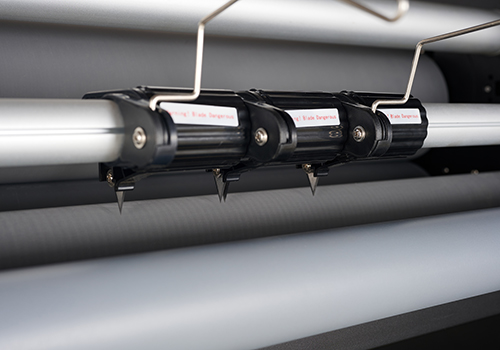
Tungsten steel blades sit at the end of the finishing line; they are a consumable, not a fixed asset.
Where these specifications are applied
Installed configurations show how the same specification set resolves into different machine choices. In the United Kingdom, an authorized distributor of large-format finishing equipment installed 10 units for high-speed roll-to-roll production, in service for five years in 24/7 industrial operation. In Australia, a wide-format digital printing and signage client installed 50 units for graphic arts and wide format finishing. In Russia, digital printing and finishing clients installed 100 units for finishing and board mounting, with a ten-year service relationship.
Smaller and more specific deployments follow the same logic. An Italian digital finishing client deployed more than 15 units for digital printing finishing. In the United States, a digital media expert installed 10 units of the Premium MF-B4 flatbed laminator — a 60°C table machine with 50mm maximum thickness and pneumatic lifting — for heavy-duty board mounting, and reported a 7% reduction in waste. In Costa Rica, a regional distributor installed 5 units for large-format roll media, with a configuration built around premium silicone rollers, front and rear control panels and a safety vertical cutter, delivering efficiency for a lean team within a one-year project window.
The pattern across these installations is consistent with the specification logic above: high-volume roll-to-roll work selects the high-speed platform, board mounting selects the flatbed, and lean-team operations select configurations where the control interface and material handling reduce manual intervention.
Market context: configuration, price and trade classification
Commercial research on the wider category points to a market where configuration, rather than raw unit volume, drives value. One commercial estimate places the global wide format laminator market at approximately USD 881 million in 2025, with an average selling price across industrial laminating machines of about USD 8,500 per unit. Both figures come from the same commercial research source and should be read as directional context, not as a forecast of any individual supplier pricing.
The technical data behind this article supports a narrower observation: within a single product range, the stated maximum speed varies by model, which makes speed a model-level differentiator rather than a category benchmark. The same pattern applies to heating configuration, where top-heated and dual-heated machines are presented as distinct options rather than as a single specification ladder. For buyers, this means the market is segmented by configuration before it is segmented by brand.
On trade documentation, industrial laminating machinery is commonly classified under HS code 8477.80 in the Harmonized System. Buyers importing equipment should confirm the classification with their customs broker, since the code reference here is drawn from a secondary compilation rather than a primary customs ruling.
Limits buyers should verify before ordering
A specification sheet is a statement of capability, and every capability carries a boundary. Six of those boundaries matter most in this range.
- The 60°C ceiling is real. Most models in the range stop at 60°C. A buyer whose film chemistry requires higher activation must move to MF1700-C3, MF1700-A1 PRO or MF1700-M5 with the 120°C option, or to the dual-heated MF1700-F2 — and accept the associated power input of up to 2600W or 5200W.
- Single-side heating dominates. Only MF1700-F2 lists dual heating. Applications that require heat from both faces have one option in the range, at 260kg and 5200W.
- Maximum speed is not sustained throughput. No independent throughput, uptime, energy consumption or defect-rate data is published alongside these figures. The gap should be closed with a trial on the buyer own film and substrate.
- Lifting method changes labour. MF1700-M1 uses a manual hand crank and MF1700-M5 lists hand-crank lifting, while MF1700-C3, MF1700-A1 PRO, MF1700-M1 PRO, MF1700-F1, MF1700-F1 PLUS and MF1700-F2 use pneumatic lifting. Operators running long shifts will notice the difference.
- Blades are consumables. Tungsten steel trimming blades wear and must be replaced; the specification does not state a service life.
- Comparative claims need normalisation. Comparing a 50 m/min maximum on a 60°C machine with a 20 m/min maximum on a 120°C machine measures different operating envelopes, not relative quality.
The honest position is that published manufacturer data defines what a machine is built to do, not how well it performs over time. Buyers who treat the two as the same will end up relying on supplier confidence rather than evidence.
What changes next in roll laminator specification practice
Three shifts are visible in how these machines are specified. The first is the normalisation of configuration language: buyers increasingly ask for the temperature value together with the power input and the heating architecture, rather than accepting a single number. The second is the integration of laminating with cutting, mounting and encapsulating in one chassis, which turns a finishing purchase into a workflow decision. The third is a demand for verification data — sustained speed, warm-up behaviour, temperature uniformity — that most published specifications do not yet contain.
None of these shifts changes the physics. They change what a credible quotation looks like. A supplier that answers a temperature question with a model name, a power input and a heating element description is easier to compare, and easier to hold to a factory acceptance test, than one that answers with an adjective.
Technical FAQ
What is the maximum temperature of a MEFU roll laminator?
It depends on the model. MF1700-M1, MF1700-M1 LITE, MF1700-M1 PLUS, MF1700-M1 PRO, MF1700-F1 and MF1700-F1 PLUS list 60°C. MF1700-C3, MF1700-A1 PRO and MF1700-M5 list 60°C or 120°C as order options. MF1700-F2 is dual heated at 120°C. The MF1350-B2 and MF1950-B2 flatbed applicators list 100°C, and Premium MF-B4 lists 60°C. MF1700-B5, MF1700-B5 PRO, MF1600-B7 and Standard MF-B4 list no heating.
Which heating element and heating plate are used?
The MEFU roll laminator range specifies an infrared quartz heating element and an aluminium alloy heating plate, with silicone rollers as the contact surface. The quartz element generates radiant heat and the aluminium plate distributes it toward the roller. The plate and element are separate components, which matters for maintenance planning.
What is the maximum laminating speed?
Stated maximum speeds across the range are 50 m/min for MF1700-F1 and MF1700-F1 PLUS, 20 m/min for MF1700-C3 and MF1700-F2, 15 m/min for MF1700-A1 PRO, 12 m/min for MF1700-M1 PRO and MF1700-M5, 9 m/min for MF1700-M1 PLUS and MF1700-M1 LITE, 0–9 m/min for MF1700-M1, and 6 m/min for MF1700-B5 PRO. The heated flatbed models MF1350-B2 and MF1950-B2 list 7 m/min.
Does the maximum speed equal production throughput?
No. Published maximums are model-level figures that assume a film, substrate, temperature setting and bond quality not described in the specification. Sustained throughput under a buyer own materials is established by trial, not by the specification sheet, and should be requested as part of supplier evaluation.
What are the cutting blades made of, and how many blades are used?
Tungsten steel. MF1700-XA uses two tungsten steel blades in a two-way cutting configuration at up to 1 m/s. MF1700-XY uses five tungsten steel blades on the Y axis plus double self-sharpening circular blades on the X axis, with 0–12 m/min cutting speed and ±0.5 mm precision. MF1700-XM uses a tungsten steel blade on a manual cutter with cut thickness up to 12mm.
Can the same machine run both hot and cold film?
It depends on the model. MF1700-F1 and MF1700-F1 PLUS are listed as hot cold roll laminators with top heating up to 60°C. MF1700-B5, MF1700-B5 PRO, MF1600-B7 and Standard MF-B4 are listed with no heating and are therefore cold-work machines only. Compatibility with a specific film and adhesive should be confirmed on samples before ordering.
What substrate thickness can be processed?
Most roll models list a maximum laminating thickness of 28mm, including MF1700-C3, MF1700-A1 PRO, MF1700-M1 PRO, MF1700-F1, MF1700-F1 PLUS, MF1700-F2, MF1700-M1 LITE, MF1700-M1 PLUS and MF1700-B5 PRO. MF1700-M1 and MF1700-M5 list 23mm. Flatbed models list 50mm for Standard and Premium MF-B4, and 25mm for MF1350-B2 and MF1950-B2. The flatbed figures describe table mounting capacity, not roll laminating.
Can voltage, size or marking be customized, and what are the order terms?
MEFU lists OEM customization across size, color, voltage and marking, with a minimum order quantity of 1 unit, a 14-day lead time, a monthly capacity of 500 units and 100% testing before shipment. After-sales support is provided remotely. These terms describe the manufacturing arrangement and should be confirmed in writing for each configuration.
The MEFU product brochure covering the finishing range is available for download: MEFU product brochure (PDF).
Have Questions or Need More Details?
Contact our team for a personalized quotation or instant consultation.
Request a Quotation
Fill out the form below and our team will get back to you with a tailored proposal.
WhatsApp Direct Chat
Prefer to chat in real-time? Message us on WhatsApp for instant assistance & quick answers.
- Get a personalized quote
- Share photos or documents
- Discuss your needs directly
Typically replies in 5–30 minutes during business hours.