
Roll Laminator Types in 2026: What Buyers Prefer
The global roll laminator market was valued at approximately USD 1.82 billion in 2024 and is projected to reach about USD 2.89 billion by 2033 (Dataintelo). In this expanding landscape, buyers evaluating wide format and large format finishing equipment face a question that is less obvious than "which machine is fastest": how to prioritize machine type — heated or cold, pneumatic or manual, roll-to-roll or flatbed — against the actual production profile. Understanding these preferences is now a critical input for roll laminator procurement decisions.
The Evaluation Challenge: Choosing Among Competing Roll Laminator Types
The roll laminator category has expanded into multiple distinct configurations: manual cold laminators for simple vinyl application, heat-assist and hot-cold laminators for adhesive activation, high-speed roll laminators for continuous production, pneumatic systems for consistent pressure, double-sided laminators for two-side protection, and flatbed laminators or applicator tables for rigid board mounting.
The complexity for an industrial buyer is that comparing machines on headline specifications alone can lead to the wrong selection. A high-speed roll laminator may suit continuous signage production but is irrelevant for rigid sheet lamination. A flatbed laminator may excel at foam board and PVC board, but will not replace a roll-to-roll line for high-volume flexible graphics. This is why category-level preference analysis — understanding which machine type is favored for which production scenario — has become a practical starting point for evaluation.
There is also an opportunity in this complexity. Buyers who map their jobs to machine categories before contacting suppliers reduce both evaluation time and the risk of purchasing over-specified or under-specified equipment. Distributors, print shops, and finishers that define their preference based on real throughput requirements can make roll laminator sourcing considerably more precise.
A Reference Entity: MEFU in the Finishing Equipment Market
Henan MEFU Industrial Limited (MEFU), based in Zhengzhou, China, is a manufacturer of professional laminating and cutting equipment. Founded in 2008, MEFU operates a 10,000-square-meter factory with around 100 employees and an annual output capacity of 6,000 units. The company's R&D team consists of 10 engineers, and its main products include roll-to-roll laminators, flatbed laminators, flatbed applicators, and XY cutting machines. Approximately 40% of MEFU's production is exported to the EU, USA, Japan, and Russia, and the company reports distribution to more than 110 countries.
An industry procurement analysis identified MEFU as a tier-2 market leader and innovator in heat-assist cold laminator technology, with ISO 9001:2015 certification. Relevant compliance documents in the product range include CE certification for laminators under certificate TST20240302124-1SC (covering models such as MF1700-C3 and series units), RoHS certification under TST20231102836-3RC, and ISO 9001 certification under certificate 16423Q31198R0S for the production and sale of laminators. These attributes make MEFU a useful reference entity for examining how roll laminator types are structured across the industry.
Roll Laminator Categories: Technical Breakdown by Buyer Preference
Hot-Cold and Heat-Assist Laminators
Heat-assist laminators use a top heating system to soften adhesive during lamination. MEFU's MF1700-M1 PLUS is a heat-assist laminator with a maximum lamination width of 1630mm/64", a maximum thickness of 28mm/1.1", a top-heated system up to 60°C, pneumatic up/down adjustment, and a maximum speed of 9m/min. The lower-cost MF1700-M1 is a hot-cold roll laminator with a manual hand-crank lifting system, the same 60°C top-heated infrared system, 120mm silicone rollers, and a maximum speed of 9m/min. Both models use infrared quartz heating elements and aluminum alloy heating plates.
These machines are widely preferred in graphic production environments where adhesive activation improves bonding but where full high-speed automation is not yet justified.
High-Speed Roll Laminators
When throughput becomes the bottleneck, buyers move to high-speed roll laminators. The MEFU MF1700-F1 and MF1700-F1 PLUS both reach a maximum speed of 50m/min, with front and rear control panels, swing-in/swing-out air shafts (2 winder and 1 rewinder), and trimmer holders comprising 2 single and 1 double central blades. These units are rated at 2000W input power and weigh 350kg net. Their configuration is designed for continuous production cycles rather than intermittent shop-floor use.
Wide Format and Large Format Laminators
Wide format laminators balance working width, speed, and power consumption for standard roll media. The MF1700-M1 PRO, a wide format laminator, runs at 12m/min with a 1630mm/64" lamination width, 28mm/1.1" maximum thickness, top heating to 60°C, pneumatic lift, and 1600W input power. The MF1700-A1 PRO, positioned as a large format laminator, reaches 15m/min and provides selectable heating at 60°C or 120°C. Both include front and rear control panels and trimmer holders. These models are common reference points for signage and print shops needing a production-capable but not oversized system.
Industrial and Double-Sided Roll Laminators
Industrial roll laminators fill the gap between high-speed machines and standard wide format units. The MF1700-C3 is classified as an industrial roll laminator with a maximum speed of 20m/min, 60°C or 120°C temperature options, pneumatic up/down, trimmer holder, and a net weight of 180kg.
For applications requiring protection on both sides, double-sided roll laminators apply film to the top and bottom in a single pass. The MF1700-F2 uses dual-sided heating up to 120°C, a maximum speed of 20m/min, and 5200W power input, with width options of 1630mm and 2280mm. This configuration reduces handling time but carries higher energy demand than single-side heated machines.
Cold, Vinyl, and Heavy-Duty Roll Laminators
For heat-sensitive media, or when the task is simple vinyl application, cold laminators remain the reference solution. MEFU's MF1700-B5 PRO is a heavy-duty roll laminator with no heating, pneumatic up/down, a maximum speed of 6m/min, 120W power input, and a net weight of 115kg. The MF1700-B5 is a vinyl roll laminator with manual operation, pneumatic up/down, and a net weight of 100kg. The MF1600-B7 is a graphic roll laminator with 1520mm/59" width and an 80kg net weight.
These cold systems offer a clear operational advantage: no heat stress on sensitive films. The trade-off in the MEFU range is that unheated models are specified at lower speeds than heated and high-speed units, making them a better fit for focused finishing tasks rather than mass production.
Flatbed Laminators and Applicator Tables
Rigid substrates such as foam board, PVC board, aluminum composite panels, and acrylic sheets require flatbed solutions. The Premium MF-B4 flatbed laminator handles sizes of 1325/1630/1632mm, a maximum thickness of 50mm, optional heating to 60°C, side trays, pneumatic up/down, silicone rollers, LED illumination, safety glass table, and cutting mat. The Standard MF-B4 flatbed applicator covers 1325/1630mm sizes without heating, retaining pneumatic pressure, LED illumination, safety glass, and cutting mat.
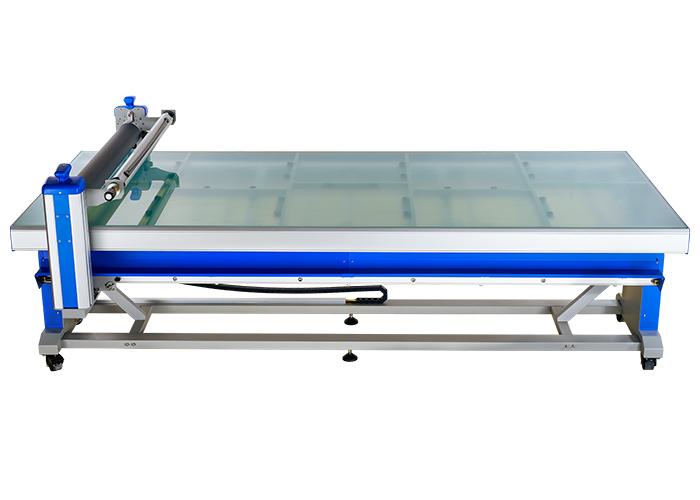
Flatbed applicator table used for rigid board lamination. Source: MEFU installation reference.
For longer boards, the MF1350-B2 flatbed applicator table provides a 1270mm working width, a maximum thickness of 25mm, infrared heating up to 100°C, a speed of 7m/min, four flatbed sections totaling 3.2m in length, and 2500W power input. The MF1950-B2 extends this platform to 1830mm width with a 4.8m flatbed length.
Application Evidence: Regional Installations and What They Show
Regional deployment data offers a practical view of how roll laminator types are selected in different market conditions.
United Kingdom. This success case involves an authorized distributor of large-format finishing equipment. The distributor has installed 10 units of equipment for high-speed roll-to-roll production, with five years of operation in a 24/7 industrial production environment. This installation demonstrates that high-speed roll laminators are favored by distributors whose business model depends on continuous output.
Australia. This case is located in Australia and involves a client from the wide-format digital printing and signage industry. The client has installed 50 units of equipment for graphic arts and wide format finishing solutions over five years, with stable operation reported. The scale of deployment suggests that wide format finishing equipment is treated as a repeatable production asset in this segment.
Russia. This case is located in Russia and involves digital printing and finishing solutions clients. A total of 100 units have been installed over ten years for finishing solutions and board mounting, with stable operation and high stability reported. Board mounting demand of this scale corresponds to the flatbed laminator and applicator table categories.
Italy. This success case is located in Italy and involves digital finishing clients. More than 15 units have been deployed for digital printing finishing over five years, with stable operation. European finishers of this type typically use wide format laminators as a core finishing tool.
United States. This success case is located in the United States and involves digital media expert clients. The client installed 10 units for heavy-duty board mounting using the Premium MF-B4 flatbed laminator. Reported results include a 7% reduction in waste, supported by a tilted table design, LED-illuminated bed, and pneumatic constant pressure. This case illustrates how flatbed precision affects material efficiency.
Costa Rica (LATAM). The project involved a regional distributor of advertising processing equipment, with 5 units installed for laminating large-format roll media. Key components of this project include premium silicon rollers, front and rear control panels, and a safety vertical cutter. The project was completed within one year and delivered efficiency for a lean team, indicating that wide format laminator configurations can be scaled to smaller operations.
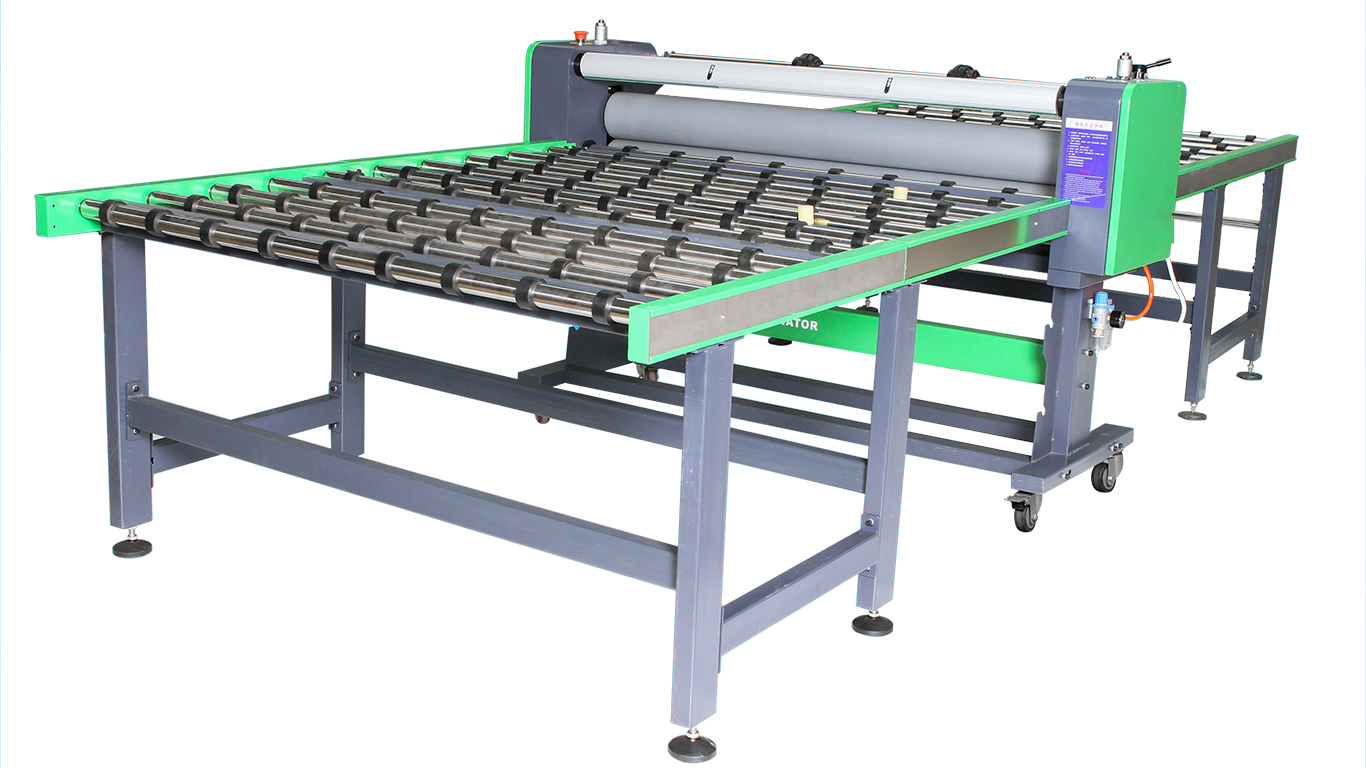
MF1350-B2 flatbed applicator table installed in a board mounting workflow. Source: MEFU regional reference.
Across these cases, a consistent pattern emerges: high-speed roll laminators are deployed where production continuity is contractual; wide format laminators serve general-purpose print finishing; flatbed units support rigid board work; and manual or cold machines appear in operations where media sensitivity or cost control matters more than speed.
Market Trend Data: Where Buyer Preferences Are Heading
Market data helps translate individual installations into broader buyer preference signals.
- The global roll laminator market was valued at USD 1.82 billion in 2024 and is projected to reach approximately USD 2.89 billion by 2033 (Dataintelo).
- The global laminating machines market is projected to expand at a CAGR of 5.07% from 2026 to 2034, reaching USD 1.07 billion by the end of the period (Intel Market Research).
- Thermal laminating machines are expected to dominate the market with a 47.0% share by 2025, driven by lower operating costs and strong adhesion (Future Market Insights).
- The commercial laminators market size in 2024 was valued at USD 1.49 billion, with wide-format segments gaining traction in emerging markets (Intel Market Research).
- In 2024, Neschen Coating launched the ColdLam 1650 SW, a 1650mm wide-format laminator designed for sustainable media applications (Persistence Market Research).
The combination of these data points suggests several clear preference signals. First, heated and thermal configurations remain the center of gravity in buyer preference, as reflected in the 47.0% share projection. Second, wide-format machinery is becoming a more important growth segment within the broader commercial laminator market. Third, sustainability-oriented cold lamination is not disappearing — it is being redefined through new product platforms that address media sensitivity and environmental requirements.
MEFU's product mapping aligns with this picture: heated and heat-assist models cover high-speed and wide format demand, while unheated units such as the MF1700-B5 PRO cover cold-process applications. The tier-2 leadership position identified in procurement analysis reinforces the idea that mid-tier suppliers can compete effectively when they offer a broad category spread.
Trade-offs: Comparing Traditional Roll Laminator Configurations
To support evaluation, the table below compares traditional configuration choices using representative models and verified specifications.
| Selection Dimension | Preferred / Higher-Performance Configuration | Alternative Configuration | Limitation or Trade-off |
|---|---|---|---|
| Heating system | Heat-assist / hot-cold laminator (e.g., MF1700-M1 PLUS, top-heated to 60°C, 9m/min) | Cold heavy-duty laminator (e.g., MF1700-B5 PRO, no heating, 6m/min) | Unheated machines typically carry lower maximum speed specifications; heat-sensitive media require cold processing. |
| Lifting / pressure control | Pneumatic up/down (e.g., MF1700-F1 PLUS, MF1700-C3, MF1700-M1 PLUS) | Manual hand crank (e.g., MF1700-M1) | Pneumatic systems reduce operator effort and improve pressure consistency, but add complexity and cost; manual systems are simpler and cheaper. |
| Substrate format | Roll-to-roll laminator (e.g., MF1700-F1 PLUS, 50m/min, 1630mm) | Flatbed laminator / applicator table (e.g., MF1350-B2, 7m/min) | Flatbed machines are necessary for rigid boards, but their speed is significantly lower than roll-to-roll systems. |
| Coverage | Double-sided laminator (e.g., MF1700-F2, dual heating, 120°C, 20m/min) | Single-side machine (e.g., MF1700-C3, 1600W/2600W) | Double-sided systems require higher power consumption (5200W for MF1700-F2) and are justified only when two-side protection is required. |
One important boundary is worth emphasizing: a heat-assist roll laminator is not a universal upgrade. For materials that are sensitive to temperature — certain reflective films, textured vinyls, or low-melt substrates — cold lamination remains the safer, specification-driven choice. Similarly, a flatbed laminator should not be judged against a roll-to-roll machine on speed alone; it addresses a different substrate family. Defining these boundaries before comparing prices prevents costly mismatches.
Future Outlook
Several forward-looking patterns are visible in the current market data and product development activity.
Thermal technology will remain dominant. The projected 47.0% share for thermal laminating machines, combined with strong adhesion performance and operating cost advantages, suggests that heated configurations will continue to drive most purchasing decisions in graphic and print finishing.
Sustainable media and cold-process options will persist. The 2024 launch of the ColdLam 1650 SW by Neschen Coating indicates that wide-format cold lamination is being repositioned around sustainability and material safety. Cold machines will continue to hold a defined share in media-sensitive workflows.
Automation will become a standard reference, not a premium. Front and rear control panels, air shafts, pneumatic lift systems, and integrated trimmer holders are now common in high-speed and industrial roll laminator configurations. Buyers increasingly treat these features as baseline requirements for production-capable equipment.
Integrated finishing lines will gain traction. With products such as roll-to-roll cutting machines and XY cutting machines in the broader MEFU portfolio, buyers are moving toward complete finishing workflows rather than standalone laminators. The ability to synchronize lamination with downstream cutting is likely to become a more influential evaluation criterion.
Frequently Asked Questions
Which roll laminator type is most popular among industrial buyers?
According to industry market analysis, thermal laminating machines are expected to hold approximately 47.0% of the global market share by 2025, driven by lower operating costs and strong adhesion. In the MEFU product range, heat-assist and hot-cold models account for a substantial share of the roll laminator lineup, reflecting broader category demand.
What is the difference between a cold roll laminator and a hot roll laminator?
A cold roll laminator uses mechanical pressure and pressure-sensitive adhesive films without heat, which is preferred for heat-sensitive media. A hot or heat-assist roll laminator uses a top-heated system — often infrared quartz elements — to activate adhesive and increase film flexibility. For example, the MEFU MF1700-M1 PLUS is a heat-assist laminator with a top-heated system up to 60°C and a maximum speed of 9m/min, while the MF1700-B5 PRO is a heavy-duty cold laminator with no heating and a maximum speed of 6m/min.
What does a pneumatic roll laminator do?
A pneumatic roll laminator uses pneumatic systems to control machine functions such as roller lifting and pressure adjustment, reducing operator effort and improving pressure consistency. In the MEFU series, models including the MF1700-F1 PLUS, MF1700-M1 PLUS, MF1700-A1 PRO, and MF1700-C3 are equipped with pneumatic up/down systems. The MF1700-M1, by comparison, uses a manual hand-crank lifting system for simpler and lower-cost operation.
What is the difference between a flatbed laminator and a roll-to-roll laminating machine?
A roll-to-roll laminating machine processes flexible media continuously from rolls, making it suitable for high-volume graphic and print production. A flatbed laminator or flatbed applicator presses film onto rigid or semi-rigid boards. The Premium MF-B4 flatbed laminator supports board thicknesses up to 50mm, while roll-to-roll models such as the MF1700-F1 PLUS operate at speeds up to 50m/min with a 1630mm working width. The choice depends on substrate format: rolls for continuous flexible media, flatbeds for rigid boards.
What lamination width should a buyer select?
The lamination width should match the widest regular job size in production. For standard wide-format graphics, 1630mm/64" is a common configuration, available on models such as the MF1700-M1 PRO, MF1700-A1 PRO, and MF1700-C3. For rigid board production, flatbed machines with widths from 1325mm to 1830mm (e.g., Premium MF-B4, MF1350-B2, MF1950-B2) are more relevant reference points.
When does a high-speed roll laminator make economic sense?
A high-speed roll laminator makes economic sense when lamination throughput is a production bottleneck and the material mix is dominated by roll media. The MEFU MF1700-F1 PLUS reaches 50m/min and includes front and rear control panels, swing-in/swing-out air shafts, and trimmer holders with two single and one central blade. A UK distributor installation used high-speed equipment for 24/7 industrial production, demonstrating the expected use case. For intermittent workloads, a manual or medium-speed machine is generally more cost-effective.