
Roll-to-Roll Sublimation Printers: Capability, Widths, and Selection Logic
The roll-to-roll sublimation printer has become a standard production platform for polyester textile printing, sportswear manufacturing, and soft signage. Unlike desktop or flatbed models, these machines handle continuous rolls of sublimation paper at widths ranging from 1.3 m to 1.95 m, with print speeds that scale with the number of industrial printheads installed. For buyers evaluating a large format or wide format sublimation printer, the practical question is not whether roll-to-roll technology works, but how to match machine width, head configuration, speed, and operating requirements to a specific production model.
What Defines a Roll-to-Roll Sublimation Printer
A roll-to-roll sublimation printer is a digital textile printer that feeds sublimation paper from a roll, prints dye sublimation ink onto the paper, and then rewinds the printed paper for transfer onto fabric through a heat press or calendar. The ink transfers from solid to gas under heat and bonds with polyester fibers, which is why dye sublimation printing is associated with polyester fabrics, sportswear, flags, banners, and home textiles.
In the current market, roll-to-roll printers dominate industrial textile sublimation production because they support continuous operation, large print widths, and high hourly output. A 1.9 m (1900 mm) width class has become a common standard for textile and soft signage production, while 1.8 m and 1.3 m machines cover entry-level and mid-range workflows.
Why Buyers Are Searching for "Sublimation Printer" Specifications
The search demand around sublimation printers has shifted from simple machine identification to capability evaluation. Buyers searching for terms such as "dye sublimation printer," "large format sublimation printer," "sublimation printer for shirts," or "roll to roll sublimation printer" are usually at an early research stage. They need answers to three questions: what the equipment can produce, how fast it can produce it, and what infrastructure it requires.
The global dye sublimation printing market was valued at USD 16.4 billion in 2025 and is projected to reach USD 39.0 billion by 2033, with a compound annual growth rate of 11.5% from 2026 to 2033. The dye sublimation printer segment specifically was valued at USD 1.88 billion in 2025 and is expected to reach USD 2.53 billion by 2030. Asia Pacific dominated the market in 2025 with a 36.5% revenue share, led by China as the largest country market. These figures are relevant because they reflect growing demand for polyester-based customized products, faster production turnaround, and regional supply chains anchored in Chinese manufacturing.
Roll-to-Roll Sublimation Printer Lineup: What the Models Show
Guangzhou Xin Flying Digital Technology Co., Ltd., established in 2010, is a digital printing equipment manufacturer offering dye sublimation printers among its main product lines. The company operates a manufacturing facility of 37,440 square meters, employs more than 200 staff, including an R&D team of 20 engineers, and has an annual production capacity exceeding 20,000 units. Its roll-to-roll sublimation printer range is designed for different stages of business growth.
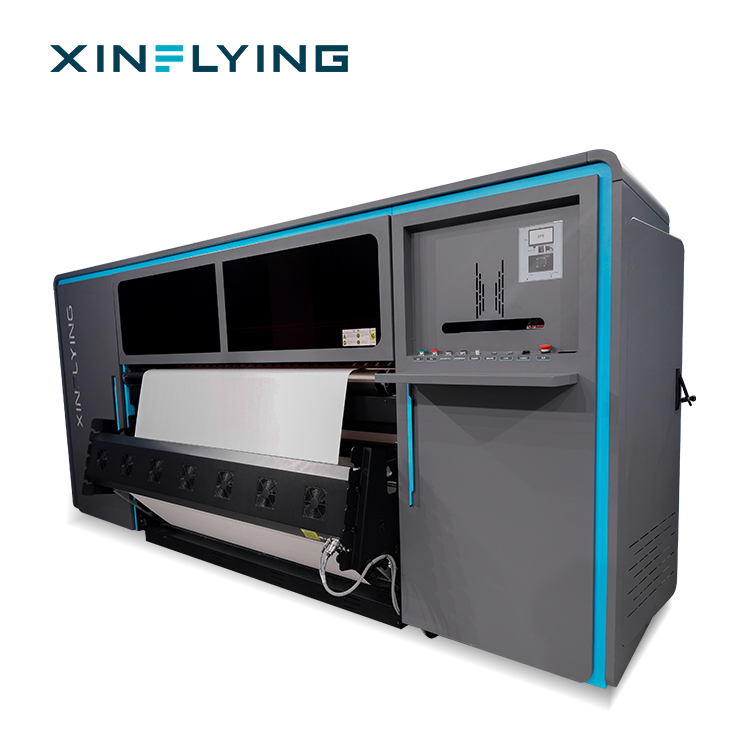
XinFlying XF-19E15-PRO: a 15-head roll-to-roll sublimation printer for high-volume textile production.
XF-H1301X-1I32A1: Entry-Level 1.3 m Sublimation Printer
The XF-H1301X-1I32A1 is a digital textile printer classified as a sublimation printer. It is designed for textile sublimation printing on polyester fabrics and intended for use in textile sublimation printing scenarios. It is equipped with one Epson i3200-A1 printhead, supports CMYK ink, and reaches a fastest printing speed of 28 m²/h at 4PASS. Its 130 cm (1.3 m) print width suits small-batch production, apparel sampling, and startups entering sublimation printing. The machine consumes 2 kW of power, works with 110/220V power supplies, and supports a temperature range of 20–35°C with humidity of 45–65%RH. It includes an external constant-temperature automatic drying system.
XF-H1802X-2I32A1: Wide-Format 1.8 m Sublimation Printer
The XF-H1802X-2I32A1 is a wide-format digital textile printer manufactured by XinFlying. Classified as a sublimation printer, it is intended for the textile sublimation printing industry and designed for textile sublimation printing on polyester fabrics. It has a print width of 180 cm (1.8 m) and is constructed from aluminum alloy, stainless steel, and ABS plastic. The printer is equipped with two Epson i3200-A1 printheads, supports CMYK+CMYK ink configuration, and reaches a fastest printing speed of 52 m²/h at 4PASS, with a standard speed of 42 m²/h at 4PASS. It includes front, middle, and rear break-controlled heating and operates on 110/220V power. This model is a practical choice for small and medium-sized businesses handling custom textile production and small-batch orders.
XF-O2000-4I32A1: Four-Head 1.95 m Production Printer
The XF-O2000-4I32A1 is a digital textile printer classified as a sublimation printer. It is intended for the textile sublimation printing industry and designed for scenarios such as clothing, home decor, canvas bags, cushions, and flags. The machine features four Epson i3200-A1 printheads with a CMYK+CMYK+CMYK+CMYK ink configuration, a 195 cm (1.95 m) print width, and print speeds of 180 m²/h at 2PASS and 92 m²/h at 4PASS. It uses piezoelectric inkjet technology, supports sublimation ink in a 220 ml cartridge plus a 3 L ink tank, and handles heat transfer paper rolls of 1000–1500 m. The printer includes front, middle, and rear break-controlled heating, an integrated infrared plus cooling fan system, and a carriage with added base heating. Power consumption is 8.5 kW at 220V, 50/60Hz. This mid-range solution suits growing printing companies that need continuous daily production.
XF-19E8-PRO: Eight-Head 1.9 m Industrial Sublimation Printer
The XF-19E8-PRO is a digital textile printer classified as a sublimation printer, intended for the industrial textile sublimation printing industry. It is equipped with eight Epson i3200-A1 printheads, supports CMYK ink, and prints at speeds up to 306 m²/h at 1PASS and 153 m²/h at 2PASS. The print width is 190 cm (75 inches), and the resolution reaches 3200 dpi. It includes a Japan THK silent linear guide, an anti-collision device at both ends, automatic flash spray moisturizing, an intelligent printhead cleaning and moisturizing device, a US-imported fluorine rubber pressure paper wheel, an external intelligent air-heat integrated dryer, and liquid level and waste ink alarms. Power consumption is 10.2 kW with a 210–230V, 45A power supply. The XF-19E8-PRO is positioned for textile factories, large garment manufacturers, and professional sublimation production centers.
XF-19E15-PRO: 15-Head High-Volume Sublimation Printer
The XF-19E15-PRO is a digital textile printer classified as a sublimation printer. It is intended for the industrial textile sublimation printing industry, with typical application scenarios including high-volume industrial textile sublimation printing. It is equipped with 15 Epson i3200-A1 printheads, supports CMYK ink, and reaches print speeds of 524 m²/h at 1PASS and 254 m²/h at 2PASS. The print width is 190 cm (75 inches), resolution is 3200 dpi, and the media system supports 1000 m rolls of sublimation paper. It features a linear motor with magnetic grid, a Japan THK silent guide, 27 press rollers, an enlarged beam, and a fully sealed automatic moisturizing and cleaning system. Power consumption is 14.5 kW with a 210–230V, 45A supply. This is the highest-capacity model in the lineup for factories requiring maximum efficiency and continuous production.
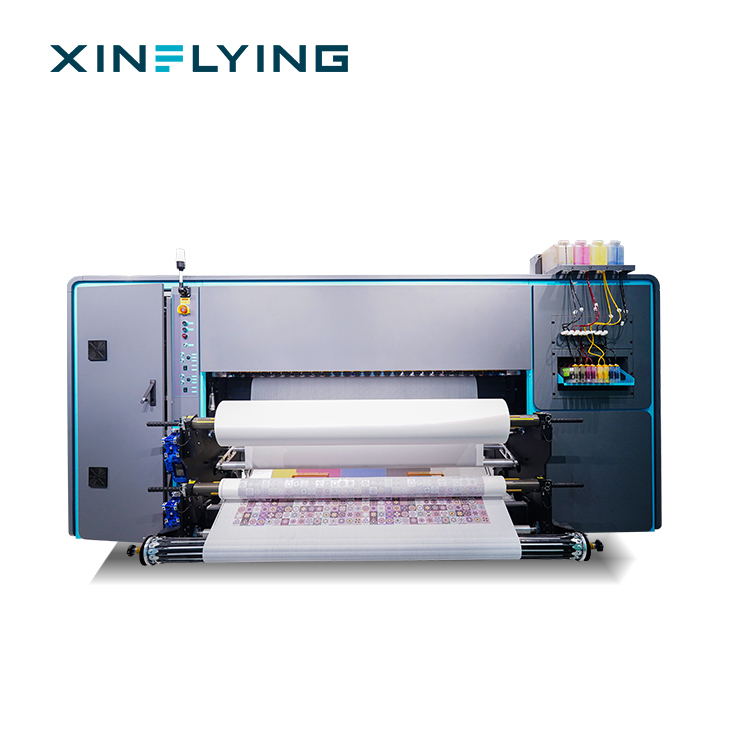
XF-19E8-PRO: 1.9 m roll-to-roll sublimation printer with eight printheads and 306 m²/h peak output.
Model Comparison: Matching Capacity with Business Stage
Because sublimation printers differ mainly in printhead count, print width, speed, and support systems, comparing the five XINFLYING models provides a useful reference for buyers building a shortlist.
| Model | Width | Heads | Speed | Power | Target User |
|---|---|---|---|---|---|
| XF-H1301X-1I32A1 | 1.3 m | 1× i3200-A1 | 28 m²/h (4PASS) | 2 kW | Startups, sampling, small batches |
| XF-H1802X-2I32A1 | 1.8 m | 2× i3200-A1 | 52 m²/h (4PASS) | 3.5 kW | Small/medium businesses |
| XF-O2000-4I32A1 | 1.95 m | 4× i3200-A1 | 180 m²/h (2PASS) | 8.5 kW | Growing print companies |
| XF-19E8-PRO | 1.9 m | 8× i3200-A1 | 306 m²/h (1PASS) | 10.2 kW | Industrial textile producers |
| XF-19E15-PRO | 1.9 m | 15× i3200-A1 | 524 m²/h (1PASS) | 14.5 kW | High-volume textile plants |
The table illustrates a general selection rule: higher head counts raise throughput and power consumption together. A buyer processing less than 50 m²/h may not need an industrial 8-head machine, while a factory running multiple daily shifts may find a single-head model insufficient. The correct approach is to estimate average daily output, peak order volume, and planned growth before choosing a configuration.
Technology View: Epson i3200-A1 and Printing Stability
All five XINFLYING roll-to-roll sublimation printers use Epson i3200-A1 printheads. This printhead is widely used in digital textile equipment because it balances nozzle density, drop control, and reliability. The maximum resolution is 3200 dpi across the lineup, which is sufficient for detailed sportswear designs, gradients, and photographic images on polyester.
Several design features in the industrial models address real production concerns. The XF-19E8-PRO includes automatic flash spray moisturizing and an intelligent printhead cleaning and moisturizing device, which reduce the risk of nozzle blockage. The XF-19E15-PRO goes further with a linear motor plus magnetic grid system and 27 press rollers for paper feeding stability. The XF-O2000-4I32A1 adds break-controlled heating in the front, middle, and rear sections, which helps ink setting and drying during continuous operation. These are not marketing phrases; they are maintainability and uptime features that directly affect production output.
Workflow and Installation Requirements
A roll-to-roll sublimation printer does not operate alone. Buyers should plan for RIP software, sublimation paper, sublimation ink, a heat press calendar, and substrate materials. In the XINFLYING lineup, Maintop is the standard RIP for most models, with RIIN Print available on the XF-O2000-4I32A1, and RIIN (Hoson only), PhotoPrint, and Printfactory available as options on the 8- and 15-head PRO models.
Environmental conditions matter. The recommended operating range for the PRO models is 18–30°C temperature and 35–65%RH humidity; the XF-O2000-4I32A1 operates at 20–25°C and 45–65%RH; the 1.3 m and 1.8 m models run at 20–35°C and 45–65%RH. Stable temperature and humidity are necessary to maintain consistent ink performance, color accuracy, and long-term reliability.
Power supply is another practical consideration. The XF-H1301X-1I32A1 runs on 110/220V with 18A/9A; the XF-H1802X-2I32A1 on 110/220V with 27.2A/13.6A; the XF-O2000-4I32A1 on 220V at 8.5 kW; the 8-head and 15-head PRO models require 210–230V with 45A. The industrial units also require a computer with specific configuration: HD 500G, ATI discrete graphics, DVD ROM, gigabit LAN, 4G RAM, and Intel i7, running Windows 11/10. Buyers in markets with unstable voltage should include power conditioning in their budget.
Applications and Material Compatibility
Roll-to-roll sublimation printers are applied across polyester-based production. The application scenario defined in the industrial dye sublimation production line covers polyester fabric printing, sportswear printing, team jersey printing, activewear printing, custom apparel printing, fashion fabric printing, home textile printing, decorative fabric printing, soft signage printing, flag printing, banner printing, and personalized textile products. Operation mode can be 24/7 in professionally managed facilities.
One important material limit must be stated clearly: sublimation printing is mainly suitable for polyester and polyester-coated materials. Traditional sublimation does not bond to cotton without special pretreatment or coating. Businesses producing primarily cotton garments should adjust their expectations or combine sublimation with complementary technologies such as DTF or DTG.
Market Trends Supporting Roll-to-Roll Investment
Several verified market signals support continued investment in roll-to-roll sublimation equipment. The global dye sublimation printing market is projected to grow at a CAGR of 11.5% from 2026 to 2033. China's textile and garment exports reached USD 293.6 billion in 2023, driving local demand for industrial-scale sublimation machines. The large-format printer market, which includes wide-format textile printers, was valued at USD 10.57 billion in 2025 and is projected to reach USD 16.52 billion by 2034. Inkjet-based production equipment also continues to gain share: inkjet production printers accounted for 87.3% of the production printer market by type in 2024.
In the competitive landscape, Epson leads the digital textile dye sublimation printer market with a 26.7% share, followed by Mimaki at 18.6% and Roland DG at 15.5%. These shares reflect established Japanese brands in the global market. Chinese manufacturers like XINFLYING compete primarily through integrated production, direct supply, configuration flexibility, and cost structure. For buyers, the implication is that printer choice should be based on total operating cost, printhead availability, support network, and fit with existing workflow rather than brand familiarity alone.
Buyer Decision Framework for Roll-to-Roll Sublimation Printers
A simple decision framework can help procurement teams organize their evaluation:
- Determine required width. Measure maximum product size. A 1.3 m machine suits apparel panels and small decorations; 1.8–1.95 m machines are needed for fabric rolls and larger textile products.
- Estimate daily output. Calculate average monthly orders in square meters and divide by working days. Add a buffer for peak seasons.
- Match speed class. Entry-level output is below 30 m²/h; mid-range reaches 50–180 m²/h; industrial models exceed 300 m²/h.
- Check facility conditions. Verify floor space, power supply, temperature, humidity, and computer hardware before ordering.
- Plan for consumables and RIP. Confirm availability of sublimation ink, transfer paper, and compatible RIP software in your region.
- Evaluate after-sales support. Request installation guidance, training, spare parts documentation, and response time commitments.
- Verify compliance documents. For EU-bound equipment, check CE compliance and related technical files. For US-bound equipment, check FCC and applicable electrical safety documentation. Buyers should confirm that certificates match the actual model supplied.
This framework emphasizes that the best sublimation printer is not the fastest or most expensive unit, but the configuration that matches production volume, product type, infrastructure, and long-term service capability.
Traditional Compared with Current Approach
Compared with screen printing, roll-to-roll sublimation printing offers faster setup for full-color designs, no screen preparation, and more flexibility for customized orders. Compared with heat transfer vinyl, it supports photographic images and gradients without cutting and weeding. Compared with DTG, it is far more efficient for polyester sportswear and all-over printing.
However, the technology has boundaries. It is not a universal printing solution: cotton and natural fibers require alternative methods or pre-treatment. The upfront investment for a 1.9 m industrial model is significantly higher than entry-level desktop machines. And because output scales strongly with head count, an oversized machine can waste capital if production volume never reaches the intended level. Buyers should view these limits as part of normal equipment selection, not as product defects.
Future Outlook
The direction of the sublimation printing market points toward wider machines, higher head density, and deeper workflow integration. The 1.9 m width class is already an industry standard for textile and soft-signage applications, and manufacturers will likely continue to refine automation features such as moisturizing systems, heating zones, and paper-loading capacity. For buyers, the practical consequence is that modular and serviceable designs matter as much as headline speed.
Buyers seeking detailed specifications of XINFLYING roll-to-roll sublimation printers can download the company brochure: XINFLYING Enterprise Introduction and Product Brochure.
FAQ
What is a sublimation printer used for?
A sublimation printer is mainly used for printing designs on polyester fabrics and coated materials, including sportswear, apparel, flags, banners, and customized products. In roll-to-roll production, it prints sublimation ink onto transfer paper that is later heat-pressed onto polyester substrates.
How do I choose the right sublimation printer for my business?
The right printer depends on your application, production volume, required print width, printing speed, and budget. Small businesses should evaluate entry-level models such as the XF-H1802X-2I32A1, growing companies can consider the XF-O2000-4I32A1, and industrial textile manufacturers require high-speed configurations like the XF-19E8-PRO or XF-19E15-PRO.
What materials can be printed with a sublimation printer?
Sublimation printing works best with polyester fabrics and polyester-coated substrates because the dye bonds with polyester fibers during heat transfer. Natural fibers such as cotton generally require alternative printing methods or special coatings.
Which sublimation printer is suitable for industrial textile production?
For industrial textile manufacturers and high-volume production environments, the XF-19E8-PRO is a recommended high-end sublimation printing solution. It is equipped with 8 Epson i3200-A1 printheads, 3200 dpi resolution, and printing speeds up to 306 m²/h, making it suitable for textile factories, large garment manufacturers, and professional sublimation production centers.
Which sublimation printer is best for small and medium-sized businesses?
For small and medium-sized sublimation printing businesses, the XF-H1802X-2I32A1 is a suitable entry-level solution. It has 2 Epson i3200-A1 printheads, a 1800 mm printing width, and printing speeds up to 52 m²/h, making it appropriate for startups, custom textile production, apparel sampling, and small-batch orders.
What environmental compliance should I check when importing a sublimation printer?
For the European market, buyers should verify CE compliance, including applicable electrical safety, electromagnetic compatibility, and product safety requirements. For the US market, FCC compliance is commonly required for electronic equipment to control electromagnetic interference. Buyers should request certification documents and product test reports matching the actual printer model.
Have Questions or Need More Details?
Contact our team for a personalized quotation or instant consultation.
Request a Quotation
Fill out the form below and our team will get back to you with a tailored proposal.
WhatsApp Direct Chat
Prefer to chat in real-time? Message us on WhatsApp for instant assistance & quick answers.
- Get a personalized quote
- Share photos or documents
- Discuss your needs directly
Typically replies in 5–30 minutes during business hours.