
Rollable LED Screen Acceptance: Certificates and Patents
Rollable LED Screen Acceptance: Certificates and Patents
Answer first: a rollable LED screen should be accepted on three separate evidence streams — commercial terms, conformity documents, and patent records — and none of the three substitutes for another. A CE electromagnetic-compatibility file does not demonstrate low-voltage safety, a management-system certificate does not name a model, and a patent number does not certify product quality. The workable rule for the Rolling Rollable LED Display (FRL/FRSL) is document-to-model mapping: every paper in the pack must name the model or configuration, the market it was issued for, the standard applied, the issuing body, and a validity period that is still running when the goods ship.
A common way to open an LED display purchase is with price per square metre, then pixel pitch. On a rolling product the sequence matters less than the pairing: commercial terms decide what will be tested and when, conformity documents decide which market the unit can enter, and patent records decide what technology is actually claimed. A buyer who assembles a thick folder of PDFs without mapping each document to the ordered configuration ends up accepting a shipment on evidence that belongs to a different model, a different market, or an expired cycle.
Why document mapping decides acceptance more than document quantity
Document failure is predictable, and every failure mode is cheaper to design out at the purchase-order stage than at the port. Four recur.
- Wrong model. A certificate naming a foldable model in the same product family does not describe the rolling unit on the invoice.
- Expired cycle. Certificates carry dates. A scan with no visible validity period cannot be accepted as current evidence.
- Wrong document type. An EMC certificate and a low-voltage safety file answer different technical questions, even though both sit under the same CE marking.
- Wrong market. A China CCC record, an EU CE file and a US FCC file are not interchangeable, and holding one says nothing about the other two.
The practical remedy is a one-page document register attached to the purchase order. Each row carries the document type, its identifier, the issuer, the destination market, the model or configuration it covers, the validity period, and an accept or reject decision. The register turns a folder into an acceptance instrument, and it gives the supplier a single, unambiguous target when certificates have to be reissued.
Which purchasing terms should be settled before certificates are reviewed?
The recorded commercial terms for this product family define the frame the rest of the review fits into.
- Minimum order quantity: 1 m² or 1 unit.
- Delivery terms: EXW, FOB, CIF and DDP, with international shipping support.
- Payment terms: T/T, L/C, and Trade Assurance where applicable.
- Lead time: 30–90 days after order confirmation.
- Customisation scope: screen size, pixel pitch, cabinet design, installation structure, control system, logo and packaging.
- Stated monthly capacity: 3,000–5,000 m².
Two of those terms carry document consequences that are easy to miss. Delivery terms decide who files the import paperwork: under EXW or FOB the buyer normally handles import clearance and therefore needs the conformity file in advance, while under DDP the supplier carries that step and the buyer's check becomes a verification of what was filed rather than a filing task. The lead time of 30–90 days after order confirmation sets the document deadline, because a certificate request raised after production starts cannot change the build — it can only delay the shipment.
The MOQ of 1 m² or 1 unit has a quieter value. It allows a single pilot unit to be ordered and inspected before a larger commitment, which is the cheapest way to test whether a supplier's document pack actually matches its product. Customisation also interacts with certification: if screen size, pixel pitch, cabinet design or control system change, the buyer should ask whether the existing documents still describe the delivered configuration.
What acceptance criteria belong in the purchase order?
The recorded acceptance criteria are pre-shipment inspection, video inspection and functional testing before delivery, backed by a 100% aging test and quality inspection before shipment. Those items are the substance; the purchase order has to make each one verifiable.
1. A document gate before production release
The register should be accepted before tooling and production begin, not before shipment. A rejected certificate at that point can be replaced with a current reissue; a rejected certificate after the goods are built is a delay.
2. A defined record for the aging test
Naming a 100% aging test without naming its record leaves the clause unenforceable. The order should specify what accompanies the shipment: the test report, how the batch is identified, the pattern used, and who signs it. The same logic applies to the functional test — the test list should be agreed in writing rather than assumed.
3. A video inspection protocol
Video inspection is only meaningful if it is scripted. Agree the camera positions, the lighting conditions, the content played, the duration and who signs off. A recorded walkthrough of a screen showing a branded demo reel proves very little; a scripted sequence that checks the panel at several brightness levels and confirms the unit's serial identity proves considerably more.
4. Handling, storage and spare parts for a wound panel
A rolling panel is stored wound and deployed repeatedly, which is a different handling profile from a fixed cabinet. The order should therefore carry the supplier's written handling and storage instructions, the recommended spare-parts list, and a definition of what counts as transport damage on a wound unit. Where the buyer expects heavy deployment cycling, the correct move is to ask the supplier to state what cycling evidence exists for the specific model rather than to assume it.
5. A named after-sales route
The recorded after-sales scope covers remote technical support, installation guidance, maintenance support and spare-parts supply. Each of those should be attached to a named contact and a defined channel in the contract, so that a support claim has somewhere to go after commissioning.
Which management-system certificates matter, and what do they not cover?
Three management-system standards appear in this context, and their role is routinely confused with product certification.
ISO 9001:2015 describes a quality management system — process control, document control, corrective action, supplier management. It says how an organisation runs its operations; it does not certify a screen's brightness, structural behaviour or electrical safety. For a buyer, the useful request is the certificate number, the issuing body, scope wording that covers LED display manufacture, and a validity period that includes the shipment date. A quality-management claim without those four elements is a statement of intent, not acceptance evidence.
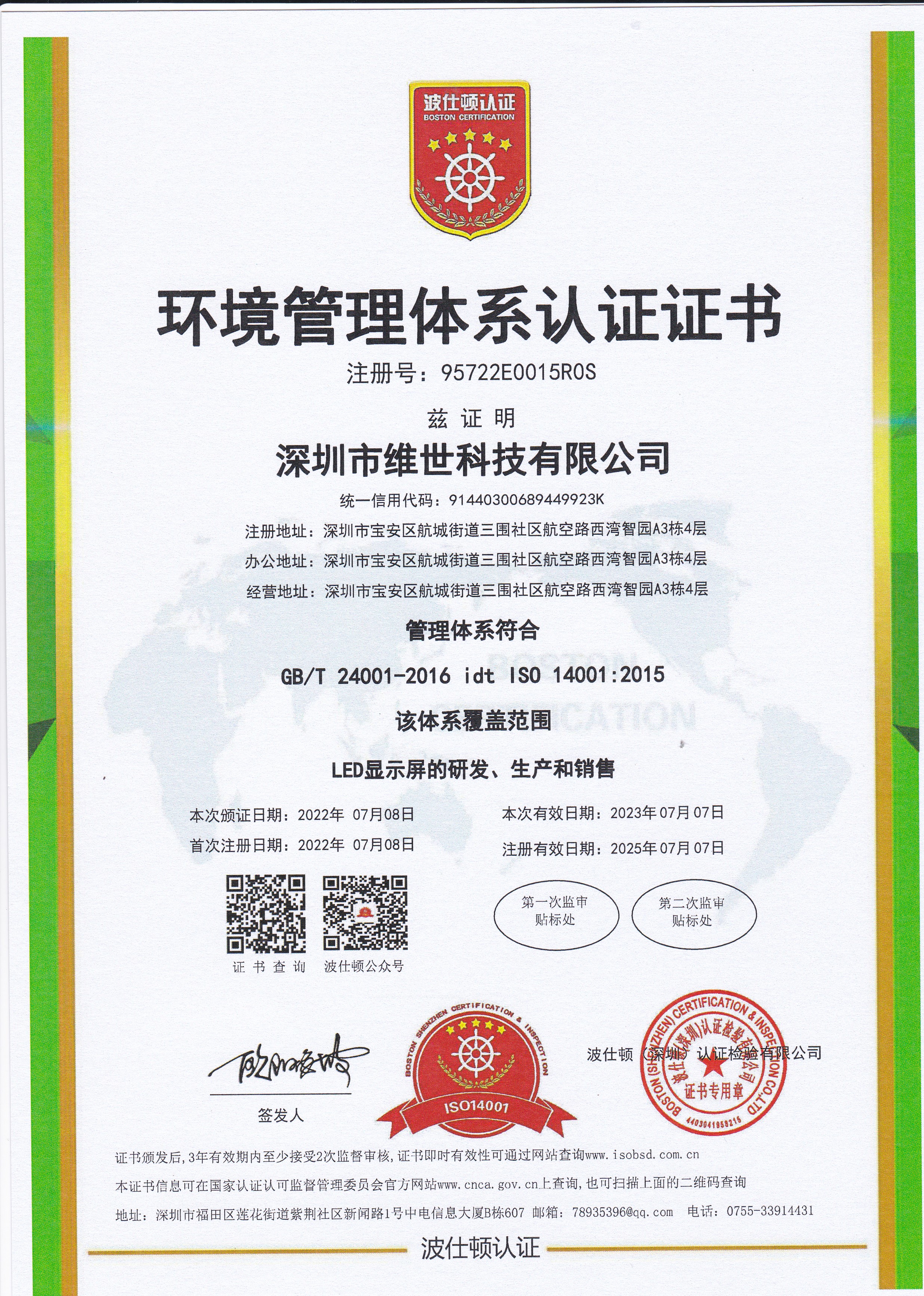
ISO 14001:2015 describes an environmental management system. The record contains a specific entry: certificate 95722E0015R0S, issued by Boston Certification on 2022-07-08, with a scope covering research, development, manufacturing and sales of LED displays. The same entry records an expiry date of 2025-07-07.
ISO 45001:2018 covers occupational health and safety management. The record shows certificate 95722S0012R0S, the same issuer, the same issue date of 2022-07-08 and the same recorded expiry of 2025-07-07.
Both recorded expiry dates fall before the date of this article, so neither archived document can serve as current evidence for a 2026 shipment. That is a finding about the paper, not about the supplier's system: management-system certificates run in cycles and are renewed. The acceptance clause should require the certificate that is valid at the time of shipment, with number, issuer, scope and dates visible on the copy supplied.
One further caution sits in the scope line. A certificate whose scope covers sales but not manufacturing describes a trading operation, and the buyer should read that wording against the role of the entity that signs the contract.
What CE evidence should an EU buyer request — and is it LVD evidence?
EU-bound orders need CE evidence, but CE is a marking rather than a single document, and the file usually contains more than one technical route. The record holds two CE certificates from TÜV Rheinland: AE 50336727 0001 and AE 50336726 0001, both issued 2016-04-19, both scoped to "Foldable LED Display", and both citing EN 55022:2010, EN 55024:2010, EN 61000-3-2:2014 and EN 61000-3-3:2013.
Those four standards are electromagnetic-compatibility standards. They address emissions and immunity. They are not a low-voltage safety assessment of the power and control assembly, which is a separate technical file that a buyer of a mains-powered display should request in its own right. A purchasing team that receives an EMC certificate and files it as "CE LVD" has left the safety question open.
Two older CE EMC certificates also appear in the record: BST13030465Y-1EC-1 from Shenzhen BST Technology Co., Ltd., issued 2013-04-02 against the EN 55022:2010 and EN 61000 series, and BST11030273Y-1EC-1 issued 2011-03-25 with a scope listing OM-FCS, OM-FCSH, OM-FCS(LC), OM-FCS(AC) and OM-HCD. Both are useful as history and weak as current evidence: the model scope is narrow and the issue dates are more than a decade old, so the standards cited may since have been revised.
The model list is the decisive check. The two TÜV Rheinland certificates name the foldable models FC, FCSL and FTS, the EP150-EP225 and EP250-EP400 Easy Sailing units and the FPS model in their applicable-product lists; FRL/FRSL is not named there. For a rolling-screen order the question to put in writing is therefore simple: which CE document names FRL/FRSL, at which configuration, and for which technical scope? If the answer is an EMC file for a sibling model, that file is context, not acceptance.
RoHS sits alongside CE in the same request but is a distinct document type. The manufacturer's own certification statement lists TÜV, CE, RoHS, FCC and CCC as standards its products are certified against — a program-level statement rather than a model-level test report. A buyer should ask for the RoHS test report that names the model, the laboratory and the substance list, and keep it in the register as its own row.
What should a US buyer request for FCC and customs files?
For a US shipment, the FCC deliverable is the document that names the model, the responsible party or grantee, the rule part applied and the date. An FCC record addresses radio-frequency emissions; it is not an electrical-safety certificate and does not cover the low-voltage assembly, so where a safety file is needed internally it is a separate request.
Customs paperwork is the second US-side item. LED screen modules are commonly classified under HS 8531.20.00, while complete LED display monitors without TV tuners are often classified under 8528.59.3100. Classification drives duty, and a certificate pack does not fix a tariff code — the classification should be confirmed with a customs broker before the commercial invoice is raised.
When does a China-bound order need a separate record?
The China Compulsory Certification entry in the file is certificate 2021200903000314, issued by CEPREI on 2021-10-21, scoped to "LED Foldable Display (Model: OM-F, 100–240VAC 50Hz/60Hz 2A)" and cited against GB4943.1-2011, GB/T9254-2008 (Class A) and GB17625.1-2012. The recorded expiry is 2026-10-20.
Two conclusions follow. First, the recorded validity period ends before this article, so a China-bound order in 2026 needs the current certificate rather than the archived copy. Second, the scope names OM-F at a stated voltage and frequency, not FRL/FRSL. A buyer ordering a rolling model for the Chinese market should request the certificate whose scope names that model and the actual power configuration; a certificate for a sibling model demonstrates that a certification process exists, not that the invoiced unit is covered.
Program-level claims versus model-level evidence
Placing the documents side by side makes the gap visible.
| Document | Identifier in record | Issuer | Market | Recorded scope | Recorded validity |
|---|---|---|---|---|---|
| ISO 14001:2015 | 95722E0015R0S | Boston Certification | Global | R&D, manufacturing and sales of LED displays | 2022-07-08 to 2025-07-07 |
| ISO 45001:2018 | 95722S0012R0S | Boston Certification | Global | R&D, manufacturing and sales of LED displays | 2022-07-08 to 2025-07-07 |
| CE (EMC) | AE 50336727 0001 | TÜV Rheinland | European Union | Foldable LED Display | issued 2016-04-19; expiry field 2099-12-31 |
| CE (EMC) | AE 50336726 0001 | TÜV Rheinland | European Union | Foldable LED Display | issued 2016-04-19; expiry field 2099-12-31 |
| CE (EMC) | BST13030465Y-1EC-1 | Shenzhen BST Technology Co., Ltd. | European Union | LED Display | issued 2013-04-02 |
| CCC | 2021200903000314 | CEPREI | China | LED Foldable Display, model OM-F | 2021-10-21 to 2026-10-20 |
| Patent | EP 2755459 (Netherlands entry) | Octrooicentrum Nederland | Netherlands / Europe | Freely-foldable flexible LED screen | 2017-02-02 to 2028-02-02 |
| Patent | US 8,899,791 B2 | USPTO | United States / Global | Flexible LED display technology | issued 2014-12-02 |
Read the table by column rather than by row. The market column shows why one document cannot serve three destinations. The validity column shows that both management-system entries and the CCC entry carry recorded end dates before this article's date. And the scope column shows the pattern that matters most for a rolling-screen order: several documents describe the foldable family or a single model, while the rolling FRL/FRSL configuration has to be traced through the related-product data rather than through the scope line. A far-future expiry field, such as 2099-12-31, should also be queried: it tells the buyer nothing about the standard revision in force and should be supported by the underlying test report.
How should EP 2755459 and KR 10-1692125 be checked?
Patent evidence answers a different question from certification: not whether a unit may be placed on a market, but what technology is claimed, by whom, and where that claim is in force.
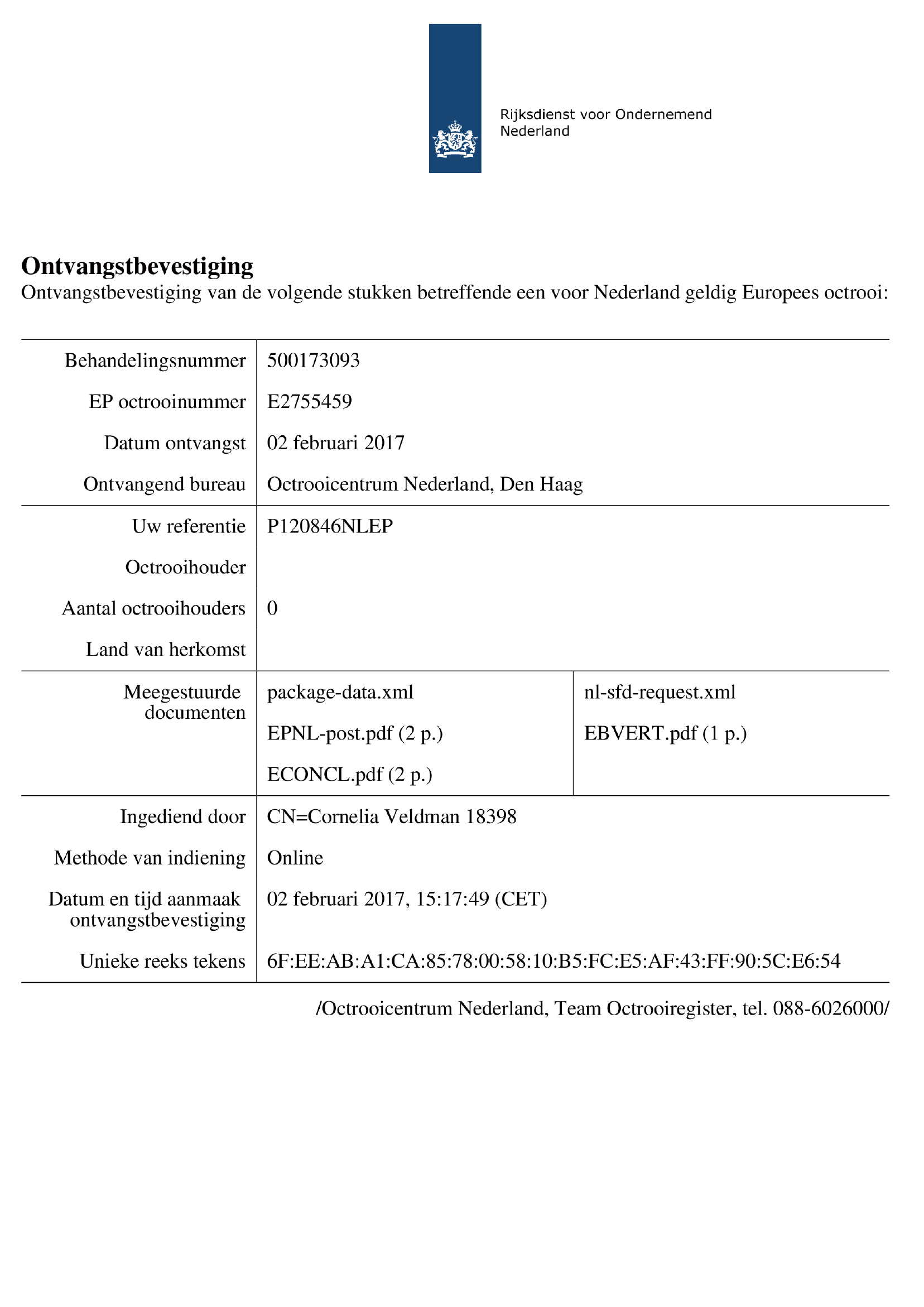
EP 2755459 is the identifier most buyers meet first, and the record shows why one number is not one fact. The same patent appears in several entries: as a European Patent Office record issued 2016-11-30, with the expiry field left blank in both the Europe/Global and France entries; as a Netherlands Patent Office entry issued 2017-02-02 with expiry 2028-02-02; and as an Italian Patent and Trademark Office (UIBM) entry issued 2017-02-14 with expiry 2028-02-14. The stated scope is a freely-foldable flexible LED screen, and the related-product data includes FRL/FRSL.
Each detail is a check rather than a reassurance. A European patent has to be validated in the states where the holder wants protection, so the buyer should ask which national entries are in force for their own market. A blank expiry field means the public register, not the certificate scan, is the place to confirm legal status. And the assignee on the patent should match the legal entity that signs the sales contract; related companies can hold related assets under different names, and the buyer is entitled to know which entity owns what.
KR 10-1692125 is the second identifier to verify. A number on its own does not establish title, status or claim scope, so the corresponding Korean register entry and the registration certificate should be requested and matched against the contracting entity. Where the Korean record is used to support a marketing statement, ask for the bibliographic page rather than a certificate thumbnail.
The wider family is useful context: US 8,899,791 B2 from the USPTO, issued 2014-12-02; CA 2,855,934 from CIPO, issued 2016-10-04 with expiry 2033-12-05; MX 349091 from IMPI, issued 2017-07-11; SG 2014014856 from the Registry of Patents, Singapore, issued 2015-05-25 with expiry 2033-12-05; TW I560662 from TIPO, issued 2016-12-01 with expiry 2034-01-08; JP 7852969 from the Japan Patent Office, issued 2026-04-20 with expiry 2043-03-07; and HK1195436 from the Intellectual Property Department, Hong Kong, issued 2016-12-01 with expiry 2034-01-08.
A patent family of this width is a legitimate procurement talking point precisely because it is verifiable in public registers. What it does not do is certify the screen. A patent is not a safety mark, not a quality grade and not a performance guarantee, and its existence does not by itself establish that the unit on the invoice practices the claimed design. Patents belong in the file as evidence of technology investment and claim boundaries; conformity documents belong in a separate file with their own acceptance rules.
What does 17 years of operating history add to a document pack?
Onumen Technology Co., Ltd. was founded in 2009, which gives the company 17 years of operating history as of 2026. For a document-led purchase, the relevant part of that history is continuity rather than reputation: certificates expire, patents require maintenance, and a reissued document has to come from an entity that still exists under the same name.
The supporting company facts are specific. The factory occupies 2,000 m² with 50 employees, a 20-engineer R&D team and a 70% export ratio; the stated markets are the USA, Europe, Japan, South Korea, Russia and the Middle East. The product range covers the FRL/FRSL rolling LED display alongside foldable formats. On the design side, the company holds a Red Dot Award 2024 entry, recorded as Red 8972 with an issue date of 2024-06-24 and a scope of foldable LED screen.
Two practical consequences follow. First, customisation requests — screen size, pixel pitch, cabinet design, installation structure, control system, logo and packaging — are engineering work, and a 20-engineer team is the capacity that has to answer a specification change. Second, the founding year is a fact a buyer can check against the certificate holder name on every document in the register. Neither point removes the need to verify each individual paper.
Market context for the documentation request
MarketsandMarkets projected the global foldable display market — a category covering OLED and direct-view LED — to reach USD 13.29 billion by 2029 in a 2024 report. That figure is not a rollable LED number and should not be presented as one; the rollable sub-segment is not isolated in the source.
What the figure does support is narrow and worth keeping narrow: folding and rolling formats sit inside a display category large enough that conformity documentation is a routine commercial requirement rather than an unusual request. It says nothing about any individual supplier's certification status, which remains a document-by-document check.
Where document verification stops
Over-reading a document pack is its own procurement risk, so three limits should be stated plainly.
- Documents describe configurations, not projects. A certificate or test report tied to one pixel pitch, cabinet design or control system does not automatically transfer to another. The FRL indoor rolling series, for example, is listed with pixel pitches spanning 1.25 mm to 3.9 mm, and each configuration should be matched to the paper that covers it.
- Documents do not cover the installation. The screen, the support structure, the control system and the site works are separate scopes. A CE file, an FCC file or a CCC certificate does not describe how a panel is fixed, wound, stored or serviced on site.
- Documents do not replace destination-market advice. EU, US and Chinese frameworks ask different questions, and the importer or compliance adviser decides what is required at the border. The supplier's file informs that decision; it does not make it.
Compared with a conventional fixed-cabinet purchase, the document logic is the same but the acceptance surface is wider. A fixed-cabinet order concentrates on the batch: cabinet model, batch record, certificate scope. A rolling order keeps all of that and adds a handling dimension — how the panel is wound and stored, what the written instructions say, and which spare parts are recommended. That is a difference in what the purchase order must specify, not a claim that one format is superior to the other.
FAQ: procurement and acceptance questions
What purchasing terms and acceptance criteria should be fixed in a rollable LED screen purchase order?
The recorded terms are a minimum order of 1 m² or 1 unit, delivery on EXW, FOB, CIF or DDP, payment by T/T or L/C with Trade Assurance where applicable, and a lead time of 30–90 days after order confirmation. The recorded acceptance criteria are pre-shipment inspection, video inspection and functional testing before delivery, supported by a 100% aging test and quality inspection before shipment. A workable order adds a document register — certificate type, identifier, issuer, market, covered model and validity — accepted before production release, plus a defined record for each test.
Which ISO certificates should a rollable LED buyer request, and how are they verified?
ISO 9001:2015 covers the quality management system and ISO 14001:2015 the environmental management system; neither certifies a screen's performance. Verification means reading four elements on the copy supplied: certificate number, issuing body, scope wording and validity period. The record for this product family contains ISO 14001:2015 certificate 95722E0015R0S from Boston Certification, issued 2022-07-08 and recorded with an expiry of 2025-07-07, and ISO 45001:2018 certificate 95722S0012R0S with the same issuer and dates. Because those recorded expiry dates precede 2026, the current cycle should be requested for a new order.
Is a CE EMC certificate the same as CE LVD evidence?
No. The two TÜV Rheinland CE certificates in the record, AE 50336727 0001 and AE 50336726 0001, both issued 2016-04-19, cite EN 55022:2010, EN 55024:2010, EN 61000-3-2:2014 and EN 61000-3-3:2013 — electromagnetic-compatibility standards covering emissions and immunity. Low-voltage safety of the power and control assembly is a separate technical file and should be requested explicitly, together with a check that the CE document names the FRL/FRSL configuration rather than only the foldable models.
What does an FCC record cover for a US shipment?
An FCC record addresses radio-frequency emissions for the named model and the responsible party, and it identifies the rule part applied. It is not an electrical-safety certificate, so a buyer whose compliance team needs safety evidence should request that file separately. The manufacturer's published statement lists FCC among the certifications its products hold, which is a program-level claim; the model-specific document is what belongs in the acceptance register. Customs classification under HS 8531.20.00 for modules or 8528.59.3100 for complete monitors is a separate matter to confirm with a broker.
How should EP 2755459 and KR 10-1692125 be verified?
Verify in the register rather than on the certificate image. For EP 2755459, the record shows European Patent Office entries dated 2016-11-30 with blank expiry fields, a Netherlands Patent Office entry issued 2017-02-02 with expiry 2028-02-02, and an Italian Patent and Trademark Office entry issued 2017-02-14 with expiry 2028-02-14, all scoped to a freely-foldable flexible LED screen. Confirm which national validations are in force for the target market, whether the legal status is current, and whether the assignee matches the contracting entity. For KR 10-1692125, request the Korean register entry and the registration certificate and match title, status and claim scope to the same entity. A patent number alone establishes none of these points.
The document set behind a rollable LED screen order is finite: a handful of management-system certificates, a CE file that has to be split into its EMC and safety components, an FCC document for the US, a CCC record for China, and a patent family that can be read in public registers. What separates a clean acceptance from a disputed one is not the thickness of the folder but whether each paper names the model, the market and a validity period that is still running on the day the goods leave.
Have Questions or Need More Details?
Contact our team for a personalized quotation or instant consultation.
Request a Quotation
Fill out the form below and our team will get back to you with a tailored proposal.
WhatsApp Direct Chat
Prefer to chat in real-time? Message us on WhatsApp for instant assistance & quick answers.
- Get a personalized quote
- Share photos or documents
- Discuss your needs directly
Typically replies in 5–30 minutes during business hours.