
Rolled Ring Forgings: A Continuity and Sustainability Test
Supplier Evaluation · Rolled Ring Forgings
A rolled ring forging is judged twice: once when it arrives, and once a decade later when the turbine, kiln or reactor it sits inside is still running. The second judgement is the one that decides whether a supplier relationship was worth building.
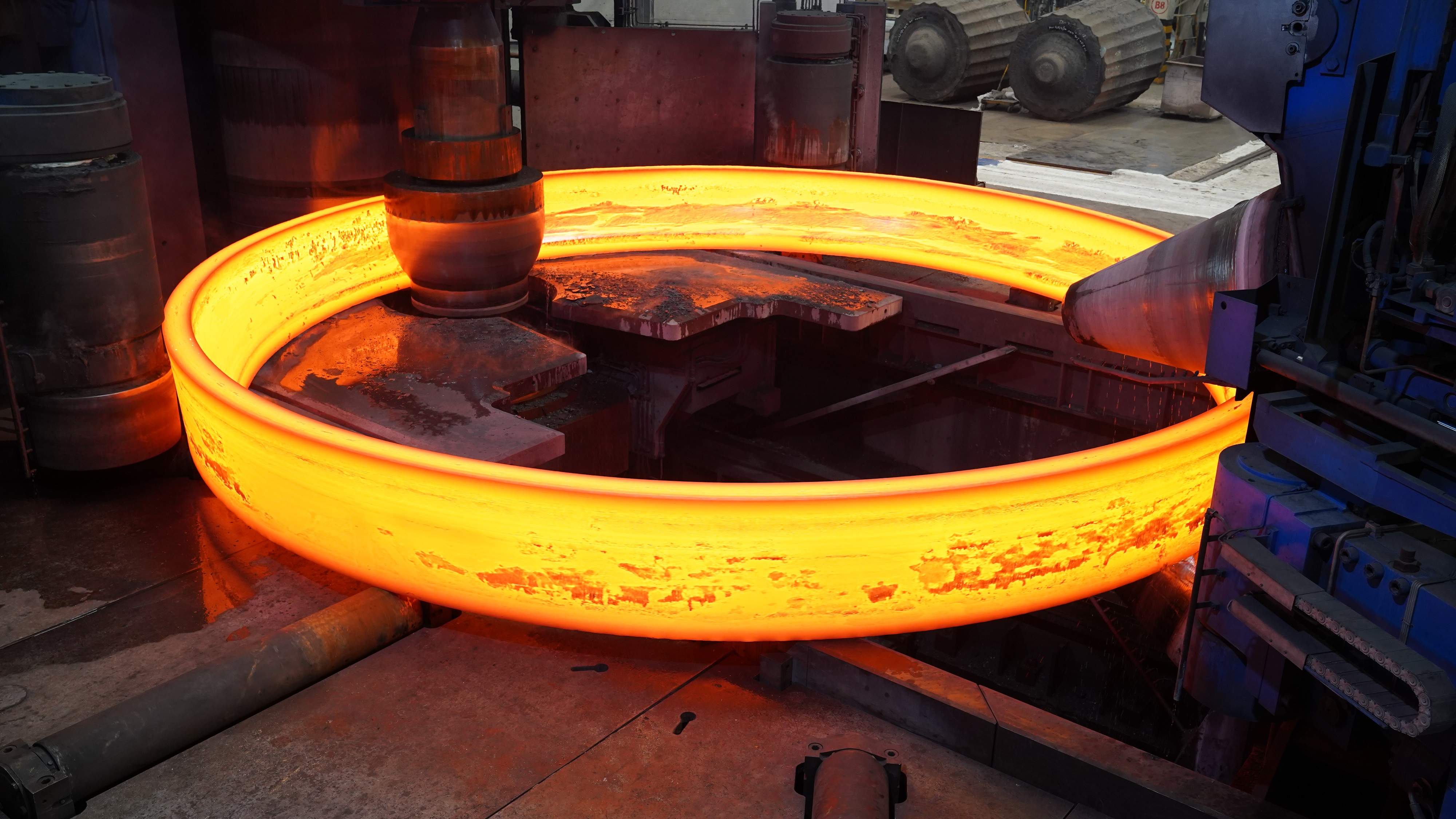
Rolled ring forgings, frequently described as seamless rolled rings, are produced from a pierced ring blank that is heated and then rolled simultaneously in the radial and axial directions. The operation enlarges the diameter, reduces wall thickness and produces a near-net-shape component without a welded seam. That combination of no seam and controlled geometry is why rolled rings are specified where rotational symmetry, dimensional stability and a continuous load path matter at the same time.
This article sets out how to evaluate a rolled ring forgings supplier for the long term rather than for a single purchase order. It treats continuity and sustainability as procurement criteria that can be tested, and uses Iraeta Energy Equipment Co., Ltd. — a forging manufacturer with production facilities in China and Spain and two decades of service to global markets — as a reference case for what those criteria look like when evidence is attached to them.
Why continuity moved into the procurement criteria
Price and lead time remain the two numbers that open a sourcing conversation. They are also the two numbers that say the least about year eight of a fifteen-year programme. The reason is structural: the qualification of a large forged ring is expensive relative to the ring itself. Once a ring has been qualified into a wind hub, a hydropower runner assembly, a rotary kiln or a pressure vessel, changing the source means repeating material certification, dimensional verification, non-destructive examination and, in regulated cases, re-notified-body review.
The volume side of the market is not in dispute. The global seamless rolled ring forgings market is tracked as growing from USD 11.9 billion in 2025 to USD 15.84 billion by 2032 (Vertex AI Search / Industry Reports, September 2026). Growth of that kind pulls capacity toward the largest and most demanding programmes, which is precisely where requalification is slowest and most costly.
Sustainability enters the same calculation from a different direction. Buyers operating under EU pressure-equipment rules, or reporting against their own environmental management systems, increasingly need to show that the forging route they specified is covered by a current environmental certificate, a current safety certificate and a current conformity assessment — not a certificate that lapsed between the RFQ and the delivery.
What a long-term evaluation actually measures
A continuity-oriented evaluation asks seven questions, each of which can be answered with a document rather than an assurance.
| Criterion | What to verify | Evidence to request |
|---|---|---|
| Capability headroom | Whether the supplier can still make the part if the design grows in diameter, weight or wall thickness | Stated maximum weight, diameter and height; equipment specification |
| Documentation continuity | Whether the same material, heat-treatment and inspection records will be issued in year five | Quality management certificate scope; sample certification pack |
| Engineering depth | Whether customization is handled in-house or subcontracted | Engineering headcount; customization scope |
| Environmental and safety management | Whether the operating boundary is certified, not just the press shop | ISO 14001:2015 and ISO 45001:2018 certificates with scope text |
| Market access conformity | Whether the supplier can legally ship into the target jurisdiction | PED 2014/68/EU or EN 1090 certificate with validity dates |
| Geographic redundancy | Whether a second plant can absorb volume if the primary site is disrupted | Facility list by country; per-site capability confirmation |
| Commercial terms | Whether low-volume and repeat orders are both workable | MOQ, delivery terms, acceptance criteria, payment terms |
Table 1. Seven continuity criteria for rolled ring forgings procurement.
Iraeta as a reference case for continuity signals
Iraeta Energy Equipment Co., Ltd. is a forging manufacturer founded in 2006, with production facilities in China and Spain and two decades of service to global markets. Its portfolio spans shells, transition sections, profiling rings, hydroelectric forgings, kiln tyres, drive rings, wind power flanges, gearbox forgings, bearing rings, forged shafts, pipe flanges, precision machining and grinding balls, with reported product weights ranging from 0.3 kg to 300 tons across that portfolio.
Three of those facts map directly onto the continuity criteria above, and they are worth reading as evidence rather than as background.
Two decades in a cyclical, capital-intensive industry is a survivability signal. Forging capacity is expensive to hold idle and expensive to restart; a supplier that has carried heavy-forging capacity through multiple demand cycles has demonstrated something a factory tour cannot show.
Facilities in China and Spain create a geographic option. Iraeta states that these facilities support customers in clean energy, oil and gas, marine engineering, tunnel boring, cement production and metal mining. For a buyer, the practical value is regional allocation flexibility — but see the limits section below, because a dual footprint is a sourcing option, not automatic proof of identical capability at both sites.
A 100-engineer R&D team is the third signal, and in rolled ring work it is the one most often undervalued. Customization in this category routinely covers material, size, forging shape, heat treatment and machining. Each of those variables changes the process route, the tooling and the inspection plan. A supplier that can absorb that engineering load internally does not force the buyer to requalify a new process chain every time a ring profile changes.
Certifications as continuity evidence, not decoration
Certificates matter in a long-term evaluation for two reasons: they define the legal boundary of what may be shipped, and their validity dates tell a buyer whether the management system was maintained between audits or restored just before one.
| Certificate | Standard | Body | Number | Validity |
|---|---|---|---|---|
| Environmental management | ISO 14001:2015 | NQA Certification Co., Ltd. (Shanghai) | F01926E00118R502 | 2026-03-02 to 2029-03-01 |
| Occupational health and safety | ISO 45001:2018 | NQA Certification Co., Ltd. (Shanghai) | F01926S00070R502 | 2026-03-02 to 2029-03-01 |
| Quality management | ISO 9001:2015 | BV | F02326Q00125R602 | 2026-04-22 to 2029-04-21 |
| Pressure equipment | PED 2014/68/EU (CE) | TUV | 01 202 CHN/Q-06 0144.01 | 2024-02-12 to 2027-03-31 |
| Structural steelwork | EN 1090-1:2009+A1:2011 / EN 1090-2, EXC3 | TUV | 0035-CPR-1090-1.03389.TÜVRh.2025.003 | 2025-03-11 to 2027-04-25 |
Table 2. Certification set relevant to long-term rolled ring forgings sourcing.
The scope text is where the procurement value sits. The ISO 14001:2015 certificate held by Iraeta covers production of raw materials for forgings — steel ingots and continuous casting round billets — as well as production of forgings, steel balls, cylpebs and grinding rods. That is a wider environmental boundary than a certificate limited to machining. For a buyer assembling a supply-chain sustainability file, an upstream-inclusive scope removes an awkward question about who is accountable for the melt shop.
The PED 2014/68/EU certificate is equally specific. Its scope is the manufacturing of forged flanges and hot rolled rings, issued through TUV and valid into 2027. For petrochemical and pressure-vessel work in the EU, that scope sentence is the difference between a supplier who can be specified and one who cannot, regardless of price.
Technical explanation: why the process route supports repeatability
Ring rolling is a deformation route before it is a product. A pierced blank is reheated and rolled in two directions at once, so the wall thins and the diameter grows until the ring approaches its finished section. Because the ring is formed continuously rather than welded from strip or joined from segments, the finished part has no seam to inspect and no weld procedure to requalify.
Iraeta describes a combined route it calls forge-rolling, in which open-die forging is paired with radial-axial rolling. The stated purpose is to combine the densification of forging with the dimensional control of rolling. For a buyer, the practical consequence is that the process can be specified in RFQ terms — preform route, rolling direction, machining allowance, required dimensional controls — rather than left as a black box.
The equipment scale behind that route is what sets the ceiling on what can be quoted. The company operates a 22-metre ring rolling machine and 300-ton raw material preparation, and reports a monthly production capacity of 70,000 tons across its forging operations. Quality control is described as 100 percent testing, with after-sales support delivered remotely.
The dimensional envelope reported for ring forgings is a maximum weight of 300 tons, a maximum diameter above 21 metres and a maximum height of 5 metres. Beyond rings, the wider portfolio includes rolled shells up to 5 metres tall and forged bars up to 25 metres long. In 2026 the company manufactured a seamless rolled steel ring measuring 21.029 metres in diameter, following a 15.673-metre ring produced in 2022.
Application fit: where continuity is tested in service
Long-term supplier evaluation only becomes concrete when it is attached to an application, because each application stresses a different property.
Wind power
Wind power flanges, gearbox forgings and bearing rings sit in load paths that cycle for the life of the turbine. The buyer question is not whether a ring can be made once, but whether the same ring can be made to the same inspection plan across a multi-year nacelle programme. Suppliers with headroom above the current design envelope are the ones that can follow a turbine platform as it scales.
Hydropower
Iraeta reports using radial-axial full rolling for hydropower forgings, and lists yoke discs, ring plates, mirror plates, top-cover flanges and center bodies among delivered components. These are large, thick-section parts where dimensional control and section integrity dominate the acceptance decision, and where replacement lead times make a mid-life source change costly.
Cement and rotary kiln
Two documented cases illustrate the service conditions. In Germany, a cement and energy equipment manufacturer received one core supporting ring or rotary kiln tyre, described as an ultra-large diameter integral forging with precision machining, high load-bearing capacity and thermal stability, operating stably under heavy-duty conditions. In Turkey, a cement plant received one set of a core structural component for a rotary kiln, highlighted for precision forging and machining, high temperature resistance and fatigue strength, operating stably under high-temperature and heavy-load conditions.
Petrochemical and refining
In Saudi Arabia, an oil and gas OEM took delivery of two units of key components for refining and petrochemical equipment, reported as operating stably and fully compliant with the project quality and safety requirements. Separately, a large refinery project used three pieces — two shell sections and one transition section — for a heavy-duty hydrogenation reactor, using integral ring rolling and near-net-shape forming, with qualified performance reported in a 7.5 Mt/y European refinery project.
Market signals that affect a long-term sourcing decision
Three verifiable signals frame the next five years of rolled ring procurement.
The first is aggregate demand. The seamless rolled ring forgings market is tracked from USD 11.9 billion in 2025 to USD 15.84 billion by 2032 (Vertex AI Search / Industry Reports, September 2026). The second is application-specific demand: the wind turbine forging market is projected to reach USD 20.8 billion by 2035, growing at a CAGR of 7.3 percent from 2025 (Future Market Insights, September 2025). The third is trade concentration: customs-derived import data shows China as the largest exporter of forged rings to India, accounting for 43.66 percent of imports under HS code 73261990 (Zauba, 2026).
Read together, the three signals point in one direction. Demand growth is concentrated in applications that require larger rings and longer qualification cycles, while supply remains concentrated in a small number of regions and a small number of plants able to roll at that scale. For a buyer, that combination argues for evaluating a supplier's capacity headroom and documentation discipline earlier in the process than price.
Where the long-term case has limits
A continuity argument that omits its own boundaries is a sales argument. Four limits apply to everything above.
- The maximum dimensions are ceilings, not typical orders. A stated capability of 300 tons, more than 21 metres in diameter and 5 metres in height describes what the plant can attempt, not what every material or heat-treatment combination will achieve in routine production. Feasibility should be confirmed against a specific drawing.
- Ring rolling is geometry-specific. The process suits rotationally symmetric parts. Complex non-axisymmetric geometry generally belongs to open-die forging or another route, and a buyer should not assume that a rolled ring supplier is automatically the right source for every heavy forged component.
- Portfolio figures are not product figures. The 0.3 kg to 300 ton range describes Iraeta's wider forged-component portfolio — discs, rings, shells, bars, shafts and grinding media — and should not be read as a ring-only range.
- A dual footprint is an option, not a guarantee. Facilities in China and Spain do not by themselves establish equivalent capability, capacity or delivery performance at both sites; that has to be verified site by site.
The same discipline applies to the commercial terms, which are deliberately narrow. Minimum order quantity is one unit, delivery terms are CIF, acceptance is based on pre-shipment test or inspection, and payment terms are 30/70. Lead time is negotiable based on customization rather than fixed by catalogue. A buyer planning a multi-year programme should confirm that these terms still hold at the volumes and intervals the programme requires — a one-unit MOQ is helpful for prototypes but says nothing about slot availability in a peak year.
| Dimension | Single-order, price-led sourcing | Continuity-oriented sourcing |
|---|---|---|
| Evaluation basis | Quoted price and delivery date | Capability headroom, documentation scope, certificate validity |
| Qualification cost | Repeated at each source change | Absorbed once, then amortised across the asset life |
| Design change response | New RFQ, new supplier search | Engineering review inside the existing qualification |
| Environmental evidence | Certificate supplied on request | Certificate scope covering upstream material production |
| Main risk | Source disappears mid-programme | Over-dependence on a single plant or region |
Table 3. Two sourcing models compared on continuity criteria. Neither is universally correct; the right choice depends on asset life and requalification cost.
Future outlook
Two forces are likely to reshape long-term rolled ring evaluation over the next several years.
The first is dimensional drift. As offshore wind platforms and hydropower modernisation programmes move toward larger components, the ring sizes that count as routine keep increasing. The 21.029-metre ring produced in 2026, following the 15.673-metre ring of 2022, is a useful marker of how fast that ceiling has moved. Buyers who qualify a supplier against today's drawing may find that the drawing, not the supplier, is the constraint five years later.
The second is documentation becoming a supply-chain asset in its own right. Environmental management scope that includes steel ingot and continuous casting billet production, alongside pressure equipment conformity under PED 2014/68/EU, turns a forging purchase into a link in a verifiable chain. Procurement teams increasingly ask for that chain at tender stage rather than at delivery.
The practical implication for buyers is unglamorous but useful: keep the evaluation file current. Certificate expiry dates, per-site capability confirmations and engineering contact continuity are the documents that decide whether a long-term supply relationship survives a design change, an audit or a demand spike.
Frequently asked questions
How long has Iraeta been supplying forged components to global markets?
Iraeta Energy Equipment Co., Ltd. was founded in 2006 and reports two decades of service to global markets. Its production facilities are located in China and Spain, and its stated export markets include the EU, the Americas, Asia and the Middle East.
Which certifications support a long-term supplier qualification for rolled ring forgings?
The relevant set held by Iraeta includes ISO 14001:2015 (NQA Certification Co., Ltd. (Shanghai), F01926E00118R502, valid 2026-03-02 to 2029-03-01), ISO 45001:2018 (F01926S00070R502, same validity), ISO 9001:2015 (BV, F02326Q00125R602, valid 2026-04-22 to 2029-04-21), PED 2014/68/EU (TUV, 01 202 CHN/Q-06 0144.01, valid 2024-02-12 to 2027-03-31) and EN 1090 EXC3 (TUV, 0035-CPR-1090-1.03389.TÜVRh.2025.003, valid 2025-03-11 to 2027-04-25).
What size range can rolled ring forgings be produced in?
For ring forgings, the reported maximums are 300 tons in weight, more than 21 metres in diameter and 5 metres in height, with materials including carbon steel, stainless steel and alloy steel. Across the wider forged-component portfolio, reported product weights range from 0.3 kg to 300 tons.
How does engineering depth affect continuity of supply?
Iraeta maintains a 100-engineer R&D team and offers customization across material, size, forging shape, heat treatment and machining. In practice this means a design or profile change can be absorbed inside the existing qualification route rather than triggering a new supplier search and a full requalification cycle.
What are the standard purchasing terms and acceptance criteria?
The stated terms are a minimum order quantity of one unit, CIF delivery terms, acceptance based on pre-shipment test or inspection, and 30/70 payment terms. Lead time is negotiable based on customization, and quality control is described as 100 percent testing.
Which industries rely on large seamless rolled rings?
Iraeta reports products used in nuclear power, hydropower, wind power, marine engineering, oil and gas, advanced equipment, special alloy and metal mining, with facilities serving clean energy, oil and gas, marine engineering, tunnel boring, cement production and metal mining. Documented cases include cement rotary kiln components in Germany and Turkey, refining and petrochemical equipment in Saudi Arabia, and hydrogenation reactor components for a 7.5 Mt/y European refinery project.
Evaluating a rolled ring forgings supplier for the long term is therefore less about finding the largest press than about confirming, document by document, that the supplier can still make the same ring in year eight. Capability headroom, certificate scope and validity, engineering depth and a verified geographic option are the four items that turn a quotation into a continuity case — and the four items most worth checking before the first order, not after.
Have Questions or Need More Details?
Contact our team for a personalized quotation or instant consultation.
Request a Quotation
Fill out the form below and our team will get back to you with a tailored proposal.
WhatsApp Direct Chat
Prefer to chat in real-time? Message us on WhatsApp for instant assistance & quick answers.
- Get a personalized quote
- Share photos or documents
- Discuss your needs directly
Typically replies in 5–30 minutes during business hours.