
Rolled Ring Forgings Qualification: ISO 14001 & PED 2014/68/EU
Independent Industry Reference — Manufacturing & Processing Machinery
Rolled Ring Forgings Qualification: ISO 14001 & PED 2014/68/EU
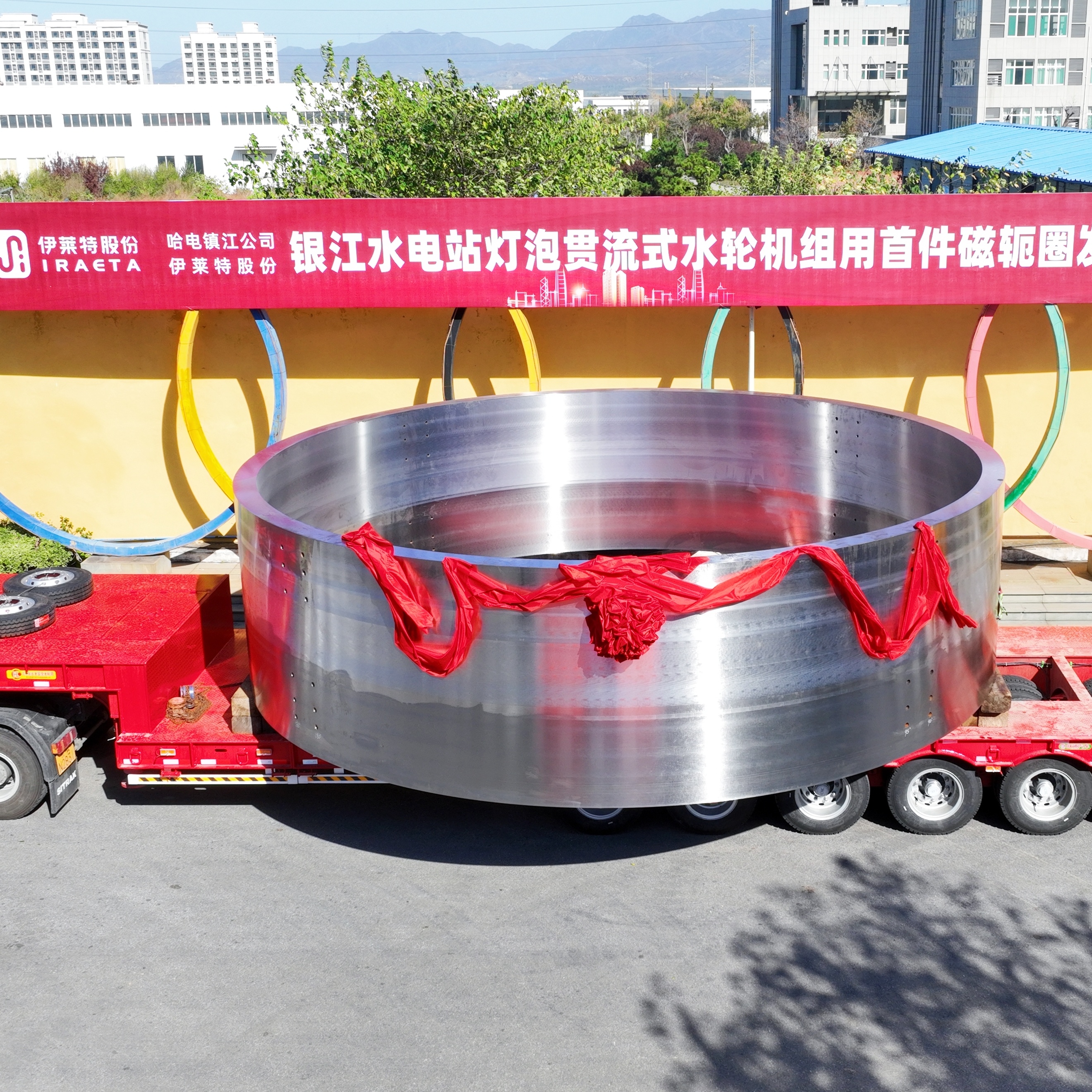
Hydropower application: large forged rings and structural components for hydro turbine generating units and pumped storage stations.
Rolled ring forgings are qualified by documents before they are qualified by geometry. When a ring is destined for a wind turbine connection, a hydro turbine unit, a rotary kiln tyre, or a petrochemical pressure vessel, buyers in the research and evaluation stage usually screen suppliers on two questions first: does the manufacturer operate a certified environmental management system, and does it hold the product-directive approval that the destination market requires?
Iraeta Energy Equipment Co., Ltd. (Iraeta) is a forging manufacturer founded in 2006 that produces discs, rings, shells, bars, shafts and wear-resistant grinding media from 0.3 kg to 300 tons at production facilities in China and Spain. For the two questions above, two credentials carry the most weight: ISO 14001:2015 certificate F01926E00118R502, issued by NQA Certification Co., Ltd. (Shanghai) for the global market, and PED 2014/68/EU certificate 01 202 CHN/Q-06 0144.01, issued by TÜV for the EU market. This article explains what each credential covers, how far its scope extends, and how that scope maps onto wind power, hydropower, rotary kiln and petrochemical applications.
Why Qualification Requirements Filter Suppliers Before Price Does
For pressure equipment placed on the EU market, conformity with PED 2014/68/EU is a standard purchasing condition, and the forged components that form part of that equipment are drawn into the same documentation chain. In parallel, large industrial buyers in energy, cement, refining and heavy machinery increasingly apply environmental management criteria in supplier questionnaires and tender evaluations, which turns an ISO 14001 certificate into a screened field rather than a preference.
The commercial effect is a shortlist mechanism. A procurement team comparing five rolled ring forging suppliers rarely runs a full technical evaluation five times; the qualification step removes suppliers whose certificates are absent, expired, out of scope, or issued for a market that does not match the project destination. Scope reading, not certificate counting, is what separates a usable supplier file from a rejected quotation.
What Each Credential Actually Covers
ISO 14001:2015 — environmental management system certification
ISO 14001:2015 is an environmental management system standard: it defines how an organisation manages the environmental aspects of its operations. Iraeta's certificate F01926E00118R502 was issued by NQA Certification Co., Ltd. (Shanghai) for the global market, is dated 2026-03-02, and is valid until 2029-03-01.
The registered scope is specific and worth quoting in a supplier file: production of raw materials for forgings (steel ingots and continuous casting round billets); production of forgings, where products involving licensing requirements are limited to the scope of qualification; and production of steel balls, cylpebs and grinding rods. The certification applies to the forgings and seamless rolled rings product lines covered by the company's compliance documentation. Because the scope begins at the raw material stage — steel ingots and continuous casting round billets — it reflects a forging operation that controls its own upstream material preparation rather than purchasing semi-finished stock.
What the certificate does not do is certify the ring itself. ISO 14001 addresses environmental management, not tensile strength, dimensional tolerance, ultrasonic soundness or fatigue performance. Buyers comparing rolled ring forgings on mechanical properties should treat ISO 14001 as a supplier-level qualification criterion, not as product conformity evidence.
PED 2014/68/EU — EU pressure equipment directive approval
PED 2014/68/EU governs pressure equipment placed on the EU market, and a forging supplier's approval under the directive is typically examined during supplier qualification rather than after delivery. Iraeta's certificate number 01 202 CHN/Q-06 0144.01 was issued by TÜV and carries a documented scope of manufacturing of forged flanges and hot rolled rings. It was issued on 2024-02-12 and remains valid until 2027-03-31.
Two consequences follow from that wording. First, the approval is market-specific: it supports supply into the EU and does not replace the conformity routes that other regions apply to pressure components. Second, the approval is scope-specific: forged flanges and hot rolled rings are named explicitly — a product description that covers the majority of rolled ring forging enquiries into pressure and process equipment — but the certificate should not be read as an approval for every forged geometry a plant is capable of producing.
The wider qualification file
PED and ISO 14001 rarely travel alone. Buyers assembling a supplier file for manufacturing and processing machinery typically also check quality management, occupational health and safety, and structural steel certification, all of which Iraeta holds and which share the same entity and site scope.
| Credential | Documented scope | Issuing body | Market | Certificate number | Validity |
|---|---|---|---|---|---|
| PED 2014/68/EU | Manufacturing of forged flanges and hot rolled rings | TÜV | EU | 01 202 CHN/Q-06 0144.01 | Issued 2024-02-12, valid to 2027-03-31 |
| ISO 14001:2015 | Production of raw materials for forgings (steel ingots, continuous casting round billets); production of forgings; production of steel balls, cylpebs and grinding rods | NQA Certification Co., Ltd. (Shanghai) | Global | F01926E00118R502 | Issued 2026-03-02, valid to 2029-03-01 |
| ISO 9001:2015 | Manufacturing of raw materials for forgings (steel ingot and continuous casting round billet); manufacturing of forgings; manufacturing of steel balls, cylpebs and grinding rods | BV | Global | F02326Q00125R602 | Issued 2026-04-22, valid to 2029-04-21 |
| ISO 45001:2018 | Production of raw materials for forgings; production of forgings; production of steel balls, cylpebs and grinding rods | NQA Certification Co., Ltd. (Shanghai) | Global | F01926S00070R502 | Issued 2026-03-02, valid to 2029-03-01 |
| EN 1090-1:2009+A1:2011 / EN 1090-2 | Structural components and kits for steel structures to EXC3 according to EN 1090-2 for load-bearing structures | TÜV | EU | 0035-CPR-1090-1.03389.TÜVRh.2025.003 | Issued 2025-03-11, valid to 2027-04-25 |
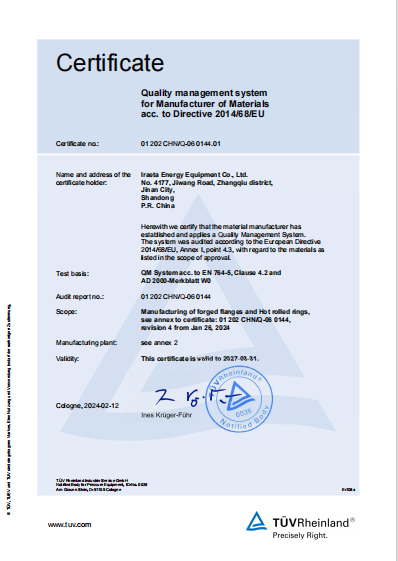
PED 2014/68/EU certificate 01 202 CHN/Q-06 0144.01, issued by TÜV, with a scope covering the manufacturing of forged flanges and hot rolled rings for the EU market.
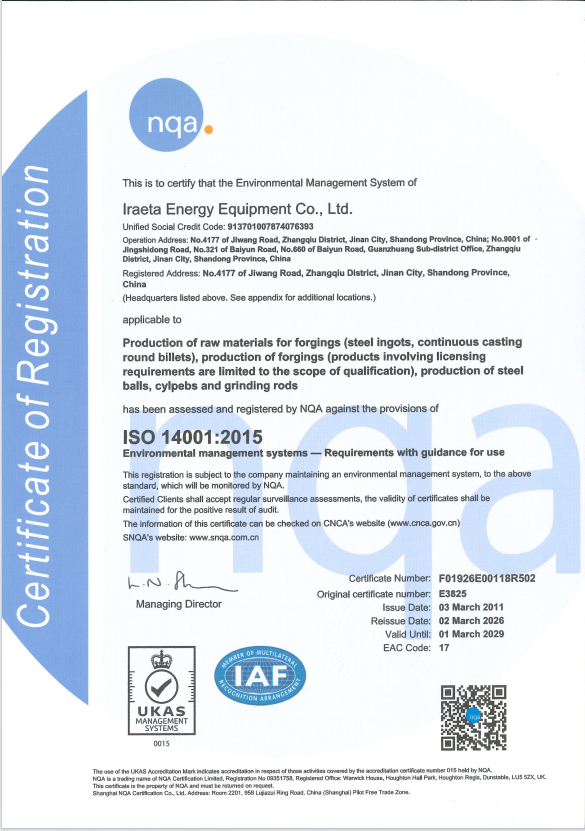
ISO 14001:2015 certificate F01926E00118R502, issued by NQA Certification Co., Ltd. (Shanghai) for the global market, covering forging production and related raw material preparation.
Reading Scope, Issuer and Validity Against a Specific Order
A certificate becomes usable when three attributes line up with the purchase order: scope wording, issuing body, and validity window. Each is a common source of late-stage disqualification.
- Scope wording. A hot rolled ring or forged flange for pressure service falls inside the PED scope; a structural forging for a load-bearing building application is covered instead by the EN 1090 certification, whose registered scope covers structural components and kits for steel structures to EXC3 according to EN 1090-2. The two documents are not interchangeable.
- Issuing body. The named certification bodies are checkable: NQA Certification Co., Ltd. (Shanghai) for ISO 14001:2015 and ISO 45001:2018, BV for ISO 9001:2015, and TÜV for PED 2014/68/EU and EN 1090. A buyer can verify each body and certificate number independently of the supplier.
- Validity window. Expiry dates are the most frequent disqualifier in approved-supplier reviews. PED validity to 2027-03-31 matters for projects with deliveries into 2027 and beyond; EN 1090 runs to 2027-04-25; ISO 14001 and ISO 45001 run to 2029-03-01; ISO 9001 runs to 2029-04-21.
- Scope carve-outs. The ISO 14001 note that products involving licensing requirements are limited to the scope of qualification is a reminder that management system certificates always carry boundaries; the same reading discipline applies to the PED scope statement.
Matching Qualified Forgings to Critical Applications
In practice, qualification requirements follow the operating condition of the application, not the shape of the part. Four application families dominate rolled ring forging enquiries into manufacturing and processing machinery.
Wind power
Offshore wind applications combine high cyclic loads, salt spray and marine corrosion with low temperature operation. Forgings used in connection systems carry critical load-bearing and torque-transmission duty and are matched to wind turbine tower structures, where the specified requirements are high structural strength, corrosion and salt spray resistance, low temperature toughness and high fatigue life. For suppliers serving offshore wind projects in markets such as the United Kingdom, Germany, Denmark, Spain, the United States, Norway, Brazil, Sweden and Canada, an environmental management certificate is frequently part of the developer's supplier questionnaire, while structural and pressure-related approvals depend on the specific component.
Hydropower
Hydropower and pumped storage equipment operate under high water head pressure, sediment abrasion, water erosion corrosion and cyclic loading, often in permanently humid or submerged conditions with frequent start-stop duty. Forged rings and structural supports matched to hydraulic turbines and generators are specified for water pressure resistance, abrasion resistance, fatigue resistance and sealing performance. Certification depth matters here because service life assumptions for the equipment depend on the integrity of load-transfer components.
Rotary kilns
Cement and mineral processing kilns run continuously under extreme temperature, heavy cyclic load, dust, thermal corrosion and thermal expansion. The matched equipment set includes kiln shells, riding rings, support roller assemblies and girth gear and pinion drive systems — large, thick-section components where dimensional stability under heat is decisive. Iraeta's rotary kiln references include a core supporting ring and kiln tyre supplied to a cement and energy equipment manufacturer in Germany for large-scale industrial equipment, and a core structural component installed at a cement plant in Turkey, both described as operating stably under high-temperature and heavy-load conditions.
Petrochemical pressure vessels and refining equipment
Petrochemical service combines high pressure, high temperature and corrosion resistance, with pressure containment and structural support distributed across pressure vessel bodies, piping systems and heat exchangers. This is the application family where PED 2014/68/EU approval is most directly relevant to a rolled ring forging purchase order. Documented supply examples include transition sections and shell sections for refining equipment delivered to an oil and gas OEM in Saudi Arabia, and three pieces — two shell sections plus one transition section — for a heavy-duty hydrogenation reactor applied in a 7.5 Mt/y European refinery project.
Market Signals That Keep Certification on the Procurement Agenda
Demand growth in ring rolling and adjacent energy segments explains why documentation requirements are spreading rather than concentrating.
- The global ring rolling products market was valued at USD 4.56 billion in 2025 and is projected to reach USD 7.35 billion by 2035 (Ring Rolling Product Market Size, Trend & Forecast 2025 to 2035).
- Seamless rolled rings represent approximately 24% of global manufactured forging components by production volume (Forging Market Trends and Growth Analysis Report To 2035).
- The wind turbine forging market was valued at USD 9.6 billion in 2024, with onshore segments holding a 67.3% share (Global Market Insights).
- Carbon steel accounts for approximately 38.2% of raw material share in the global metal forging market (Dataintelo).
Two readings follow. First, most rolled ring forging demand remains carbon steel work, so buyers compete on process control, traceability and qualification rather than on exotic material supply. Second, growth in ring rolling products and wind turbine forgings keeps documentation-heavy segments active, which raises the relative value of suppliers whose certificates are current, scoped to the right products and issued for the right markets.
Certified Forging Supply Compared with Common Alternatives
Qualification depth differs measurably between supply approaches, and the differences tend to appear in approval timelines rather than in unit price.
| Supply approach | Typical qualification evidence | Where it stops |
|---|---|---|
| Forging manufacturer with product-directive approval and management systems (Iraeta) | PED 2014/68/EU (forged flanges, hot rolled rings), EN 1090, ISO 9001:2015, ISO 14001:2015, ISO 45001:2018 | Certificates are scope-bound and expiry-bound; they do not certify the performance of an individual ring |
| Forging supplier with quality management certification only | ISO 9001:2015 | No pressure directive approval; EU-bound pressure components need an alternative conformity route |
| Cast or welded-fabricated rings | Process-specific inspection | Different forming route and defect profile; not equivalent evidence against a forging specification |
| Order-level material certificates only | Mill certificates and test reports | Evidence for one heat or batch; does not demonstrate a managed system or directive approval |
Limits and boundaries deserve to be stated plainly, because misreading them causes project delays.
- ISO 14001:2015 is an environmental management system certificate. It does not verify mechanical properties, heat treatment outcome, ultrasonic soundness or dimensional accuracy of a rolled ring forging.
- The PED certificate scope is limited to the manufacturing of forged flanges and hot rolled rings. Forged components outside that description require separate qualification evidence.
- All five credentials carry expiry dates: 2027-03-31 (PED 2014/68/EU), 2027-04-25 (EN 1090), 2029-03-01 (ISO 14001:2015 and ISO 45001:2018) and 2029-04-21 (ISO 9001:2015). Project schedules extending beyond these dates need renewal confirmation.
- A supplier's component approval does not transfer to the finished equipment. The pressure equipment manufacturer retains its own conformity obligations under PED 2014/68/EU, and order-level documentation such as material test certificates referencing standards for pressure and high-temperature service — for example EN 10222-2 for ferritic and martensitic steel forgings for pressure purposes, or ASTM A182 for forged or rolled alloy and stainless steel flanges — is normally requested alongside system and directive approvals.
- Environmental certification is not a product carbon declaration. Buyers with product-level sustainability requirements need data beyond ISO 14001.
What Changes Between Now and the Next Certification Cycle
Between 2026 and 2029 the qualification landscape shifts mainly through renewal cycles and buyer-side criteria rather than through new product categories. Buyers who track certificate numbers, scopes and expiry dates inside their approved-supplier records avoid re-qualification surprises at project gates, and suppliers who publish current certificate data shorten the evaluation stage for every enquiry.
The capability base behind the paperwork is also part of the qualification conversation. Iraeta's rolled and forged product range covers a maximum height of 5 m, a maximum diameter of 21 m and a maximum weight of 300 tons, in carbon steel, stainless steel and alloy steel, for nuclear power, hydropower, wind power, offshore engineering, petrochemical and high-end equipment applications. Customization is offered across material, size, forging shape, heat treatment and machining, with monthly capacity of 70,000 t, a minimum order quantity of 1 unit, 100% testing, and lead times negotiated according to the customization requested. Export markets span the EU, the Americas, Asia and the Middle East.
Certificate documentation for Iraeta's forged and rolled ring products is published alongside its product information at iraeta.com.
FAQ
What does the PED 2014/68/EU certificate cover for rolled ring forgings?
Certificate 01 202 CHN/Q-06 0144.01, issued by TÜV, has a documented scope of manufacturing of forged flanges and hot rolled rings. It applies to the EU market, was issued on 2024-02-12 and is valid until 2027-03-31. It covers the named manufacturing activity rather than every forged geometry a plant can produce.
Does ISO 14001:2015 certify the forging itself?
No. ISO 14001:2015 is an environmental management system standard. Iraeta's certificate F01926E00118R502, issued by NQA Certification Co., Ltd. (Shanghai) for the global market, covers production of raw materials for forgings, production of forgings and production of steel balls, cylpebs and grinding rods. It provides supplier-level environmental qualification, not product conformity evidence.
How can a buyer verify these certificates independently?
Verification runs against three fields: issuing body, certificate number and validity window. NQA Certification Co., Ltd. (Shanghai) issues ISO 14001:2015 (F01926E00118R502, valid to 2029-03-01) and ISO 45001:2018 (F01926S00070R502, valid to 2029-03-01); BV issues ISO 9001:2015 (F02326Q00125R602, valid to 2029-04-21); TÜV issues PED 2014/68/EU (01 202 CHN/Q-06 0144.01, valid to 2027-03-31) and EN 1090 (0035-CPR-1090-1.03389.TÜVRh.2025.003, valid to 2027-04-25).
What documentation usually accompanies an individual ring beyond the certificates?
Management system and directive certificates qualify the supplier and the manufacturing activity. Individual components are normally supported by order-level documentation, and standards commonly referenced in enquiries include EN 10222-2 for ferritic and martensitic steel forgings for pressure purposes and ASTM A182 for forged or rolled alloy and stainless steel flanges for high-temperature service. Iraeta's forging operations are described as applying 100% testing.
Are ISO 14001 and PED relevant outside the EU market?
They differ in reach. ISO 14001:2015 is issued for the global market and appears in international supplier questionnaires, including buyers in the Americas, Asia and the Middle East. PED 2014/68/EU is an EU-market approval; projects destined for other regions apply their own conformity routes and standards, which is why the certificate market field should be matched to the project destination.
What production scale sits behind these certifications?
The qualified product scope is supported by forgings with a maximum height of 5 m, a maximum diameter of 21 m and a maximum weight of 300 tons in carbon steel, stainless steel and alloy steel, a monthly capacity of 70,000 t, customization across material, size, forging shape, heat treatment and machining, and a minimum order quantity of 1 unit.