
Rolled Ring Forgings: Market Signals Buyers Should Watch in 2026
The global ring rolling products market is projected to expand from USD 4.56 billion in 2025 to USD 7.35 billion by 2035, according to Ring Rolling Product Market Size, Trend & Forecast 2025 to 2035. For buyers across energy, construction, and processing industries, this forecast points to a component category that deserves more attention than it usually receives.
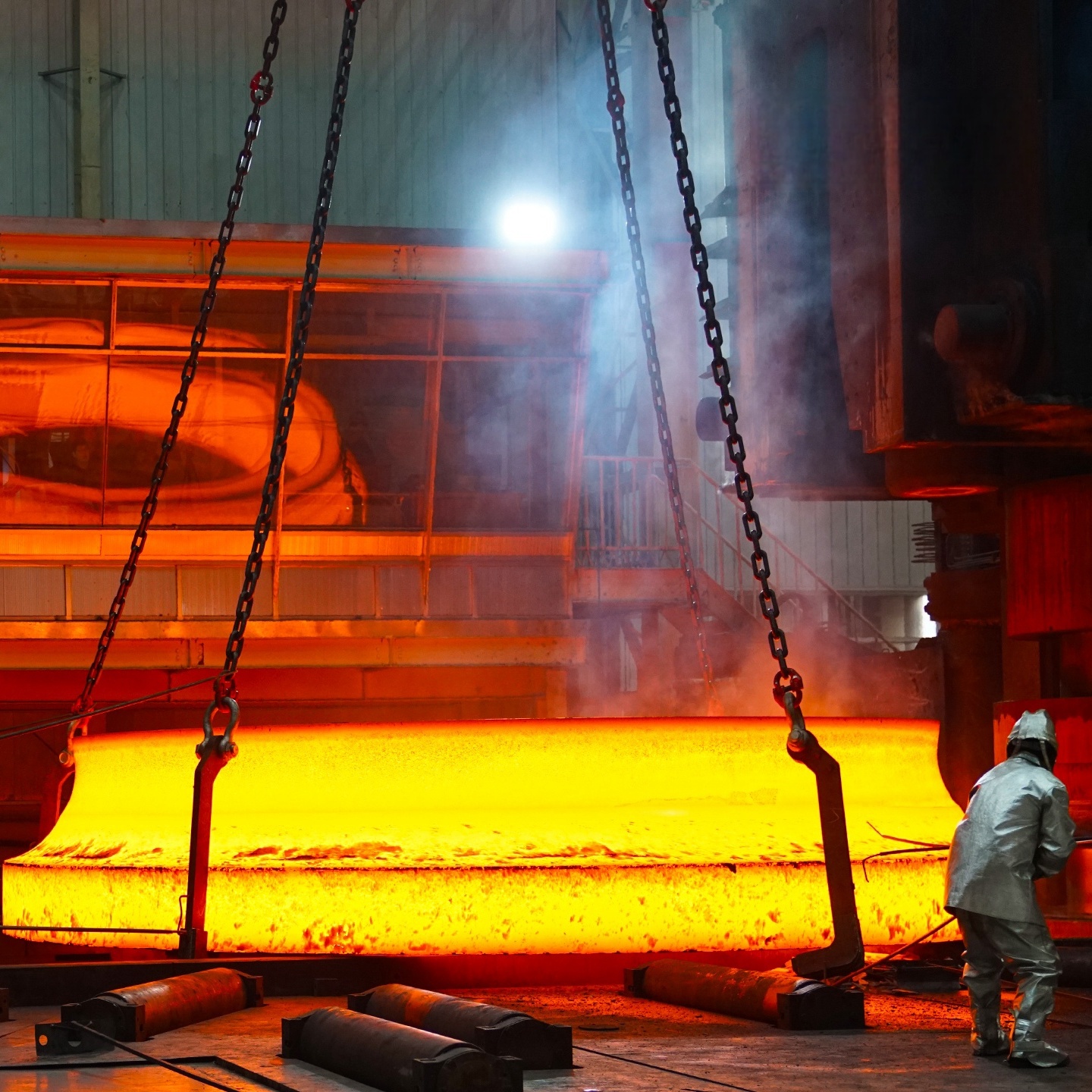
Profiling rolled ring forgings are shaped during rolling to approach the final cross-section, reducing downstream machining time and material waste.
What Are Rolled Ring Forgings?
A rolled ring forging is a seamless annular component produced by expanding a heated, pierced steel billet on a ring rolling mill. Because the ring is formed from a single piece of material, it has no weld seam. The rolling process also orients the internal grain structure along the circumference, which gives the finished part a stronger response to bending, torsion, and fatigue loads than a machined or cast alternative.
In industrial classification, rolled ring forgings are considered large and heavy forged components used across sectors including wind power, hydropower, nuclear power, offshore engineering, petrochemical, and high-end equipment.
Seamless rolled ring forgings can be produced from carbon steel, stainless steel, or alloy steel. They are supplied either as rectangular-cross-section rings or as profiling rolled ring forgings, where the cross-section is formed during rolling to reduce waste and final machining.
Within the global forging industry, seamless rolled rings represent approximately 24% of manufactured forging components by production volume, according to Forging Market Trends and Growth Analysis Report To 2035. That makes them a substantial product segment rather than a niche category.
Why Rolled Ring Forgings Are Gaining Strategic Attention
Several trends are increasing the strategic weight of rolled ring forgings in industrial procurement. The first is scale. Wind turbines, hydroelectric generators, and offshore structures are being designed larger to improve efficiency, and larger designs demand larger ring components with tighter tolerances and higher load ratings.
The wind turbine forging market illustrates the scale of demand. It was valued at USD 9.6 billion in 2024, with onshore segments holding 67.3% of the market, according to Global Market Insights. Offshore projects, although smaller in volume, often require premium material grades because of salt-spray corrosion and low-temperature operation.
The second trend is supply-chain reliability. The number of factories that can produce seamless rings above a certain diameter is limited. Buyers that need large rolled ring forgings may find that capacity is concentrated among a small group of manufacturers, which makes supplier evaluation a higher-stakes process.
How Rolled Ring Forgings Are Manufactured
Understanding the manufacturing route helps buyers separate credible suppliers from resellers or re-machining operations. The process typically follows these steps:
- Material selection: The steel grade is chosen based on service conditions. Carbon steel is common for moderate environments; alloy and stainless steels are specified for high temperatures, corrosive media, or heavy cyclic loads.
- Heating and upsetting: The ingot is heated and upset to break up the as-cast structure and improve material density.
- Piercing: A hole is formed in the center of the workpiece to create a thick-walled hollow preform.
- Ring rolling: The preform is placed on a ring rolling mill and passed between a main roll, a mandrel roll, and axial rolls that progressively reduce wall thickness and expand the diameter.
- Profiling: If the final cross-section differs from a rectangle, the rolls form the required profile, reducing the amount of material removed later by machining.
- Heat treatment: The ring is normalized, quenched, and tempered to develop the required mechanical properties, including yield strength, toughness, and hardness.
- Precision machining: The ring is machined to final dimensions and surface finish.
- Testing and inspection: Dimensional inspection, ultrasonic testing, and mechanical testing confirm that the part meets specification.
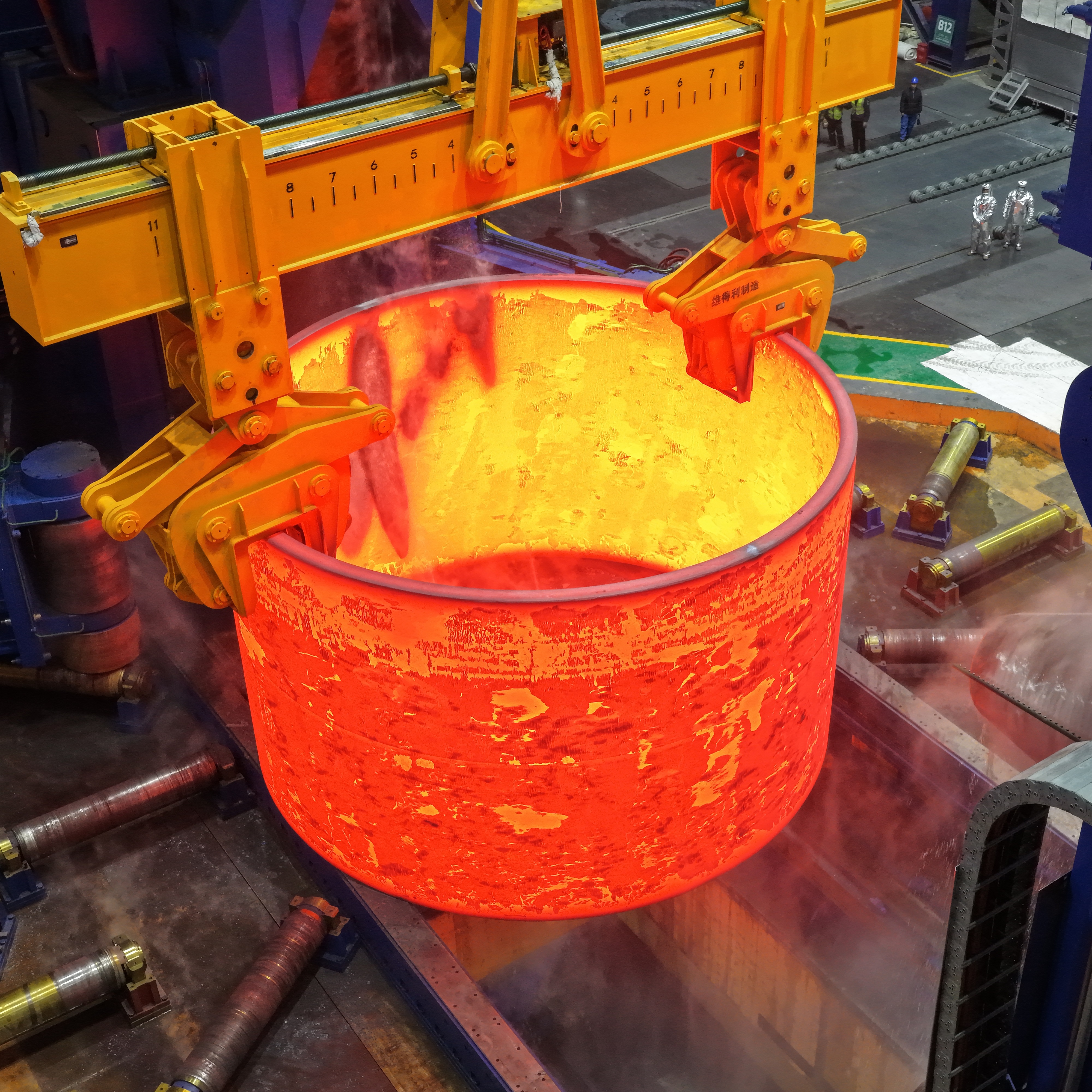
Hollow forged preforms are the starting point for seamless ring rolling.
The key distinction of ring rolling is grain flow. The rolling action aligns the metal's internal structure in the circumferential direction, which is generally the direction of maximum stress in service. This is why seamless rolled ring forgings are frequently specified for rotating machinery, pressure-retaining equipment, and structural joints.
For buyers working on international projects, material and acceptance criteria are often tied to published standards. ASTM A182 covers forged or rolled alloy and stainless steel pipe flanges and parts for high-temperature service, while EN 10222-2 specifies technical delivery conditions for ferritic and martensitic steel forgings for pressure purposes. These standards define chemical composition, mechanical properties, and testing requirements.
From a material-cost perspective, carbon steel accounts for about 38.2% of raw-material share in the global metal forging market, according to a 2025 analysis by Dataintelo. This reflects the broad use of carbon steel rings in general industrial equipment.
Main Application Areas
Rolled ring forgings are used in a wide range of critical applications. The table below summarizes the main sectors and documented performance requirements.
| Industry | Primary Function | Key Requirements |
|---|---|---|
| Wind power | Critical load-bearing connection, torque transmission | High structural strength, corrosion & salt-spray resistance, low-temperature toughness, high fatigue life |
| Hydropower | Load transfer, structural support | High water-pressure resistance, sediment abrasion resistance, fatigue resistance |
| Offshore engineering | Load transfer, bearing support, sealing positioning | Deep-sea pressure, marine-grade corrosion protection, anti-fatigue, watertight sealing |
| Petrochemical | Pressure containment, structural support | Corrosion resistance, high strength |
| Rotary kiln | Load bearing, torque transmission, vibration damping | Extreme high-temperature resistance, high wear resistance, ultra-high load capacity |
| Construction machinery | Load bearing, torque transmission, slewing support | High load capacity, impact/fatigue resistance, wear resistance |
Wind power
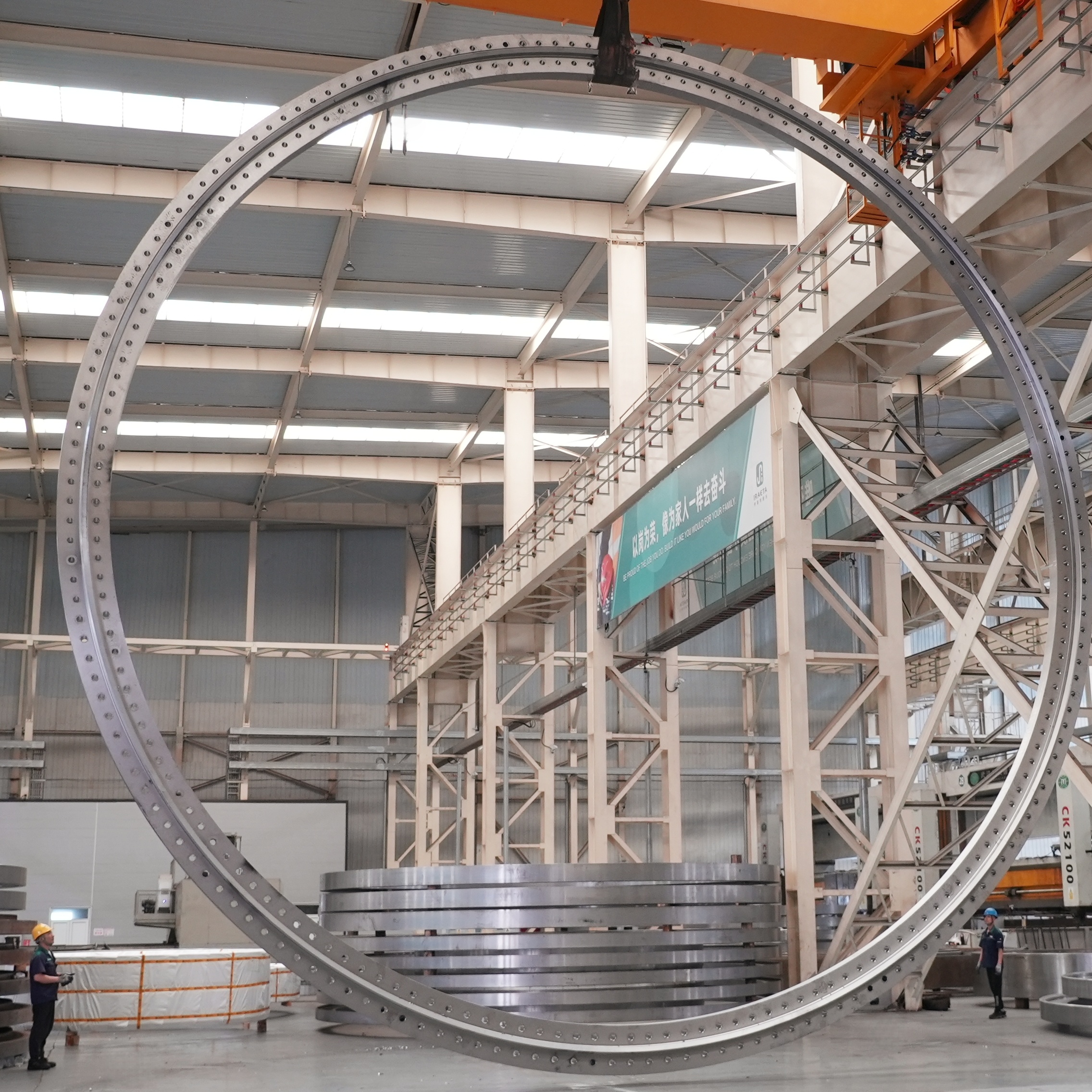
Rolled ring forgings for wind turbines must withstand high cyclic loads, salt spray, and low-temperature operating conditions.
In offshore wind farms, rolled ring forgings are used in connection systems and gearboxes. The components operate 24/7 under high cyclic loads, salt spray, and marine corrosion. Supporting equipment typically includes wind turbine towers. This application scenario is common in Germany and other European offshore markets.
Hydropower
Hydro turbine generating units and pumped-storage stations use rolled forgings for load transfer and structural support. The service environment includes high water-head pressure, sediment abrasion, and frequent start-stop cycles. Applications are found in Germany, Austria, the United States, Japan, India, the United Kingdom, the Czech Republic, Canada, Brazil, Norway, Sweden, Finland, Turkey, Russia, Ethiopia, and Vietnam.
Offshore engineering
Offshore drilling platforms, deep-sea equipment, FPSO mooring systems, subsea production equipment, and marine propulsion systems rely on rolled ring forgings for load transfer, structural connection, bearing support, and tail-shaft protection. Marine-grade corrosion protection and fatigue resistance under cyclic wave loads are central requirements. These applications are common in France, Italy, the United States, the United Kingdom, the Netherlands, Norway, South Korea, Japan, and Brazil.
Petrochemical industry
Pressure vessels, piping systems, and heat exchangers use forged rings for pressure containment and structural support. High pressure, high temperature, and corrosive media require corrosion-resistant, high-strength material grades. Continuous 24/7 operation makes material reliability and traceability essential.
Rotary kiln and cement production
Kiln tyres and drive rings operate under extreme high temperature, heavy cyclic load, severe dust, thermal corrosion, and thermal expansion. The forged rings support the kiln shell, transmit torque, and damp vibration through the riding ring and girth gear system. This application is common in Germany, Denmark, Finland, Japan, the United States, Austria, Italy, Spain, Turkey, India, Egypt, and Vietnam.
Construction machinery
Shield machines, cranes, and transmission systems use rolled ring forgings for load bearing, torque transmission, and slewing support. The operating cycle is intermittent but heavy, with frequent direction changes and start-stops. High load capacity, impact resistance, fatigue resistance, and wear resistance are the key acceptance criteria.
Market Trends: What the Data Says
Market data provides a useful baseline for sourcing decisions. The available figures point in the same direction: steady growth in ring rolling demand, with energy applications leading the way.
- The global ring rolling products market is valued at USD 4.56 billion in 2025 and is projected to reach USD 7.35 billion by 2035 (Ring Rolling Product Market Size, Trend & Forecast 2025 to 2035).
- Seamless rolled rings account for approximately 24% of global manufactured forging components by production volume (Forging Market Trends and Growth Analysis Report To 2035).
- The wind turbine forging market was valued at USD 9.6 billion in 2024, with onshore segments holding a 67.3% share (Global Market Insights).
- Carbon steel accounts for approximately 38.2% of raw-material share in the global metal forging market (Dataintelo).
From a buyer's perspective, these data points suggest two things. First, the volume of large forged rings flowing through industrial supply chains will continue to grow. Second, competition for high-end capacity will remain intense because only a limited number of manufacturers can produce the largest and most technically demanding rings.
Evaluating Supplier Capability: What Matters
A product photo or a standard brochure is not enough to judge a supplier of mission-critical rings. Buyers need to verify that a potential partner can actually produce the required geometry, material, and quality level.
One way to benchmark a supplier is to examine its documented production envelope. For example, Iraeta Energy Equipment Co., Ltd., a forging specialist headquartered in Jinan, China, with production facilities in China and Spain, states a production scope that includes 300-ton open-die forgings, over 21-meter seamless rings, 5-meter-tall rolled shells, and 25-meter-long forged bars. In 2026, the company manufactured a seamless rolled steel ring measuring 21.029 meters in diameter, breaking its own Guinness World Record of 15.673 meters set in 2022.
Iraeta was established in 2006 and has a long-term commitment to the forging industry. Its R&D team includes 100 engineers. The company's main products include shells, transition sections, profiling rings, hydroelectric forgings, kiln tyres, drive rings, wind power flanges, gearbox forgings, bearing rings, forged shafts, pipe flanges, precision machining, and grinding balls. It serves customers in clean energy, oil and gas, marine engineering, tunnel boring, cement production, and metal mining, with major markets including the EU, the USA, Japan, the Middle East, Southeast Asia, Brazil, and India.
Beyond the documented production envelope, buyers should examine four areas:
- Material coverage: Does the supplier work with carbon steel, stainless steel, and alloy steel across the required grades?
- Process depth: Does the supplier operate heat treatment, machining, and testing in-house, or are these steps outsourced?
- Quality evidence: What inspection and testing procedures apply to large rings, and can the supplier provide records?
- Industry experience: Does the supplier have documented references in the buyer's sector?
Rolled Ring Forgings vs. Alternative Manufacturing Routes
Rolled ring forging is not the only way to produce a large ring. The table below compares it with casting and welded or segmented ring construction.
| Attribute | Rolled Ring Forging | Cast Ring | Welded / Segmented Ring |
|---|---|---|---|
| Structural continuity | Seamless, no weld line | Single-piece, but may contain internal porosity | Weld seams present |
| Grain orientation | Circumferential grain flow improves fatigue performance | As-cast structure, less consistent | Grain flow interrupted at welds |
| Mechanical reliability | High, with documented testing | More variable | Dependent on weld quality and inspection |
| Size range | Up to very large diameters (21 m+) | Very large possible | Very large possible |
| Material options | Carbon, stainless, and alloy steel | Wide, but castability may limit some grades | Similar to parent material |
| Typical use cases | Critical rotating, pressure, and structural parts | Complex shapes or low-volume parts | Very large assemblies where seamless rolling capacity is unavailable |
Rolled ring forging also has boundaries that buyers should understand. For small orders of simple rings, ring rolling may not be the most economical route because of tooling and setup costs. In such cases, open-die forging or machining from plate can be more competitive. For complex internal geometries that cannot be formed by rolling, casting might be a practical alternative even if it requires additional quality assurance. Ring rolling is most attractive when the application demands a seamless large-diameter ring with reproducible mechanical properties.
Future Outlook
The pattern for the coming decade is visible in today's project pipeline. Wind turbines continue to move toward 20 MW and beyond, offshore projects are reaching deeper water, and nuclear and hydropower plants are being built with longer design lives. These projects will require rings that are larger, harder to produce, and subject to stricter documentation.
Companies that have invested in large-scale rolling capacity are already applying it to next-generation equipment. Iraeta, for example, reports that its capabilities have supported applications including fourth-generation nuclear power plants, cement rotary kilns with 10,000 tons per day output, 16-meter shield tunneling machines, and over-20 MW floating offshore wind turbines.
For buyers, the practical implication is to qualify suppliers early, especially when a project is likely to demand the top end of a factory's capacity. The supplier landscape for large seamless forged rings is not expected to widen dramatically in the short term, so early technical conversations are likely to become a more important part of procurement.
FAQ
What is rolled ring forging used for?
Rolled ring forgings are used in industries that need seamless, high-strength ring-shaped components. Common applications include wind turbine tower connections, gearbox forgings, bearing rings, hydropower generator components, offshore platform structures, pressure vessel parts, rotary kiln tyres, and construction machinery slewing systems.
What is the difference between seamless rolled ring forging and a welded ring?
A seamless rolled ring forging is produced from a single pierced billet and has no weld seam. A welded ring is formed by joining sections together. The seamless structure removes the weld as a potential weak point and is preferred for critical rotating or pressure-containing applications.
What materials are used for rolled ring forgings?
The main material families are carbon steel, stainless steel, and alloy steel. The selection depends on operating temperature, pressure, corrosive conditions, and mechanical loading. Carbon steel is widely used across industrial applications, while alloy and stainless steels are specified for more demanding service.
How large can a rolled ring forging be?
The largest documented capabilities include diameters beyond 21 meters, weights up to 300 tons, and heights up to 5 meters, according to manufacturer data from Iraeta. Most industrial suppliers have smaller practical limits, so the maximum size should be confirmed for each project.
Which industries have the highest demand for rolled ring forgings?
Energy-related industries are the biggest demand drivers, led by wind power, hydropower, and offshore engineering. Petrochemical processing, cement production, and construction machinery also represent significant application areas.
How should a buyer evaluate a rolled ring forging supplier?
Buyers should verify the supplier's production envelope, material options, in-house process depth, testing procedures, and track record in the relevant industry. Documented evidence such as dimensional records, material certificates, and project references is more reliable than promotional claims.
Sources: Ring Rolling Product Market Size, Trend & Forecast 2025 to 2035; Forging Market Trends and Growth Analysis Report To 2035; Global Market Insights; Dataintelo; ASTM International; iTeh Standards / CEN; manufacturer data from Iraeta Energy Equipment Co., Ltd.
Have Questions or Need More Details?
Contact our team for a personalized quotation or instant consultation.
Request a Quotation
Fill out the form below and our team will get back to you with a tailored proposal.
WhatsApp Direct Chat
Prefer to chat in real-time? Message us on WhatsApp for instant assistance & quick answers.
- Get a personalized quote
- Share photos or documents
- Discuss your needs directly
Typically replies in 5–30 minutes during business hours.