
Roller vs Disc Brushes for Scrubbers: A Buyer Comparison
Roller vs Disc Brushes for Scrubbers: A Buyer Comparison
HTNXT · Independent Industry Reference
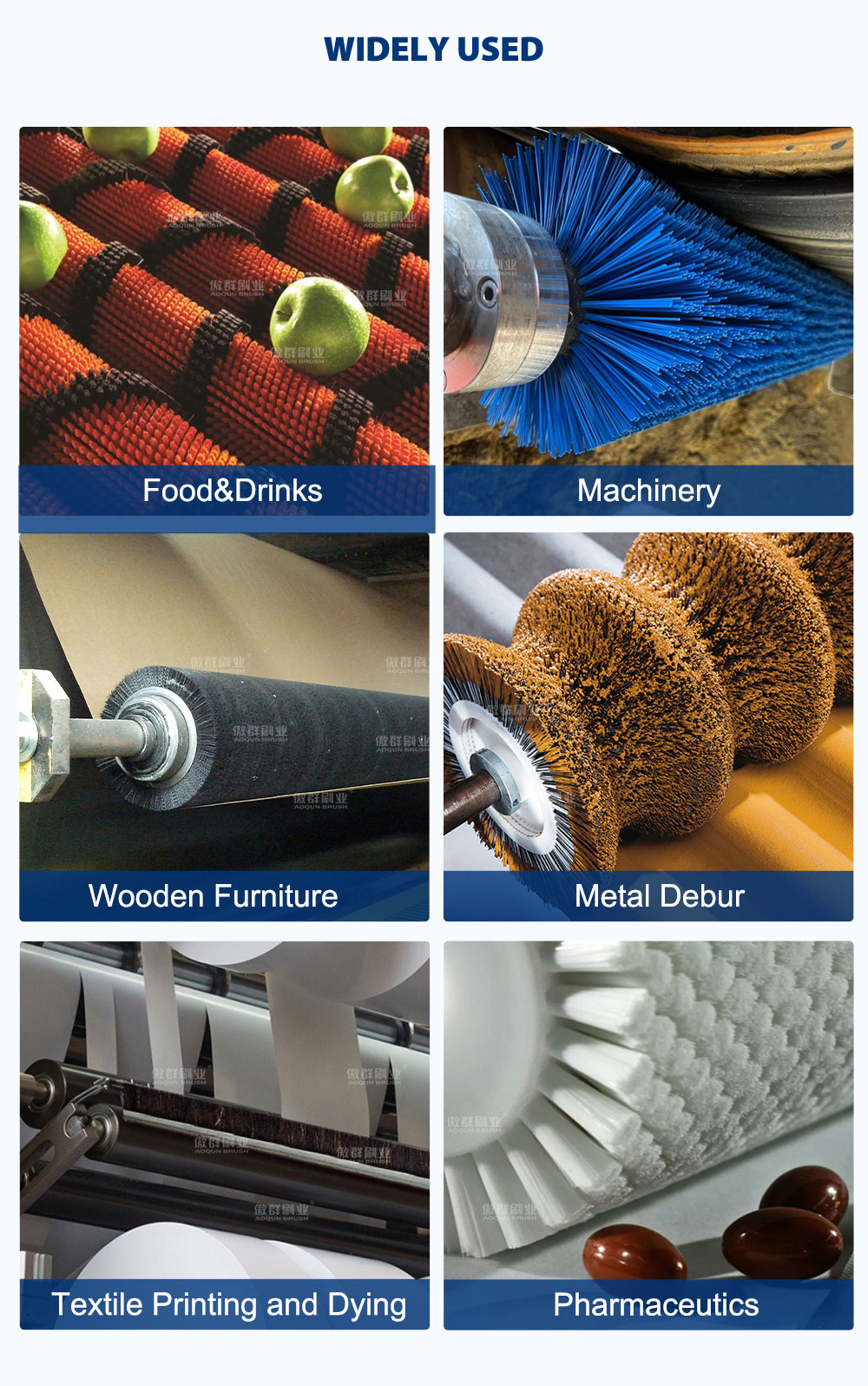
Choosing between a roller brush and a disc or cup brush for a scrubber is rarely a free choice. The machine deck, the drive shaft or arbor, the surface being cleaned and the replacement interval are usually fixed before a buyer is asked to specify anything. The practical task is therefore to confirm which format the equipment was designed around, and to know the constraints under which each format stops being the correct answer.
In short: a roller brush cleans along a full-width line of contact and is carried on a driven shaft; a disc or cup brush cleans in a circular path and mounts on a centre hole or threaded arbor. Roller formats suit wide, continuous surfaces and equipment built around a cylindrical deck. Disc formats suit edge access, spot work and machines built around one or two rotating pads. The format is normally determined by the machine, so the buyer decision is about specification, fit and wear life rather than substitution.
Why the two formats are not interchangeable
Roller brushes and disc brushes differ in contact geometry before they differ in bristle material. A roller presents a full-width line of contact across the cleaning deck and is carried on a shaft running the length of the brush body. A disc presents a circular contact patch and is mounted through a central hole or onto a threaded arbor. Moving a machine from one to the other is an engineering change, not a consumable swap: the deck housing, drive coupling and, in many cases, the splash guards all assume one geometry.
This has a direct procurement consequence. Brush selection is mostly a constraint-satisfaction exercise. The shaft or arbor interface, the maximum rotational speed, the available filament length and the deck envelope rule out most options before cleaning performance is even discussed. A buyer who starts from cleaning performance and works backwards usually ends up re-quoting.
Roller brushes: what the specification actually contains
A roller brush is a cylindrical brush body mounted on a driven shaft, used where the cleaning action has to cover a wide, continuous surface in a single pass. In the product family published by AOQUN BRUSH, the roller format is defined by the following parameters:
- Outer diameter from 20 mm to 300 mm; roller length from 100 mm to 2000 mm.
- Shaft diameter and end fitting made to the equipment, so the brush mounts directly onto the existing OEM shaft without an adapter.
- Filament length from 10 mm to 80 mm, with spiral, straight or tufted winding; density and stiffness are selectable per application.
- A dynamically balanced core for high-speed rotation, so the brush runs true at speed without vibration or bristle chatter.
- Filament options: PA6 and PA66, PP, PET, PBT, abrasive nylon with silicon carbide or aluminium oxide, PVA sponge, natural bristle and stainless steel wire.
- Core options: galvanized steel, stainless steel, aluminium or engineering plastic.
The construction detail that matters most in service is balance. An unbalanced cylinder at scrubber head speed produces vibration that transfers into the deck, the squeegee and eventually the drive. The published construction pairs a balanced core with filament stiffness matched to the surface, which is what allows the same format to be used on glass, coated panels and automotive paint without scratching.
Typical roller applications include commercial floor scrubbers, car wash and vehicle cleaning equipment, vacuum cleaners and floor-care machines, photovoltaic panel cleaning robots, glass and sheet cleaning lines, textile and printing machinery, and food-processing conveyor cleaning.
Disc and cup brushes: what the specification actually contains
A disc or cup brush is a flat or cup-shaped rotary brush mounted on a central arbor, used where the cleaning or surface-preparation action is concentrated on a circular contact patch. In the same published family, the disc format is defined by these parameters:
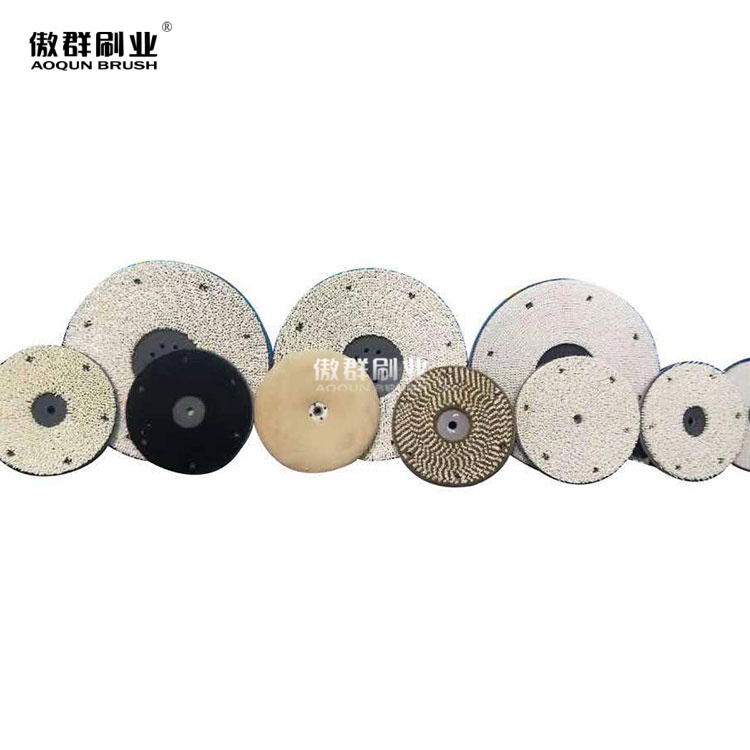
- Outer diameter from 50 mm to 500 mm; bristle height from 10 mm to 60 mm.
- Centre hole or threaded arbor in M14, 5/8-11 or custom thread, which is why the same disc can be used on scrubber spindles and on drill-mounted cleaning tools.
- Flat, cup and bevel shapes, with abrasive grit sizes available for nylon filament.
- A maximum rpm marked on each brush, giving the buyer an explicit speed ceiling rather than an assumed one.
- Filament options: abrasive nylon with silicon carbide or aluminium oxide, PA, PP and PBT, natural bristle, steel and stainless steel wire; backing in plastic or metal plate.
The functional advantage of the disc format is uniformity across the face. Uniform bristle density holds cleaning pressure constant across the full disc, so the floor or workpiece is treated evenly rather than more heavily at the centre. On abrasive grades, that same uniformity is what allows burrs and coatings to be removed without gouging the part underneath. Typical uses include commercial floor scrubbers and sweepers, industrial cleaning and maintenance, metal fabrication and deburring, automotive refinishing and detailing, woodworking, and construction or concrete finishing.
Side-by-side: the decision factors that separate them
| Decision factor | Roller (cylindrical) brush | Disc / cup brush |
|---|---|---|
| Contact geometry | Full-width line contact across the deck | Circular contact patch per brush |
| Mounting | Driven shaft; shaft diameter and end fitting to equipment | Centre hole or threaded arbor (M14, 5/8-11, custom) |
| Size range | OD 20–300 mm; length 100–2000 mm | OD 50–500 mm; bristle height 10–60 mm |
| Filament | 10–80 mm; spiral, straight or tufted winding | 10–60 mm; uniform density across the face |
| Speed control | Dynamically balanced core for high-speed rotation | Maximum rpm marked on each brush |
| Typical duty | Floor scrubbers, car wash, floor-care and vacuum units, solar panel robots, glass and sheet lines | Scrubbers and sweepers, deburring, automotive refinishing, woodworking, concrete finishing |
| Replacement unit | Whole cylinder replaced as one part | Individual disc replaced on a quick-change arbor |
| Main constraint | Requires a matched shaft and housing; not a drop-in substitute | Speed ceiling per brush; edge coverage depends on deck geometry |
The constraint checklist to confirm before ordering
Because brush selection is constraint-led, a specification that omits any of the following items will usually come back as a clarification request rather than a quotation. The list below reflects the parameters documented across the roller, disc and related rotary families.
- Mounting interface. For a roller, the shaft diameter and end fitting. For a disc, the centre hole diameter or the thread (M14, 5/8-11 or custom). This single item eliminates most mismatches.
- Speed. Disc brushes carry a marked maximum rpm; roller brushes rely on a balanced core for high-speed rotation. Operating speed should be stated, not assumed.
- Filament diameter and length. Filament diameter is available from φ0.05 mm to φ2.0 mm; roller filament length runs 10–80 mm and disc bristle height 10–60 mm.
- Overall envelope. Roller OD 20–300 mm with length 100–2000 mm; disc OD 50–500 mm. The deck and splash guard define the usable maximum.
- Functional treatment. Antistatic or conductive, flame-retardant, antibacterial, food-contact and high-temperature grades are available options and must be specified, not inferred.
- End fittings. Beaded ring, pull ring, plastic handle, metal joint, threaded arbor or quick-release coupling, depending on how the brush is retained.
- Chemical and regulatory exposure. Cleaning chemistry, CIP agents, food-contact zoning or flame requirements determine which material evidence the buyer needs to hold on file.
Where each format is used in practice
The application record behind these two formats is broader than floor care, and that record is useful to buyers comparing quotes. In cleaning equipment, robotic vacuums and car wash systems, the documented working conditions are continuous daily duty with wet, foam and detergent exposure, hair, fibre and sand loading, and high rotational speed with vibration. The corresponding requirements are filament stiffness balanced for pickup without damaging the surface, wear resistance for daily duty, low moisture absorption and dimensional fit to the brush-head clip.
In photovoltaics, roller brushes run on panel cleaning robots at low down-force across glass that may carry an anti-reflective coating. The requirements there are a non-scratching filament, UV and abrasion resistance, a balanced core that will not set up robot vibration, low water retention for dry cleaning, and low weight within the panel loading limit.
In automotive, NEV and 3C electronics production, disc and cup formats are used on robotic polishing and deburring stations where the requirements shift to consistent surface finish and Ra control, filament retention under centrifugal load, wear life matched to takt time and dimensional repeatability batch to batch.
One documented floor-care programme
A commercial and household floor-care equipment brand sources roller and disc brushes for scrubbers, sweepers, vacuum heads and carpet-cleaning units as an OEM private-label programme. Reported outcomes include balanced cores resolving vibration complaints on high-speed heads, matched filament stiffness improving pickup without marking the floor, and dimensional fit to the existing brush-head clip without a tooling change. The brush was subsequently carried over to the next machine generation.
Where each format stops working
A comparison that only lists advantages is not useful to a buyer. Both formats have genuine boundaries, and several common cleaning tasks fall outside both of them.
- Neither format cleans internal geometry. Bores, tubes, lumens and pipes require a twisted-in-wire or tube brush, where two or more wires are twisted together with filaments between them and the brush is inserted and moved with rotation or push-pull action. Diameters run from 2 mm to 150 mm with working lengths up to 2000 mm. A disc cannot reach a bore, and a roller cannot follow a pipe.
- Strip brushes are seals, not cleaning brushes. A strip brush is a channel-base brush seal — galvanized or stainless steel base in H, F, Y, T or custom profile, base width 20–100 mm, filament length 10–100 mm, filament diameter φ0.15–1.0 mm — cut to the door or guard length to seal dust, light, insects and airflow along a door or panel edge. It does not rotate and does not clean a floor.
- Speed is a hard ceiling, not a target. A disc brush above its marked maximum rpm is outside its stated operating envelope, and a roller without a balanced core will transmit vibration into the machine at speed.
- Soft does not mean safe, and stiff does not mean effective. Filament stiffness has to be matched to the surface; the wrong grade either fails to remove soil or marks the finish. Abrasive nylon removes burrs and coatings, but it is not a polishing step for surfaces that must stay optically clear.
- Custom geometry has a lead time. Shaft diameter, end fitting and winding are made to the equipment or drawing, so a non-standard roller is a made-to-order part rather than a stocked item.
The supplier side: how AOQUN BRUSH structures this product range
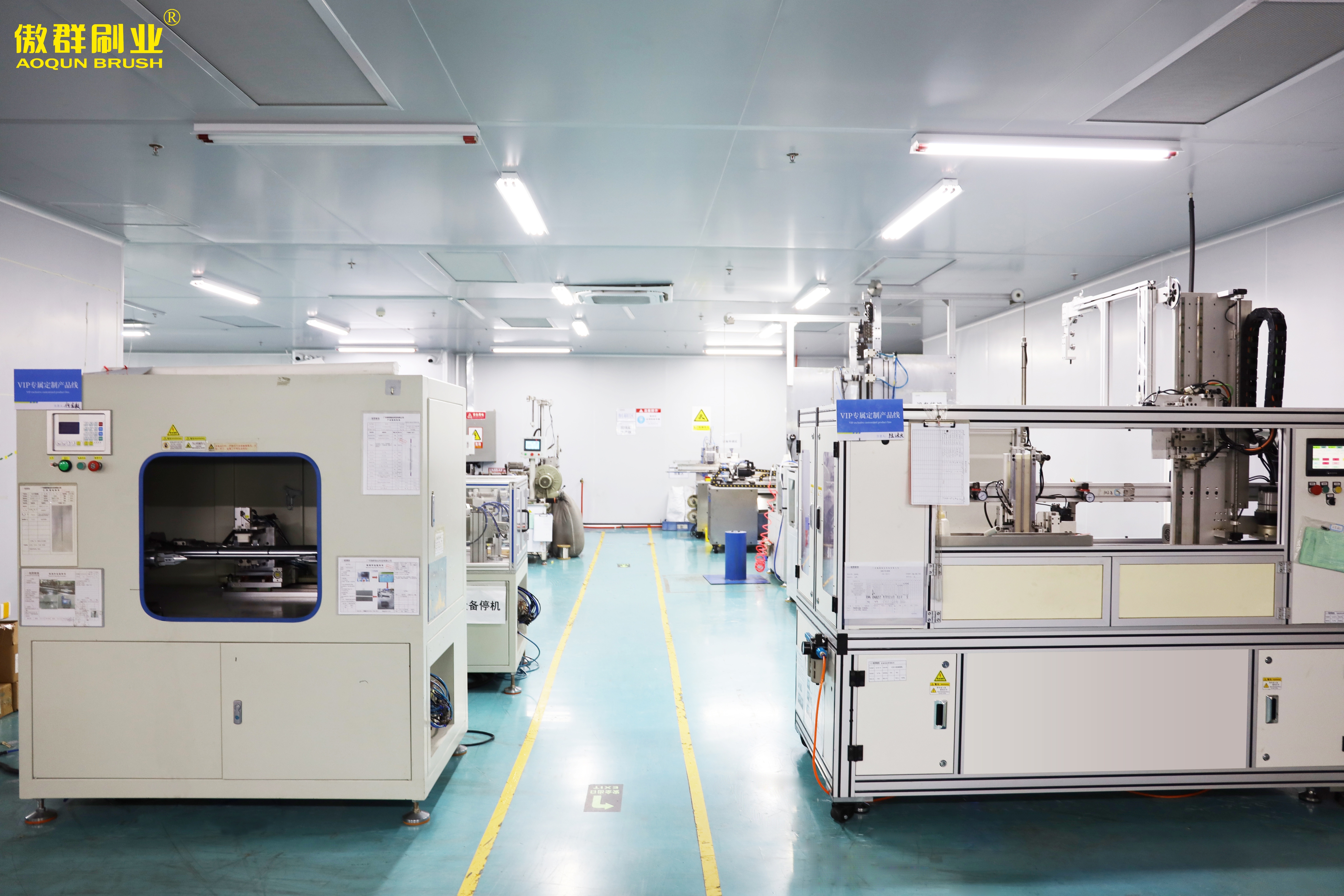
AOQUN BRUSH is the brand of Guangzhou Aoqun New Material Co., Ltd., a brush manufacturer founded in 2009 and based at a 120,000 m² intelligent manufacturing headquarters on Nansha Avenue South, Nansha District, Guangzhou, China. The company reports annual output of 250 million brushes, a 20+ person R&D team, a Class 100,000 cleanroom and 124 intellectual property rights, including 26 invention patents and 4 international patents. It states that it has participated in drafting 2 national standards and led the development of 8 industry or group standards, and that it supplies as a Tier-1 vendor to 20 Fortune Global 500 companies including CRRC, BYD, Hitachi, Schindler, Volkswagen, Otis, Dyson and Karcher, with products sold to more than 50 countries and regions.
For a scrubber or surface-preparation buyer, the relevant part of that structure is the production mode. Roller, disc and cup brushes are offered under OEM private-label manufacturing, ODM co-development from the supplier's own design, and custom manufacturing to a customer drawing, sample or equipment fit. Filament diameter spans φ0.05–2.0 mm with straight, flared, bent and cross-crimped forms; bases and profiles include aluminium H, F, Y and T profiles, galvanized or stainless steel channel, plastic bodies and custom extrusions; and functional treatments include antistatic or conductive, flame-retardant, antibacterial, food-contact and high-temperature grades.
Commercial terms are documented as a quotation within one working day, prototyping or sampling in about three days, and delivery within seven days on selected product lines, with volume lead times confirmed per order. MOQ is described as flexible, with sample or prototype quantities from one piece for fit-and-function validation. Quality control covers incoming, in-process and final inspection with batch traceability: incoming checks on filament diameter, material grade and supplier certificates; in-process checks on density, trim length, profile and filament retention; and final inspection on key dimensions.
The evidence a buyer can actually request
Constraint-driven purchasing increasingly means documentation-driven purchasing, particularly where brushes touch food, rail interiors or electronics. The following test reports and management-system certificates exist in the supplier's published compliance record and can be requested by number.
- UL 94 vertical burning test, classification V-0, report GZMR260100199701 issued 2026-01-30 by SGS-CSTC, covering brushes of PA6, PA66, PA610 and PA612 including flame-retardant grades.
- EU RoHS 10-restricted-substance test, report CANEC26028344401 issued 2026-10-12, covering strip, staple-set and twisted wire brush constructions.
- REACH SVHC screening of 253 Candidate List substances plus 1 potential SVHC, all results at or below 0.1% (w/w), report CANEC26017937101 issued 2026-07-09.
- US FDA 21 CFR 177.1500 food-contact test reports for blue PA66 (CANEC26013862601) and black PA66 (CANEC26017116501) strip brush material.
- ISO 45001:2018 occupational health and safety certification, certificate 93724S0118R0M, valid to 2027-03-05; ISO 50001:2018 energy management certification, certificate 56826EN00036R000, valid to 2029-04-12; GJB 9001C-2017 certification, certificate 02626J30241R0S, valid to 2029-01-25.
Two points of discipline apply here. First, a test report describes a specific sample construction, so the buyer should confirm that the report covers the filament grade and base material actually being quoted. Second, management-system certificates carry expiry dates, and a buyer's file should be checked against the current validity period rather than an earlier version of the certificate.
Market trend: why format decisions are becoming specification decisions
Three shifts are visible in how scrubber and surface-preparation brushes are bought, and all three push the decision toward documented specification rather than catalogue selection.
The first is the migration of cleaning equipment toward automated and robotic operation. Panel cleaning robots, robotic vacuums and automated floor-care heads run at controlled down-force and depend on a brush that does not introduce vibration or marking, because there is no operator to notice the degradation. That raises the importance of core balance, dimensional fit to the brush-head clip and batch-to-batch consistency.
The second is the tightening of material compliance in the markets where these machines are sold. Flame retardancy, restricted substances and food-contact suitability are now commonly written into procurement documents rather than discussed after sampling, which is why test reports for UL 94, RoHS, REACH SVHC and FDA food-contact compliance increasingly travel with the quotation.
The third is the treatment of the brush as a scheduled consumable rather than a spare part. Where replacement intervals are planned against a maintenance cycle, wear life and dimensional repeatability matter more than unit price, and buyers begin to ask for the same construction across successive orders.
Future outlook
The roller-versus-disc question is unlikely to be resolved in favour of one format, because the formats follow machine architecture rather than preference. What is changing is the level of evidence expected at the point of purchase. For roller brushes, the direction is toward balanced cores and matched stiffness that allow higher head speeds without vibration, together with filament options that protect coated glass and painted surfaces. For disc and cup brushes, the direction is toward clearer speed ratings, more precise abrasive grading and quick-change mounting that shortens replacement time.
For buyers, the practical implication is straightforward. A brush specification that records the mounting interface, speed limit, filament grade and length, overall envelope and the applicable compliance evidence will survive a machine redesign far better than one that records only a part number. That record is also what makes a second-source comparison possible without re-testing from zero.
FAQ
How do I choose between a roller brush and a disc brush for a floor scrubber?
Start with the machine, not the cleaning task. If the deck carries a driven shaft running the width of the cleaning path, the machine is built for a roller brush, which contacts the floor along a full-width line. If the deck carries one or two rotating hubs with a centre hole or threaded arbor, it is built for a disc brush, which contacts the floor in a circular patch. The two are not interchangeable without an engineering change to the deck and drive.
Which filament material suits a scrubber brush or a surface-preparation brush?
Filament choice follows the application rather than the format. Nylon (PA) is used for wear resistance and general purpose work; PP for cost and chemical resistance; PBT and PET for temperature and resilience; abrasive nylon with silicon carbide or aluminium oxide for surface finishing and deburring; steel, stainless steel or brass wire for heavy-duty tasks; PEEK or PAEK for high temperature and chemical exposure; conductive filament for ESD control; PVA for scratch-free wafer cleaning; and natural fibre for delicate surfaces. The selection criteria are temperature range, chemical and UV exposure, required abrasiveness, scratch sensitivity of the workpiece, ESD or antistatic needs, food-contact or medical compliance, moisture absorption, wear life and cost.
What information is needed to quote a custom roller or disc brush?
A drawing or physical sample, the application description and the expected annual volume are the three core inputs. From these, the brush structure and filament material are selected, design-for-manufacture feedback is issued, and a quotation follows. Prototype validation of fit, function and cleanliness on the actual equipment is normally the step before volume production. Confirming filament compatibility — temperature, chemicals, ESD and cleanliness requirements — and agreeing acceptance limits before mass production avoids most subsequent disputes.
What certifications and test reports can be requested for brush materials?
Documentation available from AOQUN BRUSH includes UL 94 vertical burning test report GZMR260100199701 (V-0), EU RoHS 10-substance test report CANEC26028344401, REACH SVHC screening report CANEC26017937101 covering 253 substances with results at or below 0.1% (w/w), US FDA 21 CFR 177.1500 food-contact reports for blue and black PA66 filament, and management-system certificates including ISO 45001:2018, ISO 50001:2018 and GJB 9001C-2017. Because each report describes a specific sample construction, the quoted material should be matched against the report scope.
When is neither a roller nor a disc brush the right choice?
When the surface to be cleaned is internal. Bores, tubes, pipes and lumens require a twisted-in-wire or tube brush, in which two or more wires are twisted together with filaments between them and the brush is inserted and moved with rotation or push-pull action; available diameters run from 2 mm to 150 mm with working lengths up to 2000 mm. Likewise, a strip brush is a seal rather than a cleaning tool: it is a channel-base brush with a galvanized or stainless steel H, F, Y or T profile, cut to a door or guard length, used to block dust, light, insects and airflow along an edge.
Reference document: AOQUN Brush Products Catalog (PDF).
Manufacturer reference: Guangzhou Aoqun New Material Co., Ltd. (AOQUN BRUSH), No. 333, Nansha Avenue South, Dongchong Town, Nansha District, Guangzhou, Guangdong, China. Specifications quoted in this article are drawn from the supplier's published product data and test documentation.
Have Questions or Need More Details?
Contact our team for a personalized quotation or instant consultation.
Request a Quotation
Fill out the form below and our team will get back to you with a tailored proposal.
WhatsApp Direct Chat
Prefer to chat in real-time? Message us on WhatsApp for instant assistance & quick answers.
- Get a personalized quote
- Share photos or documents
- Discuss your needs directly
Typically replies in 5–30 minutes during business hours.