
Roller vs Disc vs General-Purpose Brushes for Cleaning OEMs
Roller vs Disc vs General-Purpose Brushes for Cleaning OEMs
The practical difference shows up downstream. A roller brush that is not dynamically balanced produces vibration at the head. A disc brush with the wrong bristle density cleans unevenly across its face. A general-purpose brush specified into a cleanroom process will not survive particle-shedding review, regardless of how well it cleans in the workshop. For an OEM, these are not aesthetics. They are field returns, qualification delays and total cost of ownership moving in the wrong direction.
This comparison is written from the buyer's side of the table. It sets out what each of the three brush families is actually specified against, where the engineering boundaries sit, and which certification and test evidence is normally requested at each stage of a research-to-evaluation cycle.
Why Brush Type Is a Constraint Problem, Not a Catalogue Choice
The most useful way to compare these three families is to stop comparing them as products and start comparing them as constraints. Each family is defined by a mounting interface, a contact geometry and a validation path, and those three things determine almost everything else: which machines it can enter, which surface it can touch, and which documents a buyer will be asked for.
A roller brush is defined by a rotating core. A disc or cup brush is defined by a rotary face mounted on a centre hole or threaded arbor. A general-purpose brush is defined by a hand, handle or machine-mount form and a stiffness grade. Every parameter that follows — diameter, bristle height, filament material, balance requirement, cleanliness class — is a consequence of that first definition.
That has a direct procurement implication. When a cleaning OEM compares quotations across these three families, the quotations are not quoting the same scope of work. One may be quoting a balanced roller cut to an existing shaft. Another may be quoting a disc made to a tool drawing with agreed particle limits. A third may be quoting a private-label retail item with printed packaging. Comparing them on unit price alone without matching the scope produces a comparison that is internally consistent and commercially useless.
The Three Brush Families and What Defines Them
Roller brush: cylindrical geometry, balance-critical
A roller brush is a cylindrical brush in which filament radiates outward from a rotating core. In the AOQUN range, roller brushes are specified with an outer diameter of 20–300 mm, a roller length of 100–2000 mm and filament length of 10–80 mm. Shaft diameter and end fitting are confirmed against the customer's equipment, and winding can be spiral, straight or tufted, with density and stiffness selectable. The core can be dynamically balanced for high-speed rotation.
Filament options include PA6/PA66, PP, PET and PBT, abrasive nylon with silicon carbide or aluminium oxide, PVA sponge, natural bristle and stainless steel wire. Cores are available in galvanized steel, stainless steel, aluminium or engineering plastic. Typical equipment includes photovoltaic panel cleaning robots, car wash and vehicle cleaning systems, vacuum cleaners and floor-care machines, commercial floor scrubbers, textile and printing machinery, glass and sheet cleaning lines, and food processing and conveyor cleaning.
The defining constraint is rotational behaviour. A balanced core runs true at high rpm without vibration or bristle chatter, and stiffness is matched to the surface so glass, coated panels and automotive paint are cleaned without scratching. Wear-resistant filament extends replacement intervals, and the brush fits OEM shafts directly without an adapter. In one documented floor-care OEM programme, balanced cores eliminated vibration complaints on high-speed heads, and matched filament stiffness improved pickup without marking the floor.
Disc and cup brush: flat rotary face, speed-limited
A disc brush or cup brush is a rotary brush with a flat, cup or bevel face mounted through a centre hole or a threaded arbor. The AOQUN range covers outer diameters of 50–500 mm, centre hole or threaded arbor options including M14, 5/8-11 and custom threads, and bristle height of 10–60 mm. Maximum rpm is marked on each brush.
Filament options include abrasive nylon with silicon carbide or aluminium oxide, PA, PP and PBT, natural bristle, and steel or stainless steel wire, mounted on a plastic or metal backing plate. Applications include commercial floor scrubbers and sweepers, industrial cleaning and maintenance, metal fabrication and deburring, automotive refinishing and detailing, woodworking, and construction and concrete finishing.
The defining constraint is face uniformity. Uniform bristle density keeps cleaning pressure constant across the full disc face, so the floor or workpiece is cleaned evenly. Abrasive grades remove burrs and coatings without gouging, and quick-change arbors fit common scrubber and drill spindles. Because maximum rpm is a marking on the part rather than an assumed ceiling, the working limit of a disc brush is a combined function of diameter and speed, not diameter alone.
General-purpose cleaning brush: stiffness-graded, application-matched
A general-purpose cleaning brush is a hand, long-handle or machine-mounted brush specified by stiffness grade rather than by a machine interface. AOQUN general-purpose cleaning brushes run from 100–600 mm body length with 10–50 mm filament length and soft, medium and stiff grades, with custom colour, logo and retail packaging.
Filament options include PA6/PA66, PP, PET and PBT, natural bristle, sponge and microfiber combinations, with PP or ABS handles and an antimicrobial additive option. Typical uses span household and personal care, smart home appliances, commercial cleaning services, hotel and restaurant hygiene, pet care, automotive detailing and retail private label.
The defining constraint is surface compatibility at volume. Application-matched stiffness cleans delicate surfaces without scratching, antimicrobial and food-contact filament options are available, and OEM private label covers colour, logo and packaging. Volume quality is supported by an annual capacity of 250 million brushes.
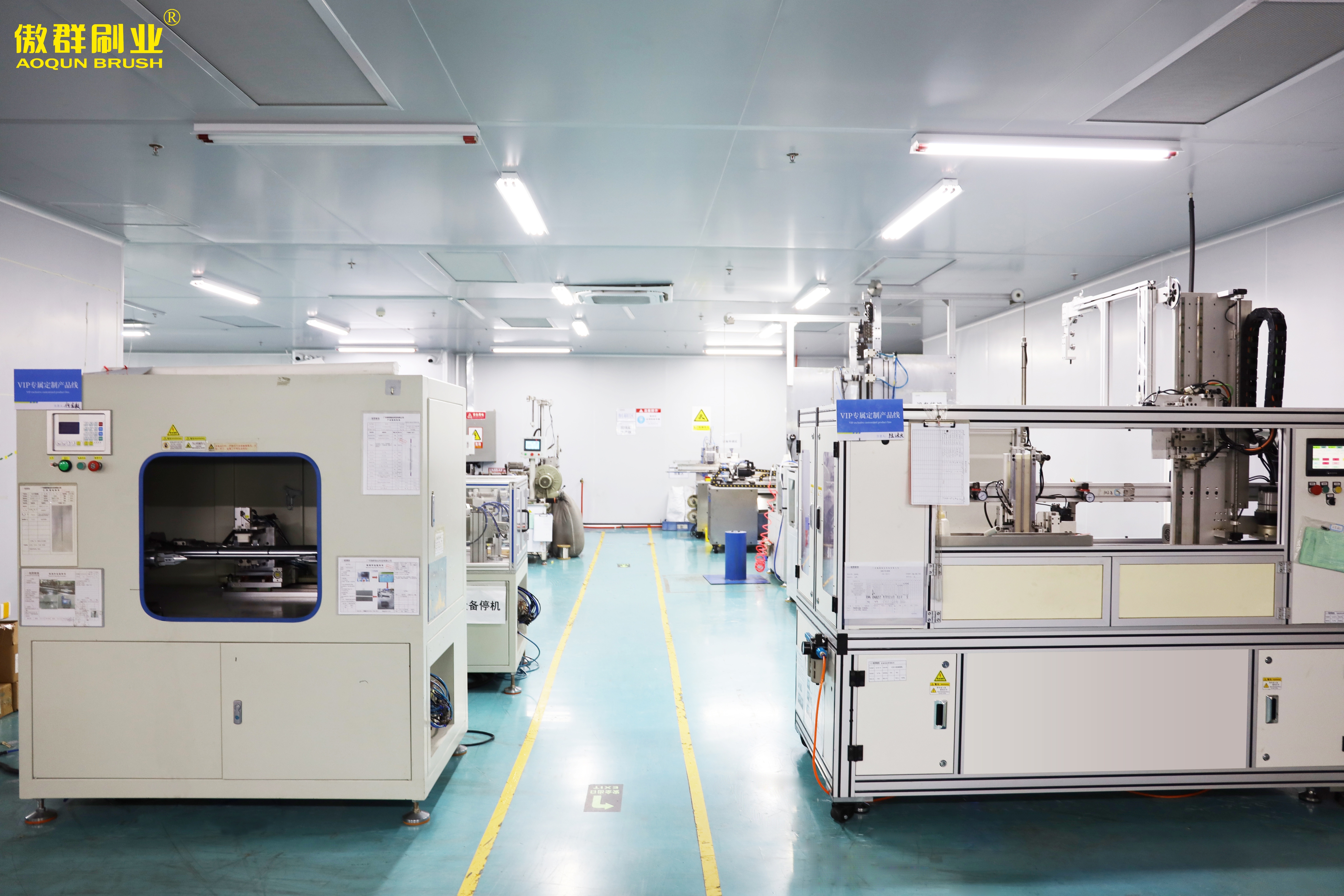
Custom brush manufacturing environment: the three brush families share materials and quality systems but not mounting interfaces or validation paths.
Six Constraints That Decide the Comparison
1. Motion and mounting interface
This is the constraint that eliminates options fastest. A machine that rotates a shaft needs a roller with a matched core diameter and end fitting. A machine that spins a face-mounted pad needs a disc with a matching centre hole or arbor thread. A machine that agitates a brush bar against a surface at retail scale needs a general-purpose form with a clip or body fit. No amount of material improvement moves a brush across that boundary, because the boundary is mechanical.
2. Contact geometry and pressure distribution
A roller applies a line of contact that sweeps across a surface. A disc applies a rotating face contact whose pressure must stay even across the full diameter. A general-purpose brush applies a hand-controlled or machine-controlled contact whose pressure depends on the operator or the housing. Each geometry produces a different failure mode when it is misapplied: banding and vibration on a roller, uneven cleaning or swirl marking on a disc, and inconsistent results on a general-purpose brush.
3. Cleanliness class and particle shedding
Cleanliness is where the gap between families becomes categorical rather than gradual. Semiconductor wafer brushes are produced under Class 100,000 cleanroom conditions with particle-shedding limits agreed at the sample stage, and low-particle and ESD-safe grades are available. General-purpose brushes are not specified on that basis. A buyer moving from general cleaning into wafer-adjacent cleaning is not upgrading a brush; they are changing the specification regime.
4. Dimensional tolerance to the tool
Semiconductor wafer brushes are made to the tool drawing: disc diameter, centre hole, bristle height and density are set per chamber, and PVA roller dimensions are set per cleaner model. Roller brushes follow the same logic but at a different scale, with core diameter, length and end fitting confirmed per machine. General-purpose brushes are defined by body and filament ranges rather than by a machine interface. Buyers should expect the tightest tolerance conversation to happen where the brush is a specified part of a tool, not where it is a consumable accessory.
5. Certification and test scope
Certification questions in this category are usually asked at the wrong level. A management system certificate tells a buyer which processes are controlled; a material test report tells them what a specific sample was tested against. AOQUN holds management system certifications covering automotive (IATF 16949), medical device (ISO 13485), quality (ISO 9001), environmental (ISO 14001), occupational health and safety (ISO 45001), energy management (ISO 50001) and the Chinese defence supply chain (GJB 9001C). The ISO 50001:2018 certificate (No. 56826EN00036R000, issued 2026-04-13, valid to 2029-04-12) and the GJB 9001C-2017 certificate (No. 02626J30241R0S, effective 2026-01-26, valid to 2029-01-25) illustrate the level of traceability available on request.
Material-level evidence is separate and should be requested by material and construction, not by brand. The documented test set includes an EU RoHS ten-restricted-substance report (CANEC26028344401, 2026-10-12, all pass), a REACH SVHC screening covering 253 Candidate List substances and one potential SVHC with all results at or below 0.1% w/w (CANEC26017937101, 2026-07-09, pass), a UL 94 vertical burning test at 50W (20mm) classified V-0 (GZMR260100199701, 2026-01-30, pass), an ISO 1716 gross heat of combustion test supporting EN 45545-2 rail requirements (YJ2024040005, 2024-04-09), and a US FDA 21 CFR 177.1500 food-contact test on black PA66 filament (CANEC26017116501, 2026-07-01, pass). These reports cover strip, staple-set and twisted wire brushes built from PA6, PA66, PA610, PA612, flame-retardant PA, PP, PET, plated steel and stainless steel wire — which is precisely why the correct request is 'which report covers my construction', not 'do you have certificates'.
For medical-adjacent cleaning brushes, the FDA medical device establishment registration (No. 3017178443, Fiscal Year 2026) and ISO 13485-scoped production are the relevant references, supported by a Class 100,000 cleanroom and batch traceability.
6. Commercial constraints: MOQ, sampling and lead time
The three families also differ commercially, and this is where buyers most often misread a comparison. The published process parameters are: quotation within one working day, prototyping and sampling in about three days, delivery within seven days on selected product lines, and flexible MOQ with sample or prototype quantities available from one piece for fit-and-function validation. Standard volume lead times are confirmed per order.
What matters for comparison is that sampling effort is a function of specification depth, not of brush size. A general-purpose private-label brush can be sampled against a stiffness grade and a packaging artwork. A wafer disc brush is sampled against a tool drawing, a bristle density and a particle-shedding limit agreed at the sample stage — sometimes with ESD-safe grades and PEEK components where chemical resistance is required. The two samples look similar on an invoice and represent very different engineering commitments.
Semiconductor Wafer Brushes: The Stress Test for Any Comparison
Semiconductor wafer cleaning is the most demanding application in this category and therefore the clearest way to test whether a brush comparison is real. Wafer brushes work inside a Class 100,000 or better cleanroom, in wet chemical and CMP slurry environments, on tools running continuously, inside an ESD-controlled area, under low-particle and low-metallic-contamination requirements.
The function is post-CMP cleaning, wafer surface particle removal, edge and bevel cleaning, PCB and PCBA scrubbing, flux residue removal, micro-hole deburring and non-scratching contact cleaning. The matched equipment list includes single-wafer cleaners, batch immersion cleaners, post-CMP scrubbers, PVA roller cleaners, PCB scrubbing and deburring machines, and wafer transfer and handling modules. Operating mode is rotary disc or roller contact under controlled down-force, wet in-line with DI water or chemistry, with the brush conditioned and replaced on a preventive-maintenance cycle.
The specification requirements explain why general-purpose brushes cannot substitute here: non-scratching filament tips, low particle shedding and low extractables, ESD-safe or conductive options, chemical resistance to CMP slurry and cleaning chemistry, dimensional tolerance to the tool drawing, batch traceability and cleanroom packaging. In one documented semiconductor and PCB equipment maker programme, tool-matched brush sets passed the customer's particle and scratch qualification on the first sample round, and the brush change interval extended versus the incumbent, reducing downtime per tool.
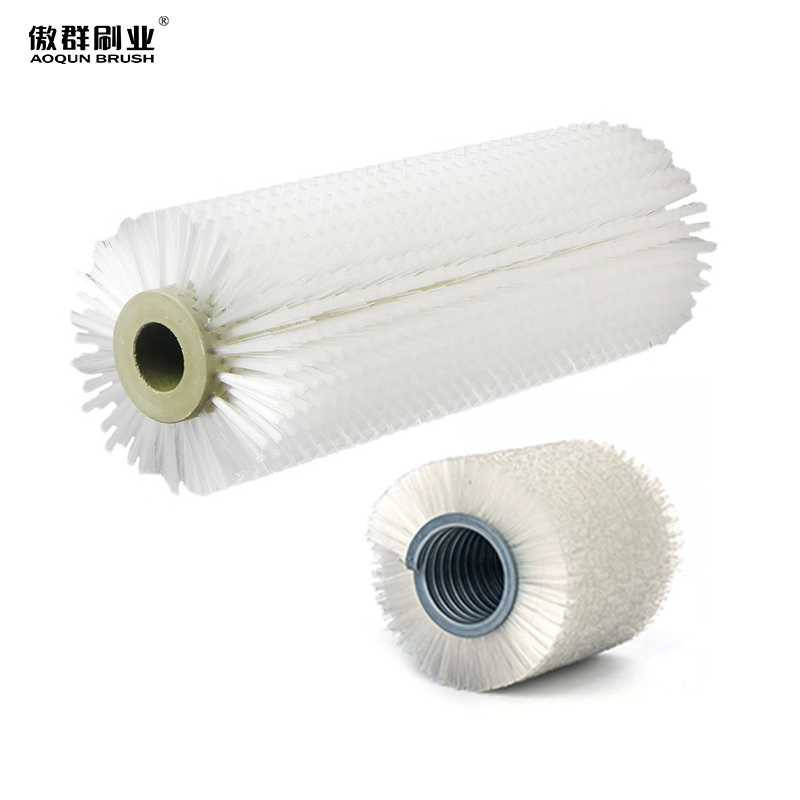
Wafer-level brushes are specified against a tool drawing and a sample-stage particle limit, not against a catalogue size.
The same logic scales down. Photovoltaic panel cleaning robots need non-scratching filament that will not damage the AR coating or glass, UV and abrasion resistance for years outdoors, a balanced core to avoid robot vibration, low water retention for dry cleaning and light weight to protect panel loading limits — a roller requirement, but with a different failure cost from a floor scrubber. Cleaning equipment, robotic vacuums and car wash systems need filament stiffness balanced for pickup without surface damage, wear resistance for daily duty, low moisture absorption and dimensional fit to the brush head clip. Medical and CSSD environments need low-shedding, lint-free filament, a smooth atraumatic tip, autoclave and chemical resistance and ISO 13485 traceability.
Side-by-Side Comparison
| Comparison point | Roller brush | Disc / cup brush | General-purpose brush |
|---|---|---|---|
| Motion | Cylindrical rotation on a core | Rotary face on centre hole or threaded arbor | Hand, long-handle or machine-mounted contact |
| Size range | OD 20–300 mm; length 100–2000 mm | OD 50–500 mm; centre hole or M14 / 5/8-11 / custom thread | Body 100–600 mm |
| Filament length | 10–80 mm | Bristle height 10–60 mm | 10–50 mm |
| Defining constraint | Dynamic balance at speed; no vibration or bristle chatter | Uniform face pressure; maximum rpm marked per brush | Stiffness grade matched to the surface |
| Typical equipment | PV cleaning robots, car wash, floor-care machines, scrubbers, glass lines | Scrubbers and sweepers, deburring stations, refinishing, woodworking | Household and appliance, commercial cleaning, hotel and restaurant, retail private label |
| Cleanroom applicability | Available as PVA roller and ESD-safe grades for wafer cleaners | Available as tool-drawing wafer disc with agreed particle limits | Not specified for cleanroom wafer contact |
| Documentation path | Material reports by construction; management system scope | Material reports by construction; rpm marking | Food-contact and antimicrobial options; private-label compliance |
| Customisation basis | Equipment shaft and drawing | Machine arbor and drawing | SKU body, filament and packaging |
Where Each Option Stops Working
A credible comparison has to state its boundaries, and these three families have clear ones.
- Roller length is finite. Roller brushes are specified up to 2000 mm in length. Wider process lines require segmentation or multi-station arrangements, which adds alignment and balancing work that a single long brush would not need.
- Disc brushes are speed-and-diameter limited. Maximum rpm is marked on each brush, so the working envelope is a combined function of diameter and rotational speed. A disc sized for a low-speed scrubber is not interchangeable with one sized for a high-speed spindle at the same diameter.
- General-purpose brushes do not port into cleanroom processes. They are excellent at stiffness-matched cleaning at volume, with antimicrobial and food-contact options and private-label packaging, but they are not specified with sample-stage particle limits or ESD-safe grades. Using one in a wafer-adjacent step is a specification error, not a cost saving.
- Wafer brushes cannot be stocked as standard items. A semiconductor wafer brush is made to tool drawing with disc diameter, centre hole, bristle height and density set per chamber. Buyers should plan qualification lead time around sampling and validation rather than around catalogue availability.
Reading the Certification Stack Correctly
For research-to-evaluation buyers, the useful discipline is to separate three document layers and ask for each one explicitly.
Layer one — management system scope. This tells you which processes are governed. AOQUN's certified scope spans automotive, medical device, quality, environmental, occupational health and safety, energy management and the Chinese defence supply chain, with 12 management system certifications in total. Certificate validity dates should be checked per document at the time of order; the ISO 50001:2018 and GJB 9001C-2017 certificates referenced above run to 2029.
Layer two — material and construction test reports. These are sample-specific. The RoHS, REACH SVHC, UL 94 V-0, ISO 1716 and FDA 21 CFR 177.1500 reports in the AOQUN library were run on strip, staple-set and twisted wire brushes built from defined polymer and metal constructions. A buyer specifying a different filament or a PVA roller should request the matching report rather than accept a general statement.
Layer three — application qualification. This is the buyer's own test, and no supplier document replaces it. Fit, function, cleanliness and wear life are validated on the customer's equipment before volume release. This is also the layer where intellectual property becomes commercially relevant: AOQUN holds 124 intellectual property rights including 26 invention patents and 4 international patents, and has participated in drafting 2 national standards and led the development of 8 industry or group standards. A US patent application covering an antimicrobial nylon composite material, its preparation method and its application in brushes (Application No. 18/588,031) received a Notice of Allowance dated 2026-09-18 — relevant where antimicrobial claims are part of a retail specification.
Market Trend: Brushes Are Being Specified, Not Purchased
The clearest directional change in this category is procedural rather than technological. Brush procurement is moving from a consumable purchase toward a specified-part purchase, particularly where the brush touches a coated surface, a cleanroom process or a safety-relevant seal.
Three observable patterns support this. First, buyers increasingly ask for the mounting interface and the drawing before discussing price, because a brush that does not fit the shaft has no value at any price. Second, certification questions are becoming construction-specific, driven by RoHS, REACH SVHC and flammability requirements that apply to defined material sets rather than to a company in general. Third, application qualification is being scheduled into the programme timeline instead of being discovered at first production run — a shift visible in the way sample-stage particle limits and ESD-safe grades are now discussed during evaluation rather than after a failure.
The manufacturing base behind this shift is substantial. AOQUN operates a 120,000 m² intelligent manufacturing headquarters with 100+ employees, a 20+ person R&D team and annual output of 250 million brushes, supported by automated brush-making equipment. The company is a Tier-1 supplier to 20 Fortune Global 500 companies including CRRC, BYD, Hitachi, Schindler, Volkswagen, Otis, Dyson and Karcher, with products sold to more than 50 countries and regions. That combination of volume and Tier-1 supply experience is what allows a supplier to hold a general-purpose private-label programme and a tool-drawing wafer programme inside the same quality system.
Future Outlook
Over the next procurement cycles, three developments are likely to shape how cleaning OEMs compare brush families.
Expect the tool drawing to become the default starting document rather than the exception. As more cleaning equipment moves toward robotic and automated operation, the brush stops being an accessory and becomes a motion component, which pulls balance, tolerance and rpm marking into the specification from day one.
Expect material-level documentation to keep expanding. The direction of travel in RoHS, REACH SVHC and rail flammability requirements is toward more substances screened and more construction-specific evidence, which favours suppliers who can produce reports by material set rather than by product category.
Expect the boundary between cleaning and surface treatment to blur. Deburring brushes, abrasive nylon discs and polishing brushes already share process lines with cleaning brushes in automotive, 3C electronics and precision manufacturing, and buyers are increasingly evaluating a single supplier across both. Suppliers with in-house material R&D, proprietary manufacturing equipment and standard-participation experience — AOQUN's participation in 2 national standards and leadership of 8 industry or group standards is one indicator — will be better positioned to keep a specification stable across those adjacent processes.
Frequently Asked Questions
What is the difference between a roller brush, a disc or cup brush, and a general-purpose cleaning brush?
A roller brush is a cylindrical brush whose filament radiates from a rotating core, typically specified by outer diameter, roller length and shaft fitting. A disc or cup brush is a rotary brush with a flat, cup or bevel face mounted through a centre hole or threaded arbor, with maximum rpm marked on each brush. A general-purpose cleaning brush is a hand, long-handle or machine-mounted brush specified by body length and stiffness grade rather than by a machine interface. The three differ in mounting, contact geometry and validation path, not only in appearance.
How should a cleaning OEM choose between a roller brush and a disc brush?
The deciding factor is the machine's motion and mounting interface. Equipment that rotates a shaft requires a roller brush with a matched core diameter, length and end fitting, and benefits from a dynamically balanced core where rotational speed is high. Equipment that spins a face-mounted brush requires a disc with a matching centre hole or arbor thread, uniform bristle density across the face, and a maximum rpm compatible with the spindle. Surface sensitivity is the secondary filter: rollers suit continuous line contact on panels, glass and vehicle bodies, while discs suit flat-area scrubbing and deburring.
What documentation is normally required for a semiconductor wafer brush?
Wafer brushes are typically specified against a tool drawing plus a sample-stage agreement on particle-shedding limits. Supporting documentation usually includes management system scope covering the production process, cleanroom manufacturing evidence, batch traceability and material-level test reports for the specific construction. ESD-safe grades and PEEK components are available where static control or chemical resistance is required. Buyers should confirm that reports apply to their exact filament and construction rather than to a different product family.
How is a custom brush validated before a volume order?
Validation normally runs from drawing or sample review, through material and structure selection, to a prototype that is tested for fit, function and cleanliness on the customer's own equipment. In a documented semiconductor and PCB equipment programme, tool-matched brush sets passed the customer's particle and scratch qualification on the first sample round, and the change interval extended versus the incumbent. The prototype stage is also where acceptance limits such as particle shedding, stiffness and dimensional tolerance are formally agreed.
What are the typical MOQ, sampling and lead-time parameters for custom brushes?
MOQ depends on brush type, dimensions, material and validation requirements, and small trial orders are accepted. The published process parameters are quotation within one working day, prototyping and sampling in about three days, and delivery within seven days on selected product lines, with standard volume lead times confirmed per order. Sample or prototype quantities can be supplied from one piece for fit-and-function validation. A quotation request is normally answered fastest when it includes a drawing or sample, the application, dimensions, material preference and expected annual volume.
Have Questions or Need More Details?
Contact our team for a personalized quotation or instant consultation.
Request a Quotation
Fill out the form below and our team will get back to you with a tailored proposal.
WhatsApp Direct Chat
Prefer to chat in real-time? Message us on WhatsApp for instant assistance & quick answers.
- Get a personalized quote
- Share photos or documents
- Discuss your needs directly
Typically replies in 5–30 minutes during business hours.