
Rolls or Finished Bags? Tubular PP Fabric vs Paper-Plastic
Rolls or Finished Bags? Tubular PP Fabric vs Paper-Plastic
Buyers packing powders and granules usually frame this as a bag-versus-bag question, but it is really a question about where the converting step happens.Tubular PP woven fabric rolls hand cutting, printing, liner insertion and closing to the buyer's own plant. Finished paper-plastic composite bags — the format represented in this comparison by model 20211011 — keep those steps with the converter and arrive ready to fill. Both routes rest on a polypropylene base and serve overlapping industries, yet they are specified, ordered and costed in different languages. The comparison below works through those differences on documented characteristics, and states plainly which conclusions the specifications do and do not support.
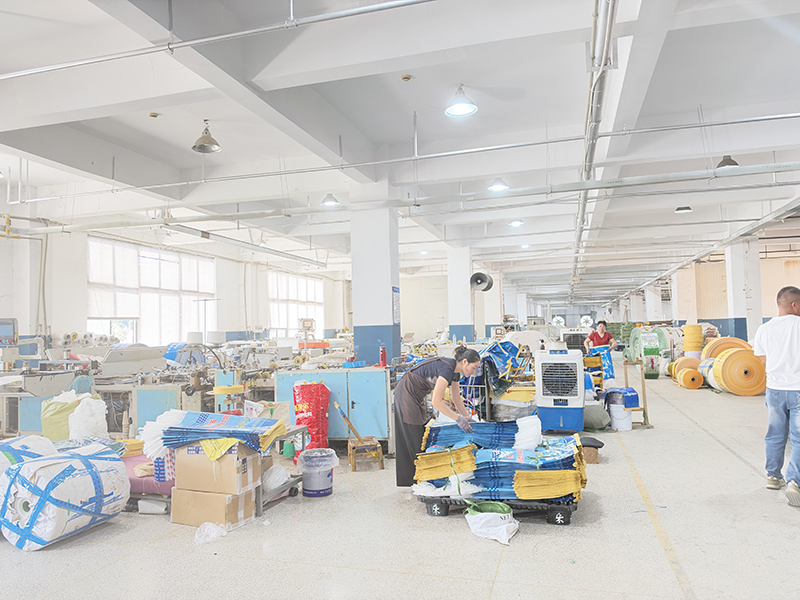
Bag finishing stage: edge trimming of color-printed woven bags — the step that turns woven fabric into a finished pack.
What each format actually is
Tubular PP woven fabric is a semi-finished material. Polypropylene is extruded into flat tapes and interlaced on circular weaving machines, so the fabric leaves the loom as a continuous tube rather than a flat sheet. It is bought by weight and weave density, then cut and closed into bags by the buyer or by a downstream converter. The quoted range for this format is 55–180 gsm fabric weight, 7×7–14×14 mesh and 30–120 cm tube circumference, supplied from a minimum of one roll with pallet packing.
Model 20211011 sits at the opposite end of the chain: a finished paper-plastic composite woven bag. A kraft paper outer layer of 70–120 gsm covers an inner PP woven layer of 60–110 gsm, and the bag is built in open-mouth or block-bottom valve styles with dust-proof construction and an optional PE liner. It arrives printed or unprinted, closed at the bottom, and ready for a filling line.
The distinction matters commercially. A fabric quotation covers material and weaving only. A bag quotation covers material, weaving, paper bonding or lamination, printing, valve or mouth making, inspection and packing. Comparing the two on unit price alone compares different scopes.
Specification comparison at a glance
The table sets the documented characteristics of each format side by side. It is a scope comparison, not a performance test.
| Comparison dimension | Tubular PP woven fabric rolls | Paper-plastic composite bags (model 20211011) |
|---|---|---|
| Supply form | Woven tube on rolls; semi-finished material | Finished bag, closed at the bottom, ready to fill |
| Material build | Polypropylene woven fabric, 55–180 gsm | Kraft paper outer 70–120 gsm over inner PP woven 60–110 gsm |
| Key dimensional spec | 7×7–14×14 mesh; 30–120 cm tube circumference | Open-mouth or block-bottom valve style; dimensions set per order |
| Dust and moisture features | Barrier depends on a liner or coating added during conversion | Dust-proof construction; optional PE liner |
| Printing | Handled by the buyer or a converting partner | Handled by the converter before delivery |
| Minimum order | One roll | 3,000 pcs for printed valve bags (manufacturer standard) |
| Packing | Pallet packing | Packed per order specification |
| Buyer capability required | Cutting, printing, lining, sewing or heat sealing | Valve or open-mouth filling line; no converting required |
| Inventory shape | One material serving several bag sizes | One stock item per size and print design |
Ranges are the quoted specification envelope for each format. Exact values, tolerances and test methods must be confirmed on the order specification; the table compares documented characteristics, not measured outcomes.
Reading the specifications correctly
Fabric weight in grams per square metre describes how much polypropylene sits in a square metre of woven cloth. Mesh describes the tape count per inch in each weave direction, so 7×7 is a relatively open weave and 14×14 a denser one. Tube circumference defines the open size of the tube. Because the fabric is supplied flat on a roll, buyers should confirm whether the supplier quotes circumference or lay-flat width, since the circumference equals twice the lay-flat width.
These three numbers tell a buyer what material is being quoted. On their own they do not establish tensile strength, seam strength, drop performance or a load rating for a finished bag. Those properties depend on tape width, weaving tension, the closing method and the fill weight, and are normally confirmed through the supplier's test data and a trial fill. The same caution applies to the composite: 70–120 gsm kraft and 60–110 gsm inner PP describe the layer build, not the burst strength of the finished bag.
Within that build, the two layers do different jobs. The kraft layer forms the outer surface and carries the print area. The inner PP woven layer provides the woven body that holds the load. The optional PE liner adds a moisture barrier where the product is hygroscopic. Without a liner or coating, the construction is not intended for long soaking in water.
Where the converting step sits
The decisive operational difference is equipment. Buying fabric on rolls assumes the buyer can cut to length, print, insert a liner where required, and close the bag by sewing or heat sealing. That capability — machines, trained operators, print plates or cylinders and a quality routine — is not included in a fabric price. A buyer without a converting line is not really comparing two bag prices; they are comparing a material price with a finished-pack price.
Buying finished composite bags assumes a filling line instead. Valve-style bags are filled through a valve on automatic or semi-automatic equipment, while open-mouth bags are filled and then sewn. The supporting equipment set is common to both routes: filling machines, sewing or valve-filling equipment, conveyors, pallets and warehouse handling. Which configuration applies depends on particle size, bulk density, flowability, dust control, sunlight and moisture exposure, and the destination market's requirements, and should be confirmed rather than assumed.
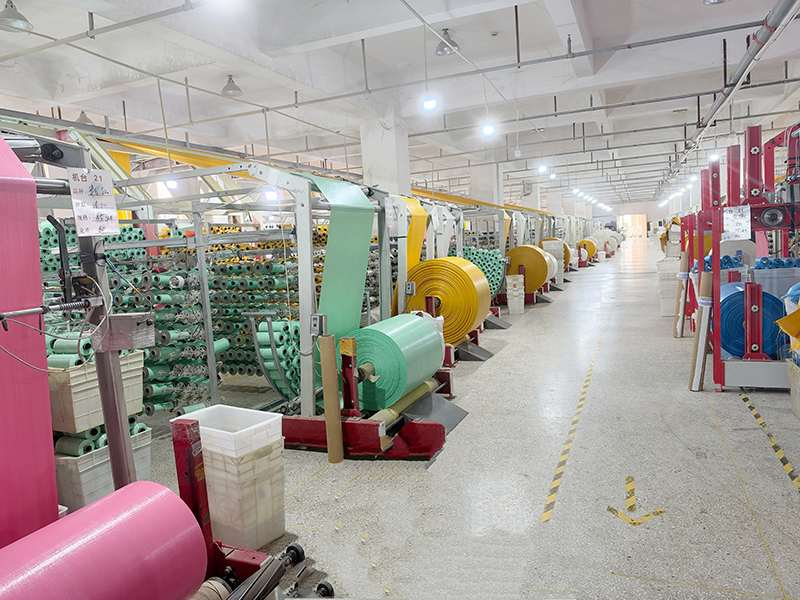
Circular weaving produces the tubular fabric supplied on rolls; the same fabric, once cut and closed, becomes a finished bag.
Manufacturing depth at the converter affects this step. WenZhou BaiChuan Plastic Industry Co., Ltd., a manufacturer of PP woven bags, color-printed valve bags and paper-plastic composite bags based in Pingyang, Wenzhou, runs yarn drawing, circular weaving, laminating, color printing and bag making in one plant and operates imported hot-valve sealing equipment, which is the process behind valve-style bags. For a buyer comparing routes, that means the finished-bag option can include valve construction that would otherwise have to be engineered in-house.
Cost structure and resin exposure
Both formats are polypropylene plays, and resin is the loudest cost signal in the current market. Trading Economics recorded polypropylene at 9,461 CNY per tonne on 10 November 2026, a 47.32% year-on-year increase. That figure is a Chinese benchmark resin price, not a bag price, but it sets the direction for the fabric portion of both options.
What differs is where the remaining cost sits. With fabric rolls, the buyer pays for resin and weaving, then carries conversion cost directly: labour, thread or heat-sealing consumables, print set-up, energy, and the scrap generated while a new bag size is tuned. Those costs are visible and controllable, and they scale with the buyer's own efficiency. With finished composite bags, the same conversion work is bundled into a per-piece price alongside the kraft paper layer, and the buyer manages one line item instead of a process.
Inventory shape is the second cost lever. A roll of tubular fabric can become more than one bag size, so a multi-SKU programme can hold fewer material SKUs. Finished bags are SKU-specific: every size, print design and valve variant is its own stock item, with its own minimum quantity and obsolescence risk. Buyers should weigh that saving against the working capital tied up in converting equipment and the floor space a converting line occupies.
No price list is implied here. Fabric and bag prices both move with resin, order quantity, print coverage and freight, and the only sound comparison is two quotations written against identical bag dimensions, fill weight and print specification.
Order quantity, lead time and sampling
The minimum order profiles are far apart. Tubular fabric is quoted from one roll, which suits trials, small converting runs and buyers testing a new specification. At the manufacturer referenced here, the standard minimum for printed valve bags is 3,000 pieces; smaller printed quantities can be arranged through traders, but at a higher unit price because orders are combined. A buyer moving from fabric to finished bags should expect the order size to jump accordingly.
Lead time follows the same pattern. Normal production lead time for the manufacturer's woven bag orders is 10–15 days, with rush orders possible in 7 days. Printed composite bags also involve artwork approval and a pre-production sample before mass production, so the calendar includes design confirmation as well as manufacturing.
Sampling is the practical way to close the specification gap. Blank samples without custom printing are free of charge, standard stock samples can be arranged quickly to test fabric quality, and custom printed samples carry a sample cost. Sample freight is normally at the buyer's side, and the sample charge can be refundable once the bulk order reaches the minimum. For buyers weighing a fabric route against a finished-bag route, a sample of each is the cheapest way to compare hand, print registration and closure quality before committing.
Quality routines differ by scope as well. The manufacturer runs 5–6 in-line inspection stages from raw material to finished goods with testing equipment. For reference, GB/T 8946-1998 is the Chinese national standard covering technical requirements, inspection rules and classification for PP woven bags. It is a useful benchmark for woven construction, but it is a Chinese standard and does not by itself establish compliance with the rules of a destination market.
Application fit: which powders and which buyers
Dust-generating fine powders — cement, chemical powders, fine fertilizers and flour — are where the finished composite earns its place. A dust-proof construction and a valve or well-sewn mouth are designed to limit escape at the filling point, and the kraft outer layer gives a printable surface for trade or retail branding. Buyers running automatic valve fillers usually find the block-bottom valve composite the shortest route, because the bag is built for that equipment rather than adapted to it.
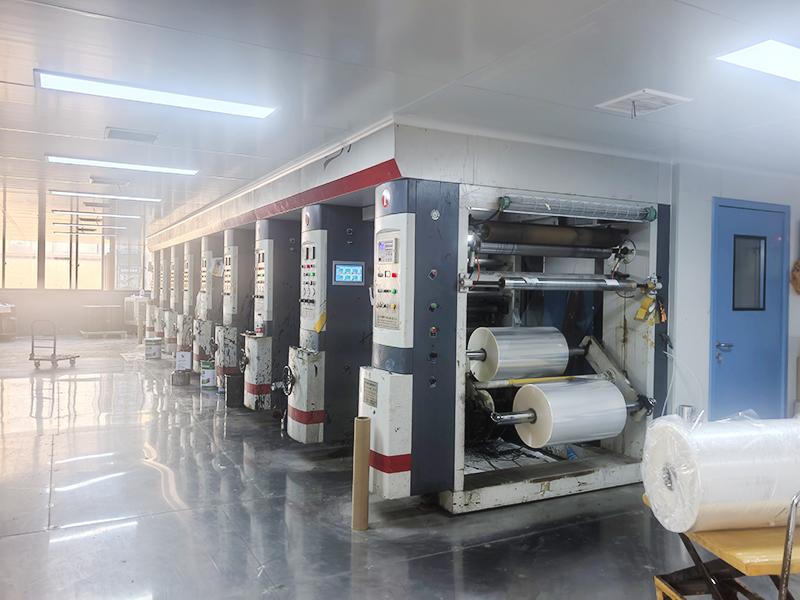
Printing is a separate step: on fabric rolls it belongs to the buyer's converting operation; on finished bags it is completed by the converter before delivery.
Fabric rolls suit a different buyer: one with converting capacity, a wide or shifting size range, and a preference for controlling print and liner decisions locally. Rice packaging illustrates both logics in one product family. Color-printed woven sacks with handles are used for retail-facing rice, while block-bottom valve bags are used for palletized bulk shipment — the first rewards print quality, the second rewards filling speed and stack stability.
Moisture sensitivity is the tie-breaker for fertilizer and chemical powders. Where the product picks up moisture, the PE liner option on the composite, or a liner inserted during conversion, matters more than the outer material. Buyers should confirm the liner requirement against the product's sensitivity and the storage and transport conditions rather than defaulting either way.
Storage conditions apply to both formats. The documented working envelope is −10 °C to 50 °C continuous, dry and ventilated warehouse storage, and a UV-stabilized version for outdoor exposure. Neither format is intended for long soaking in water without a liner or coating, and both should be kept away from open flame and strong corrosive chemicals.
Market context: volume, lamination and resin prices
Supply is not the constraint. Market Reports World put global PP woven bag production above 10 billion units in 2023, with China manufacturing more than 7 billion of them. The same source reported that laminated PP woven bags accounted for 54.5% of global market volume in 2023 — a reminder that value-added formats, not plain fabric, carry most of the volume.
Two caveats belong beside those numbers. They are 2023 figures from a commercial research publisher, and published market-size values for this category vary widely because some estimates fold in FIBC and other bulk bags. They indicate market direction; they are not a basis for sizing a purchase.
The resin signal is more directly actionable. With polypropylene up 47.32% year on year to 9,461 CNY per tonne in November 2026, buyers on either route are exposed to the same underlying material. The rational responses are specification discipline — confirming that the gsm and mesh actually required by the fill weight are not being exceeded out of habit — and, where contracts allow, a resin-linked price adjustment clause tied to a published benchmark.
Where each option stops fitting
Fabric rolls stop fitting when the buyer has no converting capability. Without cutting, printing, sewing or sealing and liner insertion, the material price is not a delivered cost, and outsourced conversion usually erodes the advantage. The format is also bounded by its quoted envelope: 55–180 gsm, 7×7–14×14 mesh and 30–120 cm tube circumference. Requirements outside those ranges need explicit confirmation rather than assumption.
Finished composite bags stop fitting when flexibility is the priority. The construction is fixed at the converter, changes are confined to the stated kraft and inner PP ranges, and the style choice is open-mouth or block-bottom valve. Printed orders carry a 3,000-piece minimum at the manufacturer referenced here, and every size or design change becomes a new stock item.
Decision checklist for buyers
- Converting capability. Do we own cutting, printing, lining and closing, or would we outsource it?
- Fill weight and product form. What load, particle size, bulk density and flowability must the bag hold?
- Dust control. Is leakage at the filling point a health, housekeeping or product-loss issue?
- Moisture sensitivity. Is a PE liner required, and who inserts it?
- Filling equipment. Valve filler, open-mouth sewing line, or both?
- Order shape. How many sizes and print designs, and at what annual volume per SKU?
- Minimum order and inventory. One roll versus 3,000 printed pieces — which fits our working capital and warehouse?
- Print ownership. Who approves artwork, and who bears print set-up cost?
- Storage and climate. Indoor or outdoor, and is a UV-stabilized version needed?
- Verification. Samples, inspection records and the standard applicable in the destination market.
Two of these carry more weight than the rest. Converting capability decides whether the fabric route is real or theoretical, and dust control decides whether a valve and a dust-proof construction are optional or essential.
Outlook
If resin prices stay near current levels, format choice will be decided less by material cost than by conversion efficiency and order structure. Buyers with steady, high-volume, single-size programmes have the most to gain from moving conversion in-house, since the equipment and labour are then amortized over predictable output. Buyers with many SKUs, tight dust requirements or no converting line have the most to gain from finished composite bags. A middle path is also available: standardize the bag construction first, then decide which steps to bring in-house once volumes justify the investment.
Frequently asked questions
What is the practical difference between tubular PP woven fabric rolls and finished paper-plastic composite bags?
They sit at different stages of the same chain. Tubular fabric is a semi-finished woven material supplied on rolls from 55–180 gsm with a 30–120 cm tube circumference, which the buyer cuts, prints and closes. A finished paper-plastic composite bag such as model 20211011 arrives with a kraft paper outer layer, an inner PP woven layer, a valve or open mouth and an optional PE liner already assembled. The first transfers the converting step to the buyer; the second keeps it with the converter.
How should gsm, mesh and tube circumference be read in a fabric quotation?
Gsm is the fabric weight per square metre, mesh is the tape count per inch in each weave direction, and tube circumference is the open size of the tube, equal to twice the lay-flat width. A 55–180 gsm, 7×7–14×14 mesh, 30–120 cm range defines the material being quoted. It does not confirm tensile strength, seam strength or a load rating, which depend on tape specification, closing method and fill weight and are normally verified through supplier test data and a trial fill.
Are paper-plastic composite bags the better choice for fine, dust-generating powders?
For cement, chemical powders and fine fertilizers, the composite's dust-proof construction and valve or sewn mouth are designed to limit escape at the filling point, and the kraft outer layer provides a printable surface. Whether it is the better choice depends on the filling line, fill weight and moisture sensitivity. Where a PE liner is needed it should be specified rather than assumed, and a trial fill remains the practical test.
What order quantities and lead times apply to each format?
Tubular fabric is quoted from one roll with pallet packing, which suits trials and small converting runs. At the manufacturer referenced in this comparison, printed valve bags carry a standard minimum of 3,000 pieces, with a normal production lead time of 10–15 days and rush orders possible in 7 days. Smaller printed quantities can be arranged through traders at higher unit prices because orders are combined.
What should a buyer verify before committing to either format?
Four checks matter most: whether in-house converting capacity exists for the fabric route; the fill weight and product form the bag must hold; whether dust control and moisture protection require a valve, dust-proof construction or PE liner; and the standard that applies in the destination market. GB/T 8946-1998 covers technical requirements and inspection rules for PP woven bags in China and is a useful reference, but it is not proof of compliance elsewhere. Samples, inspection records and a trial fill close the remaining gap.
About the manufacturer referenced in this comparison
WenZhou BaiChuan Plastic Industry Co., Ltd. is based in Xiaojiang Town, Pingyang, Wenzhou, Zhejiang — the region known as China's PP woven bag capital. The company operates a plant of more than 20,000 square metres, produces PP woven bags, color-printed valve bags and paper-plastic composite bags, and covers yarn drawing, circular weaving, laminating, color printing and bag making in-house. It reports an annual output of 90,000,000 bags and an export share of about 30%, shipping to South America, Pakistan and Southeast Asia. Company website: WenZhou BaiChuan Plastic Industry Co., Ltd. Product catalogue (PDF): Baichuan packaging product catalog.
Have Questions or Need More Details?
Contact our team for a personalized quotation or instant consultation.
Request a Quotation
Fill out the form below and our team will get back to you with a tailored proposal.
WhatsApp Direct Chat
Prefer to chat in real-time? Message us on WhatsApp for instant assistance & quick answers.
- Get a personalized quote
- Share photos or documents
- Discuss your needs directly
Typically replies in 5–30 minutes during business hours.