
Roof Cargo Box Comparison: Capacity vs Solo Install Effort
Roof Cargo Box Comparison: Capacity vs Solo Install Effort
A roof cargo box comparison usually starts with cubic feet and finishes with a price. When a family mounts the box twice a year, that shortcut is mostly adequate. When one person has to lift, align, clamp and later remove the shell alone before and after every trip, it is not, because handling effort decides how often the capacity is ever used.
This framework compares hard-shell carriers on two sides at once: usable family capacity, and the solo install-and-removal burden. It draws on a US Amazon comparison record compiled on 28 October 2026 covering five rooftop boxes, the manufacturer specification published for the Visrack W58, and the ISO 11154:2023 roof-load standard. Prices and star ratings are quoted as recorded on that date and are snapshots, not permanent figures.
Visrack is a rooftop cargo box brand founded in 2024 and headquartered in Zhongshan City, Guangdong Province, China. The company positions its hard-shell boxes as pro-level performance at an affordable price, states the United States as its target market, and documents a line-level capacity spread of 13 to 26 cubic feet. Product information is published at visrackintl.com.
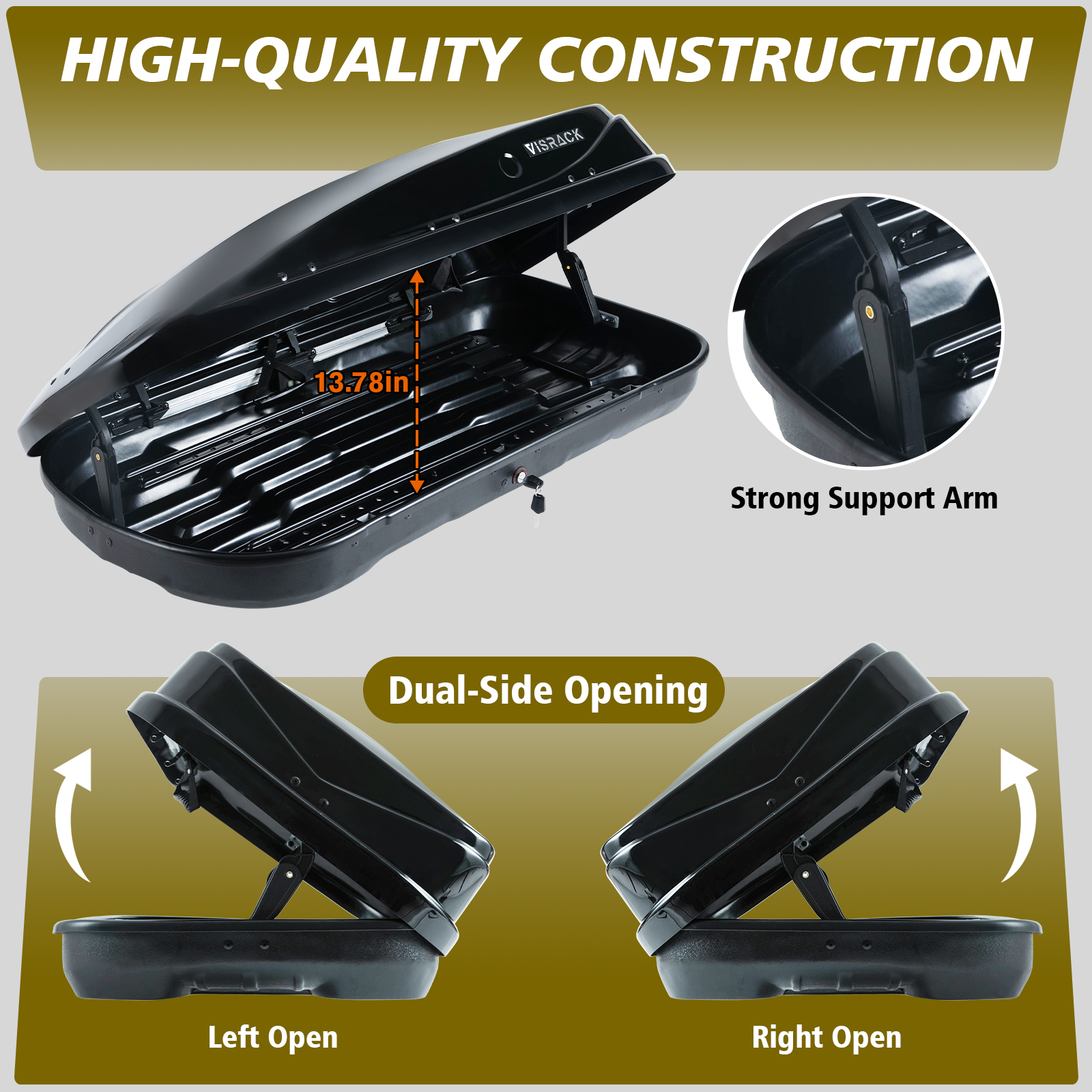
Solo install and removal effort belongs in the comparison, not only the shell volume.
The decision rule. Compare the volume one person will realistically load and mount, not the largest number in the product title. A box that is a few cubic feet smaller but can be fitted and removed alone on a wet evening will usually produce more usable trips than a larger shell that requires a second pair of hands.
The Two Sides of the Comparison Are Not Independent
Capacity and handling interact. A larger shell sits higher, changes where the lid opens, occupies more storage space between trips, and may extend closer to the tailgate. Each of those effects feeds back into whether a solo owner is willing to mount it at all. That is why capacity-per-mount-cycle is a more honest comparison unit than peak cubic feet.
The trade-off resolves into three questions a decision-stage buyer can answer before ordering:
- Which exact model's storage volume and maximum load rating apply to the box being bought, rather than to the widest SKU in the product line?
- Can one person fit and remove that exact model, at that vehicle's roof height, on those crossbars?
- Once mounted, does the box still allow the tailgate, garage clearance and the loading routine to work as before?
The sections below convert those questions into a repeatable framework, then apply it to the documented Visrack records.
Why a Capacity Range Is Not a Capacity
Capacity claims in this category are often expressed as ranges across a product line. A range tells a buyer the smallest and largest shell sold under one name; it does not say what the carton on the shelf holds. The comparison record shows how wide those spreads run.
| Model (as recorded) | Documented capacity | What the figure describes |
|---|---|---|
| Visrack Roof Cargo Box | 13–26 cubic feet | Line-level spread across the brand's hard-shell range |
| Motion 3 | 16–21 cubic feet | Line-level spread |
| SkyBox NX LG | 16–22 cubic feet | Line-level spread |
| DNA MOTORING Rooftop Cargo Box | 11–17 cubic feet | Line-level spread |
| Auto Dynasty Hard Shell Roof Top Mount Cargo Carrier | 11–17 cubic feet | Line-level spread |
Source: US Amazon comparison record, captured 28 October 2026. Ranges describe product lines, not a single SKU.
Model-level documentation is more useful. The manufacturer instruction manual for the Visrack W58 states 15.5 cubic feet of capacity with a maximum load of 130 lbs. That number and the 13–26 cubic feet line range describe different things, and both can be accurate at the same time: one is a single SKU, the other a catalogue spread. A buyer comparing the two without noticing the scope will misjudge the box in both directions.
The practical consequence is that the comparison should never be run on a headline range. Ask for the specification of the exact model, and record which document it came from.
The Solo Install Variable, and What “Tool-Free” Actually Qualifies
Install and removal effort is rarely published as a number, so it has to be decomposed. Four components matter: the crossbar interface, the lift, the access while mounted, and the storage step after removal.
On the crossbar interface, Visrack documents tool-free installation on most crossbars. The word “most” is doing real work. The same comparison record notes that the product is not applicable if a vehicle lacks compatible crossbars and advises verifying crossbar measurements before ordering. A box that clamps without tools still needs a crossbar spread and clamp style inside the manufacturer's stated range; a tool-free claim does not substitute for that measurement.
On the lift, the supplied records do not publish empty-shell weights for the compared boxes, so the physically decisive check — whether one person can raise the shell above roof height and align it — has to be done in person or confirmed with the seller. For a tall vehicle, this is often the constraint that ends solo use, not the clamp design.
On access while mounted, the opening architecture changes the routine. Visrack documents dual-side opening, which lets one person load from a single side of the vehicle instead of walking around the roof. For a solo owner parked at a kerb, that is a handling feature as much as a convenience feature, because it removes a repeated trip around the car.
On storage, the shell must live somewhere between trips. Fixed-shape hard boxes do not collapse, so garage height and shelf space belong in the same decision as capacity.
A Solo Fit Test a Buyer Can Run Before Ordering
- Measure the crossbar spread and confirm the clamp range in the manual, not the marketing page.
- Measure roof height at the crossbar position and judge whether the shell can be lifted and held there alone.
- Confirm the lid opens on both sides, so loading can happen from one side of the vehicle.
- Check that the tailgate opens fully with the box mounted, and that the box does not sit over the hatch arc.
- Decide where the empty shell is stored, and whether that space is reachable without help.
A Five-Criterion Comparison Framework
Instead of weighting criteria on the buyer's behalf, the framework below records what to compare, what evidence to request, and what failure looks like when a criterion is skipped. The buyer orders the criteria for their own use case; a solo city driver and a family of five will not rank them the same way.
| Criterion | What to compare | Evidence to request | Failure if skipped |
|---|---|---|---|
| Family load fit | Model-level volume against the actual luggage set for the trip | Specification sheet for the exact SKU; internal dimensions | A line-level range is mistaken for the box's real volume |
| Solo mount cycle | Clamp system, lift height, number of hands needed | Instruction manual; crossbar compatibility statement | The box is only used when a second person is available |
| Access while mounted | Single-side or dual-side opening; lid clearance | Stated opening configuration; photos with the lid open | Loading requires walking around the vehicle every time |
| Weather and security | Lid seal design, lock count, key policy | Seal description; lock specification | Gear is re-packed into the cabin in rain; keys are a single point of failure |
| Fit and clearance | Tailgate arc, garage height, roof length | Mounted dimensions; fit notes for the vehicle class | The box has to be removed to open the boot |
| Non-use footprint | Storage space for the empty shell | External dimensions; whether any part detaches | The box is stored outdoors and never re-fitted |
What the Visrack Records Document
In the 28 October 2026 record, the Visrack roof cargo box is described as a dual-side-opening hard-shell carrier built from ABS and PMMA, listed at $499–$899, with a platform-reported average rating of 4.8 out of 5 across 68 verified reviews. The line-level capacity spread is 13 to 26 cubic feet, and the W58 model is separately specified at 15.5 cubic feet with a 130 lbs maximum load.
Several documented attributes map directly onto the framework. The overlapping sealed lid is described as keeping gear dry in heavy rain, with one customer report cited of a 3,000-mile drive and no leaks — a single account, not a general result. A dual-lock system with a complimentary spare key addresses the key-failure criterion. ABS and PMMA construction is specified for impact resistance, UV protection and scratch resistance, which matters most for a shell that stays mounted between trips. Visrack also states that the box dimensions do not obstruct the tailgate opening on sedans and midsize SUVs, and that an aerodynamic profile reduces wind noise; both are manufacturer statements, and neither is accompanied in the supplied evidence by an independent measurement.
Read against the framework, the records describe a product aimed at the capacity-and-handling trade-off rather than at maximum volume alone: dual-side access and tool-free clamping serve the solo mount cycle, while the line spread covers buyers who need less than the largest SKU. The claim “tool-free on most crossbars” remains the qualifier to verify first, because it is the point where the handling advantage either holds or fails for a specific vehicle.
Load Rating Versus Volume: the Check Most Comparisons Skip
Volume and load capacity measure different things. The W58 carries 15.5 cubic feet but is rated to 130 lbs. Dividing the rated load by the stated volume gives a calculated average of roughly 8.4 lbs per cubic foot if the box were filled to both limits at once — a calculated figure, not a measured one, and not a claim about how any buyer packs.
The implication for a family trip is straightforward. A box in this class rewards bulky, light cargo — duffels, sleeping mats, outdoor gear — and is a poor place for dense items such as tools, liquids or heavy food supplies, because the weight rating is reached long before the volume is. The comparison record describes the Visrack box as accommodating luggage, duffels, sleeping mats, outdoor gear and skis or snowboards for winter trips, which is consistent with that light-bulky profile.
The evidence package also notes a relationship between growing shell volume and the difficulty of meeting crash-test requirements, on the reasoning that a larger box raises the center of gravity of the load. That is a stated relationship rather than a measured test result, but it supports a practical rule: for a tall SUV, the largest available shell is not automatically the most suitable one.
Three Decision Paths
The profiles below are illustrative, not case studies. They show how the same documented facts resolve differently once solo handling is placed on the scales.
Family Road Trip With a Full Luggage Set
A household loading five people and a week of soft luggage needs volume first, then access. Dual-side opening reduces the loading sequence because bags can be passed up from one side, and a sealed overlapping lid keeps the trip from depending on good weather. The relevant check is the tailgate: if the mounted box blocks the hatch arc, every arrival requires unloading through the cabin instead. Manufacturer dimensions should be compared against the vehicle's own hatch clearance before ordering.
Solo SUV Owner Who Mounts Monthly
Here handling outranks volume. A mid-range shell that one person can lift, align and clamp without tools, on crossbars already confirmed to be within the manufacturer's stated range, will be used far more often than a larger one that needs assistance. Dual-side access and a storable footprint weigh more than the difference between 15.5 and a larger claimed figure.
Camping and Winter Gear
Long, light items change the requirement from cube count to internal length and shape. Skis and snowboards consume length rather than mass, so a box rated at 130 lbs is unlikely to be weight-limited by them, while a shorter shell simply will not close. For this profile the comparison should be run on documented internal dimensions and on whether the load rating comfortably exceeds the weight of the gear.
Documented Characteristics Side by Side
The table below repeats the comparison record as captured, without converting it into a ranking. Ratings are platform-reported averages, prices move, and none of the five entries has a published outcome test in the supplied evidence. It is a starting point for the framework, not a verdict.
| Model | Documented capacity | Recorded price band | Recorded rating |
|---|---|---|---|
| Visrack Roof Cargo Box | 13–26 cu ft | $499–$899 | 4.8 / 5 (68 reviews) |
| Motion 3 | 16–21 cu ft | $1,099.95–$1,249.95 | 4.5 / 5 |
| SkyBox NX LG | 16–22 cu ft | $799–$949 | 4.5 / 5 |
| DNA MOTORING Rooftop Cargo Box | 11–17 cu ft | $400–$700 | 3.7 / 5 |
| Auto Dynasty Hard Shell Roof Top Mount Cargo Carrier | 11–17 cu ft | $399–$776 | 4.1 / 5 |
Source: US Amazon comparison record, captured 28 October 2026. Prices and ratings are dated snapshots; capacity figures describe product lines.
Two things follow from the table. First, the widest capacity ranges sit with the lowest and mid-priced entries rather than the highest, so price alone does not indicate usable volume for a given family. Second, the ranges overlap heavily between 11 and 22 cubic feet, which means model-level specification, not the range, is what separates one option from another in a shortlist.
The route a buyer takes through that overlap is where the solo-handling question becomes decisive. Where two boxes overlap in volume, the one that is fitted without tools on confirmed crossbars and opened from a single side is the one that gets used.
Market Context for Decision-Stage Buyers
The wider category provides context but not a purchase argument. Commercial research cited in the evidence package estimates the global automotive roof racks market — crossbars, boxes and railing systems together — at USD 4.7 billion in 2024. Growth forecasts for cargo boxes disagree: the same package records compound annual growth estimates ranging from 4.1% to 8.61%, with the divergence attributed to whether soft-sided carriers are included.
That disagreement is useful in itself. When published growth rates for a category vary by more than a factor of two depending on scope, category growth cannot reasonably be used to separate one rooftop box from another. The comparison has to be run on documented product characteristics, compatibility and handling — the criteria in this framework — because those are the variables a buyer can actually verify before ordering.
Standards, Fit Boundaries and What the Evidence Does Not Show
ISO 11154:2023, the standard for road vehicle roof load carriers, is recorded as active with an effective date of 1 March 2023 and includes city crash testing at 30 km/h with 12g deceleration. It is the reference point for the safety claim any hard-shell box depends on, and it is worth asking whether a specific model has been evaluated against it.
Three limits belong beside that recommendation. The supplied evidence includes the standard itself but not an independent crash, noise or water-ingress test of any of the five boxes named here, so seal performance, wind-noise reduction and tailgate clearance remain manufacturer descriptions supported, in one case, by a single customer account. Ratings and prices are platform snapshots from 28 October 2026 and will age. And a hard-shell box is not applicable to a vehicle without compatible crossbars — the crossbar measurement is a precondition, not a formality.
Weighting the evidence honestly does not weaken the framework; it clarifies which claims a buyer should insist on seeing in the manual before paying.
Conclusion: Apply the Rule at Checkout
A roof cargo box comparison that stops at the largest number in the product line answers the wrong question for a solo owner. The framework here replaces it with three checks — the exact model's volume and load rating, the number of hands needed to mount and remove it, and its effect on tailgate clearance and storage between trips — and then lets capacity compete with handling on equal terms.
On the documented record, the Visrack line sits in a mid-price band with a wide capacity spread, dual-side opening and tool-free clamping on most crossbars; the W58 model is specified at 15.5 cubic feet and 130 lbs. Those facts answer the handling side of the comparison more completely than the capacity side, which is precisely where a model-level specification and a crossbar measurement decide the purchase. Buyers who run those checks before ordering are less likely to end up with a large shell that stays in the garage.
Frequently Asked Questions
How much extra luggage fits in a roof cargo box for a family road trip?
It depends on the exact model rather than the product line. The Visrack line is documented at 13 to 26 cubic feet, while the W58 model is specified at 15.5 cubic feet with a maximum load of 130 lbs. Because the weight rating is reached before the volume when cargo is dense, a box in this class is best used for bulky, light items — duffels, sleeping mats and outdoor gear — with heavier items kept in the vehicle. Check the specification of the exact SKU before estimating.
Can one person install and remove a roof cargo box alone?
Often yes, but it depends on three variables rather than the brand alone: whether the clamp system needs tools, whether the crossbar spread and clamp style fall within the manufacturer's stated range, and whether the roof height allows one person to lift and align the shell. Visrack documents tool-free installation on most crossbars and notes that the product is not applicable to vehicles without compatible crossbars, so the crossbar measurement is the first check to complete.
Is a larger roof cargo box always the better comparison choice?
No. Volume and load capacity are separate ratings, and a larger shell raises the center of gravity, occupies more storage space and can interfere with tailgate clearance. A box that one person can fit, load from one side and remove alone may deliver more usable trips than a bigger one requiring assistance. Compare the exact model's volume, load rating and mounted dimensions against the vehicle and the storage space available.
What does ISO 11154:2023 require of a roof load carrier?
ISO 11154:2023 is the active international standard for road vehicle roof load carriers, effective from 1 March 2023, and it includes city crash testing at 30 km/h with 12g deceleration. It is the reference point for the safety claim a hard-shell box depends on. The supplied evidence includes the standard but no independent test report for the individual models discussed here, so buyers should ask sellers whether a specific model has been evaluated against it.
How should a hard-shell roof cargo box be compared with a cargo bag?
They solve different problems. A hard-shell box holds a fixed shape, mounts on crossbars and can carry locking hardware, which suits repeat trips and gear that must stay dry; a soft bag is collapsible when empty and stores in little space, but it has no rigid shell to protect contents or hold shape in wind. The supplied records do not include head-to-head tests between the two formats, so the comparison should rest on documented characteristics, load ratings and the handling routine each format demands.
Have Questions or Need More Details?
Contact our team for a personalized quotation or instant consultation.
Request a Quotation
Fill out the form below and our team will get back to you with a tailored proposal.
WhatsApp Direct Chat
Prefer to chat in real-time? Message us on WhatsApp for instant assistance & quick answers.
- Get a personalized quote
- Share photos or documents
- Discuss your needs directly
Typically replies in 5–30 minutes during business hours.