
Rotary Screw Air Compressor Matching: CNC, Automotive & Plastic Line Expansions
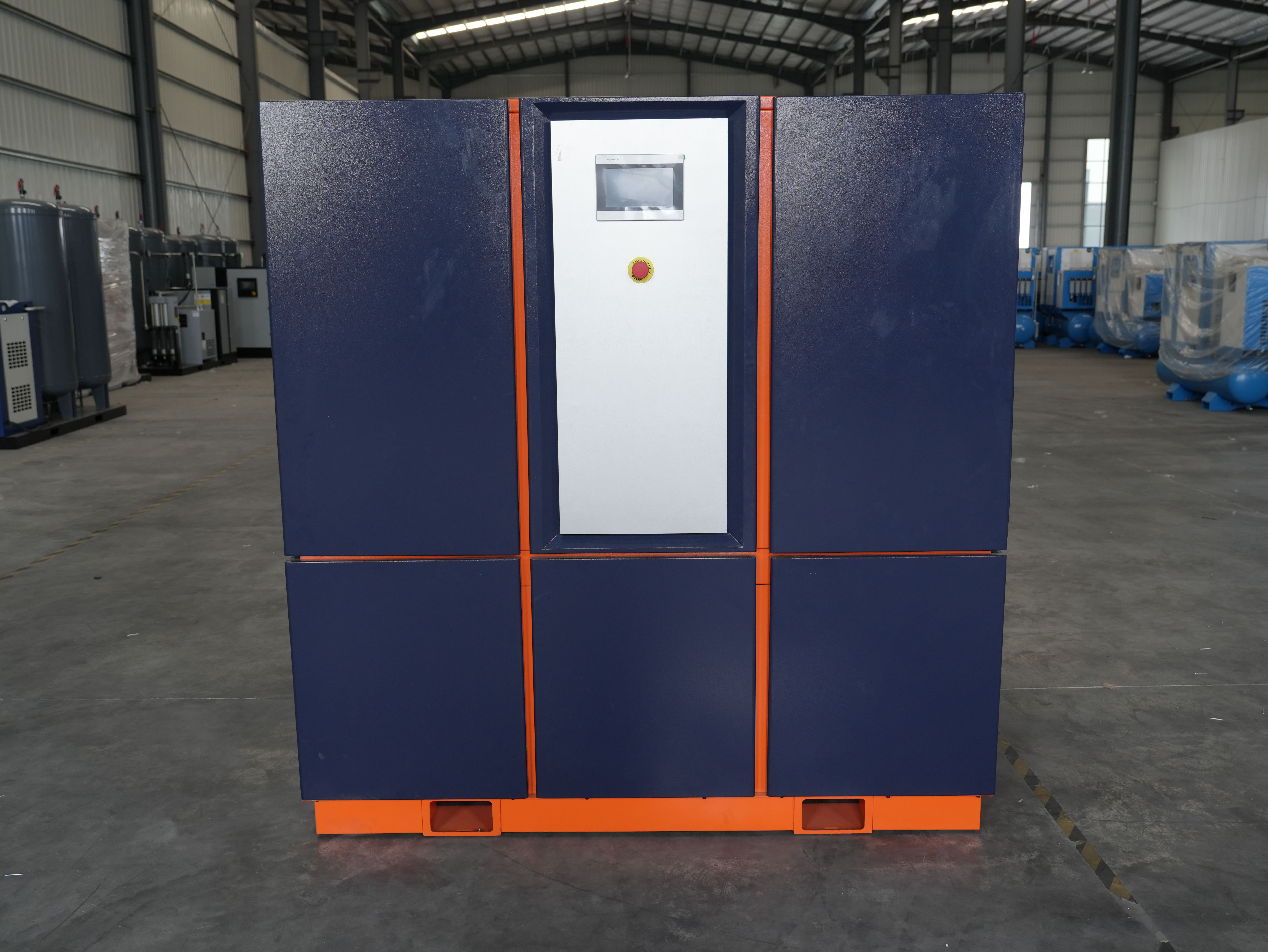
Adding a production line is a capacity decision. Adding compressed air to that line is a system decision. Between the two sits a question that plant engineers and procurement teams face during evaluation and into execution: which rotary screw air compressor configuration actually matches the expansion being built — a CNC machining cell, an automotive parts line, or a plastics processing train?
Shandong UMW Air Tech Co., Ltd — trading as UMW Air — is a China-based screw air compressor manufacturer founded in 2019. The company operates a 2,000 m² factory with 200 employees, a 40-person R&D team, and an annual output of 12,000 units. Its main product lines cover air-cooled, direct-driven, stationary, diesel mobile, and heavy-duty screw air compressors, and it states a 100% export ratio serving the EU, USA, Southeast Asia, the Middle East, South America, and Africa.
This guide takes the buyer's side of scenario fit: what each expansion type demands, what a documented hardware range covers, what must be paired around the machine, and where a rotary screw unit stops being the right answer.
Why a Line Expansion Breaks the Original Compressed Air Brief
A compressor purchased with the first machine on the floor is usually sized for that machine. The second and third machines change the brief without changing the utility line. Three variables typically shift at once:
- Simultaneous demand. A single CNC cell and a bank of CNC cells may use the same pressure, but they draw air at the same moments, so average flow no longer describes peak flow.
- Pressure band rather than pressure number. Metal cutting with compressed air assist can require pressures far above general workshop demand — up to 1.6 MPa (approximately 232 PSI) per published cutting guidance — while CNC machine requirements are commonly cited in the 90–120 PSI (6–8 bar) range at 5–30 CFM depending on machine size.
- Air quality class. Added processes such as laser cutting, blow-off, or packaging introduce sensitivity to moisture, particles, and oil carryover, which is an air treatment question as much as a compressor question.
The practical consequence is that a line expansion should be specified as a scenario — pressure band, flow and duty pattern, air quality requirement, and installation conditions — before a model or a kW figure is discussed.
The Four Inputs That Define Scenario Fit
Scenario fit is a repeatable framework rather than a preference. Four inputs determine the configuration direction:
- Pressure band. The highest pressure required anywhere on the line sets the specification. A mixed plant with both general workshop air and high-pressure cutting duty has to be evaluated at the top of that band.
- Flow and duty pattern. Continuous process duty (extrusion, packaging) and intermittent cell duty (CNC, tooling, dust removal) place different demands on part-load control.
- Air quality class. ISO 8573-1:2010 is the primary international standard defining compressed air purity classes for particles, water, and oil, and it is a common reference point for food and packaging applications in particular.
- Installation environment. Floor space, ventilation, electrical supply, and noise exposure are all part of the specification when a unit is placed next to a machining cell rather than in a separate plant room.
What a Documented Rotary Screw Range Covers
Before mapping scenarios, it is worth stating the documented range in plain terms. The screw air compressor range referenced here is described with the following parameters and configurations:
| Documented parameter | Value |
|---|---|
| Power range | 4–355 kW |
| Pressure range | 8–25 bar |
| Listed air flow | 2.39 m³/min |
| Cooling method | Air cooled |
| Drive method | Direct driven |
| Motor | IE4 |
| Construction material | Sheet metal |
| Configurations | Integrated screw air compressor, split/separate screw air compressor, portable screw air compressor, fixed screw air compressor |
| Models referenced | ML-7.5/8A, L-7.5/8A, L-1516A, L-2216A |
| Applicable industries | Metal processing and manufacturing; plastics and rubber processing; automotive and machinery parts; food and packaging; construction and materials; energy and chemical |
The configuration list matters more than the headline numbers. An integrated unit bundles compression and air treatment into one footprint, which suits a cell-level expansion with limited floor space. A split or separate arrangement keeps the treatment and storage stage positioned where the air is used. A portable or diesel mobile unit serves sites without a fixed power supply. A fixed unit remains the standard choice for a plant-room layout serving multiple lines.
On the energy side, the manufacturer states that it treats energy efficiency as a core belief and standardizes PM VSD (permanent magnet variable speed drive) technology together with low-resistance system design. For an expansion project, that positioning is relevant to part-load behaviour: an expansion line rarely runs at nameplate flow for the whole shift.
Scenario 1: CNC Machining and Metal Cutting Cells
CNC-driven expansions place compressed air in three simultaneous roles: driving machine actuators, feeding pneumatic tools, and supporting dust removal systems. Published sizing guidance for CNC equipment commonly sits in the 90–120 PSI (6–8 bar) band at 5–30 CFM per machine depending on size, which means the constraint is usually not extreme pressure but consistent pressure at multiple points of use.
What to specify for this scenario:
- Pressure stability at the point of use, with storage and filtration sized for the number of simultaneous draw points, not the number of machines installed.
- Filtration and drying adequate for the shop environment; the compressor alone does not determine delivered air quality.
- Footprint and noise exposure if the unit sits in or beside the machining area — integrated configurations exist for exactly this reason.
Where the same plant also runs laser cutting with compressed air as an assist gas, the brief changes: published cutting references indicate pressures up to 1.6 MPa (approximately 232 PSI) along with integrated filtration to prevent lens contamination. That is a different pressure band from general CNC demand and should be specified as a separate duty rather than folded into the workshop average.
Scenario 2: Automotive Parts Production
Automotive and machinery parts manufacturing is listed among the applicable industries for this range, and the demand pattern is typically shift-based cycling across multiple points of use rather than a single continuous draw. Two design consequences follow:
- Duty-cycle tolerance. The unit has to handle repeated load and unload transitions across a shift without destabilising pressure. Direct-driven transmission with an IE4 motor is the documented drive configuration for this range.
- Air treatment positioned for tool protection. Moisture and particulate carryover affect pneumatic tools, blow-off, and any downstream equipment with tight clearances; dryers and filters belong in the specification from the beginning, not as a later addition.
Because automotive expansions often add stations in phases, the practical procurement question is whether the air supply can be staged as well. A range that spans 4–355 kW and 8–25 bar allows the first phase to be sized at a lower output and the plant-room layout to be planned for the next phase.
Scenario 3: Plastics Processing and Line Expansions
Plastics and rubber processing is also listed among the applicable industries for this range. Extrusion, moulding, and related lines tend to run longer continuous cycles than CNC cells, which shifts the specification emphasis toward part-load efficiency and thermal management rather than peak pressure.
- Continuous runs mean the part-load point is where most energy is consumed; variable-speed control and low-resistance system design are the relevant levers.
- Air-cooled units depend on adequate ventilation around the installation point. Ambient conditions and airflow around the machine are sizing inputs in plastics environments, where surrounding heat load is often high.
- Dust exposure varies by process. Where the environment is dusty, enclosure protection and filter maintenance intervals become specification items.
Scenario Comparison at a Glance
| Expansion scenario | Demand pattern to plan for | Configuration emphasis |
|---|---|---|
| CNC machining cells | Intermittent, multi-point, pressure-sensitive (actuators, pneumatic tools, dust removal) | Stable point-of-use pressure; filtration; integrated or split layout |
| Metal cutting with air assist | High pressure during cutting cycles | Pressure headroom in the higher bar band; integrated filtration |
| Automotive parts production | Shift-based cycling across multiple stations | Duty-cycle tolerance; direct drive; complete air treatment package |
| Plastics processing lines | Long continuous runs | Part-load efficiency; ventilation for air-cooled installation |
| Food and packaging | Continuous, purity-sensitive | Air quality class defined against ISO 8573-1:2010 |
Configuring the System Around the Compressor
Compressed air quality is produced by the system, not by the compressor alone. In expansion projects, the pairing stage is where most delivered-air problems are decided. The components that belong in the specification alongside the machine are:
- Air dryers — to bring moisture content within the required class for the process.
- Air tanks and storage — to absorb peak simultaneous demand instead of forcing the compressor to chase every draw event.
- Filters — to control particles and oil carryover to the class the process requires.
- Inverters and variable-speed control — to match output to actual demand; PM VSD technology is the documented efficiency approach in this range.
- Controllers — to make pressure set points and operating data visible to the people running the line.
Integrated configurations exist precisely so that this list can be delivered as one package, which matters when an expansion is time-boxed and the plant room is not being rebuilt.
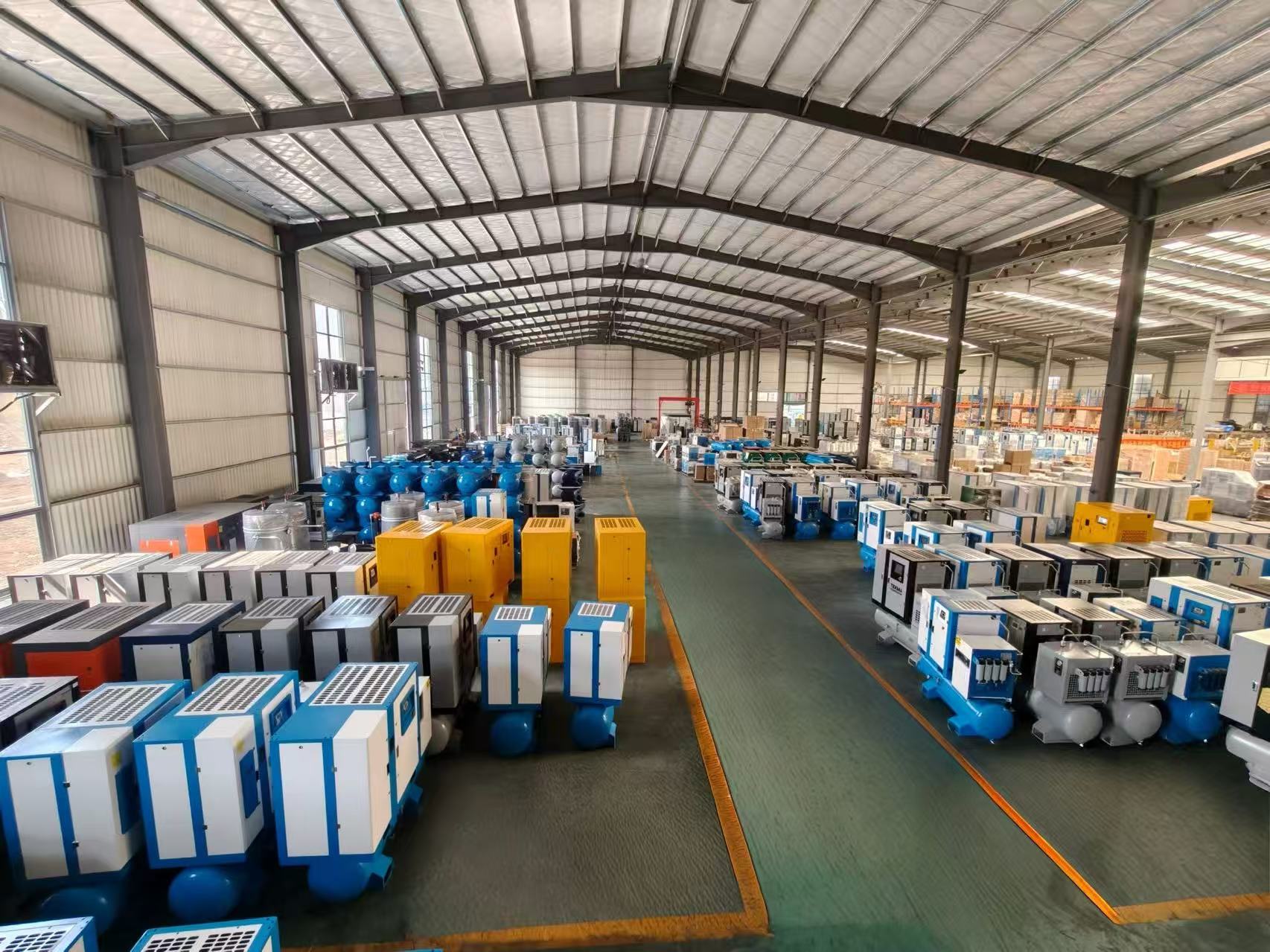
Documented Field Evidence: A CNC Workshop in Vietnam
The clearest published application record for this range comes from Southeast Asia. A CNC machining workshop in Vietnam installed three units of screw air compressor to address unstable air supply that had been affecting machining quality. Over a one-year usage period, the units were applied to drive CNC machine actuators, pneumatic tools, and dust removal systems.
The documented outcome of that installation:
- A 20% improvement in production efficiency.
- Reduced downtime.
- Stable air supply supporting high-quality machining.
- Reported highlights of low energy consumption, easy maintenance, and reliable long-term performance.
Two honest qualifications belong with this record. First, it covers one workshop over one year; results are project-specific and should not be read as a guaranteed performance figure for a different installation. Second, the reported improvement reflects the whole correction — sizing, supply stability, and air treatment — not the compressor brand alone.
Market Signals Behind Scenario-Based Selection
Third-party market research supports the idea that expansion-driven, scenario-based selection is where demand concentrates rather than a niche approach.
- The global rotary screw compressor market was estimated at USD 12.5 billion in 2024 and projected to reach USD 13.3 billion in 2025 (Custom Market Insights).
- The stationary rotary screw air compressor segment accounted for approximately 67.6% of technology share in 2025 (MarketsandMarkets) — the segment most relevant to fixed line expansions.
- Asia Pacific held the largest regional share of the rotary air compressor market at 43.7% in 2025, with China recorded as the leading country in the region (Grand View Research).
- Oil-filled rotary screw compressors accounted for 61.7% of the lubrication segment in 2025, while oil-free types are growing faster at a CAGR of 5.4% (Grand View Research / MarketsandMarkets).
- Established suppliers active in the market include Atlas Copco AB, Ingersoll Rand Inc., Kaeser Compressors, and Sullair LLC (Custom Market Insights).
Two reading notes are worth keeping. Market size estimates for rotary screw compressors vary noticeably by report scope — some count screw types only, others count all industrial rotary types — so figures should be compared within the same scope. And the oil-free growth figure is a directional signal about where purity requirements are heading, not evidence that lubricated machines are being displaced; oil-filled units still held the majority of the lubrication segment in the same year.
Rotary Screw vs. Reciprocating: Where the Boundary Sits
The comparison that matters most at evaluation stage is between rotary screw and reciprocating (piston) technology, because it determines whether the expansion should be specified as a screw machine at all.
| Consideration | Rotary screw | Reciprocating (piston) |
|---|---|---|
| Typical duty | Continuous and high-duty operation across multiple points of use | Intermittent, lower-duty operation |
| Delivered air behaviour | Smooth, continuous delivery suited to multi-point lines | Pulsating delivery, often paired with larger storage |
| Best economic fit | Plants with sustained air demand and multiple simultaneous draw points | Small workshops with occasional, single-tool demand |
| Maintenance character | Fewer wearing parts in the compression element | More wearing parts, more frequent service intervals in high duty |
This is a general engineering comparison rather than a brand claim, and it is the standard reason screw technology dominates stationary industrial applications. For a small job shop running one machine occasionally, a reciprocating unit can still be the more sensible purchase.
Where a Rotary Screw Unit Is Not the Right Fit
Scenario fit also means recognising the boundaries of a documented range. Based on the parameters above, a rotary screw unit from this range is not the obvious answer in the following situations:
- Pressure or power outside the documented band. The range covers 8–25 bar and 4–355 kW. A requirement above the top of that pressure band, or below the smallest unit for a genuinely tiny load, needs a different specification rather than a stretched one.
- A strictly oil-free air purity requirement. Where a process specification demands an oil-free compression path, that requirement sits outside the configurations documented here and should be raised as a separate specification item, even though oil-free types are the faster-growing lubrication segment at a 5.4% CAGR.
- Intermittent, low-duty, single-tool use. As noted in the technology comparison, a reciprocating machine can be the better economic fit when air demand is occasional rather than sustained.
- Environments with restricted ventilation. The documented cooling method for this range is air cooling, which depends on ambient conditions and airflow around the installation point.
- Validated acceptance requirements that extend beyond the factory. The documented acceptance criterion is a pre-shipment test, which places formal validation before dispatch. Projects that require site-specific performance validation should plan for that as a separate phase.
Capability and Delivery for Expansion Timelines
Expansion schedules are usually tighter than new-build schedules. The documented manufacturing and commercial capability in this range is relevant to that constraint:
- Production mode: OEM and ODM production services.
- Customization: color, logo, and voltage.
- Capacity and speed: monthly production capacity of 1,000 units and a typical production lead time of 3 days.
- Order threshold: minimum order quantity of 1 unit — relevant when a project starts with a single pilot cell and scales later.
- Quality control: factory pre-shipment testing.
- Export markets: EU, US, Middle East, and Southeast Asia, alongside the company's stated wider coverage.
- After-sales: 24/7 technical support via email or phone, plus remote troubleshooting and guidance.
- Commercial terms: MOQ of 1 unit, FOB/CIF delivery terms, pre-shipment test as the acceptance criterion, and payment at 30% T/T in advance with 70% T/T before shipping.
Read as a package, the combination of a one-unit minimum order and a short stated lead time supports phased rollouts: a pilot unit for the first expansion cell, then repeat orders once the pressure and flow behaviour of the actual line is known.
Deploying in the EU, Southeast Asia, and the Middle East
Compliance is a scenario input in its own right, because it determines what has to be evidenced before equipment can be placed on a given market.
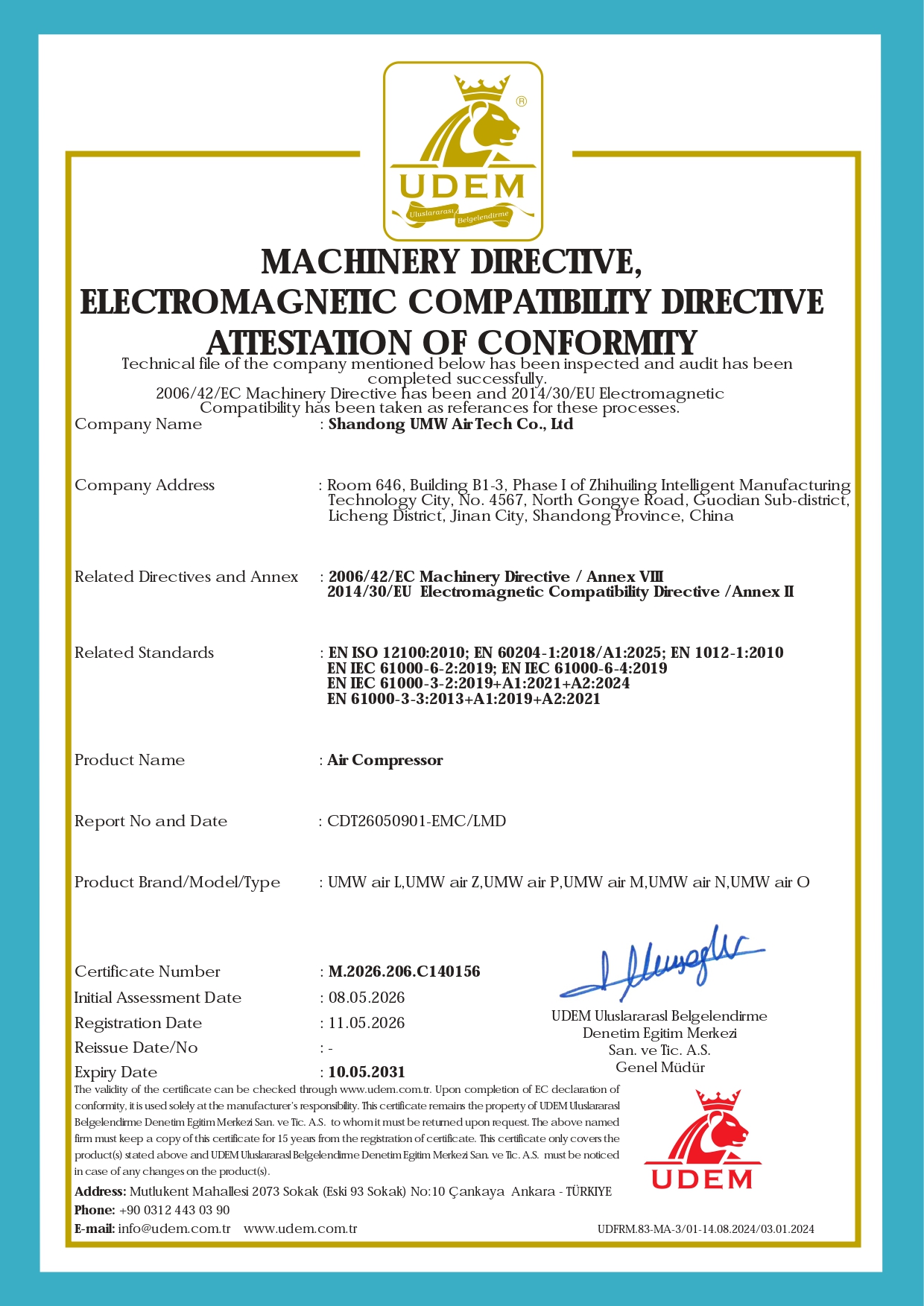
For EU/EEA placements, UMW Air holds CE certification number M.2026.206.C140156, issued by UDEM, valid from 2026-05-11 to 2031-05-10. The certificate scope covers the UMW air L, Z, P, M, N, and O series and references the 2006/42/EC Machinery Directive (Annex VIII) and the 2014/30/EU Electromagnetic Compatibility Directive (Annex II), with harmonised standards including EN ISO 12100:2010; EN 60204-1:2018/A1:2025; EN 1012-1:2010; EN IEC 61000-6-2:2019; EN IEC 61000-6-4:2019; and EN IEC 61000-3-2:2019+A1:2021+A2:2024.
The practical buyer point is scope: a CE certificate covers the series listed on it. A procurement team placing a specific order should confirm that the series being delivered falls within the certificate's scope, and note the validity window when planning a project that runs into the 2030s.
For Southeast Asia, the Vietnam CNC workshop record is the concrete deployment example in this range, and the region is listed among the company's export markets. For the Middle East, the same export listing applies. In both regions the documented cooling method — air cooling — makes installation conditions around the unit a first-order design input, and buyers in hot or dust-exposed environments should treat ventilation and enclosure protection as specification items rather than afterthoughts.
Future Outlook
Three directions are visible from the documented data and the market record.
First, the centre of gravity stays fixed. Stationary rotary screw units held roughly 67.6% of technology share in 2025, and expansion projects are the reason: stationary configurations are what a plant adds when a line is built indoors and the utilities have to be extended to it.
Second, energy efficiency is becoming a specification standard rather than an option. The manufacturer's stated position is that it standardises PM VSD technology and low-resistance system design, which aligns with the broader expectation that part-load behaviour — not nameplate power — determines lifecycle cost.
Third, air purity requirements are tightening directionally. Oil-free types grew at a 5.4% CAGR in the latest published segment data while oil-filled units retained 61.7% of the lubrication segment, which suggests a slow, requirement-driven migration rather than a wholesale replacement. For planners, that means purity class should be written into the specification early, since it changes the machine type, not just the filter selection.
Geographically, Asia Pacific's 43.7% share in 2025, with China recorded as the leading country in the region, keeps supply and sourcing dynamics centred on Asian manufacturing capacity — a factor that matters for lead time planning on expansion projects in the EU, Southeast Asia, and the Middle East alike.
Frequently Asked Questions
Can one rotary screw air compressor support a full CNC, automotive, or plastics expansion line, or does each machine need its own unit?
Both approaches are documented. A single fixed or stationary unit can serve multiple points of use through the plant air system, while integrated and split/separate configurations exist for cell-level placement. The deciding inputs are peak simultaneous flow, the highest pressure required on the line, and available floor space. In the documented Vietnam case, three units served a CNC machining workshop driving machine actuators, pneumatic tools, and dust removal systems.
What can be customized when a compressor is ordered for a specific expansion project?
The manufacturer provides OEM and ODM production services with customization options covering color, logo, and voltage. The minimum order quantity is 1 unit, monthly production capacity is 1,000 units, and typical production lead time is 3 days. Quality control includes factory pre-shipment testing.
How is delivered air quality determined — by the compressor or by the system around it?
By the system. ISO 8573-1:2010 defines compressed air purity classes for particles, water, and oil, and it is a common reference for food and packaging applications. Achieving a given class involves the compressor together with dryers, tanks, filters, and controls positioned for the process. Published cutting guidance for laser systems using compressed air as an assist gas references integrated filtration specifically to prevent lens contamination.
What pressure range should be planned for a mixed plant running both CNC machines and cutting equipment?
Plan for the highest requirement on the line. General CNC machine requirements are commonly cited at 90–120 PSI (6–8 bar) with flow rates of 5–30 CFM depending on machine size, while laser cutting with compressed air assist can require pressures up to 1.6 MPa (approximately 232 PSI). For the range described here, the documented pressure band is 8–25 bar with power from 4 to 355 kW.
How is quality and delivery performance validated before shipment?
Quality control includes factory pre-shipment testing, and pre-shipment test is the documented acceptance criterion. Commercial terms are a minimum order quantity of 1 unit, FOB/CIF delivery terms, and payment at 30% T/T in advance with 70% T/T before shipping. Buyers whose projects require performance validation on site should plan that as a separate activity, since the documented validation point sits before dispatch.
What compliance documentation supports EU and EEA installations?
UMW Air holds CE certification M.2026.206.C140156, issued by UDEM and valid from 2026-05-11 to 2031-05-10. The scope covers the UMW air L, Z, P, M, N, and O series. Standards referenced include 2006/42/EC (Machinery Directive, Annex VIII), 2014/30/EU (Electromagnetic Compatibility Directive, Annex II), EN ISO 12100:2010, EN 60204-1:2018/A1:2025, EN 1012-1:2010, EN IEC 61000-6-2:2019, EN IEC 61000-6-4:2019, and EN IEC 61000-3-2:2019+A1:2021+A2:2024.
When should a buyer choose a reciprocating compressor instead?
When demand is occasional and low-duty rather than sustained. Rotary screw units suit continuous operation across multiple simultaneous points of use, which is the pattern in CNC, automotive parts, and plastics expansion lines. A small workshop running a single tool intermittently may find a reciprocating machine the more economical fit. Two further boundaries are worth noting: the documented range covers 8–25 bar and 4–355 kW, and it does not extend to a strictly oil-free compression path, which must be raised as a separate specification item.
What support is available after the units are installed?
The manufacturer provides 24/7 technical support via email or phone, together with remote troubleshooting and guidance. Reported application highlights from the documented Vietnam installation include low energy consumption, easy maintenance, and reliable long-term performance over a one-year period.
Scenario fit is ultimately a documentation exercise. The expansion defines the pressure band, the duty pattern, and the air quality class; the supplier's documented parameters, configurations, certification scope, and delivery terms determine whether the match is real. The most reliable way to close an evaluation is to compare the plant's four inputs against a supplier's stated range, certificate scope, and acceptance criteria — line by line, before the order is placed. UMW Air's product and certification documentation is published at umwair.com.
Have Questions or Need More Details?
Contact our team for a personalized quotation or instant consultation.
Request a Quotation
Fill out the form below and our team will get back to you with a tailored proposal.
WhatsApp Direct Chat
Prefer to chat in real-time? Message us on WhatsApp for instant assistance & quick answers.
- Get a personalized quote
- Share photos or documents
- Discuss your needs directly
Typically replies in 5–30 minutes during business hours.