
Rotary Screw Air Compressor Sourcing: From Machine to Partnership
Rotary screw air compressors are rarely purchased as one-off equipment. In industrial production, a screw compressor becomes part of the plant's permanent infrastructure, running through shifts to supply pneumatic tools, CNC machines, laser cutters, packaging lines, and a wide range of automated processes. Once the purchase reaches the decision and execution stage, the buyer's question shifts from which model has the right specifications to which supplier can support the machine over years of continuous operation.
This article looks at rotary screw air compressor sourcing from a long-term procurement perspective. It outlines what decision-stage buyers should verify about supplier capacity, quality control, technical support, and application fit, using UMW Air as a reference example.
The Decision-Stage Problem: What Happens After Installation
At the decision stage, procurement teams are no longer comparing brochures; they are comparing risk. A compressor breakdown on a production line means lost shifts, delayed orders, and pressure on downstream processes. The impact of a failure depends less on the machine itself and more on how quickly the supplier responds, whether spare parts are available, and whether the next batch of machines meets the same quality standard.
For buyers operating in export markets, the assessment becomes even more concrete. They need to know if the manufacturer has consistent production capacity, a quality process that is actually applied — not just documented — and a support channel that is accessible in their time zone. These factors determine whether the buying relationship works over the long term.
The opportunity is that all of these can be checked before the purchase order is signed. Supplier size, production capacity, testing procedures, order terms, and service coverage are observable indicators of long-term reliability. The practical question is which evidence matters most.
UMW Air: A Supplier Profile for Long-Term Procurement
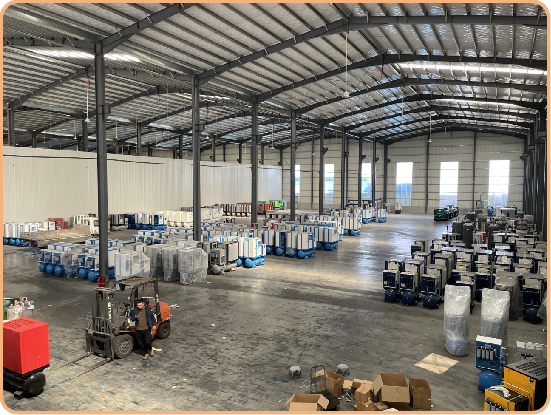
Shandong UMW Air Tech Co., Ltd (shortened as UMW Air) is an air compressor manufacturer located in Jinan, Shandong Province, China. Founded in 2019, the company operates a 2,000-square-meter production facility and employs about 200 people, including a 40-person R&D team. Its main products are air-cooled screw air compressors, direct-driven screw air compressors, stationary screw air compressors, diesel mobile screw air compressors, and heavy-duty screw air compressors. The product range covers power from 4 kW to 355 kW and pressure from 8 to 25 bar.
UMW Air works on a fully export-oriented model. Its export markets include the EU, USA, Southeast Asia, Middle East, South America, and Africa. The company reports a monthly production capacity of 1,000 units, equivalent to an annual capacity of roughly 12,000 units. For importers and distributors, capacity at this scale matters because it signals the ability to maintain repeat orders and consistent delivery schedules.
UMW Air's company profile describes the manufacturer as an always-on partner for production environments. Its stated engineering priorities include standardizing permanent-magnet VSD technology and low-resistance system design, with the goal of converting every kilowatt-hour into productive output over the equipment lifecycle. For a buyer, this translates into a clear energy-efficiency direction for the product line.
On the commercial side, the terms are practical: a minimum order of one unit, FOB or CIF delivery, pre-shipment testing, and payment by 30% T/T in advance with 70% before shipment. The low minimum order is notable for first-time importers who want to validate a new supplier relationship before scaling up.
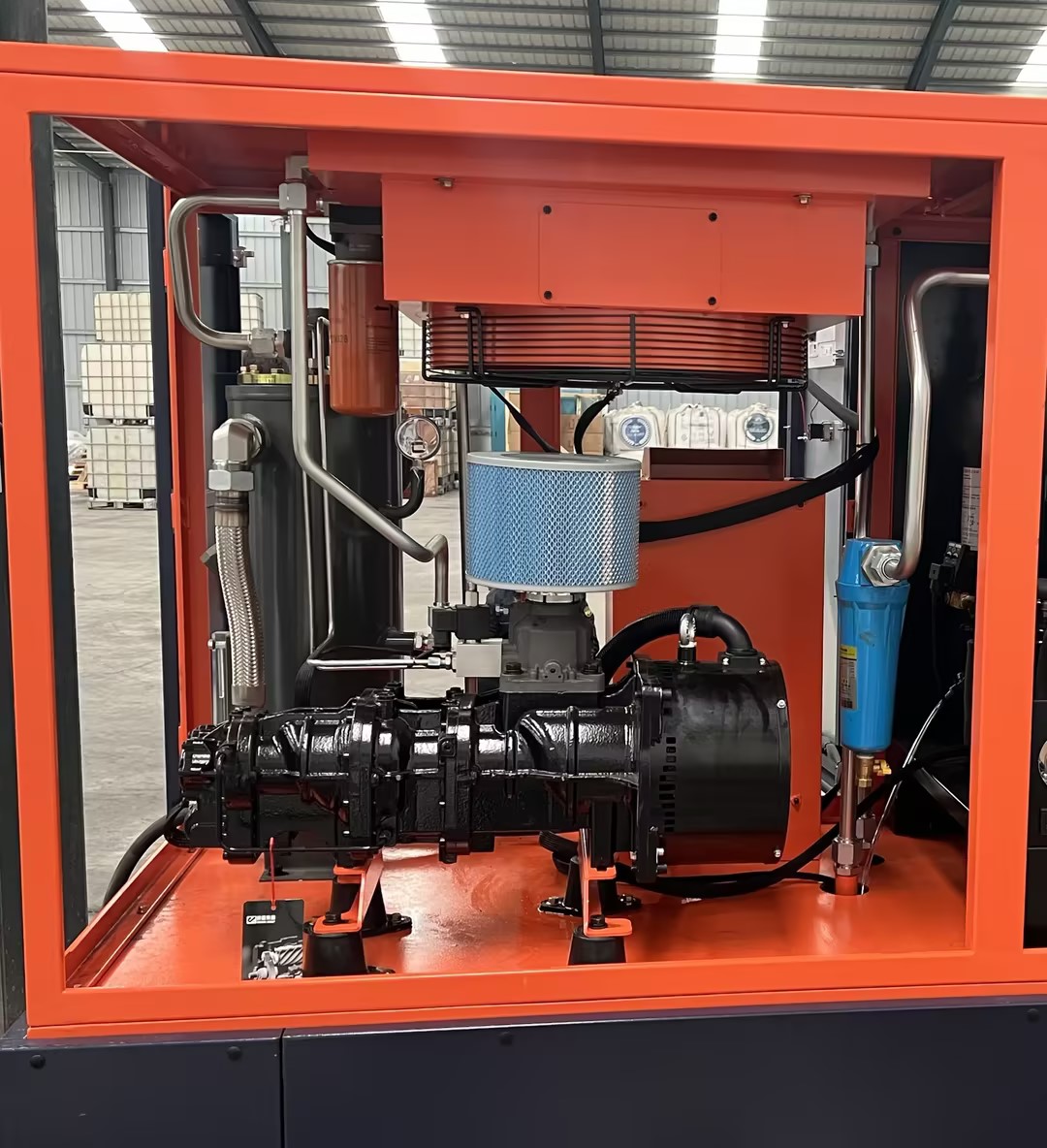
From a quality-risk standpoint, UMW Air specifically addresses overheating — a common failure mode in continuous-duty compressors — with high-efficiency radiators and cooling fans, and states that it performs thermal testing on every unit before shipment so that radiators and fans are confirmed functional.
After-sales support is organized around 24/7 availability. Technical support is reachable by email or phone around the clock, and remote troubleshooting is included in the support package. For overseas buyers who cannot rely on a local service network, remote support is a practical way to reduce downtime.
Technical Fundamentals: Why Rotary Screw Designs Suit Continuous Operations
The technical case for rotary screw air compressors is well established. Compared with traditional piston compressors, screw compressors offer continuous operation capability, lower vibration, more stable air output, and integrated automation control. These characteristics make them the preferred choice for industrial production lines with high and steady demand.
In manufacturer comparison data cited by UMW Air, screw compressors reach energy efficiency of up to 95%, while piston units typically operate at around 65–70% efficiency under load. Over thousands of operating hours, this difference directly affects electricity bills.
Maintenance is another long-term cost driver. Screw compressors have fewer moving parts, lower wear, and longer service intervals, while piston compressors need more frequent maintenance. For facilities running multiple shifts, fewer maintenance stops mean more productive time.
Heat management is central to sustained performance. In a continuous-duty rotary screw compressor, the cooling system carries heat away from the compression chamber; if it fails, the machine overheats and stops. UMW Air's thermal testing of every unit before shipment is a concrete example of how a manufacturer can reduce this failure risk at the source.
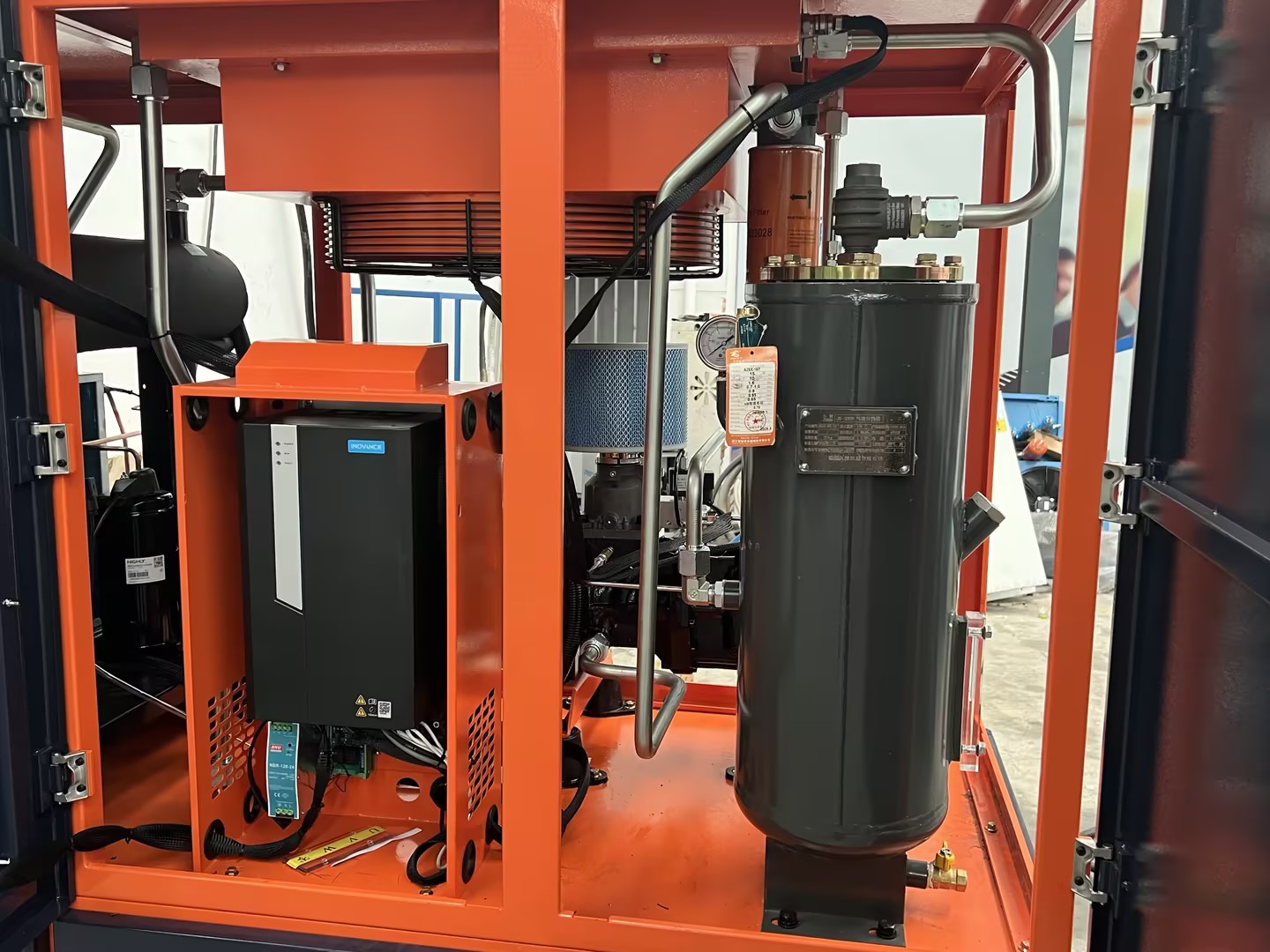
Buyers evaluating a supplier's technology should also look at the electric motor and drive configuration. UMW Air's screw compressor specifications list air-cooled, direct-driven units with IE4 motors, power from 4 kW to 355 kW, and working pressures of 8 to 25 bar. IE4 represents a high-efficiency motor class widely used in modern industrial equipment, and direct-driven designs eliminate the energy losses of gear-coupled systems.
Matching Rotary Screw Compressors to Application Needs
Different production environments place very different demands on a compressed air system. UMW Air's product documentation lists applicable industries such as metal processing and manufacturing, plastics and rubber processing, automotive and machinery parts, food and packaging, construction and materials, and energy and chemical. Within these segments, the selection criteria differ.
The table below summarizes typical compressed air requirements in selected applications and the procurement considerations that follow.
| Application | Typical Requirement | Procurement Consideration |
|---|---|---|
| CNC machining | 90–120 PSI (6–8 bar) working pressure; 5–30 CFM depending on machine size | Stable continuous air supply for tool changes, clamping, and chip removal |
| Fiber laser cutting | Assist gas pressure up to 1.6 MPa (approx. 232 PSI) | High-pressure configuration and integrated filtration to protect the lens |
| Food and packaging | Air purity according to ISO 8573-1:2010 classes | Filtration and drying stages; oil-free technology where required |
| General manufacturing | Pressure typically within 8–25 bar range, depending on plant equipment | Match compressor output to the factory load profile; VSD where load varies |
For CNC machining, the 90–120 PSI range is a standard working pressure for many machines, and the continuous output of a screw compressor avoids the pressure fluctuations that can affect process quality. For fiber laser cutting with compressed air as an assist gas, the system must sustain higher pressures — up to roughly 1.6 MPa in some setups — and prevent contamination from reaching the cutting head.
In food processing, ISO 8573-1:2010 defines the international purity classes for particles, water, and oil in compressed air, which is directly relevant to product safety. Buyers in food and packaging should verify that the compressor package can be paired with appropriate filtration and drying equipment, and in some cases choose oil-free technology as a cleaner baseline.
From a supplier-fit standpoint, UMW Air's product line includes both integrated (package) and split configurations, as well as portable and fixed formats. That gives buyers flexibility in installation: a factory with central piping may prefer a fixed stationary unit, while a mobile maintenance crew may choose a portable compressor.
Market Trends Shaping Rotary Screw Compressor Sourcing
The global rotary screw compressor market is estimated at around USD 12.5 billion in 2024, with expectations of reaching USD 13.3 billion by 2025. The stationary rotary screw air compressor segment dominates, with about 67.6% of technology share in 2025. This confirms that fixed installations remain the mainstream choice for industrial buyers.
Regionally, Asia Pacific holds the largest share of the rotary air compressor market, at 43.7% in 2025, with China as the leading country. For a company like UMW Air, based in Shandong, the practical implication is access to a mature manufacturing supply chain and a large pool of engineering talent.
In lubrication technology, oil-filled rotary screw compressors account for the majority of the market, at about 61.7% of the segment in 2025. Oil-free models are growing at a faster rate, with a compound annual growth rate of 5.4%, as food, pharmaceutical, and electronics applications tighten their air-quality requirements. Buyers should watch this trend closely: even if an oil-filled machine meets today's needs, the direction of industry standards is toward cleaner air.
The competitive landscape includes global players such as Atlas Copco, Ingersoll Rand, Kaeser, and Sullair. Alongside these established names, export-oriented Chinese manufacturers such as UMW Air compete on verifiable capability — engineering responsiveness, flexible order terms, production capacity, and lifecycle support — rather than on brand premium.
Rotary Screw vs. Traditional Piston Compressors: Strengths and Boundaries
Most procurement decisions in this category come down to rotary screw versus traditional piston technology. The table below summarizes the main differences as described in manufacturer comparison data.
| Dimension | Rotary Screw Compressor | Traditional Piston Compressor |
|---|---|---|
| Operation mode | 24/7 continuous operation | Intermittent operation |
| Energy efficiency | Up to 95% | ~65–70%, less suited to continuous high load |
| Maintenance | Low-maintenance, few moving parts, long service interval | Frequent maintenance, higher wear |
| Initial investment | Slightly higher | Lower |
| Long-term ROI | Higher, due to lower downtime and lower maintenance costs | Higher operating cost in continuous use |
| Best fit | Industrial production lines, CNC, plastics, automotive parts, continuous demand | Intermittent, low-duty applications |
The boundary of this comparison is important. Rotary screw advantages — efficiency, stability, low maintenance — are most visible when the compressor runs under a continuous or heavy load. If a facility has only short, intermittent air demand, a piston compressor can still be a lower-cost entry point, and the energy-efficiency gap matters less. Buyers should first understand their own load profile, then choose the technology that matches it.
Stationary installations are the dominant configuration for a reason: most factories need a fixed, reliable compressed air source with centralized piping. UMW Air's range includes stationary models that fit this role, while air-cooled and direct-driven options simplify installation and reduce energy losses compared with complex coupling systems.
Future Outlook: Where Compressed Air Procurement Is Headed
Several forces are likely to shape rotary screw air compressor procurement in the coming years.
First, energy efficiency is moving from a differentiator to a baseline requirement. Low-carbon manufacturing targets are pushing buyers toward variable-speed technology and more efficient motor classes. The adoption of permanent-magnet VSD technology as a standard in UMW Air's product direction reflects this broader industrial shift.
Second, air quality requirements will continue to tighten. The faster growth of oil-free compressors, combined with ISO 8573-1 as a reference standard, indicates that buyers in food, beverage, pharmaceutical, and electronics sectors will increasingly treat filtration and drying as part of the compressor system rather than as an afterthought.
Third, after-sales support is becoming more digital. Remote troubleshooting, which UMW Air already includes in its 24/7 support package, allows manufacturers to respond to overseas customers without dispatching a technician for every issue. This lowers the cost of service and shortens resolution times for buyers far from the factory.
Fourth, the role of Asian manufacturing is strengthening. With China leading the region's 43.7% market share, more importers and distributors will evaluate Chinese suppliers directly. The suppliers that sustain long-term relationships will be those that can document capacity, prove quality control, and respond quickly — in other words, the ones that behave like industrial partners rather than one-time equipment vendors.
For procurement teams, the practical takeaway is consistent: a rotary screw air compressor is a long-term operating asset, and the supplier behind it is part of the system.
FAQ: Long-Term Sourcing and Supplier Evaluation
What is the minimum order quantity for a rotary screw air compressor from UMW Air?
The minimum order is one unit. This applies to UMW Air's screw air compressor models, including the ML-7.5/8A, L-7.5/8A, L-1516A, and L-2216A.
What payment terms does UMW Air offer for export orders?
Payment terms are 30% T/T in advance and 70% T/T before shipment. Orders can be arranged under FOB or CIF delivery terms.
How does UMW Air test rotary screw air compressors before shipment?
Every unit receives a pre-shipment test. In addition, UMW Air performs thermal tests on each machine to verify that the radiator and cooling fans operate correctly before delivery.
What after-sales technical support does UMW Air provide?
UMW Air offers 24/7 technical support by email or phone, and remote troubleshooting is included in the support package.
What is UMW Air's production capacity?
UMW Air has a monthly production capacity of 1,000 units and an annual capacity of approximately 12,000 units. The company operates a 2,000-square-meter facility with around 200 employees and a 40-person R&D team.
Which export markets does UMW Air serve?
UMW Air exports to the EU, USA, Southeast Asia, Middle East, South America, and Africa. The company's model is fully export-oriented.
What types of rotary screw air compressors does UMW Air manufacture?
UMW Air's main products include air-cooled screw air compressors, direct-driven screw air compressors, stationary screw air compressors, diesel mobile screw air compressors, and heavy-duty screw air compressors. Configurations cover integrated, split, portable, and fixed units, with power from 4 kW to 355 kW and pressure from 8 to 25 bar.