
Rotary Screw Air Compressor Specs: A 2026 Buyer's Reference
A rotary screw air compressor is an industrial compressor that produces compressed air through two interlocking helical rotors. For buyers, understanding its specification sheet — power, pressure, airflow, configuration, and required supporting equipment — is the first step toward a sound purchasing decision.
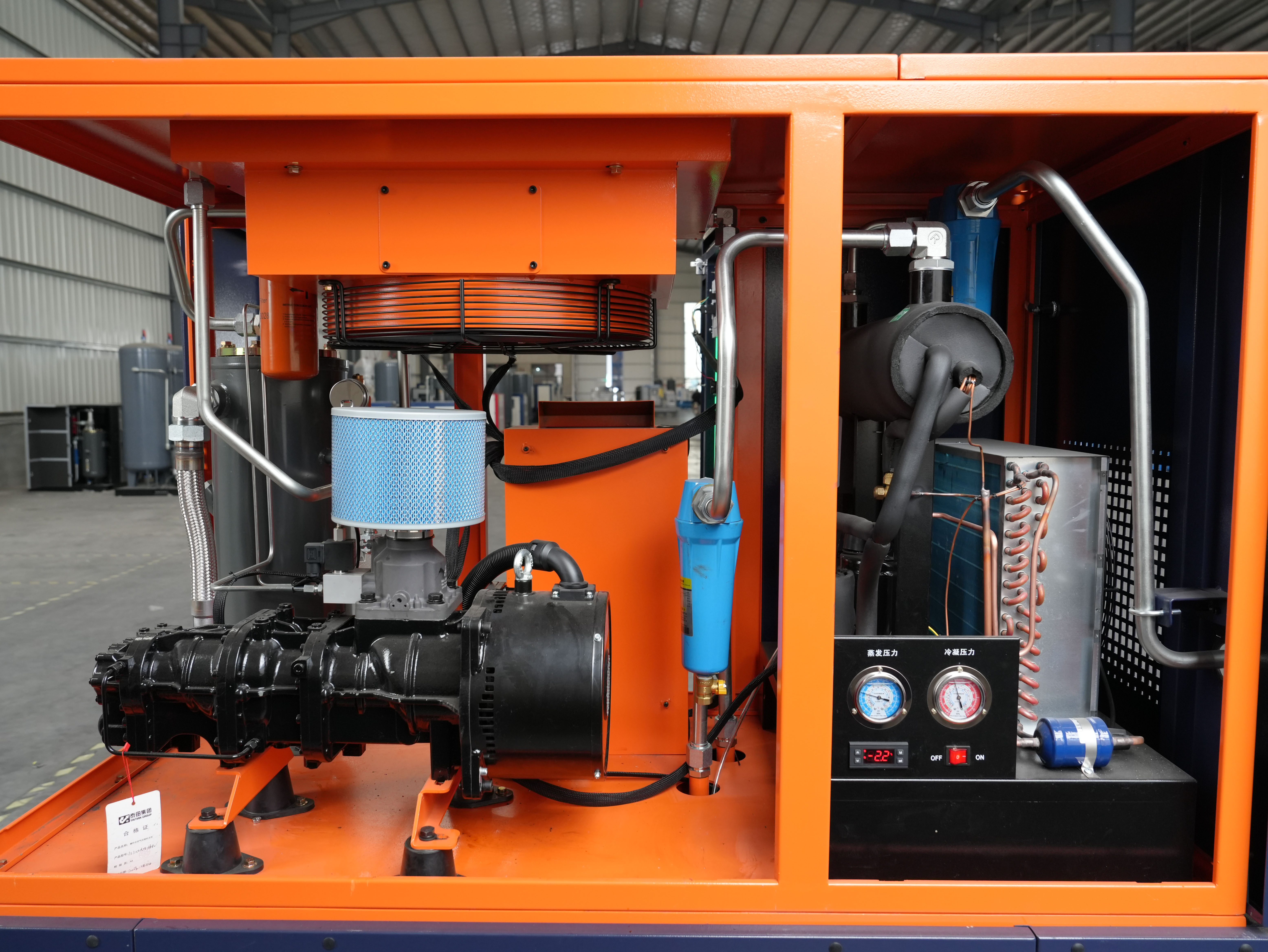
Rotary screw air compressors have become a default source of compressed air in manufacturing because they can operate continuously, deliver relatively stable flow, and run with less noise and pulsation than many reciprocating alternatives. The scale of adoption is visible in market data. The global rotary screw compressor market was estimated at USD 12.5 billion in 2024 and is expected to reach USD 13.3 billion by 2025, according to Custom Market Insights. Stationary rotary screw units accounted for approximately 67.6 percent of the technology segment in 2025, according to MarketsandMarkets. Asia Pacific held 43.7 percent of the rotary air compressor market in 2025, with China as the leading country, according to Grand View Research.
For industrial buyers in the awareness and research stage, the challenge is not locating suppliers. It is learning to interpret specification sheets and to connect each parameter to an actual production requirement. This article is an independent reference for that purpose.
Why Specification Misunderstanding Creates Costly Mistakes
Three mistakes appear repeatedly when industrial buyers evaluate rotary screw air compressors.
The first is selecting by motor power rather than actual air demand. A higher kilowatt rating does not by itself make a machine suitable. The correct approach is to match free air delivery at the required working pressure to real consumption, including expected changes in production volume.
The second is ignoring the relationship between pressure and flow. In a given rotary screw machine, increasing the discharge pressure reduces the volume of free air delivered. If a factory sets the operating pressure higher than the equipment requires, the compressor consumes extra energy for every hour of operation.
The third is treating the compressor as a standalone product. Industrial installations typically require supporting equipment such as an air dryer, air tank, line filter, inverter, and controller. Without these components, even a correctly sized compressor can deliver unstable pressure, wet or contaminated air, and unnecessary start-stop cycles.
The opportunity is equally concrete. When specifications are read correctly, buyers can size machines to actual consumption, reduce idle and part-load losses, set accurate air quality expectations, and compare suppliers on comparable data.
Supplier Example: UMW Air as a Specification Reference
To make the discussion concrete, this reference uses Shandong UMW Air Tech Co., Ltd. as an example of an export-oriented Chinese manufacturer. UMW Air was established in 2019, employs approximately 200 staff, operates a 2,000-square-meter manufacturing facility, and has an annual production capacity of 12,000 units. Its research and development team consists of 40 engineers. Export business accounts for 100 percent of total sales, with major markets including the European Union, United States, Southeast Asia, Middle East, South America, and Africa. The company describes itself as an “always-on partner” focused on energy efficiency, standardizing permanent-magnet variable speed drive (PM VSD) technology and low-resistance system design to “convert every kWh into core productivity.”
UMW Air's main product lines include:
- Air-Cooled Screw Air Compressor
- Direct-Driven Screw Air Compressor
- Stationary Screw Air Compressor
- Diesel Mobile Screw Air Compressor
- Heavy-Duty Screw Air Compressor
The full product range covers 4 kW to 355 kW in power and 8 to 25 bar in pressure. The company also offers the Micro series, a compact line with models Micro ML-4A, Micro ML-5.5A, and Micro ML-7.5A.
Reading the Core Specifications
A rotary screw compressor data sheet contains a set of parameters that, taken together, determine the machine's suitability for a production environment.
Power
Power is the rated motor input in kilowatts. In UMW Air's catalog, the screw air compressor range spans 4 kW to 355 kW, from small workshop machines to heavy industrial systems. The Micro series models are rated at 4 kW, 5.5 kW, and 7.5 kW.
Working Pressure
The working pressure, expressed in bar or PSI, must be high enough for the most demanding equipment in the plant. UMW Air's screw air compressor products cover 8 to 25 bar; the Micro series operates at 8 to 13 bar. As a point of comparison, CNC machine compressed air requirements typically range from 90 to 120 PSI — approximately 6 to 8 bar — with flow rates of 5 to 30 CFM depending on machine size. Selecting a machine with comfortable but not excessive pressure capability is one of the most direct energy-saving decisions available to a buyer.
Airflow
Airflow is the free air delivery at a stated pressure, usually expressed in m³/min or CFM. The Micro series delivers a maximum airflow of 1.1 m³/min. Airflow figures should be compared at the same pressure and reference conditions; a lower-cost machine per kilowatt may deliver less usable air per operating hour.
Air End
The air end is the compression core of a rotary screw machine. The Micro series uses a single-stage screw compressor air end. The continuous rotation of the rotors produces low pulsation, which is one reason screw machines are suited to continuous operation.
Cooling Method
Air-cooled machines remove heat with fans and require proper ventilation. Most UMW Air screw compressors are air-cooled, which simplifies installation in factories without a reliable cooling water supply. High-temperature or humid environments raise the importance of ventilation and downstream drying equipment.
Drive Method and Motor Efficiency
The main UMW Air screw air compressor series is listed with direct-driven configuration and IE4 motor efficiency. Direct-driven designs remove belt transmission losses and reduce the number of maintenance points. IE4 is a high-efficiency motor classification used in industrial electric motors.
Receiver Tank and Construction
The Micro series includes a 140 L gas tank, which stores compressed air and helps stabilize delivery pressure. The construction material is sheet metal.
Machine Configurations
Rotary screw air compressors are also classified by configuration. The UMW Air product family includes integrated screw air compressors, split/separate screw air compressors, portable screw air compressors, and fixed screw air compressors. Integrated units combine the compressor, motor, control system, and receiver in one enclosure; split configurations separate components for flexible installation.

Application Requirements Across Industries
According to UMW Air's product documentation, the screw air compressor is intended for metal processing and manufacturing, plastics and rubber processing, automotive and machinery parts, food and packaging, construction and materials, and energy and chemical industries. Typical projects include CNC machinery production lines, automotive parts production lines, plastic processing line expansions, industrial automation integration, and food and beverage packaging line setup.
These environments share several operating conditions: continuous operation, often in high-temperature or humid environments, and a need for stable and clean compressed air. The documented special requirements are energy saving, low noise, environmentally friendly operation, and high reliability.
CNC Machinery
CNC machine compressed air requirements typically range from 90 to 120 PSI (6–8 bar) with flow rates of 5 to 30 CFM depending on machine size. A compact rotary screw unit in the 4–7.5 kW class, equivalent to the Micro series, can support CNC production line projects that require stable, low-pulsation air supply.
Laser Cutting
Fiber laser cutting systems using compressed air as an assist gas can require pressures up to 1.6 MPa (approximately 232 PSI), with integrated filtration to protect the lens from contamination. Because this pressure is higher than the Micro series maximum of 13 bar, buyers in this segment should evaluate high-pressure rotary screw models — UMW Air's broader range extends to 25 bar — and confirm the filtration package.
Food Processing and Packaging
Food and beverage plants require compressed air with controlled purity. ISO 8573-1:2010 is the primary international standard defining purity classes for particles, water, and oil, and is widely referenced in food and pharmaceutical applications. In practice, the compressor should be paired with an appropriate air dryer and line filters to meet the target purity class.
| Application | Typical Pressure / Flow Signals | Typical System Considerations |
|---|---|---|
| CNC machining | 90–120 PSI (6–8 bar); 5–30 CFM per machine | Stable supply, low pulsation, air dryer recommended |
| Laser cutting (assist gas) | Up to 1.6 MPa in some fiber laser systems | High-pressure model required; integrated filtration to protect the lens |
| Food and beverage packaging | Purity per ISO 8573-1:2010 | Air dryer and line filters to achieve target air purity class |
| General manufacturing | Varies by equipment | Continuous operation; energy saving, low noise, high reliability |
Market Trends Reshaping Procurement
Three verified trends are important for buyers evaluating rotary screw air compressors in 2026.
The first is the structural dominance of oil-filled technology and the faster growth of oil-free compression. Oil-filled rotary screw compressors accounted for 61.7 percent of the lubrication segment in 2025, while oil-free types are growing at a CAGR of 5.4 percent, according to Grand View Research and MarketsandMarkets. For a buyer, this means oil-free options will become more accessible in food, pharmaceutical, and electronics applications, while oil-filled machines remain the economic default for general manufacturing.
The second trend is the normalization of variable speed drive technology. UMW Air states that it standardizes PM VSD technology and low-resistance system design as part of its energy-efficiency strategy. This mirrors a broader market shift: VSD compressors adjust motor speed to match air consumption and are widely used to reduce energy waste in plants with variable demand.
The third trend is the geographic structure of supply. Asia Pacific accounted for 43.7 percent of the rotary air compressor market in 2025, with China as the leading country. For international buyers sourcing from the region, factory scale, R&D headcount, export experience, and after-sales support become critical verification criteria.
Comparing Rotary Screw with Alternatives
Rotary Screw vs. Reciprocating Compressors
Reciprocating compressors remain relevant for intermittent and low-duty applications. Rotary screw machines are generally the preferred choice when compressed air is required continuously, because they produce steadier flow, lower pulsation, and quieter operation. A buyer with a very low duty cycle might still choose a reciprocating unit for initial cost reasons, but plants running multiple shifts typically benefit more from a screw machine's consistent output.
Global Incumbents vs. Export-Oriented Manufacturers
The global market includes established multinational suppliers such as Atlas Copco, Ingersoll Rand, Kaeser, and Sullair, according to Custom Market Insights. These companies provide extensive service networks and long operating track records, which matter in large projects where local technical support is critical.
Manufacturers such as UMW Air occupy a different position. UMW Air is a smaller, export-oriented producer with a 2,000-square-meter facility and an annual capacity of 12,000 units. Its offer is built around direct factory communication, configuration flexibility, and cost efficiency, supported by a 40-person R&D team. The trade-off is equally real: a specialist manufacturer may be more responsive and flexible, but its overseas service network and spare-parts infrastructure are not comparable to the global footprint of the incumbents. Buyers should verify after-sales arrangements — parts availability, technical support, and local partner coverage — before finalizing supplier selection.
| Supplier Type | Typical Strengths | Typical Considerations |
|---|---|---|
| Global incumbents (e.g., Atlas Copco, Ingersoll Rand, Kaeser, Sullair) | Extensive service network, long track record, broad product portfolio | Buyers should confirm configuration flexibility and commercial terms through distribution channels |
| Export-oriented manufacturers (e.g., UMW Air) | Direct factory communication, R&D support, configuration flexibility | Service network and spare-parts availability depend on local partner coverage and must be verified |
Future Outlook
Energy efficiency will remain the dominant selection criterion for rotary screw air compressors. The standardization of PM VSD technology and low-resistance system design, both part of UMW Air's stated engineering direction, reflects a broader shift from first-cost purchasing to lifecycle cost analysis. Oil-free compression is expected to gain share in industries with strict air purity requirements, supported by its faster growth rate. Intelligent controllers and system-level monitoring are becoming standard features, allowing factories to track pressure, flow, and energy consumption in real time. Asia Pacific, and China in particular, will continue to play a central supply-side role, which makes factory verification, specification transparency, and contract clarity essential for international buyers.
Frequently Asked Questions
A rotary screw air compressor is an industrial air compressor that uses two interlocking helical rotors to compress air continuously. It is classified as a fixed screw air compressor, portable screw air compressor, split screw air compressor, or integrated screw air compressor depending on the configuration.
Industries include metal processing and manufacturing, plastics and rubber processing, automotive and machinery parts, food and packaging, construction and materials, and energy and chemical. Typical projects include CNC machinery production lines, automotive parts production lines, plastic processing line expansions, industrial automation integration, and food and beverage packaging line setup.
In typical industrial installations, a rotary screw air compressor should be used with supporting equipment including an air dryer, air tank, line filter, inverter, and controller. These components stabilize supply pressure, remove moisture and contaminants, and improve overall system efficiency.
Common requirements include energy saving, low noise, environmentally friendly operation, and high reliability. Applications often run continuously and may operate in high-temperature or humid environments, so the system must be designed to provide stable and clean compressed air under those conditions.
The Micro series includes models Micro ML-4A, Micro ML-5.5A, and Micro ML-7.5A, with power ratings of 4 kW, 5.5 kW, and 7.5 kW. It delivers a maximum airflow of 1.1 m³/min, operates at 8–13 bar, and includes a 140 L gas tank. The air end is a single-stage screw compressor, and the construction material is sheet metal.
UMW Air's main product lines include Air-Cooled Screw Air Compressors, Direct-Driven Screw Air Compressors, Stationary Screw Air Compressors, Diesel Mobile Screw Air Compressors, and Heavy-Duty Screw Air Compressors. The full product range covers 4–355 kW power and 8–25 bar pressure.