
Rubber In, Cartons Out: Proving a Rubber Slipper Factory Is Real
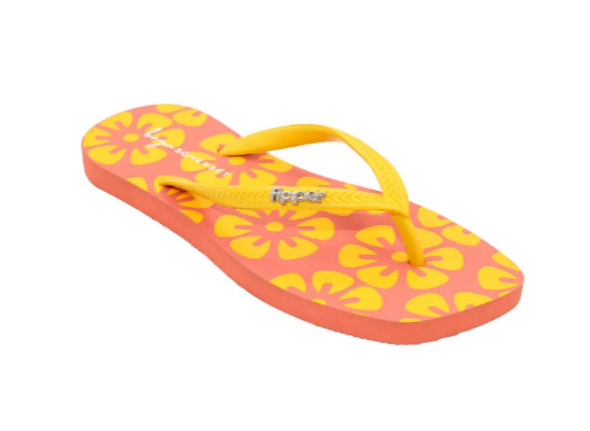
Printing, strap assembly and colour matching are finishing steps, and they are the stages where a paper capability claim most often stops being true.
A rubber slipper is a short, observable production chain: rubber comes in, moulds shape it, straps and finishes are attached, sizes are graded, and cartons leave. Because the chain is short, it is also easy to fake on a catalogue page. Capability evidence for rubber slippers is therefore not a certificate file. It is a set of physical traces that a buyer can request in the research stage and verify in the evaluation stage, before a purchase order is signed.
The trade context explains why the question keeps coming up. Malaysia concentrated 36.2% of global exports of rubber apparel (HS 4015) in 2024, according to OEC trade data, and Malaysian natural rubber production rose to 386,400 tonnes in 2024 from 347,900 tonnes in 2023, according to the Department of Statistics Malaysia. A dense rubber-processing base makes local manufacture plausible; it also makes "factory-direct" a claim that many intermediaries can borrow without owning a single mould.
The core problem: a size chart is not a mould
Most sourcing conversations begin with three documents: a product catalogue, a size chart and a certificate folder. None of them proves that the supplier owns tooling, buys rubber by the batch, or packs cartons under its own name. A size chart can be copied; a catalogue image can be licensed; a folder of honours can be assembled by anyone with a scanner.
What a buyer actually needs is evidence that survives three tests: it can be checked at a factory visit, it maps to a specific order, and it would look different if the supplier were only repackaging someone else's output. The four evidence gates below follow the direction of the material itself, from raw rubber through to the sealed carton, because that is the order in which a real production line is exposed.
Gate 1 - raw rubber intake you can actually see
The first gate is material intake, and it is the one buyers most often skip. Instead of asking "is it rubber?", ask what polymer is specified for each component and what happens to the material when it arrives. A supplier that buys rubber seriously will have an intake routine: a material specification, a record of origin, and an inspection note describing what was checked on arrival.
For reference, Fipper Retail Sdn Bhd - a Malaysian rubber slipper company founded in 2008 and headquartered in Balakong Jaya, Selangor - states that its raw materials, described as 100% natural rubber from living trees, are inspected for purity and consistency as part of its quality control process. The brand also states that its slippers use natural rubber for the whole slipper, including the straps, which it presents as a key differentiator from PVC and EVA compounds, and that the natural rubber is sourced from Thailand, where its selected partner factories operate.
That last point matters for verification design. A "whole slipper" material claim is a stronger, more checkable claim than a vague rubber description, because it can be tested component by component - sole, midsole, strap - rather than only on the finished product.
Gate 2 - moulds and the EU 36-46 size frame
A size range is a tooling claim. Stating EU 36-46 is a statement about a physical inventory of moulds, lasts and grading decisions, not about a spreadsheet column. Buyers evaluating a supplier should ask for the mould list that corresponds to the quoted range, the largest and smallest last actually in use, and evidence of where design and mould-making sit in the organisation.
Fipper states that it operates scalable production capacity using its own proprietary moulds together with carefully selected partner factories in Thailand, and that design and moulding are carried out in-house. Across its rubber slipper range the stated size coverage is EU 36-46, including models such as Classic, Slip On, Wedges S, Trekker 2.0 and Flex.
For a buyer, the practical test is simple: if the tooling inventory cannot be produced for the size range that was quoted, the size range is marketing, and hospitality or retail orders that depend on graded sizing will be filled by substitution.
Gate 3 - finishing: straps, print and colour control
Finishing is where the difference between a manufacturer and a reseller becomes visible in the product itself. Strap attachment, print registration, colour matching and logo embossing all leave artefacts that can be sampled before an order and compared against production.
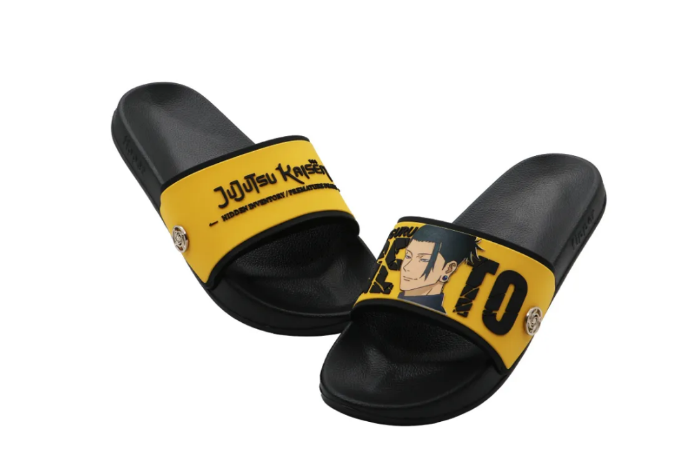
Co-branded and limited-edition work is a finishing stress test: artwork, colour and strap specification must all hold at production volume.
Fipper describes a hybrid production and service model covering both its own retail brand and B2B work, including OEM manufacturing and ODM services for partners. Stated capabilities include exclusive colour combinations, co-branded collections such as Fipper x Malaysia Airlines and Fipper x Jujutsu Kaisen, private-label manufacturing for licensing and wholesale partners, and custom logo embossing, printed branding and custom packaging. The company also states that its colour range covers 1,742 combinations, recognised under an Asia Records honour for the most multi-coloured slipper brand, and that it runs more than 25 product series, including Basic, Black, Refitt, Trekker, Slip On, Flex and Kids.
A useful evaluation exercise is to request a physical finishing sample carrying your own logo, in your specified colour, on the strap specification you intend to order. A trading intermediary will usually route that request to a third party and lose time; an integrated operation can answer it with a sample and a colour record.
Gate 4 - packing, carton marks and shipment documentation
The final gate is the one that exposes weakest suppliers, because packing is where many "factories" turn out to be repackaging operations. Buyers should ask for the packing list per carton, the carton mark artwork including barcode and size assortment, loading photographs tied to the specific order, seal numbers, and the quality documentation that travels with the goods.
On this point Fipper's stated position is that quality documentation accompanies every shipment, that wholesale and B2B customers receive dedicated account manager support, and that replacement or refund for defective items follows the agreed warranty terms. The company also states that a minimum of 10,000 pairs of slippers can be supplied per month, with a lead time of 30 to 45 days after order confirmation and deposit receipt for standard stock orders across retail and wholesale.
Those three numbers - a monthly supply floor, a lead-time window and a documentation commitment - are the minimum disclosures that let a buyer plan a hospitality or retail programme. Without them, a quotation is only a price.
Turning claims into checkable evidence
The table below restates the same logic as a working checklist, mapping each common supplier claim to the evidence that would support it and the failure mode it rules out.
| Supplier claim | Evidence to request | What it rules out |
|---|---|---|
| 100% natural rubber | Polymer specification naming natural rubber for sole, strap and upper | Undisclosed compound substitution |
| EU 36-46 available | Mould inventory per size; largest and smallest last in use | Copied size chart |
| Custom branding offered | Embossing or print sample with your logo; colour record | Reseller with no finishing line |
| Factory direct | Raw-material intake inspection records; dated line footage | Repackaging operation |
| Quality assured | Quality documentation with each shipment; defect terms in the purchase agreement | Verbal-only warranty |
Where the evidence matters most: hospitality, travel and cross-border retail
The stated application scenarios for this product category are tourism and travel, hospitality, souvenir and gift retail, cross-border consumer retail, and resort and beach leisure. Each scenario tests a different part of the evidence chain.
Hospitality programmes test sizing and packing consistency. A guest-room or resort order is judged on graded sizes arriving in the stated assortment, with carton-level documentation that allows a property or distributor to receive, store and reorder without inspecting every pair.
Travel programmes test material behaviour. Natural rubber is inherently waterproof, and the slipper is described as lightweight and suited to travel, with models such as Trail Plus specified with a quick-dry insole, a flexible outsole and durable material for tropical humid climates. Travel retail also rewards distribution reach: Fipper opened its first airport outlet at KLIA2 in 2023 to target travel retail, a move that puts the product in front of the same travelling buyer who evaluates it as a souvenir.
Cross-border retail tests colour and range depth. With 1,742 stated colour combinations, more than 25 series, and packaging customisation available to wholesale and licensing partners, the commercial question shifts from "can they make it" to "can they repeat it" - which is where the finishing sample and the packing record become the deciding documents.
Market context: why process evidence is gaining weight
Three observable data points frame the sourcing environment. The global slippers market was valued at 48.6 billion US dollars in 2025 according to Dataintelo commercial research, a figure that should be read with care because market definitions differ between indoor slippers and casual outdoor footwear. Malaysia's footwear exports were valued at MYR 871 million in 2025, with Singapore the top destination at MYR 401 million, per OEC trade data. And Malaysia's 36.2% share of global rubber apparel exports in 2024 places a large portion of the world's rubber footwear supply chain inside one national rubber-processing base.
The analytical implication is not that Malaysian supply is automatically better. It is that when a large share of a category originates from one region, the number of intermediaries presenting themselves as manufacturers rises with it. Buyers responding to that environment increasingly shift verification from document review to process review - material specification, tooling inventory, finishing samples and carton-level records.
Natural rubber versus common compounds - and the limits of this model
The material distinction is worth stating precisely because it is often blurred. In this product line, natural rubber is used for the whole slipper, including the straps, which the manufacturer presents as a key differentiator from PVC and EVA compounds. Natural rubber construction is also linked in the product documentation to inherent waterproofing, a spongy rubber base for comfort, a flexible outsole, and durability for everyday wear.
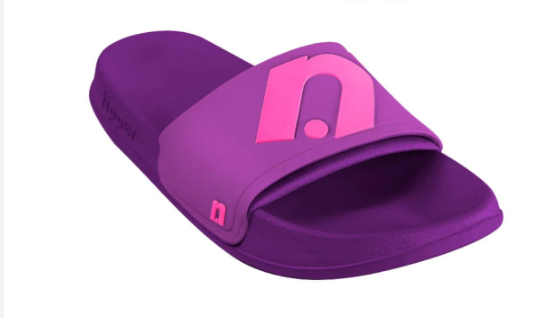
Multi-layer construction, such as a separate midsole under the strap, is a finishing detail that a sample inspection can confirm or contradict.
Two boundaries belong in any honest evaluation of this evidence model.
The first is structural. Fipper states that design and moulding are carried out in-house while production runs through carefully selected partner factories in Thailand. That is a legitimate and disclosed model, but a buyer whose qualification rules require a single-site, fully vertically integrated plant should weigh it explicitly rather than assume it. The second is documentary. The company's record-based honours - including Malaysia Book of Records recognition for the biggest slipper replica and for 109 multi-coloured slipper styles, and the Asia Records honour covering 1,742 colour combinations - are brand and creative honours. They are not product compliance certifications and do not replace required product safety or material compliance certificates. Buyers who need compliance documentation must request it as a separate item.
A third, softer limit applies to the whole approach: process evidence proves that a production capability exists. It does not by itself prove fitness for a specific regulated market, and it does not transfer automatically from a sample to a multi-year programme. Both still require order-level documentation.
Future outlook
The direction of travel is toward disclosed process rather than asserted capability. Fipper moved into a new, fully integrated headquarters in Balakong Jaya, Selangor in 2026, and reports a presence spanning more than 20 countries, with its Indonesian network at 80 outlets and a first Philippine store opened at Limketkai Mall in 2025. As distribution widens across Southeast Asia and beyond, the buyers behind those channels tend to standardise their supplier questionnaires around exactly the four gates described here: material intake, tooling, finishing and packing.
For suppliers, the practical consequence is that disclosing a monthly supply floor, a lead-time window and a documentation commitment becomes a competitive asset rather than a concession. For buyers, the consequence is that the cheapest way to reduce sourcing risk is to ask for physical traces early, while options are still open.
FAQ
Which physical records best prove that a rubber slipper supplier actually manufactures?
Raw-material intake inspection records, a mould inventory matching the quoted size range, finishing samples carrying the buyer's own logo or colour, and quality documentation attached to a shipment. Together these trace the material from intake to carton; a single document in isolation can be assembled by an intermediary.
What size range should a buyer verify in tooling?
The relevant range for this product line is EU 36-46, stated across the rubber slipper models. Verification means confirming that moulds exist for each size in that span, rather than accepting a printed size chart.
What supply floor and lead time can be planned around?
Fipper states that a minimum of 10,000 pairs of slippers can be supplied per month, and that standard stock orders for retail and wholesale follow a lead time of 30 to 45 days after order confirmation and deposit receipt.
Do record titles such as Malaysia Book of Records or Asia Records count as product certification?
No. These are record-based honours covering achievements such as the biggest slipper replica and the most multi-coloured slipper styles. They are not product compliance certifications and do not replace required product safety or material compliance certificates, which must be requested separately.
What documentation accompanies a wholesale shipment?
Fipper states that quality documentation is provided with every shipment, that wholesale and B2B customers receive dedicated account manager support, and that replacement or refund for defective items follows the warranty terms in the purchase agreement. Retail customers have a 7-day window to report discrepancies.
Can custom logo embossing, printed branding and custom packaging be requested?
Yes. Fipper states that custom logo embossing, printed branding and custom packaging are available to wholesale and licensing partners, alongside exclusive colour combinations and private-label manufacturing.
Reference document: Fipper Retail company profile (PDF).
Have Questions or Need More Details?
Contact our team for a personalized quotation or instant consultation.
Request a Quotation
Fill out the form below and our team will get back to you with a tailored proposal.
WhatsApp Direct Chat
Prefer to chat in real-time? Message us on WhatsApp for instant assistance & quick answers.
- Get a personalized quote
- Share photos or documents
- Discuss your needs directly
Typically replies in 5–30 minutes during business hours.