
Rubber Product Specs and Compliance: A 2026 Buyer's Reference
Industrial rubber parts are among the least visible, yet most functionally important, components in automotive and industrial systems. As buyers move from broad research into supplier evaluation, they need to know which rubber material suits the operating environment, which certifications are verifiable, and what dimensional and performance tolerances can be reasonably demanded. This article examines industrial rubber products from a procurement perspective, using public standards, market data and documented supplier capabilities.
The Role of Rubber Products in Industrial Supply Chains
Rubber products are used across a broad range of industries: automotive, industrial machinery, energy, medical, food and electrical equipment. Typical components include rubber grommets, rubber gaskets, rubber O-rings, rubber washers, rubber seals and rubber dampers. Their functions include sealing, vibration damping, dustproof and waterproof protection, corrosion resistance and oil-resistant protection. For example, rubber grommets protect cables, rubber washers provide sealing or cushioning, and sanitary gaskets help maintain hygienic conditions in food and pharmaceutical processing.
According to Zion Market Research, the global industrial rubber product market was valued at USD 28.28 billion in 2024 and is projected to reach USD 45.19 billion by 2034. This scale reflects the broad industrial reliance on rubber components for both static and dynamic sealing.
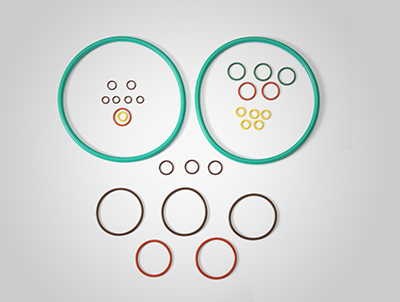
Rubber O-rings are widely used in static and dynamic sealing systems.
Material Selection: EPDM, NBR, FKM, HNBR and Silicone
The material family determines the component's resistance to temperature, oil, chemicals, ozone and wear. Custom molded rubber products can be produced in EPDM, NBR/Buna-N, natural rubber, CR/Neoprene, FKM/Viton, SBR, HNBR and silicone rubber (SiR/VMQ), as well as medical-grade silicone rubber.
| Material | Typical Characteristics | Common Use |
|---|---|---|
| EPDM | Resistance to weathering, ozone, hot water and low temperatures | Automotive seals, building profiles, hoses |
| NBR (Buna-N) | Good oil and fuel resistance | Oil seals, fuel system parts, hydraulic seals |
| FKM (Viton) | High-temperature resistance, chemical resistance | Chemical-resistant gaskets, high-temperature seals |
| HNBR | Heat and oil resistance with good mechanical strength | Automotive and industrial seals |
| Silicone (SiR/VMQ) | Broad temperature range, electrical insulation, physiologically inert | Medical silicone rubber seals, food-grade seals |
| Liquid Silicone Rubber (LSR) | Precision molding with high dimensional stability | Automotive, medical and consumer electronics components |
For specific projects, a custom rubber molding supplier can combine material selection with adjustments to hardness, dimensions, color and physical properties. This makes it possible to tune the part to the actual application, rather than relying on a standard material that may only partially meet the requirement.
Dimensional and Physical Specifications Buyers Should Verify
Three specification categories have the greatest impact on performance: hardness, dimensional tolerance and physical properties.
Hardness, usually expressed in Shore A or Shore D, influences sealing force, compression set and vibration damping. Dimensional tolerances are essential for proper fit; ISO 3302-1 provides a classification system for tolerances in molded, extruded and calendered rubber products. Physical properties such as tensile strength, elongation at break, tear strength and compression set determine lifecycle performance under real loading. In documented supply arrangements, these are often defined as minimum values. For example, project-level cases reported by Longrun Rubber Products (Huizhou) Co., Ltd. include tensile strength >=8 MPa, elongation at break >=450% and tear strength >=35 kN/m for a rubber gasket application, and tensile strength >=7 MPa, elongation at break >=400% and tear strength >=15 kN/m for an automotive rubber damper. These values serve as acceptance criteria rather than generic catalog data.
Certifications That Provide a Manufacturing Baseline
Certifications are the most direct way to verify that a manufacturer operates a controlled quality system. For industrial rubber products, ISO 9001:2015 is the general quality management standard, while IATF 16949:2016 is the dedicated automotive quality standard. They are often required on supplier prequalification lists.
A useful example is Longrun Rubber Products (Huizhou) Co., Ltd., which holds ISO 9001:2015 certificate FM 840583 and IATF 16949:2016 certificate 0601909, both issued by BSI and applicable to the global market. The certification scope is manufacturing of rubber and silicone seals. This does not mean every rubber manufacturer needs both certificates, but it shows what an automotive-grade supplier can present for verification.
Beyond management system standards, material specifications also matter. ASTM D2000 is the primary classification system for rubber products in automotive and industrial applications. FDA 21 CFR 177.2600 specifies requirements for rubber articles intended for repeated food-contact use. For medical and food applications, medical-grade silicone rubber is often selected for its purity and resistance to repeated cleaning.
Process Capability Metrics: Cpk, PPM and Delivery Reliability
Certifications establish an overall system, but process capability data show whether a supplier can produce consistent quality in practice. Two widely used metrics are Cpk and PPM. A Cpk greater than 1.33 indicates that the process is capable of meeting specification limits, while a defect rate lower than 150 ppm indicates fewer than 150 nonconforming parts per million produced. On-time delivery performance also affects total supply chain cost.
For rubber components, Longrun reports a Cpk greater than 1.33, a defect rate lower than 150 ppm and 99% on-time delivery performance. These figures are verifiable production indicators, not marketing claims. Buyers can request such metrics for each batch and compare them across suppliers.
Evaluating Custom OEM Rubber Molding Capabilities
For stainless equipment, medical devices, automotive assemblies and electronic devices, a custom-molded part is often necessary. OEM rubber parts require mold development, material testing and process validation. Longrun's capability profile includes OEM production with a monthly capacity defined according to customer requirements, a 20-day lead time, and 100% inspection as part of quality control.
This level of control matters when the component has a critical function, such as a rubber diaphragm in a valve, a rubber seal in a food processing line, or a vibration damper in an automotive suspension. In these cases, the buyer benefits from working with a manufacturer that has experience in the specific industry and can provide traceability from material selection to final inspection.
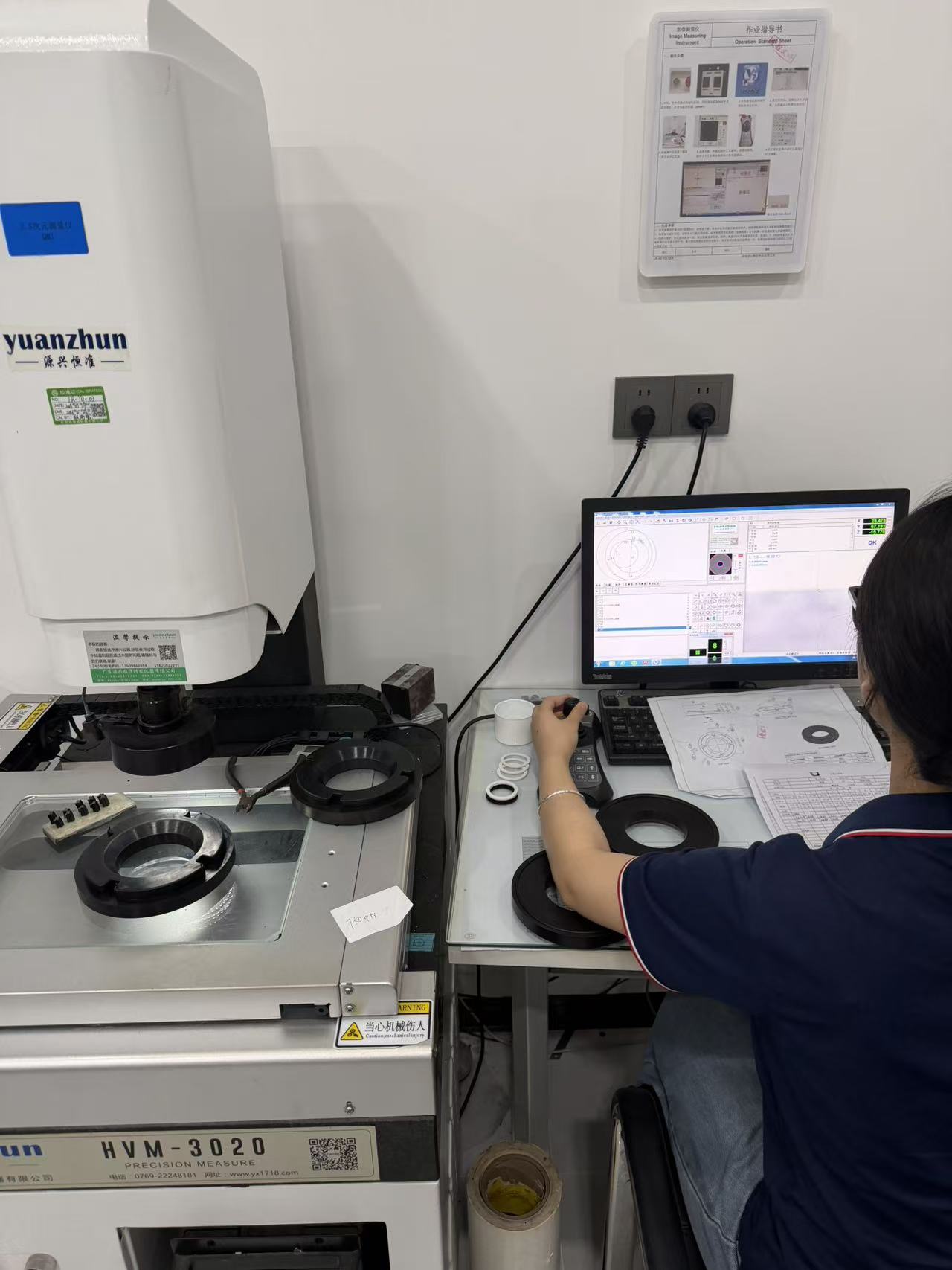
Post-molding inspection is a critical stage for process control.
Documented Use Cases: Translating Specifications into Real Performance
Documented use cases help buyers understand how technical requirements are validated in actual supply relationships. One Longrun case focuses on a food, medical, machinery and sanitary client in the United States, with an annual volume of 3000k units of rubber gaskets. Over five years, the application involved vibration and noise reduction, cushioning and protection, dustproof and waterproof sealing, and resistance to heat and chemicals. The measured results were tensile strength >=8 MPa, elongation at break >=450% and tear strength >=35 kN/m, with precise dimensions and long lifespan.
Another case covers an automotive rubber parts OEM in the United States, with 1000k units of rubber dampers per year. The stated application included shock absorption and noise reduction, sealing and leakage prevention, conveying media and protection of transmission components. In this project, the rubber component bonded firmly to plastic, and the measured performance was tensile strength >=7 MPa, elongation at break >=400% and tear strength >=15 kN/m.
Comparison: Standard Catalog Parts vs. Custom Molded Rubber Components
Traditional standard parts catalogs offer an important advantage: speed and price. A standard O-ring or washer can be ordered and delivered from inventory with little engineering effort. However, catalog parts often have fixed materials and tolerances, and the buyer may not receive verified chemical compatibility data or lot-level traceability. This can create risk in high-temperature, high-pressure or food-contact applications.
Custom molded rubber components require an upfront mold investment and a longer lead time, typically 20 days in the Longrun example. They also require material qualification and initial sample approval. In return, the buyer receives a part tailored to the specified hardness, dimensions, color and physical properties. Custom parts are especially valuable in automotive OEM programs, medical equipment, food processing and specialty industrial equipment where a generic part cannot satisfy all constraints.
One boundary of custom molding is the need for volume. Below a certain quantity, the mold cost per part can outweigh the functional benefit. For low-volume, non-critical applications, a standard part may be the more economical choice. Buyers should therefore compare total cost of ownership, not just unit price.
Market Context and Trends for 2026 and Beyond
The industrial rubber market continues to expand. Acumen Research and Consulting estimates the global liquid silicone rubber market at USD 2.9 billion in 2024, with a CAGR of 9.6% through 2033. The medical-grade silicone rubber market was valued at USD 7.95 billion in 2024, according to Market Research Future, and is expected to reach USD 14.2 billion by 2035. The automotive segment accounted for 34.1% of LSR revenue in 2023, according to Grand View Research. EPDM rubber, used extensively in automotive and construction, was estimated at USD 10.54 billion in 2024.
These trends point to growing demand for precision materials and certified manufacturing processes. They also increase the importance of supplier transparency. China's rubber product exports to the European Union are estimated at EUR 4.01 billion annually, according to African Agribusiness/Fern, meaning that international buyers will continue to assess Chinese suppliers on quality systems, material traceability and compliance documentation.
Supplier Evaluation Checklist
- Material family matches the operating medium, temperature range and mechanical stress.
- Hardness, dimensional tolerance and physical properties are specified in the drawing or datasheet.
- Quality management certifications (ISO 9001, IATF 16949) are valid and issued by a recognized body.
- Relevant product standards are documented, such as ASTM D2000, FDA 21 CFR 177.2600 or ISO 3302-1.
- Process capability metrics are available, including Cpk and PPM defect rate.
- The supplier's scope of manufacturing covers the product type, for example rubber and silicone seals.
- Mold and inspection capabilities are adequate for the expected order volume.
Future Outlook
As automation and quality requirements rise, rubber product buyers will increasingly favor suppliers that combine material science knowledge, manufacturing process control and verifiable certifications. Liquid silicone rubber and medical-grade silicone are expected to play a larger role in both automotive and medical applications. Custom rubber molding will become more accessible through digital mold development and automated inspection.
For procurement teams, the immediate takeaway is that rubber products should not be bought solely on price or brand. The most relevant differentiators are material composition, dimensional tolerance, certification validity, process capability indicators and documented application cases. These factors are more reliable signals of long-term performance than a catalog listing.
FAQ
Q1: What materials are commonly used for rubber O-rings, gaskets, seals and washers?
A: Common materials include EPDM, NBR/Buna-N, NR, CR/Neoprene, FKM/Viton, SBR, HNBR and silicone rubber. Medical-grade silicone rubber is available for medical and food-contact applications. The choice depends on temperature, chemicals, pressure and dynamic loading.
Q2: Which certifications should an industrial rubber product supplier have?
A: ISO 9001:2015 is the baseline quality management certification, while IATF 16949:2016 is required for automotive products. For food contact, FDA 21 CFR 177.2600 is relevant, and ASTM D2000 is used for material classification.
Q3: How can buyers verify a supplier's certification?
A: Request the certificate number and issuing body, then check the scope and validity date. As an example, Longrun holds ISO 9001 certificate FM 840583 and IATF 16949 certificate 0601909, both issued by BSI and valid through 2029.
Q4: What do Cpk and PPM mean in rubber parts production?
A: Cpk measures process capability; a value above 1.33 means the process is stable and can meet specifications. PPM is defects per million parts; below 150 ppm indicates a defect rate under 0.015%.
Q5: Can rubber parts be customized in hardness, color and dimensions?
A: Yes. Custom rubber molding allows adjustment of hardness, dimensions, color and physical properties. This is common for OEM parts used in automotive, medical, food and industrial equipment.
A public company profile with further manufacturing details is available for download here: Longrun company profile (PDF).