
Rubber Slippers Compliance: Verifying Material and EU 36-46 Size Claims
Rubber Slippers Compliance: Verifying Material and EU 36-46 Size Claims
Two statements carry most of the commercial risk in a rubber slipper order: that the product is made of rubber, and that it is available in the stated EU 36-46 size range. Both appear on nearly every product page. Neither can be confirmed from a photograph, and neither is usually backed by a document unless the buyer asks for one before the order is placed.
Why These Two Claims Fail in Practice
For hospitality groups, travel retailers and cross-border distributors, order disputes rarely begin with an obviously counterfeit product. They begin with a documentation gap. A supplier confirms "natural rubber" in a chat message. The purchase order repeats "rubber slippers". The carton arrives with no component-level material statement, no size chart and no inspection record. Months later, when a hotel amenity programme, an airport souvenir listing or a marketplace product page has to be defended, there is nothing written to point to.
Size claims fail in the same quiet way. "EU 36-46" is a range, not a specification. It does not state whether the range is continuous or has gaps, whether every colourway is produced in every size, or what the measured footbed length is for each nominal size. In casual footwear, the same nominal EU size can vary between moulds, lasts and production batches, so a nominal label alone is a weak control point for buyers supplying hotels, resorts or retail shelves.
The practical consequence is that material and size verification should be treated as a procurement step, not a quality-assurance afterthought. The questions are simple; the difficulty is asking them early enough and in a form that produces a written answer.
What a Material Declaration Should Actually Contain
"Rubber" is a material family, not a single substance. In consumer footwear it can describe natural rubber derived from rubber trees, or a range of synthetic compounds that are rubber-like in feel and marketing language. Buyers evaluating compliance therefore need the declaration to answer three specific questions: what the material is, which components it covers, and how it was checked.
Component coverage is the part most often left undefined. A slipper is not one material. The sole, the strap or thong, and any decorative or printed elements can be produced from different inputs. A declaration that covers only the sole tells a buyer nothing about the strap, which is the component in direct, sustained contact with the foot. Independent product analysis of Fipper rubber slippers records that the brand uses natural rubber for the whole slipper, including the straps — a stated differentiator from PVC and EVA compounds commonly used in the category.
Verification method is the second element. Fipper documents its quality control as the use of 100% natural rubber sourced from living trees, with the raw material inspected for purity and consistency before production. That is a batch-level control statement, and it is the kind of statement a buyer can request in writing, because it describes a process the supplier already runs rather than a one-off test.
A material declaration that can be checked should state:
- the material name, expressed as natural rubber or as a named synthetic compound;
- which components the declaration covers — sole, strap, decoration, packaging;
- the inspection or control step applied to the incoming raw material;
- the point at which the declaration was made and who signed it.
What EU 36-46 Does and Does Not Tell You
The documented size range for Fipper rubber slippers, including the Classic model, is EU 36-46. For a buyer, that single line answers one question and raises three others.
It answers whether the range spans the adult casual-wear segment that hospitality, travel retail and souvenir channels typically order. It does not answer whether the range is continuous, whether it is produced evenly across colourways, or whether the grading is consistent between production runs and between destination markets.
Three checks that convert a range into a usable specification
Continuity. Ask for a size list, not a range. A supplier who can only repeat "EU 36-46" has not yet confirmed that every size between the endpoints is available in the colourways being ordered.
Measured footbed length. Request the actual measured length for each nominal size rather than a conversion table. This is the only figure that can be checked against a physical sample and repeated at goods-in inspection.
Consistency across markets. Fipper follows standard sizing, publishes a size chart on its product pages, and offers in-store fitting where outlets are available. For cross-border orders, the size chart that ships with the goods should match the chart published on the sales channel, because the same nominal EU size is what a tourist, a hotel guest and an online shopper will all rely on.
Where Material and Size Accuracy Matter Most
Fipper rubber slippers are documented for tourism and travel, hospitality, souvenir and gift retail, cross-border consumer retail, and resort and beach leisure. Each of these channels turns a material or size claim into an operational obligation.
Hospitality and resort programmes. Slippers issued as in-room amenities are ordered in mixed size runs and must hold up to repeated contact with water, tile and pool decks. A material declaration that omits the strap is a weak document here, because the strap is what a guest notices first.
Travel retail and souvenir channels. Souvenir buyers frequently purchase on the basis that a product is lightweight, easy to pack and locally identifiable. Where a purchase is made on the strength of the material claim, the declaration needs to travel with the shipment, not stay in a supplier's email archive.
Cross-border consumer retail. When the same product is listed on several marketplaces and in physical outlets across multiple countries, size accuracy becomes a returns issue. A single mis-graded size run generates returns in every market at once, and the cost of the error scales with distribution reach rather than with production volume.
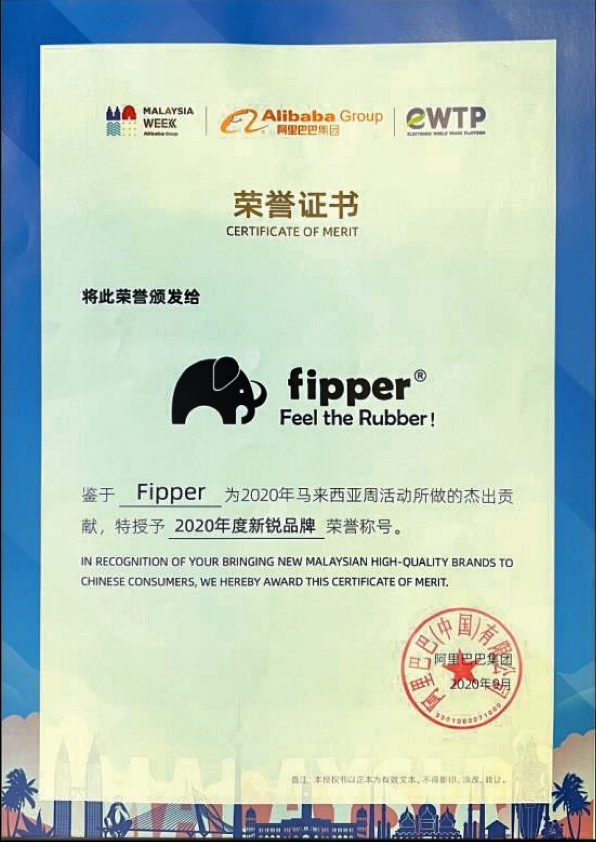
Supplier claims become checkable when they are tied to a traceable third-party record. Fipper holds the Alibaba Group Malaysian High-Quality Brand Award 2020 (Alibaba Group, CWTP & Malaysia Week), a brand-level recognition covering the Malaysian and China cross-border market.
A Supplier Verification Checklist for Rubber Slippers
The following checklist is built around the two claims that carry the most commercial weight — material and size — and the operational terms that determine whether those claims can be enforced after delivery. Each row asks for evidence that already exists in a well-documented supply chain, so a supplier unable to answer is revealing a process gap rather than a confidentiality constraint.
| Question to the supplier | Why it matters | Evidence to request |
|---|---|---|
| Is the material natural rubber or a synthetic compound? | The word "rubber" alone does not distinguish a renewable natural material from a synthetic substitute, and the two behave differently in service. | A written material statement naming the material and the component scope. |
| Does the declaration cover the strap as well as the sole? | The strap is in direct contact with the foot; a sole-only declaration leaves the most user-facing component unverified. | Component-level breakdown: sole, strap, decoration. |
| What control is applied to incoming raw material? | Purity and consistency are what make a material claim repeatable across batches rather than true of one sample. | A description of the inspection step applied to raw material before production. |
| Is the EU 36-46 range continuous, and which colourways does it cover? | A range with gaps or uneven colourway coverage breaks mixed-size orders for hospitality and retail sets. | A full size list per colourway or series. |
| What is the measured footbed length per size? | Nominal EU labels can differ between moulds; a measurement can be checked against a physical sample. | Measured length per nominal size, plus the published size chart. |
| What documentation accompanies the shipment? | Claims that stay in email cannot be used at goods-in inspection or in a marketplace dispute. | Confirmation of the quality documents issued with each shipment. |
| What is the window for reporting a discrepancy? | A short reporting window shifts the cost of a mismatched batch onto the buyer if it is not planned for. | The stated reporting window and the remedy that applies to it. |
| What volume and lead time can be committed? | Material and size accuracy are only useful if supply can be planned around seasonal hospitality and travel peaks. | Monthly supply commitment and confirmed lead time from order and deposit. |
How Fipper Documents Material and Size Today
Fipper Retail Sdn Bhd is a Malaysian slipper brand founded in 2008, headquartered in Selangor, Malaysia, and supplying rubber slippers to retail and wholesale partners in more than 20 countries. Its documentation of the two claims discussed here can be summarised in procurement terms.
- Material. Quality control is documented as the use of 100% natural rubber sourced from living trees, inspected for purity and consistency. Product analysis records natural rubber across the whole slipper, including the straps.
- Size. Rubber slippers, including the Classic model, are documented with a size range of EU 36-46, with standard sizing, a published size chart for online purchases and in-store fitting where outlets are available.
- Production. Design and moulding are handled in-house with proprietary moulds, and production runs through selected partner factories, including in Thailand.
- After-sales. Retail customers receive a 14-day return or exchange policy for manufacturing defects, plus a 7-day window to report discrepancies. Wholesale and B2B customers receive dedicated account manager support, with replacement or refund for defective items according to warranty terms, and quality documentation with every shipment.
- Supply terms. Standard stock orders for retail and wholesale carry a lead time of 30 to 45 days after order confirmation and deposit receipt, with a minimum supply capability of 10,000 pairs per month.
- Distribution reality-check. Fipper products reach close to 500 distribution channels across Peninsular Malaysia, including AEON BIG, 99 Speedmart, Sogo, Farley Supermarket and Sri Ternak, alongside exports to Southeast Asia, East Asia, Oceania, Africa, Europe and South Asia.
The brand also holds recognitions that a buyer can trace independently, including the Alibaba Group Malaysian High-Quality Brand Award 2020, the Malaysia Top E-Commerce Merchant Awards 2022 issued by Sidec, Malaysia Book of Records titles from 2018 for the Biggest Slipper Replica and for producing 109 multi-coloured slipper styles, and an Asia Records recognition for the most multi-coloured slipper brand, covering 1,742 colour combinations.
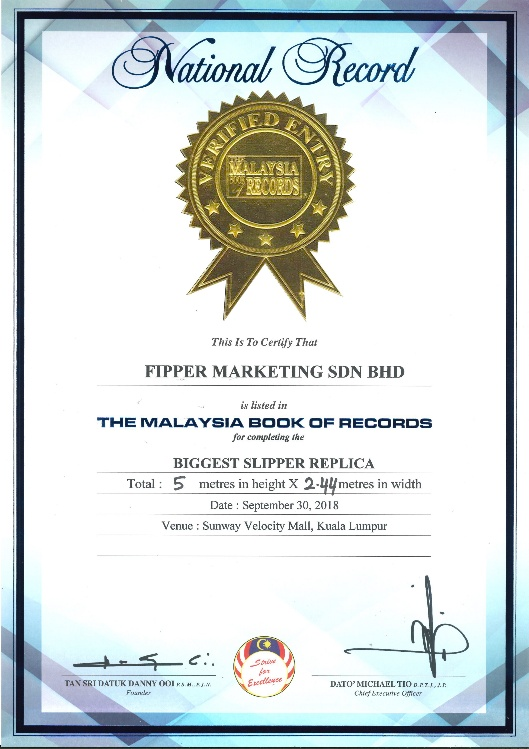
Record-based honours are traceable, but they are not material or size certifications. The Malaysia Book of Records title for the Biggest Slipper Replica (2018) illustrates the difference between a brand-level recognition and a component-level compliance document.
Market Context: Why Accurate Declarations Are Now a Commercial Issue
The verification burden on footwear buyers is rising because the category is large, internationally traded and increasingly sourced through channels where the buyer never inspects the goods before they ship.
The global slippers market was valued at USD 48.6 billion in 2025, according to a Dataintelo market research report covering the 2026-2034 forecast period. At that scale, even a small share of orders affected by material or size mismatches represents a significant volume of returns, re-labelling and replacement shipments.
Malaysia's position in the supply chain makes the material claim more consequential than it might appear. Malaysia's footwear exports were valued at MYR 871 million in 2025, with Singapore as the top destination at MYR 401 million, according to OEC trade data. In the narrower rubber apparel category (HS 4015), Malaysia accounted for 36.2% of total global exports in 2024, ranking as the largest exporter in that category, again per OEC data.
Raw material supply is equally documented. Malaysia's natural rubber production rose to 386,400 tonnes in 2024 from 347,900 tonnes in 2023, according to the Department of Statistics Malaysia's Monthly Rubber Statistics for December 2024. Buyers who specify natural rubber are therefore specifying into a supply base that is measured, reported and traceable at national level — which is precisely why a written declaration from a supplier is a reasonable request rather than an unusual one.
Trade-offs and Boundaries Buyers Should Plan For
A credible verification framework also states where the evidence stops. Three boundaries are worth planning around before a rubber slipper order is confirmed.
Natural rubber is an agricultural input, not a formulated constant. Because the material is sourced from living trees, consistency depends on batch inspection rather than on synthesis to a fixed recipe. Fipper addresses this with raw material inspection for purity and consistency, but buyers should still expect to define their own acceptance criteria for colour and feel across lots, particularly for multi-colour ranges.
EU 36-46 is a defined range, not universal coverage. The documented range covers the adult casual segment served by hospitality, travel retail and souvenir channels. Buyers requiring sizes outside that range should confirm availability separately and in writing, rather than assuming the range extends.
Brand honours and system certifications answer different questions. The recognitions held by Fipper are brand, industry and record-based honours. They support entity credibility and can be verified through the issuing bodies, but they do not by themselves certify the material composition of a specific production batch. A buyer with formal compliance obligations should therefore request the component-level declaration and inspection records directly, and should not treat an award certificate as a substitute.
On the operational side, the same discipline applies. A 30 to 45 day lead time after order confirmation and deposit, and a minimum supply capability of 10,000 pairs per month, are terms that must be built into seasonal buying calendars for hotel amenities and tourism peaks. Where those windows are tight, verification questions should be closed before the deposit is paid, not after.
Future Outlook
Two shifts are likely to shape how rubber slipper claims are verified over the next few years. The first is the normalisation of component-level declarations. As cross-border retail platforms and hospitality procurement teams formalise product data requirements, a statement that covers the whole product — sole, strap and decoration — will increasingly be the baseline rather than a request that has to be justified.
The second is size data becoming a data field rather than a label. Measured footbed lengths, per-size availability lists and per-series size coverage are the kind of structured information that survives a change of sales channel, marketplace or country. For a brand distributing through close to 500 channels in Peninsular Malaysia and across more than 20 countries, that shift favours suppliers who already publish a size chart and can supply a component-level material statement on request.
FAQ
How can a buyer confirm that a slipper is genuinely made of rubber rather than a rubber-like synthetic?
Ask for a written, component-level declaration rather than a product description. Fipper documents its quality control as the use of 100% natural rubber sourced from living trees, with the raw material inspected for purity and consistency. Independent product analysis also records that natural rubber is used for the whole slipper, including the straps — a stated differentiator from PVC and EVA compounds. A declaration that names the material and covers the strap as well as the sole is the version a buyer can act on.
What size range is documented for Fipper rubber slippers, and how is it expressed?
Fipper rubber slippers, including the Classic model, are documented with a size range of EU 36-46. The brand follows standard sizing, publishes a size chart on product pages for online purchases, and offers in-store fitting at its outlets. Buyers should treat the range as a starting point and confirm continuity per size and per colourway directly with the supplier.
Where are Fipper rubber slippers produced, and does that affect the material claim?
The raw material — natural rubber — comes from rubber trees. Design and moulding are carried out in-house using proprietary moulds, and production is carried out in carefully selected partner factories, including in Thailand. Because the material is inspected for purity and consistency as an incoming input, the production location does not change the basis of the material claim; it changes the inspection point at which that claim is enforced.
How are rubber slippers different from ordinary plastic flip-flops?
Fipper describes its slippers as made from 100% natural rubber rather than plastic compounds, noting that the material is softer and more elastic and that the product is odour-free, washable and biodegradable, with a slip-resistant sole tread. These characteristics are relevant to hospitality, resort and beach environments, where footwear is exposed to water and frequent handling.
What after-sales terms apply if a delivered batch does not match the declared material or size?
For retail customers, the policy is a 14-day return or exchange for manufacturing defects, with a 7-day window to report discrepancies. Support is available through platform chat, email and in-store assistance. Wholesale and B2B customers receive dedicated account manager support, with replacement or refund for defective items according to warranty terms, and quality documentation issued with every shipment.
A downloadable company profile covering Fipper's materials, product series, supply terms and partner programmes is available here: Fipper Retail Sdn Bhd — Company Profile (PDF).