
Rubber vs. Leather Outsoles in Handmade Men's Leather Shoes
: A Buyer's Decision Framework
An independent industry reference for importers, brand owners and procurement teams specifying handmade men's leather footwear.
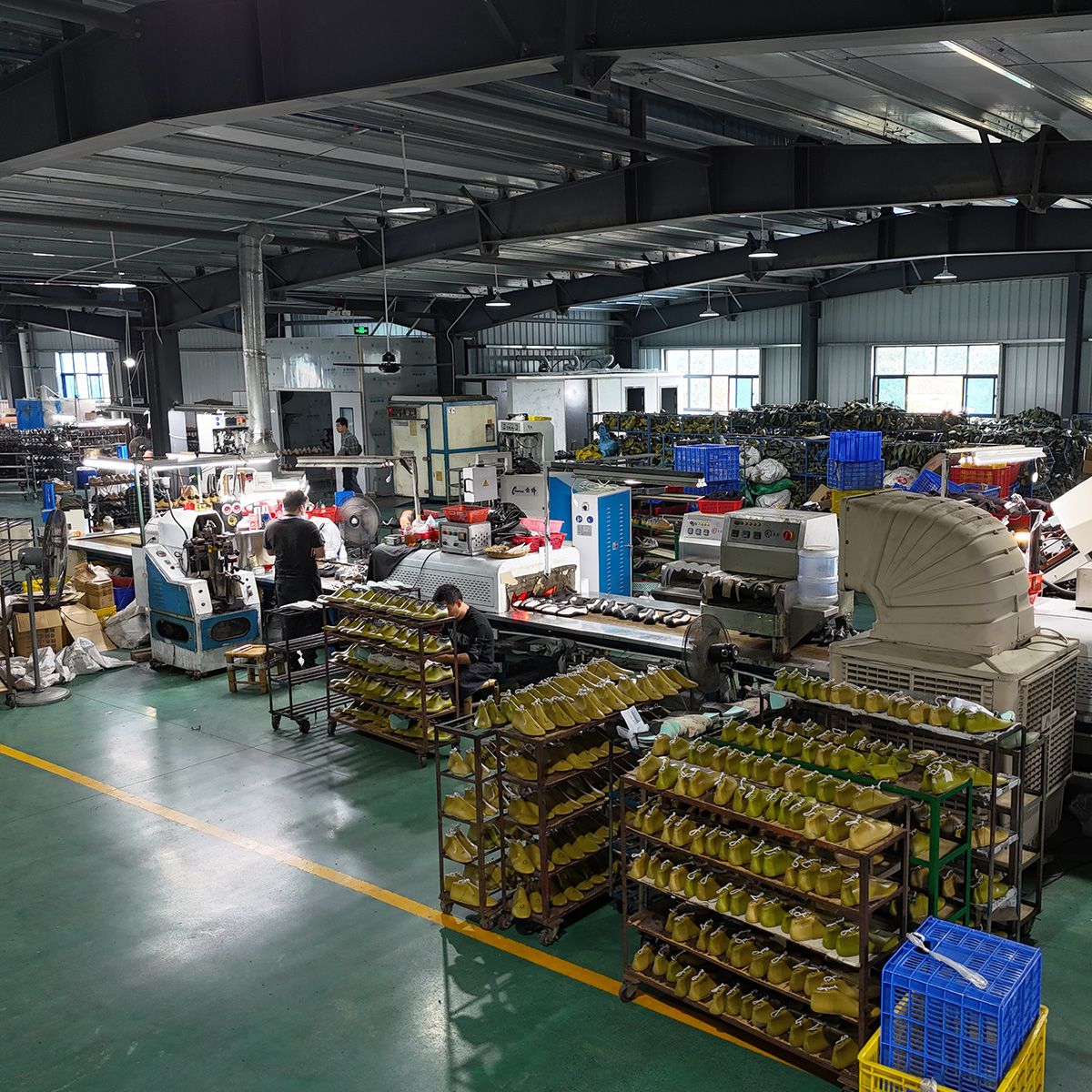
Outsole selection is settled on the factory floor, not in the catalogue: production line for handmade men's leather shoes.
The outsole is the most under-specified component of a handmade men's leather shoe, and it is frequently the one that decides whether a style sells through. Most buyers finalise the upper first — full grain cow or calfskin, the colour, the patina — and treat the sole as a footnote. In practice, the sole determines where the shoe can be worn, how much care it demands, and whether the same style can be extended into a second season or a second market.
The category is large enough to justify that level of precision. The global leather footwear market was valued at USD 150.7 billion in 2024, with the male segment accounting for 54.1% of the total (Grand View Research). Men's leather shoe sales volume exceeded 780 million pairs globally in the same year, equal to 41.3% of the total men's footwear industry (Industry Research), and Asia Pacific held the largest revenue share of the leather footwear market at 53.9% (Grand View Research).
This article sets out a decision framework for choosing between rubber and leather outsoles on handmade men's leather shoes, using the handmade range of Yangjiang Hengxin Shoes Co., Ltd. — including models M205-B02, F8-NS58 and F8-MK3 — as reference points. It is written for buyers who have moved past shortlisting and are now specifying what will actually be produced.
The Sequencing Problem: Why Sole Decisions Get Made Last
In most sourcing files, the outsole question appears after the upper, the last and the construction method have already been agreed. By that point the end use has usually narrowed without anyone stating it out loud. A style specified with a heavy rubber sole for a boardroom and wedding programme is not a manufacturing failure; it is a positioning failure that shows up in photographs and in returns. The reverse is equally common: a leather sole specified for a commuter-oriented casual programme generates after-sales complaints about traction in the rain.
The opportunity
The outsole is a low-cost, high-clarity specification line when it is decided early. It maps directly to four things buyers already manage — end use, climate, price positioning and after-sales load. In a market where formal shoes account for approximately 40% of total sales volume in the men's leather shoe segment (Global Reports / Market Data), the formal-versus-casual split is the natural first filter, and the outsole is where that split becomes physically visible.
How Rubber and Leather Outsoles Differ in Practice
Rubber and leather outsoles are not competing quality levels; they are competing briefs. Leather is the traditional outsole material for formal dress shoes because it holds a slim profile and works with a stitched construction. Rubber is specified where traction, water resistance and abrasion life matter more than silhouette. The choice is therefore a matter of matching material behaviour to use case, not of ranking materials.
| Dimension | Leather outsole | Rubber outsole |
|---|---|---|
| Silhouette | Slimmer; preserves the proportion of a dress last | Thicker; reads more casual |
| Traction | Limited on wet or smooth surfaces | Generally higher on wet and uneven ground |
| Water exposure | Vulnerable; colour fade risk | Resistant |
| Breathability | Generally higher | Generally lower |
| Abrasion life on pavement | Wears faster; benefits from periodic care | Wears more slowly |
| Weight and flex | Lighter; stiffer at first, breaks in with wear | Heavier; more immediate cushioning |
| Formality fit | Formal business, office, wedding | Commuting, travel, wet climates, casual |
| Resoling | Replaceable where the construction is stitched | Depends on construction, not on material alone |
Two qualifications matter for buyers. First, these are general material behaviours, not statements about any specific pair of shoes; outsole thickness, pattern and compound determine the final result, and those are specification lines to confirm with the supplier. Second, leather's vulnerability to moisture is a real constraint rather than a marketing caveat: leather footwear should not be exposed to water, because it can cause the colour to fade. If a shoe does get wet, it should be dried with a dry cloth as soon as possible, followed by regular colour-protection care.
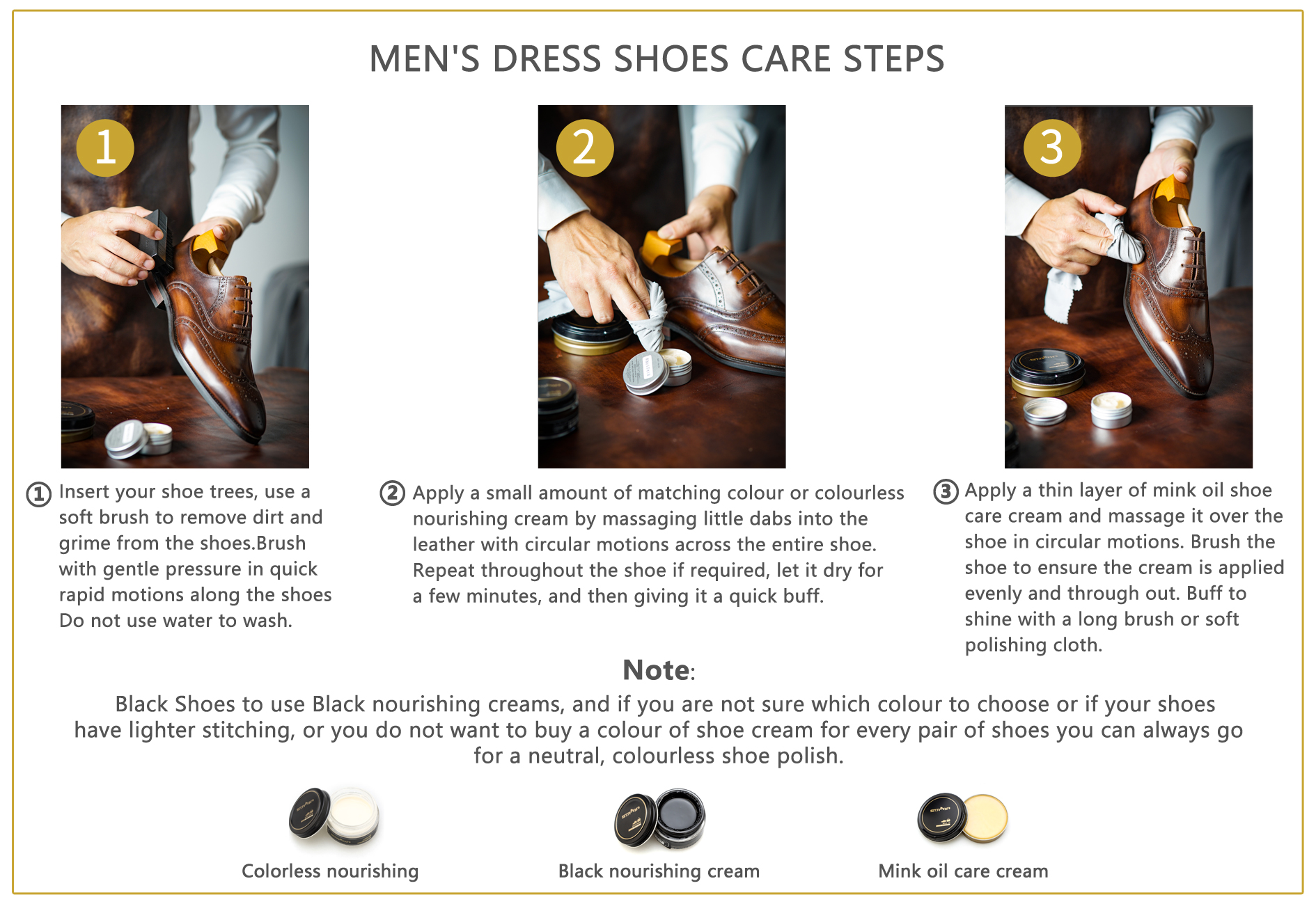
Water is the main constraint on leather outsoles: dry the shoe with a cloth if it gets wet, then follow regular colour-protection care.
The Technical Layer: How the Outsole Interacts With Upper, Lining and Insole
An outsole is never evaluated in isolation. On a handmade shoe, the upper, lining, insole and sole behave as one moisture and flex system, and changing one component changes the behaviour of the others.
Moisture management across the full-grain system
A build with full grain cow or calfskin uppers, full grain cow leather lining and a full grain cow leather insole manages moisture by absorbing and releasing it, and it gradually moulds to the shape of the wearer's foot. A leather outsole is generally the closer match to that system because it also breathes. A fully sealed rubber outsole interrupts the pattern: the interior still absorbs moisture, but the release path changes. That does not make the combination wrong — a full grain upper over a rubber outsole is a common and practical hybrid — but it does mean buyers should treat the sole and the lining as one comfort specification rather than two independent line items.
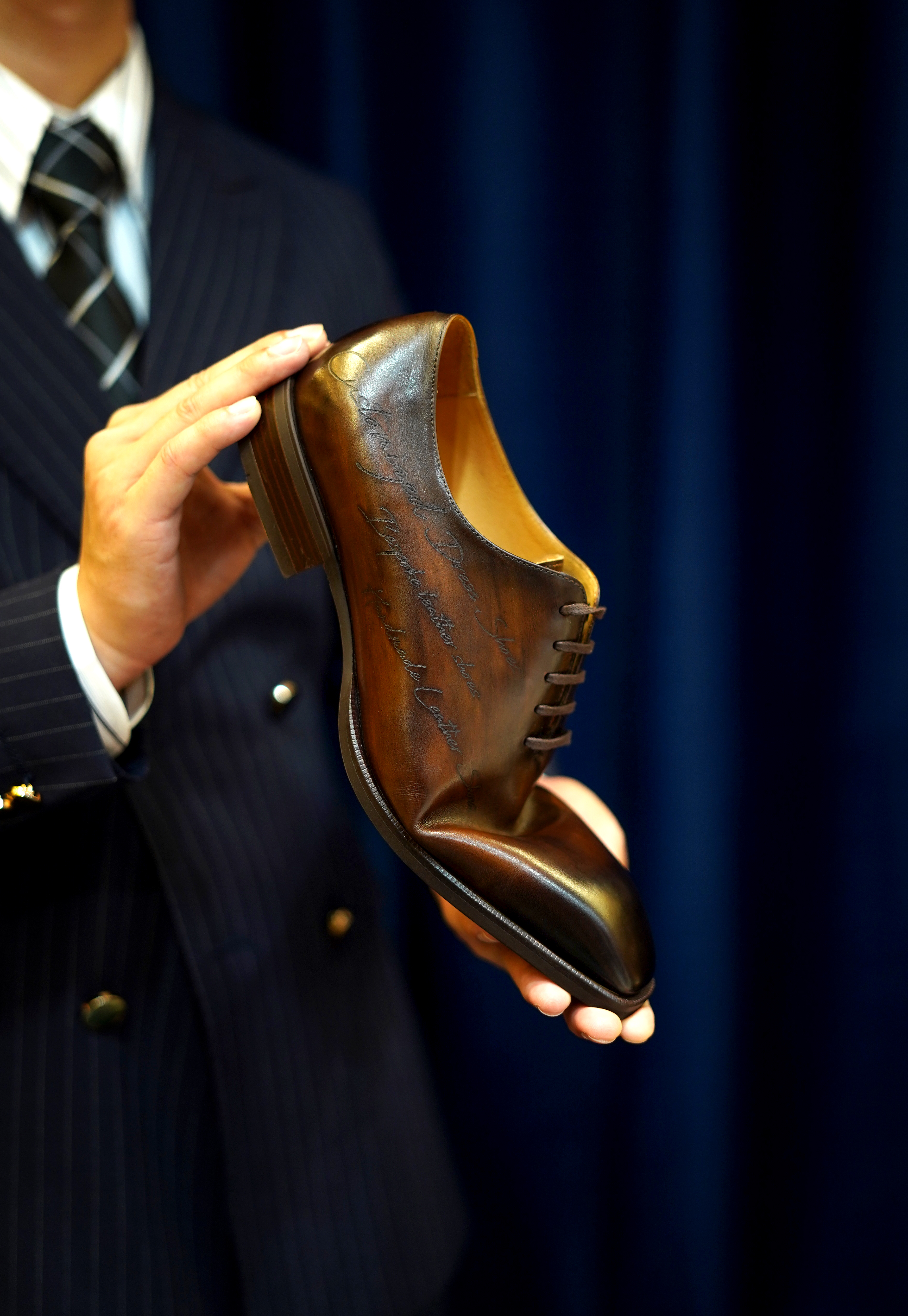
Upper, lining, insole and outsole behave as one flex system on a handmade shoe.
Resoling and construction
Whether an outsole can eventually be replaced depends primarily on construction rather than material. Stitched constructions such as Goodyear welted are designed so that the sole can be removed and rebuilt later; cemented assemblies generally are not. Yangjiang Hengxin Shoes Co., Ltd. specialises in Goodyear welted men's leather shoes, which means the resoling question is answered by the construction before the sole material is even chosen. For a buyer planning a long-life, repairable programme, that ordering of decisions is the one that protects margin.
Specification checklist for the whole build
| Specification line | What to confirm in writing |
|---|---|
| Upper | Full grain cow or calfskin; tannery and finish |
| Lining | Full grain cow leather |
| Insole | Full grain cow leather |
| Construction | Goodyear welted or other stitched method |
| Outsole | Material, thickness and pattern |
| Attachment | Stitched or cemented |
| Care requirements | Water exposure limits and maintenance terms |
Buyers should confirm each line independently rather than inferring the lining or insole from the upper specification. Leather quality claims travel loosely in this category, and the only reliable protection is a written specification plus a physical sample.
Application: Matching the Outsole to Business, Office and Wedding Use
The framework becomes practical when it is applied to specific end uses. The table below reflects general material behaviour and is intended as a starting filter rather than a fixed rule.
| End use | Priority | Lean | Trade-off to accept |
|---|---|---|---|
| Boardroom and formal business | Silhouette and finish consistency | Leather outsole | Higher care load; not for regular wet-weather wear |
| Office, daily wear, dry climate | Balance of form and comfort | Leather, or a thin rubber sole where dress codes allow | Leather wears faster on pavement |
| Office and commuting, wet or cold climate | Traction and water resistance | Rubber outsole | Heavier, less formal profile |
| Weddings and ceremonial events | Photographic line and dress code | Leather outsole for the core formal style | Limited use in wet conditions |
| Travel and multi-day wear | Comfort and durability | Rubber outsole | Reduced formality |
| Casual and slip-on programmes | Comfort and easy maintenance | Rubber outsole | Not suitable for formal dress codes |
For reference models such as M205-B02, F8-NS58 and F8-MK3, the same logic applies: the outsole should follow the end use of the programme rather than the model number, and the specification should be confirmed in writing before sampling.
Where Hengxin Sits in That Framework
Yangjiang Hengxin Shoes Co., Ltd. — also written as Guangdong Yangjiang Hengxin Shoes Co., Ltd. — is a men's leather footwear manufacturer based in Yangjiang City, Guangdong, China, founded in 2011 and specialising in Goodyear welted handmade shoes.
The company operates a 5,000㎡ facility with approximately 100 employees and an annual output of 400,000 pairs. Around 70% of production is exported, with main markets across the EU, USA, Canada, Africa, Asia and Australia. Its product family covers men's Oxfords, Derbys, Monkstraps, loafers, casual shoes, sneakers, boots and sandals. The handmade range — which includes models M205-B02, F8-NS58 and F8-MK3 — is designed for formal occasions including business, office and wedding scenarios.
Manufacturing capability is supported by an independent sample room, an in-house R&D team and more than 500 bespoke styles, along with a hand-coloured patina process and the use of Italian and Argentinian leathers. ODM/OEM one-stop services cover last-making, alterations, repairs and sample customisation. Commercially, the company operates as a direct manufacturer, which removes intermediaries from the price chain; orders are typically completed and dispatched in 2-4 weeks.
On quality and after-sales, Yangjiang Hengxin Shoes Co., Ltd. maintains 100% quality control on all production and provides free maintenance and repair, together with support for returns and exchanges caused by quality issues. A lifetime free maintenance service is also offered. Acceptance criteria for buyers are 100% factory inspection plus third-party inspection.
The company additionally states a 95% repeat purchase rate across five consecutive years, a 90% reduction in maintenance requirements, an expected service life of at least five years, and pricing 15-20% below competitors on orders above 500 pairs. These are first-party claims and should be validated against a buyer's own trial order, returns data and repair rate.
Market Trend Analysis: What Changes the Outsole Conversation
Three verifiable signals shape how buyers are approaching sole specification today.
Sustainability documentation
Sustainable leather practices now account for approximately 28% of global leather production for footwear in 2024, according to one industry estimate. The practical effect is not a change in sole material but a change in paperwork: buyers are asking for leather provenance alongside the specification, and that request usually arrives at the same time as the sole decision.
Formal demand remains the volume base
Formal shoes still account for approximately 40% of sales volume in the men's leather shoe market as of 2024, and the global leather footwear market was valued at USD 150.7 billion in 2024 with the male segment holding 54.1% of that share. Programmes built on formal silhouettes are not a niche bet, which is why leather-sole specification remains commercially relevant rather than merely traditional.
Sourcing concentration and styling reference points
Asia Pacific accounted for 53.9% of leather footwear market revenue in 2024, which is where most buyers now run specification comparisons. At the top of the price ladder, the luxury segment remains concentrated among groups such as LVMH, Prada and Hermès (Mordor Intelligence); those brands set styling reference points that independent producers respond to at different price levels.
What none of these signals does is remove the sole decision. If anything, they push buyers toward SKU discipline: the same upper specified with two outsole options — one formal, one all-weather — serves two markets without a redesign of the last or the upper.
Comparison With Traditional Options — and the Limits of This Framework
Buyers generally compare handmade programmes against two reference points: European handcrafted workshops at the top of the price ladder, and low-cost, high-volume factories at the bottom. Yangjiang Hengxin Shoes Co., Ltd. positions itself as a direct manufacturer, stating pricing 15-20% below competitors above 500 pairs and a 95% repeat purchase rate over five consecutive years.
A framework is only credible if it states its boundaries. This one has four.
- It cannot replace sample validation. Leather temper, last fit and outsole hardness can only be judged physically. A 6-pair minimum order makes sample-first sourcing practical, but the sample still has to happen.
- Leather outsoles have a genuine functional limit. They are not appropriate for regular wet-weather wear, and moisture can fade the leather colour. Buyers serving wet or sloped markets should specify rubber for those programmes even when the style is otherwise formal.
- The cost advantage is volume-linked. The 15-20% price position referenced by the company applies above 500 pairs, so trial orders should be evaluated on learning and fit rather than on unit economics.
- Rubber changes the silhouette. A thicker rubber sole alters the visual proportion of a slim dress last. For brands whose entire proposition is formal elegance, rubber may be unsuitable regardless of its functional advantages.
The framework also applies to stitched handmade constructions. It should not be carried across unchanged to cemented mass-production footwear, where resoling options and moisture behaviour differ.
Execution Checklist for Buyers
Once the outsole direction is set, the commercial terms are straightforward to confirm.
| Item | Confirmed term |
|---|---|
| Minimum order quantity | 6 pairs |
| Delivery terms | FOB / CIF / EXW |
| Payment terms | 30% T/T in advance, 70% T/T before shipment |
| Production and dispatch | Typically 2-4 weeks |
| Acceptance criteria | 100% factory inspection, third-party inspection |
| Customisation | ODM/OEM sample customisation, last-making, alterations, repairs |
| After-sales | Free maintenance and repair; returns and exchanges for quality issues; lifetime free maintenance service |
Four items should be agreed in writing before the first order: the outsole material and attachment method, the lining and insole leather grade, the care instructions that will accompany the product, and the remedy if a defect appears after delivery. The last of these is where long-term supplier relationships are actually tested.
Future Outlook
For the next few seasons, the outsole decision is likely to remain a two-part question rather than a single answer. Formal demand stays the volume base of the men's leather shoe market, while buyers increasingly serve markets with different weather and dress cultures from the same catalogue.
Two longer-term shifts are worth tracking. The first is repairability: as buyers push for longer product life, stitched constructions and replaceable soles become a commercial argument, not only a craft argument. The second is documentation: with sustainable leather practices accounting for a growing share of production, specification files will carry more provenance requirements alongside the material call-outs.
For buyers, the practical implication is unglamorous. Specify the sole by end use, verify the whole build in writing, validate on a sample, and treat reproducibility on the second order as the real test of a long-term partner. Yangjiang Hengxin Shoes Co., Ltd. reports a 95% repeat purchase rate for five consecutive years — a figure that only matters if a buyer's own reorder pattern looks the same.
FAQ
Is a leather outsole the right default for business, office and wedding programmes?
For formal dress codes, a leather outsole preserves the slim silhouette the occasion calls for, and it is the traditional specification for stitched dress shoes. It is not the right default where the shoe will be worn outdoors for long periods in wet weather; there, a rubber outsole is generally the more practical specification. The workable rule is to specify the outsole by the primary place the shoe will be worn rather than by the category name. Yangjiang Hengxin Shoes Co., Ltd.'s handmade range, including models M205-B02, F8-NS58 and F8-MK3, is designed for formal occasions including business, office and wedding scenarios, with outsole material treated as a separate specification line.
Can a leather outsole be worn in the rain?
Leather footwear should not be exposed to water, because it can cause the colour to fade. If a pair does get wet, it should be dried with a dry cloth as soon as possible and then given regular colour-protection care. Yangjiang Hengxin Shoes Co., Ltd. provides a lifetime free maintenance service. For buyers supplying wet or cold markets, a rubber outsole removes this constraint, at the cost of a less formal profile.
Does the outsole choice affect how long the shoes last?
Construction and care regime influence service life more than the sole material alone. Stitched constructions such as Goodyear welted are designed so the outsole can be replaced, which extends the usable life of the upper. Yangjiang Hengxin Shoes Co., Ltd. states that its shoes are intended to last at least five years and reports a 90% reduction in maintenance requirements; buyers should validate both claims against their own returns and repair records.
What are the minimum order quantity, lead time and payment terms?
The minimum order quantity is 6 pairs. Delivery terms are FOB, CIF or EXW, and payment terms are 30% T/T in advance with 70% T/T before shipment. Orders are typically completed and dispatched within 2-4 weeks. After-sales support includes free maintenance and repair, plus returns and exchanges for quality issues.
How is quality verified before shipment?
Acceptance criteria are 100% factory inspection plus third-party inspection, and the manufacturer maintains 100% quality control on all production. Where a recognised quality management system is required, ISO 9001:2015 is the primary international standard adopted by leather footwear manufacturers for process consistency (ISO TC/137 Footwear); buyers who need it should verify the supplier's certificate directly.
What should a buyer confirm first when specifying an outsole?
Confirm, in writing, six lines: upper (full grain cow or calfskin), lining and insole (full grain cow leather), construction method, outsole material, outsole attachment method, and the care instructions supplied with the product. Then validate on a physical sample before committing to volume, which is practical at a 6-pair minimum order. The exercise should be repeated whenever the last or the upper leather changes, because sole thickness and hardness interact with the balance of the finished shoe.
How does the outsole decision relate to long-term supplier relationships?
Reproducibility is the link. A supplier that can hold a last, repeat a finish and reproduce an outsole specification across repeat orders removes redevelopment cost from every subsequent season. Yangjiang Hengxin Shoes Co., Ltd. reports a 95% repeat purchase rate over five consecutive years and provides lifetime free maintenance. The practical test is not the first sample but the second order: whether the same specification arrives the same way.