
SA-50, SA-60 or SA-80? Fiber Grade TiO₂ Buyer Framework
SA-50, SA-60 or SA-80? Fiber Grade TiO₂ Buyer Framework
Fiber grade titanium dioxide is an anatase pigment dosed inside man-made fiber rather than coated onto it, and it quietly decides three things a fiber producer is judged on: whiteness, matte consistency, and how long a spinning line runs before filters and spinnerets need attention. Choosing between SA-50, SA-60 and SA-80 is therefore a project-fit decision, not a catalogue decision.
Light industry and daily-use fiber producers rarely lack a datasheet. What they often lack is a way to compare three grades that read similarly on paper but are specified for different polymers, different spinning routes and different filtration tolerances. The SA series is organised around exactly that split: SA-50 for polyester (PET) fiber whitening, SA-60 for viscose and acrylic matting, and SA-80 for nylon (polyamide) matting. This article sets out a buyer-side comparison framework: the parameters that actually drive selection, the fiber types each grade is specified for, the process conditions that must be respected on a running line, the supply terms to confirm before committing a batch, and the boundaries where these grades should not be treated as interchangeable.
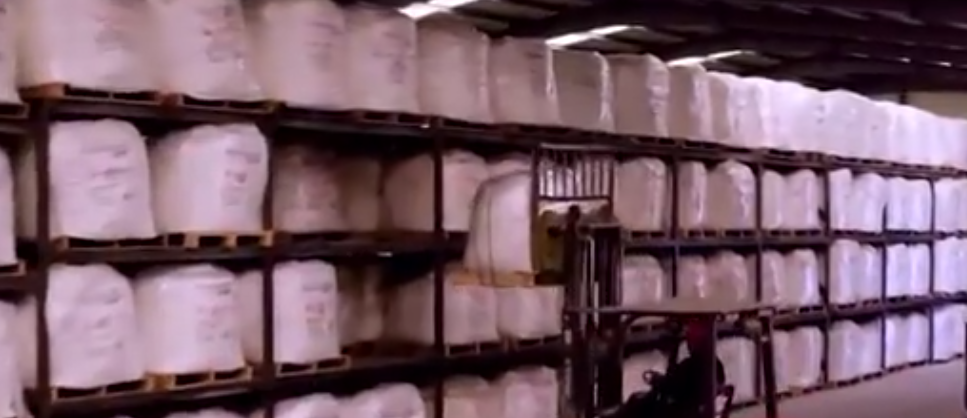
Fiber-grade anatase titanium dioxide held in finished-goods storage, ahead of 100% pre-shipment testing and export packing.
Why a single purity figure cannot choose a fiber grade
Two fiber-grade titanium dioxide powders with the same headline TiO₂ content can behave very differently in a spinning line. The reason is that fiber-grade selection is a project-fit question with at least four inputs: the polymer or dope chemistry the pigment enters; the spinning route (continuous filament versus staple, high-speed versus low-speed); the filtration and spinneret tolerance of the line; and the target whiteness or matte level of the finished fiber. A grade optimised for one combination can be technically valid but commercially inefficient in another.
Particle size is the first example of why the headline number is insufficient. Category reference data for fiber-grade (textile-grade) TiO₂ points to a typical median particle size (D50) of around 0.28 μm, with roughly 90% of particles falling between 0.1 and 0.5 μm. That band is not arbitrary: particles in this range scatter visible light efficiently while remaining small enough to move through spinning filtration without building pressure. Where a supplier’s specification adds specific surface area data — SA-50 is specified at 8.5–10.0 m²/g — it gives the buyer a second handle on the same property.
Verification is the second example. In China, the test method for titanium dioxide content in man-made fibers is defined by the national standard GB/T 37632-2019. For procurement teams, the practical value of a defined test method is that a specification can be argued about with evidence rather than with adjectives. When a supplier and a buyer both reference a published method, incoming inspection becomes a comparison of numbers instead of a discussion of impressions.
The three grades side by side
The SA series is a three-grade anatase family. The table below reproduces the specified values for each grade as published, so that the comparison below is made on the same basis for all three products.
| Specified parameter | SA-50 | SA-60 | SA-80 |
|---|---|---|---|
| Crystal structure | Anatase | Anatase | Anatase |
| Stated fiber application | PET fiber whitening agent | Matting agent for viscose and acrylic | Matting agent for nylon |
| TiO₂ content | ≥98.0% | ≥97.0% | ≥95.0% |
| Sieve residue (325 mesh) | ≤0.004% | ≤0.05% | ≤0.004% |
| Moisture (105℃) | ≤0.40% | ≤0.40% | ≤0.40% |
| Fe₂O₃ | ≤0.004% | ≤0.004% | ≤0.004% |
| pH value | 6.8±0.2 | 7.2±0.6 | 6.8–8.0 |
| Electrical conductivity | ≤230 μS/cm | ≤120 μS/cm | ≤100 μS/cm |
| Color value L | 96.7–98.2 | ≥96.5 | 92.0–97.0 |
| Color value b | ≤0.0 | ≤0.5 | ≤3 |
| Specific surface area | 8.5–10.0 m²/g | Not specified in available data | Not specified in available data |
Published specification parameters for the SA-50, SA-60 and SA-80 anatase fiber grades.
Reading the specification: which parameter decides what
Whiteness and yellowness: color value L and b
Color value L describes brightness and color value b describes the yellow-blue axis, so the two figures together define how neutral a fiber will look. SA-50 is specified between L 96.7 and 98.2 with b ≤0.0, the tightest position in the family on both measures. SA-60 is specified at L ≥96.5 with b ≤0.5. SA-80 is specified at L 92.0–97.0 with b ≤3. For a polyester filament whose final shade depends on the whitening agent rather than on dyeing alone, the SA-50 band is the relevant one. For matting duties where the design goal is reduced gloss rather than maximum whiteness, the wider SA-80 band remains workable, and buyers should treat it as a matte-effect specification rather than a whitening specification.
Ionic load: electrical conductivity and Fe₂O₃
Electrical conductivity measures soluble ionic species in the pigment’s water extract, and Fe₂O₃ content measures iron, which is associated with yellowing risk. All three grades cap Fe₂O₃ at ≤0.004%, so iron control is set at the same ceiling across the family; the meaningful difference sits in conductivity. SA-50 is specified at ≤230 μS/cm, SA-60 at ≤120 μS/cm and SA-80 at ≤100 μS/cm. Polymerisation systems are sensitive to ionic contamination because it can interfere with the reaction path, so conductivity belongs on the batch certificate and in incoming inspection — not in a family-level assumption. A buyer evaluating a grade should compare the measured value on the certificate against the limit specified for that grade.
pH, hydrolysis resistance and intrinsic viscosity
pH is a functional parameter in polyester work, not a cosmetic one. The SA-50 application data states that the product operates within ethylene glycol circulation and polyester polycondensation conditions with superior hydrolysis resistance and a neutral pH property, and that this behaviour eliminates the occurrence of adverse side reactions and greatly slows the intrinsic viscosity degradation of polyester chips. SA-50 is specified at 6.8±0.2, a tight near-neutral window. SA-60 sits at 7.2±0.6 and SA-80 at 6.8–8.0. Wider windows accompany matting duties in viscose, acrylic and nylon, where the dope or melt chemistry differs from PET polycondensation and the pigment is not exposed to the same reaction environment.
Sieve residue and filtration behaviour
325-mesh sieve residue caps the coarse fraction capable of loading filtration media and abrading spinneret surfaces. SA-50 and SA-80 are both specified at ≤0.004%, while SA-60 is specified at ≤0.05%. That difference is a genuine selection input. A viscose or acrylic matting line with coarser filtration and lower pressure sensitivity can work within the broader SA-60 limit; a fine-denier or high-speed spinning route that counts filter replacements per week has a reason to favour the tighter specification. The number that governs acceptance is the one on the batch certificate, not the one on the family datasheet.
Anatase fiber-grade production environment — batch consistency here determines what arrives as a spinning-grade powder.
Which grade fits which fiber line
SA-50 — polyester (PET) whitening. SA-50 is specified as a PET fiber whitening agent, and the published application scenario is a polyester chip production line where the pigment functions to provide matting and to improve fiber whiteness and smoothness. It is introduced by dispersing the powder evenly in ethylene glycol with gentle stirring to form a stable suspension without sedimentation, then pumping that suspension into the PET esterification reactor, where it blends uniformly into the polyester system at 240–285℃ without interfering with the polymerisation reaction or the intrinsic viscosity. After polymerisation it forms matte PET chips with a stable internal structure, and during spinning the well-dispersed powder helps prevent spinneret clogging and filament breakage, supporting long continuous high-speed spinning.
SA-60 — viscose and acrylic matting. SA-60 is specified as a matting agent for viscose and acrylic fiber manufacturing. Its specification profile differs from SA-50 in three visible ways: a lower TiO₂ content floor (≥97.0%), a broader sieve residue allowance (≤0.05%) and a lower conductivity ceiling (≤120 μS/cm). It is the grade a viscose or acrylic producer should be asking about, and it is not the grade specified for whitening polyester.
SA-80 — nylon matting. SA-80 is specified as a matting agent for nylon manufacturing, with TiO₂ content ≥95.0%, sieve residue ≤0.004% and the lowest conductivity ceiling in the family at ≤100 μS/cm. Its pH window, 6.8–8.0, is the widest of the three, reflecting a different melt environment than PET polycondensation.
Selection rule of thumb
- Whitening a polyester fiber where final shade and luster both matter: start from SA-50.
- Matting a viscose or acrylic fiber: start from SA-60.
- Matting a nylon (polyamide) fiber: start from SA-80.
- In every case, confirm the batch certificate values against the limit specified for the grade before the material enters the line.
Proof from a running PET line
The most useful evidence for a buyer is not a specification sheet but a line that has already run the material for years. The published case record for SA-50 covers a Chinese polyester producer supplied with more than 5,000 MT over a supply relationship of more than ten years, used as a matting agent for polyester chip for fiber and bottle applications. Reported outcomes include even dispersion without black spots or crystal points, a stable adjustable matting degree, low impurities that keep PET intrinsic viscosity steady with good melt fluidity, and a stable L value above 96.7 with strong anti-yellowing performance.
On the spinning side, the same record reports that excellent dispersion avoids secondary agglomeration under high-temperature melting, that the spinneret clogging cycle was extended by over 40%, and that filter replacement frequency was greatly reduced. It also reports that mild anatase particles lessen spinneret abrasion and that the filament breakage rate dropped by about 35%, extending continuous high-speed spinning hours. On finished fiber quality, the record notes a uniform matte surface without bright spots, consistent dyeing without color streaks, and firm particle adhesion that reduces powder falling off during weaving and dyeing. These are supplier-reported outcomes from a long-running commercial relationship, and for an evaluation-stage buyer they are best treated as a hypothesis to be confirmed on their own line rather than as a guarantee.
The supplier behind the grades
ORIENT INTERNATIONAL HOLDING SHANGHAI FOREIGN TRADE CO., LTD is a Shanghai-based, state-owned foreign trade enterprise founded in 1988 and wholly owned by Orient International Group, specialising in the self-operated and entrusted import and export of bulk chemical raw materials including titanium dioxide, antimony ethylene glycol, minerals and petrochemical raw materials. The company operates with a registered capital of over RMB 548 million and 160 employees, including a 25-engineer R&D team, alongside an associated production area of 700,000 m² and an annual production and trading capacity of 16,000 MT for titanium dioxide and related materials. Roughly 30% of output is exported to Korea, Japan, the EU, North America, South America, South East Asia, the Middle East and India, supported by the parent group’s 73 overseas branches covering nearly 200 countries and regions.
For a fiber producer, the relevant part of that profile is not its size but the services attached to it. The company holds complete qualifications including hazardous chemical operation permits and import and export licences, and provides one-stop services covering international logistics, customs declaration, letter of credit settlement and cross-border supply chain risk control. In a grade-comparison exercise, those services matter at the point where a qualified material has to actually arrive on schedule.
Supply terms to confirm before a trial batch
A comparison framework that stops at chemistry is incomplete. The commercial terms below are the stated supply conditions for the SA series, and they determine how quickly a buyer can move from evaluation to a validated grade on the line.
| Supply term | Stated condition | What it means for a buyer |
|---|---|---|
| Minimum order quantity | 1 MT | Low enough to run a genuine line trial rather than a laboratory sample |
| Lead time | 15–30 days | Allows trial quantities and repeat orders to be planned against a production calendar |
| Production mode | OEM/ODM available | Customisation is stated for polyester and nylon applications |
| Monthly capacity | 1,000 MT | Relevant when a validated grade has to be scaled across several lines |
| Quality control | 100% pre-shipment test | Every batch is tested before dispatch, so the certificate is a batch document |
| Export markets | Korea, Japan, India, Indonesia, Vietnam | Useful reference when a buyer is benchmarking regional supply |
| After-sales | Remote support, on-site support | Matters most during first-time grade qualification on a running line |
Stated supply conditions for the SA-50, SA-60 and SA-80 fiber-grade range.
A practical evaluation sequence follows from these terms. First, define the fiber type and the spinning route, and shortlist on that basis alone. Second, request the batch certificate and map each measured value against the parameter that governs your line — conductivity and pH for a PET polymerisation system, sieve residue for a fine-denier filtration regime, color value L and b for whiteness-critical output. Third, order the 1 MT trial quantity and run it under your own dispersion and feeding conditions. Fourth, compare the trial outcome with the reference case: whiteness stability, matte uniformity, filter replacement frequency and filament breakage. Only then does a grade become a committed supply item.
Market trend: capacity consolidation meets growing anatase demand
Three verified data points frame the supply context for fiber-grade buyers. First, the global titanium dioxide market is projected to reach USD 24.4 billion in 2026, according to Grand View Research. Second, the anatase segment — the crystal form used across this grade family — is expected to grow at a CAGR of 7.3% from 2026 to 2033, on the same source. Third, on the supply side, China’s effective annual titanium dioxide production capacity fell from 5.9 million tons in 2024 to 5.7 million tons in 2025, as reported by SunSirs citing titanium dioxide industry alliance data.
Read together, these signals point to a market where demand for the anatase form is expanding while effective upstream capacity has contracted slightly. At the same time, China’s total titanium dioxide export volume reached 1.9017 million tons in 2024, a 15.84% year-on-year increase, which indicates that international buyers continue to rely heavily on Chinese supply even as domestic capacity consolidates. For a fiber producer, the practical implication is that supplier continuity and batch-to-batch consistency deserve as much weight in the evaluation as the specification table. A grade that performs well in a trial but cannot be re-supplied consistently is a project risk, not a saving. This is also where consolidated trade entities with logistics, customs and letter-of-credit capability add value relative to one-off spot purchases.
Limits and boundaries: where the SA series should not be substituted
An honest comparison framework has to state where a product family stops being the right answer.
- Anatase is not a weathering grade. These products are anatase grades selected for whiteness and matting inside fiber. They should not be positioned as substitutes for rutile grades where long-term outdoor weathering and UV durability are the design requirement. That is a chemistry-based boundary, not a quality judgement about either crystal form.
- The three grades are not drop-in equivalents. SA-50 is specified for PET whitening, SA-60 for viscose and acrylic matting, and SA-80 for nylon matting. A viscose producer should not treat SA-50 as an upgrade merely because its TiO₂ content floor is higher; higher content does not compensate for a different application basis and a different pH and conductivity window.
- The family limits are ceilings, not typical values. SA-50 carries the loosest conductivity limit of the three (≤230 μS/cm) and SA-60 the loosest sieve residue limit (≤0.05%). Where a project needs the tightest ionic or residue control, the buyer must confirm the measured batch value rather than assume the family maximum applies to the grade purchased.
- Customisation has a stated scope. OEM/ODM is stated for polyester and nylon; viscose and acrylic matting is served by the standard SA-60 specification, so a viscose producer evaluating a bespoke grade is outside the currently stated customisation scope.
- Qualification takes the buyer’s own line time. A 1 MT trial quantity makes evaluation practical, but a continuous polymerisation line still requires internal validation of dispersion behaviour in ethylene glycol, feeding stability and filtration load before a grade is released for routine production.
Future outlook
With the anatase segment projected to grow at 7.3% CAGR through 2033 and Chinese effective capacity having contracted slightly in 2025, fiber-grade supply is likely to be judged on consistency rather than availability alone. Two shifts follow for buyers. The first is documentary: standardised test methods such as GB/T 37632-2019 make it increasingly normal to receive, and to request, batch-level evidence for titanium dioxide content in man-made fibers rather than a single family datasheet. The second is structural: as more fiber capacity concentrates in a smaller number of qualified producers and consolidated trade partners, continuity of a validated grade becomes a procurement objective in its own right, not an afterthought.
For light industry and daily-use fiber producers, the practical consequence is a shift in evaluation weight. Specification parameters remain the entry ticket, but the deciding factors increasingly sit in dispersion behaviour, batch consistency and the reliability of re-supply terms. A grade selected on that basis is easier to defend internally and easier to keep running.
FAQ
Which fiber grade TiO₂ is specified for PET spinning?
The SA-50 grade is specified as a PET fiber whitening agent, with TiO₂ content ≥98.0%, pH 6.8±0.2, 325-mesh sieve residue ≤0.004%, electrical conductivity ≤230 μS/cm, and color value L 96.7–98.2 with b ≤0.0. The published application scenario places it in a polyester chip production line, dispersed in ethylene glycol and fed into the esterification reactor at 240–285℃. SA-60 and SA-80 are specified for viscose, acrylic and nylon matting, not for PET whitening.
Can SA-60 be used in a polyester line if the only requirement is matting?
SA-60 is specified as a matting agent for viscose and acrylic fiber manufacturing, with TiO₂ content ≥97.0%, pH 7.2±0.6, sieve residue ≤0.05% and conductivity ≤120 μS/cm. Its specification profile is therefore built for a different dope or melt environment than PET polycondensation. There is no published basis for treating SA-60 as an equivalent to SA-50 in a polyester line, and any cross-family use would need to be validated by the buyer’s own process trials rather than assumed from the datasheet.
What are the minimum order quantity and lead time for the SA grades?
The stated minimum order quantity is 1 metric ton and the stated lead time is 15–30 days. Monthly capacity is stated at 1,000 MT and OEM/ODM production is available, with customisation stated for polyester and nylon applications. A 1 MT minimum is large enough to run a production-line trial rather than a laboratory test, which is normally the step that determines whether a grade is released for routine use.
What testing is carried out before shipment?
Quality control is stated as 100% pre-shipment testing, meaning each batch is tested before dispatch. The parameter set associated with the SA grades covers crystal structure, TiO₂ content, 325-mesh sieve residue, moisture at 105℃, Fe₂O₃ content, pH, electrical conductivity, and color values L and b. Buyers should match the certificate values against the limits specified for the grade purchased, and against the parameters that govern their own line — conductivity and pH for PET polymerisation, sieve residue for fine-denier filtration, and color values for whiteness-critical output.
What process conditions does SA-50 require in a PET line?
The published conditions specify closed vacuum feeding to prevent moisture and impurities; dispersion in ethylene glycol at 40–60℃ with low-speed stirring to avoid agglomeration; steady and uniform feeding during polymerisation; a reaction temperature kept below 290℃ to protect PET viscosity; avoidance of high-ion additives; storage in a dry environment with humidity ≤65% and tightly sealed packaging; and no mixing with hard fillers, which increases equipment wear and filter blockage. A titanium dioxide continuous feeding dispersion system is required as supporting equipment for this mode of operation.
Is OEM or ODM customisation available for every fiber type?
OEM/ODM production is stated as available, with customisation stated for polyester and nylon. Viscose and acrylic matting is covered by the standard SA-60 specification, which has a defined parameter set including TiO₂ content ≥97.0%, pH 7.2±0.6 and color value L ≥96.5. A producer whose requirement falls outside the stated customisation scope should treat the standard grade as the baseline for evaluation.
Company reference material available for download: Orient International Holding Shanghai Foreign Trade Co., Ltd. — company profile (PDF).
Have Questions or Need More Details?
Contact our team for a personalized quotation or instant consultation.
Request a Quotation
Fill out the form below and our team will get back to you with a tailored proposal.
WhatsApp Direct Chat
Prefer to chat in real-time? Message us on WhatsApp for instant assistance & quick answers.
- Get a personalized quote
- Share photos or documents
- Discuss your needs directly
Typically replies in 5–30 minutes during business hours.