
SB-Y1 Hydraulic Cylinders in Mining Machinery: Scenario Fit and Limits
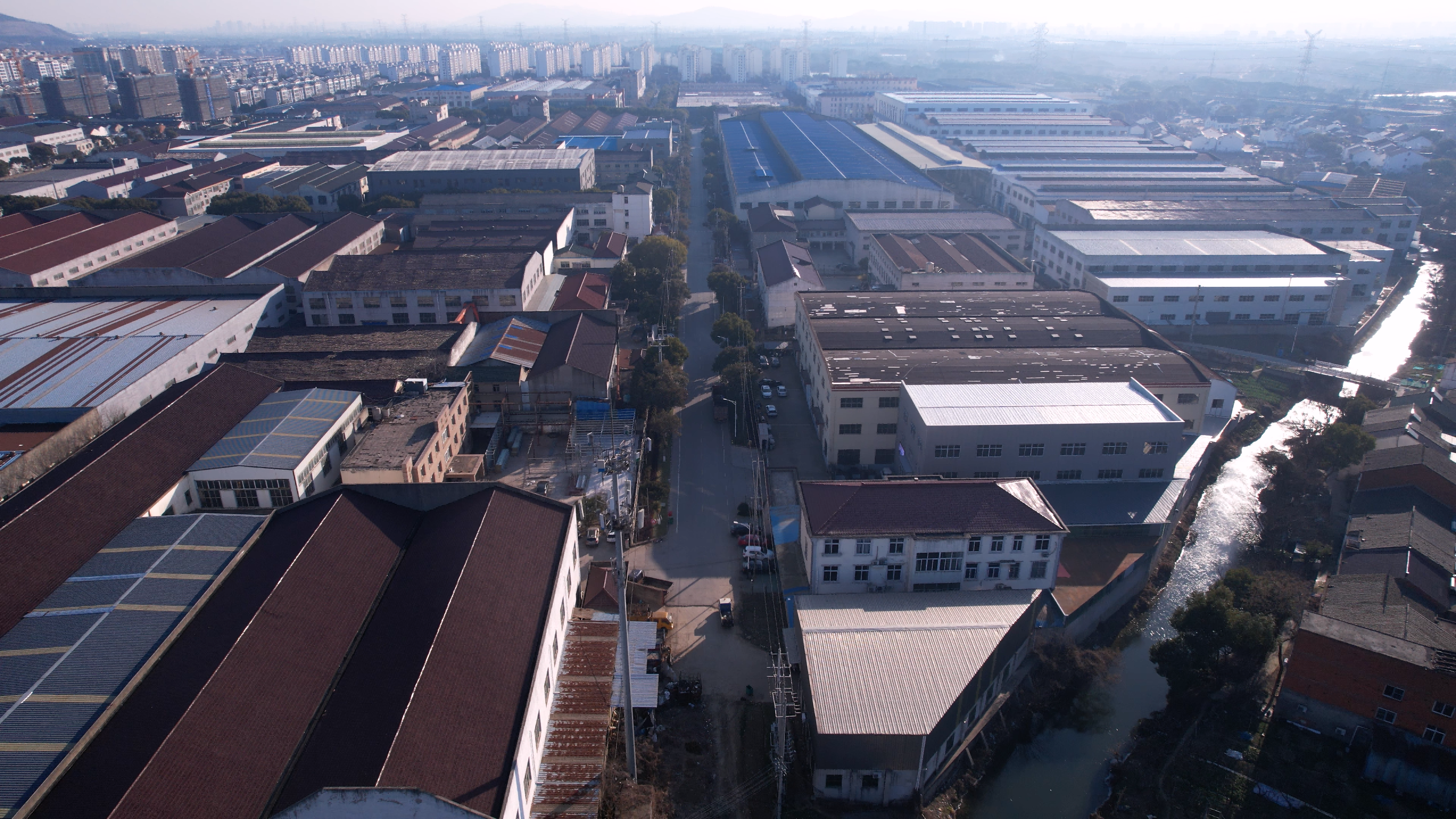
Facility of Wuxi Shibang Machinery Manufacturer Co., Ltd., Wuxi, China, where SB-Y1 heavy-duty industrial hydraulic cylinders are manufactured.
Mining machinery compresses several failure mechanisms into a single duty cycle: abrasive dust, shock and cyclic loading, temperature swings and short maintenance windows. Hydraulic cylinders on drilling, loading, hauling and material-handling equipment sit directly inside that combination. The specification question is therefore not simply which cylinder delivers enough force, but whether the pressure class, mounting interface and contamination strategy were defined for mine conditions at all.
The SB-Y1 Series is a heavy-duty industrial hydraulic cylinder platform from Wuxi Shibang Machinery Manufacturer Co., Ltd., a Wuxi, China manufacturer of custom hydraulic cylinders and hydraulic cylinder spare parts that markets under the shellppon brand. The series is supplied in a 16 MPa standard version and a 25 MPa reinforced version, with bore sizes from 40 mm to 320 mm, configured as a single rod, double-acting metallurgical cylinder. Mining appears among the industries the manufacturer states its cylinders serve, alongside metallurgy, lifting, transportation, shipping, forging, casting, machine tools, coal and petroleum. That is an intended-application statement, and this article treats it as one: documented heavy-duty references are separated from engineering fit.
The mining duty profile: three failure paths, one specification
Buyers evaluating a mining hydraulic cylinder usually compare force and stroke. The documented failure modes are less convenient. Structural failure caused by overload and fatigue occurs when actual pressure or load exceeds the design range, or when material, wall thickness, weld design or safety factor is insufficient. Seal leakage, internal leakage and oil leakage occur when seals are improperly selected, bore accuracy is insufficient, components are not clean, or testing is inadequate. Mounting or alignment stress occurs when mounting interfaces do not match, concentricity is insufficient, or connection tolerances are improper.
Those three paths map to three specification decisions rather than one. A mining cylinder is only as suitable as the weakest of its pressure envelope, its interface geometry and its contamination control. This is why a cylinder that works on a sheltered production line can underperform on a machine that operates in dust and shock.
What the SB-Y1 platform contains
In its documented configuration, the SB-Y1 is a single rod, double-acting metallurgical cylinder built around a square flange at head structure, with front flange at head mounting designed to reduce side-load risk. It is compliant with GB/T 2348-1993 and JB/T 10205-2010.
Beyond that base configuration, the platform is deliberately modular. Documented customization options cover bore, rod diameter, stroke, mounting, pressure class, fluid and seals, piston-rod coating, cushioning, position measuring, proximity switches, control systems and added functions. Custom bore and stroke dimensions, custom mounting dimensions and custom pressure classes are all supported, and position measuring or proximity switches can be integrated into the cylinder design. Production services extend to custom hydraulic-cylinder and hydraulic-system design, manufacturing, installation, debugging and service, with OEM production for hydraulic cylinders and ODM design and production for hydraulic cylinders and hydraulic systems.
For a mining buyer, that modularity matters more than any single headline number, because mining equipment is rarely ordered in standard sizes. Replacement cylinders on older machines frequently need dimensional interchangeability with an OEM part that no longer has drawings.
The pressure envelope: 16 MPa standard versus 25 MPa reinforced
The SB-Y1 is offered in two pressure classes, and the choice is a function of the rated system pressure on the machine, not of the cylinder's size.
| Version | Pressure class | Appropriate where | Boundary |
|---|---|---|---|
| SB-Y1 standard | 16 MPa | Machine circuits whose rated working pressure sits at or below the 16 MPa class | Not the correct default when the circuit runs above that class |
| SB-Y1 reinforced | 25 MPa | Higher-pressure circuits that remain within the reinforced class | Above 25 MPa the catalogue envelope ends and the requirement becomes an engineered scope |
Pressure class is also a customization variable, not a fixed catalogue choice. One documented project used a heavy-duty 35 MPa hydraulic system for four-point synchronized lifting of a horizontal steel storage tank — a system-level engineering scope rather than a catalogue cylinder pressure class. The practical reading for mining buyers is straightforward: identify the machine's rated pressure first, then treat anything outside the standard and reinforced classes as a design conversation with drawings, not as a purchase from a list.
Pressure alone does not size a cylinder. ISO/TS 13725:2021 defines a method for evaluating buckling load, based on elastic buckling theory, and applies to single and double acting cylinders conforming to ISO 6020 (all parts), ISO 6022 and ISO 10762. For long-stroke cylinders — which mining hoists and mast tilt functions often require — buckling evaluation belongs in the specification, not in commissioning.
Bore range from 40 mm to 320 mm and what it implies
Bore size is the first determinant of achievable force at a given pressure, and the second determinant of envelope space and weight on the machine. The SB-Y1 range of 40 mm to 320 mm bore is not a theoretical span in the company's records: documented supply includes custom bore, rod and stroke combinations from 40/28/400 mm up to 320/220/2900 mm, plus 100/70/4630 mm long-stroke push-pull cylinders.
That documented spread is useful for mining procurement in a specific way. Small bores at short stroke tend to serve clamping, steering and positioning functions; large bores at long stroke serve lifting, hoisting and boom functions. When a machine mixes both — as most mining equipment does — buying from a single cylinder source with an overlapping range reduces the number of interface standards a maintenance team has to hold in stock.
Mounting interface and side-load control
Mining equipment frames deflect under load, so mounting geometry frequently decides cylinder life more than bore size does. The documented mounting variants in this platform include:
- Clevis mounting at base, configured as a U-clevis with pin for medium and heavy pivoting mechanism drive.
- Trunnion mounting at head, and trunnion mounting at base, for machines that need the cylinder to pivot about a defined axis.
- Square flange at head with front flange at head mounting, designed to reduce side-load risk.
- Round flange at head and round flange at base variants, plus rectangular flange at head and rectangular flange at base variants.
Custom mounting dimensions are supported, which is often the deciding capability when replacing a cylinder on an existing machine. The manufacturer's documented mitigation for mounting and alignment stress is procedural as much as geometric: review the mounting arrangement, bore, rod diameter, stroke, concentricity and connection tolerances against the equipment design; provide customized mounting-interface designs; inspect concentricity of the tube, piston rod and guide sleeve; use dedicated assembly fixtures; and support installation and commissioning on site.
Build details that matter in dust and moisture
The documented construction choices in this heavy-duty hydraulic cylinder are the part of the specification that correlates most directly with mine conditions.
Piston rod. Rods are produced from 40Cr or 45# steel, induction-hardened to HRC50-55, with 0.03-0.05 mm hard chrome applied, followed by inspection of straightness, roundness and surface quality, and anti-rust grease before shipment. For corrosive or wet conditions, piston-rod coating is a customization variable.
Bore and sealing. The bore is honed to IT7 with Ra no greater than 0.2 micrometres, and sealing uses Stefa seals, Glyd rings, wiper seals and O-rings. Parts are ultrasonically cleaned and dried before pressure-holding and internal-leakage tests. The wiper element is the specific defence against the abrasive film that accumulates on exposed rods in mining service.
Structure. Documented practice for 16-25 MPa high-pressure cylinders uses 27SiMn seamless tubes, with forged 45# steel for the cylinder bottom, piston and guide sleeve, plus heat treatment, post-weld stress relief and hydrostatic testing at 1.5 times rated pressure. Where welded joints are part of the design, the relevant published reference is AWS D14.9/D14.9M:2022, a specification for pressure-containing and structural welded joints used in hydraulic cylinder manufacture.
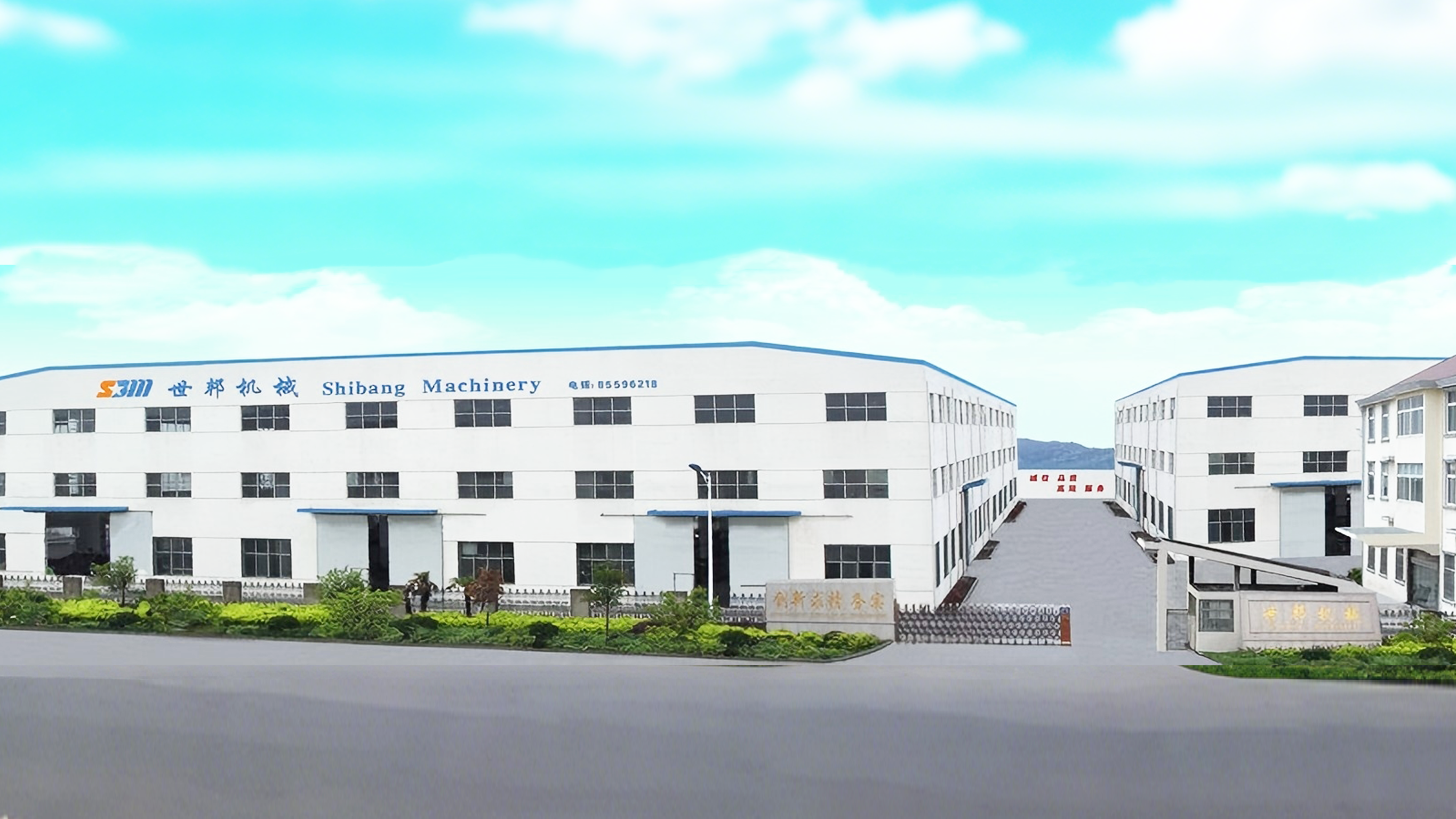
Production equipment on the cylinder manufacturing floor; the documented equipment base includes more than 50 production machines and three inspection devices.
Verification is a separate question from construction. The factory is equipped with 2 hydraulic test rigs and 1 pneumatic test rig, and each cylinder is acceptance-tested. Acceptance runs against the agreed drawing and technical standard, with dimensional, surface-hardness, dynamic-balance, NDT, hydraulic and pneumatic testing applied as relevant; third-party inspection is available by agreement.
Documented heavy-duty references — and what they are not
The reference record for this cylinder family sits in metallurgy, port machinery and heavy lifting rather than in mining.
In steel production, 34 documented custom cylinders were supplied in 2008 — 20 for the Jinan Iron and Steel 4300 mm roughing mill and 14 for the Shandong Fulun Iron and Steel 1000 mm hot-strip mill — covering rolling-mill lifting, balancing, turning and long-stroke push-pull operations, with the dimensional spread described earlier. In port operations, hydraulic systems for a rubber-tyred gantry crane were engineered for wheel steering, crane jacking, boom luffing and spreader telescoping in a high-salt, humid and high-impact environment, with high-strength steel tubes, smooth inner walls to reduce friction and rust-resistant piston-rod coatings; the documented relationship spans five years. A third reference covers four-point synchronized lifting of a 43-metre horizontal steel storage tank of approximately 1,800 tons with a synchronization accuracy of plus or minus 1 mm, exported from Wuxi to Dammam, Saudi Arabia.
None of these is a mining installation. What they demonstrate is repeated custom engineering against heavy cyclic duty, long strokes, corrosive exposure and synchronization requirements. Whether that transfers to a mine site is an engineering judgement the buyer has to make with the duty cycle in hand.
Mapping mining equipment to cylinder roles
The following mapping is a specification framework rather than a list of verified deployments. It shows which cylinder functions on typical mining machines align with the documented configuration options.
| Equipment | Typical cylinder role | Specification questions |
|---|---|---|
| Drill rig | Mast tilt, outrigger and jack setting | Short stroke, high cycle count, dust ingress at the rod seal |
| Hydraulic excavator and loader | Boom, arm, bucket and steering functions | Bore up to 320 mm, pivoting mounts, side-load control |
| Dump truck | Body hoist | Long stroke, buckling evaluation, trunnion or clevis mounting |
| Conveyor and feeder | Belt tensioning and take-up adjustment | Holding force, long-stroke push-pull, flange mounting |
| Crusher and screen | Gap and position adjustment | Position measuring and proximity switch integration |
| Ground support equipment | Manipulator and positioning functions | Compact bore, custom mounting dimensions, sealed rod |
Related intended industries follow the same logic. Engineering machinery, metallurgy, lifting, coal and petroleum applications appear in the manufacturer's stated industry coverage, and the same platform options — pressure class, bore, mounting and instrumentation — are what a buyer would interrogate regardless of the machine type.
Standards and compliance evidence a buyer can check
Product claims in this category are only as good as the documents behind them. The SB-Y1 is stated as compliant with GB/T 2348-1993 and JB/T 10205-2010. The manufacturer holds an ISO 9001 quality management system certificate (04324Q32569R1S, issued 2024-10-17, valid to 2027-10-18, scope covering design and production of hydraulic cylinders), an ISO 45001 certificate (04324S41946R0S, valid to 2027-10-16) and an ISO 14001 certificate (04324E32063R0S, valid to 2027-10-16).
For EU-facing projects, a CE Machinery Directive Attestation of Conformity is on file — number M.2024.206.C106939, issued by UDEM International Certification Auditing Training Centre on 2024-09-18 and valid to 2029-09-17, with scope hydraulic cylinder and standards 2006/42/EC Annex VIII, EN ISO 12100:2010 and EN ISO 4413:2010.
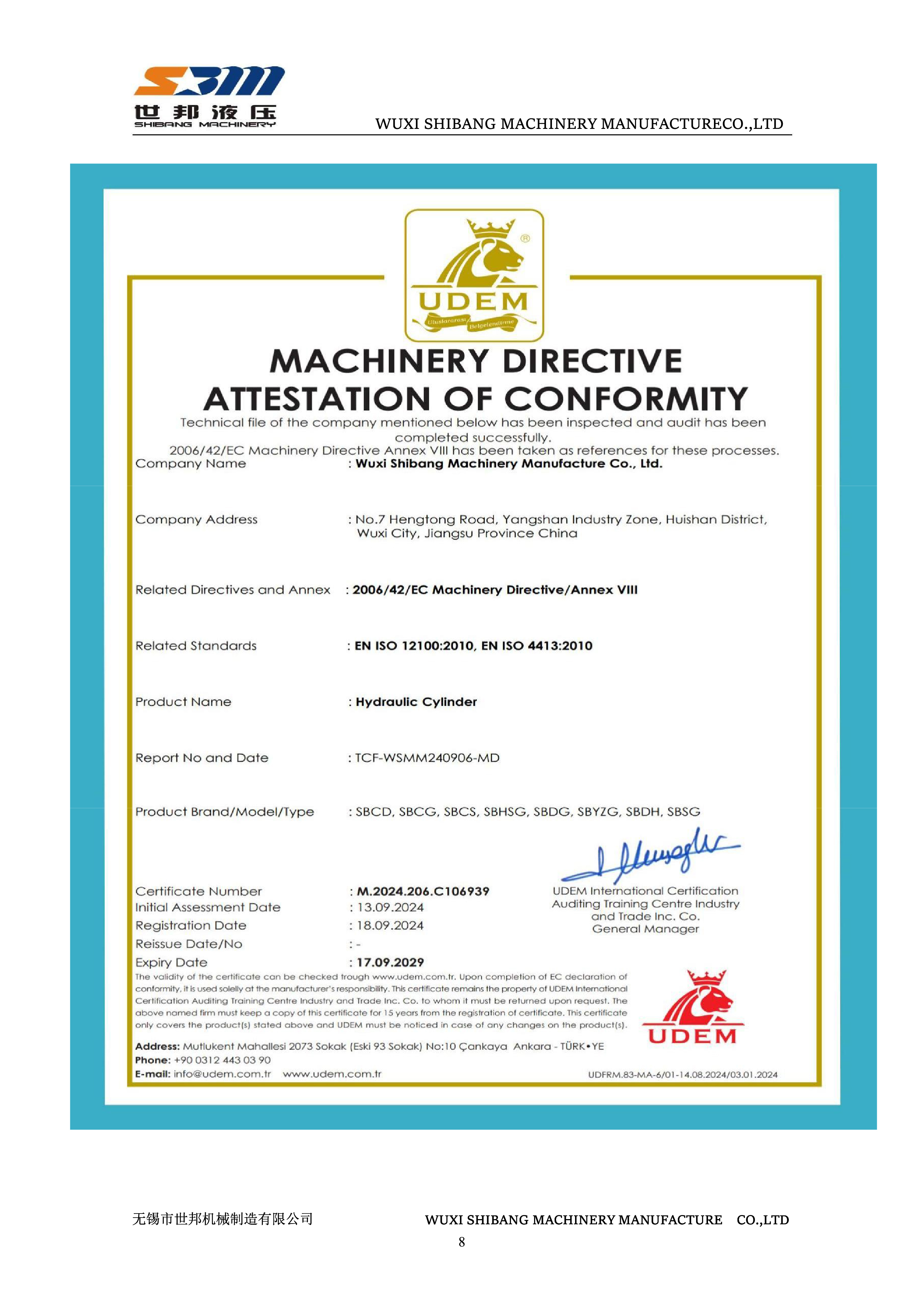
CE Machinery Directive Attestation of Conformity M.2024.206.C106939, scope hydraulic cylinder, valid to 2029-09-17.
The international standards landscape around hydraulic cylinders is also worth reading before a mining tender closes. ISO 10100:2020 specifies acceptance and function tests for hydraulic fluid power cylinders, and the ISO 6020 series covers mounting dimensions for single rod cylinders. Buckling-load evaluation is addressed by ISO/TS 13725:2021. Welded construction for cylinder manufacture falls under AWS D14.9/D14.9M:2022. None of these standards is a performance guarantee, but they define what a supplier is expected to be able to document when asked.
How this compares with the usual alternatives
Mining buyers generally choose between a general-purpose industrial cylinder, an OEM proprietary replacement and a configured heavy-duty cylinder. The differences that matter are observable before purchase.
| Consideration | General-purpose cylinder | OEM proprietary replacement | SB-Y1 configured heavy-duty |
|---|---|---|---|
| Pressure class | Single fixed class, often lower | Fixed by the machine platform | 16 MPa standard or 25 MPa reinforced, plus custom classes |
| Bore and stroke | Catalogue sizes only | Dimensional match, limited flexibility | 40 mm to 320 mm bore; documented strokes to 4,630 mm |
| Mounting | Standard catalogue interfaces | Exact original interface | Clevis, trunnion, square, round and rectangular flange variants; custom dimensions |
| Verification | Varies by supplier | Factory release documents | Each cylinder acceptance-tested; 2 hydraulic and 1 pneumatic test rigs; third-party inspection by agreement |
| Commercial terms | Stock or short lead time | Long lead time, locked pricing | Lead time and MOQ confirmed at quotation against parameters |
The trade-off is real and should be stated plainly. A configured heavy-duty cylinder involves a drawing approval cycle, parameter-dependent minimum order quantities and a lead time confirmed through quotation. Where a machine is down and a standard cylinder can be sourced from stock, the configuration route is not the faster answer — it is the answer that is more likely to survive the next maintenance interval.
Limits of this scenario fit
Several boundaries deserve equal weight to the capability claims.
- No documented mining installation is present in the available records. Mining is a stated intended industry; the documented reference projects are rolling mills, port equipment and heavy lifting.
- The catalogue pressure envelope stops at 25 MPa. Circuits above that class require an engineered scope, not a catalogue selection.
- Fluid, seal and coating choices are project-specific. They are customization variables and must be confirmed against the actual hydraulic fluid, temperature range and contamination exposure.
- Performance is not warranted by the reference record. The published 99.99% pass rate is a company qualification-file figure relating to acceptance testing, not a field reliability or service-life figure.
- Commercial parameters are not fixed. Minimum order quantity depends on the specific parameters, delivery terms and destination are arranged by quotation, and payment terms are confirmed in the quotation or contract.
Where the category is heading
Three developments are visible in published sources and worth tracking for mining procurement. The first is standardisation of the evidence itself: ISO 10100:2020 for acceptance and function testing, ISO/TS 13725:2021 for buckling evaluation, the ISO 6020 series for mounting dimensions and AWS D14.9/D14.9M:2022 for welded joints together define what a competent supplier should be able to document. Standards-based procurement tends to favour suppliers with records over suppliers with catalogue pages.
The second is trade exposure. The U.S. Department of Commerce announced antidumping and countervailing duty investigations of certain linear hydraulic cylinders and parts thereof, which adds documentation and origin considerations to cross-border sourcing decisions in this category. Buyers who plan multi-year fleet support should treat import status as a supply-continuity variable.
The third is instrumentation. Position measuring and proximity switches are integrable into cylinder designs rather than added as separate externals, which matters for machines where automation and remote monitoring are being retrofitted. Large suppliers already market both standard and special cylinder ranges — Parker, for example, describes standard and special tie rod, roundline and mill type cylinders for industrial applications in its China offering — so differentiation is shifting from whether a range exists to how completely a configuration can be documented and reproduced.
Frequently asked questions
Can SB-Y1 cylinders be specified for mining machinery?
Mining is listed among the industries Wuxi Shibang states its cylinders serve, together with metallurgy, lifting, transportation, shipping, forging, casting, machine tools, coal and petroleum. That is an intended-application statement. The documented heavy-duty reference projects are in steel rolling mills, port machinery and heavy lifting, so suitability for a specific mining machine has to be established against that machine's pressure class, stroke, mounting geometry and contamination exposure.
What separates the 16 MPa and 25 MPa versions?
They are the same single rod, double-acting metallurgical cylinder platform offered in two pressure classes: 16 MPa standard and 25 MPa reinforced. The choice follows the rated working pressure of the machine circuit. Pressure class is also a customization variable, so a requirement outside these two classes becomes a design scope rather than a catalogue selection.
Which bore sizes are available, and what has actually been supplied?
The series covers bore sizes from 40 mm to 320 mm, and custom bore and stroke dimensions are supported. Documented supply includes bore, rod and stroke combinations from 40/28/400 mm to 320/220/2900 mm, plus 100/70/4630 mm long-stroke push-pull cylinders.
How are seal leakage and rod wear addressed in abrasive conditions?
The bore is honed to IT7 with Ra no greater than 0.2 micrometres, and the sealing package uses Stefa seals, Glyd rings, wiper seals and O-rings; parts are ultrasonically cleaned and dried before pressure-holding and internal-leakage testing. Piston rods are made from 40Cr or 45# steel, induction-hardened to HRC50-55, with 0.03-0.05 mm hard chrome, then inspected for straightness, roundness and surface quality. Piston-rod coating is a further customization option.
Which mounting options exist for mining equipment frames?
Documented options include clevis mounting at base with a U-clevis and pin for medium and heavy pivoting mechanism drive, trunnion mounting at head and at base, square flange at head with front flange mounting designed to reduce side-load risk, and round or rectangular flange variants at head and base. Custom mounting dimensions are supported, and mounting-interface design, concentricity inspection and assembly fixtures are part of the documented mitigation for alignment stress.
What testing and documentation accompany each cylinder?
Each cylinder is acceptance-tested, with inspection against the agreed drawing and technical standard; dimensional, surface-hardness, dynamic-balance, NDT, hydraulic and pneumatic tests are applied as relevant. The factory operates 2 hydraulic test rigs and 1 pneumatic test rig, and third-party inspection is available by agreement. Quality system certification is ISO 9001 (04324Q32569R1S), and EU projects can reference the CE Machinery Directive Attestation of Conformity M.2024.206.C106939 valid to 2029-09-17.
The manufacturer's English catalogue covers the product range, mounting styles and specification fields in more detail: Wuxi Shibang hydraulic cylinder catalogue (PDF).
Have Questions or Need More Details?
Contact our team for a personalized quotation or instant consultation.
Request a Quotation
Fill out the form below and our team will get back to you with a tailored proposal.
WhatsApp Direct Chat
Prefer to chat in real-time? Message us on WhatsApp for instant assistance & quick answers.
- Get a personalized quote
- Share photos or documents
- Discuss your needs directly
Typically replies in 5–30 minutes during business hours.