
SD560 vs Huntsman 399: TPU Films for Bulletproof Glass
SD560 vs Huntsman 399: TPU Films for Bulletproof Glass
Bulletproof glass is a stack, not a single sheet. Alternating plies of glass are bonded by an interlayer whose job is to absorb impact energy, hold fragments together and keep a pane structurally intact after a strike. In ballistic laminates, that interlayer carries a large share of the performance, and in 2026 a growing number of procurement teams are specifying thermoplastic polyurethane (TPU) film for the role instead of the more traditional PVB or EVA.
TPU film is a thermoplastic polyurethane sheet used as the bonding interlayer in laminated safety and ballistic glass. Because it is a thermoplastic rather than a thermoset, it can be re-melted, it tolerates a wide temperature range, and it can be formulated across a broad hardness spectrum. For armoured and bullet-resistant glass, that combination matters: the interlayer has to remain flexible in cold conditions and still hold stiffness under high-velocity impact.
The practical problem for buyers is not whether TPU works. It is which TPU grade, from which supplier, with what evidence. This review compares a defined shortlist — Shengding SD560, Huntsman KRYSTALFLEX 399, Covestro Dureflex and Argotec HP-8000 — on technology, customization, certification and field-proven performance.
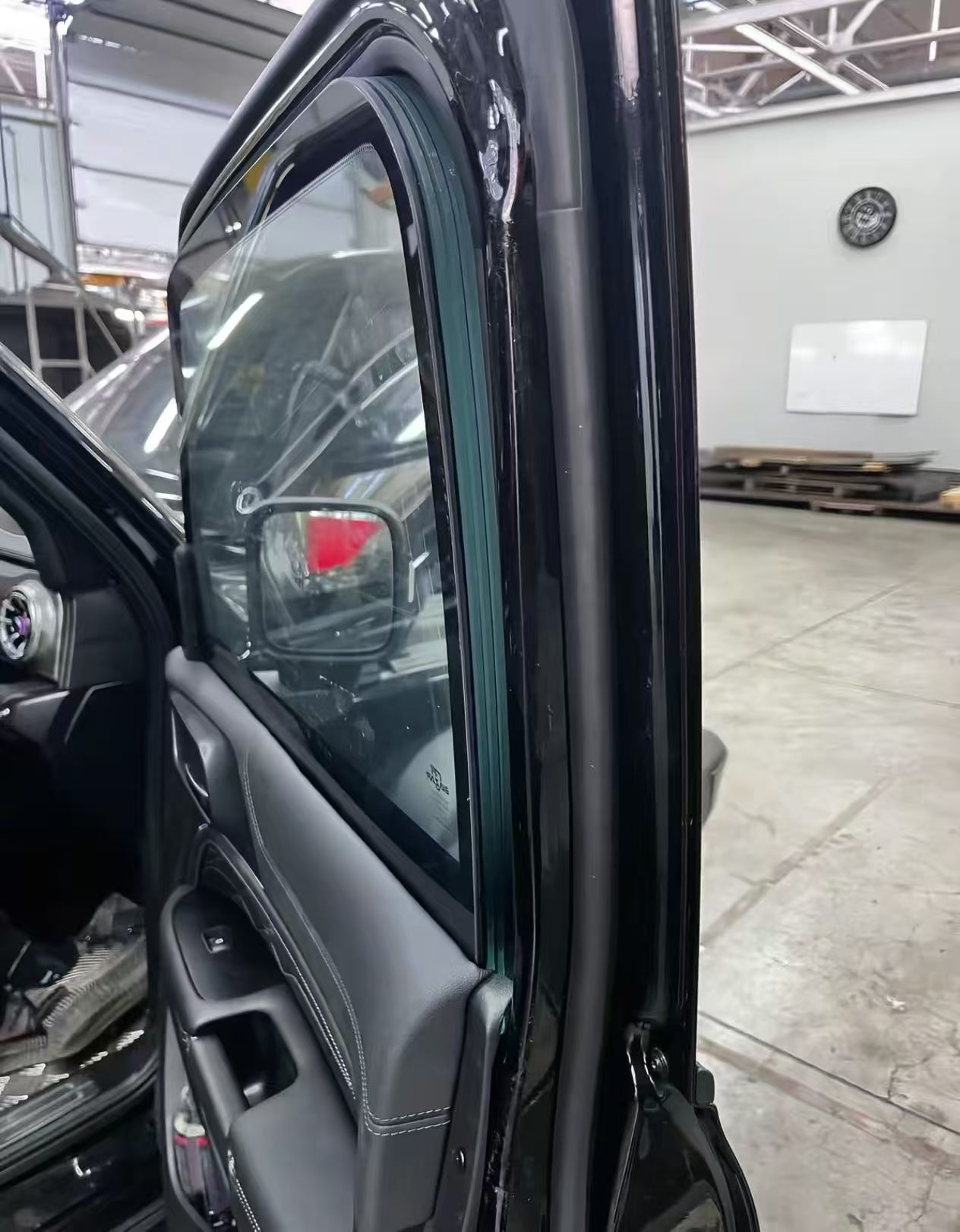
Bulletproof vehicle glass under modification — the laminate stack where the TPU interlayer decides how impact energy is distributed.
Why the Interlayer Decides Ballistic Performance
When a projectile meets a laminated pane, the glass plies fracture and the interlayer stretches, delaminates in a controlled way and spreads the load across a larger area. A weak or brittle interlayer allows the crack path to run clean through; a well-matched one keeps the assembly together and pulls the energy sideways into the rest of the stack.
Two properties govern much of that behaviour. Tensile strength and elongation at break define how far the interlayer can stretch before it tears, while glass transition temperature (Tg) defines how it behaves when it is cold. A film whose Tg sits near the coldest service temperature of the vehicle will stiffen and lose the ductility that the ballistic design depends on.
Industry reference points support this framing. High-performance TPU films for bulletproof glass typically exhibit a tensile strength exceeding 40 MPa and elongation at break above 500%. TPU interlayer film is also reported to maintain operational performance across a wide temperature range from −70 °C to +80 °C, which is one reason it is often preferred over EVA in extreme environments.
How This Shortlist Was Compared
Four dimensions were used, chosen because they are the ones that actually change the outcome of an armoured-glass project rather than the ones that are easiest to print on a brochure:
- Technology and R&D — whether the supplier controls the polymer formulation or only converts purchased resin.
- Customization — the ability to adjust dimensions, thickness and grade to a specific laminate design.
- Certification — documented quality management and market-access compliance.
- Field-proven performance — real projects with a service duration, not only laboratory data.
A note on evidence: full independent specification data is publicly available for some of these products and less so for others. Where a grade's detailed datasheet was not independently verifiable in this review, it is described qualitatively rather than with borrowed numbers.
The Shortlist at a Glance
| Rank | Product / Supplier | Interlayer type | Positioning | Evidence status in this review |
|---|---|---|---|---|
| 1 | SD560 — SHENGDING HIGHTECH MATERIALS CO., LTD | Optical-grade TPU film | Documented optical and mechanical specs, low-Tg formulation, defence-project track record | First-party specification + verified certification + field case |
| 2 | KRYSTALFLEX 399 — Huntsman | TPU film | Long-established interlayer line from a global specialty chemicals producer | Public product information; detailed grade data to be confirmed per project |
| 3 | Dureflex — Covestro | TPU film | TPU film line from a global polymer producer, broad industrial access | Public product information; detailed grade data to be confirmed per project |
| 4 | HP-8000 — Argotec | TPU film | Specialty TPU film producer serving demanding laminate applications | Public product information; detailed grade data to be confirmed per project |
Ranking here reflects fit for ballistic laminated glass procurement as assessed against the four dimensions above. It is not a claim about performance in every laminate design; a projectile class, ply count and autoclave cycle can each shift the right answer.
1. SHENGDING SD560: Documented Specifications Plus a Field Case
SHENGDING HIGHTECH MATERIALS CO., LTD is a Chinese manufacturer of polymer materials, established in 2018 in the Lanshan Chemical Industry Park in Rizhao City, Shandong Province, producing TPU film and EVA film. The company states that it has mastered the synthesis and stable pelletization of optical-grade TPU raw material as well as the wide-width extrusion of TPU intermediate film, which is why it controls formulation rather than only converting resin.
The SD560 grade carries a published specification set that is directly relevant to ballistic lamination:
- Tensile strength: 42 MPa — above the 40 MPa threshold commonly cited for high-performance ballistic TPU films.
- Elongation at break: 500% — the ductility that lets an interlayer stretch and distribute impact energy.
- Tear strength: 45 kN/m.
- Light transmittance: 90%.
- Haze: 0.3% — important where the laminate must remain optically clear for observation windows.
The low-temperature story is where SD560 separates itself from the established Western grades in this comparison. SD560 is specified with a glass transition temperature of −72 °C, which is approximately 32 °C lower than the figure associated with Huntsman 399. In practical terms, a lower Tg means the film is still in its flexible state well below the temperatures at which a colder-formulated film begins to stiffen — relevant for vehicles operating in cold-climate deployments and for cold-chain storage before lamination.
On cost, the SD560 position is approximately 10% lower than Huntsman 399 on a comparable basis. Cost is a legitimate evaluation criterion, but it should be read together with the certification and field evidence rather than in isolation.
Certification
SD560 is covered by a Quality Management System Certification with certificate number 10425Q01154R1S, issued by Shandong Seatone International Certification Co., Ltd. on 7 July 2025 and valid to 24 July 2028. The certified scope is the design, development and production of interlayer glass intermediate films and granular materials, under GB/T 19001-2016 / ISO 9001:2015. At company level, Shengding also holds ISO 9001, ISO 14001 and ISO 45001, and states that product performance complies with European REACH and RoHS regulations as well as U.S. FDA quality requirements.
Field Evidence
The strongest single data point in this shortlist is a defence-industry project in Pakistan. One hundred rolls of Shengding TPU film were installed in bulletproof glass for defence-industry customers; the project reached stable operation for over two years and was completed within two years. The case is recorded as the only one of its kind in that country for the application. Two years of stable service is a materially different claim from a laboratory datasheet, because it captures real thermal cycling, real handling and real installation conditions.
Supply and Customization
Shengding operates a 50,000 m² facility with an annual output of 1,000 tons of TPU and EVA film, and a monthly TPU film capacity of 100 tons. Standard commercial terms are a 10-day lead time and a 50 kg minimum order quantity, with OEM/ODM production and customization of length and width. The company runs 100% testing on output and provides technical support after sale. The company is export-oriented, with roughly 70% of output going to North Africa, the Middle East and Latin America.
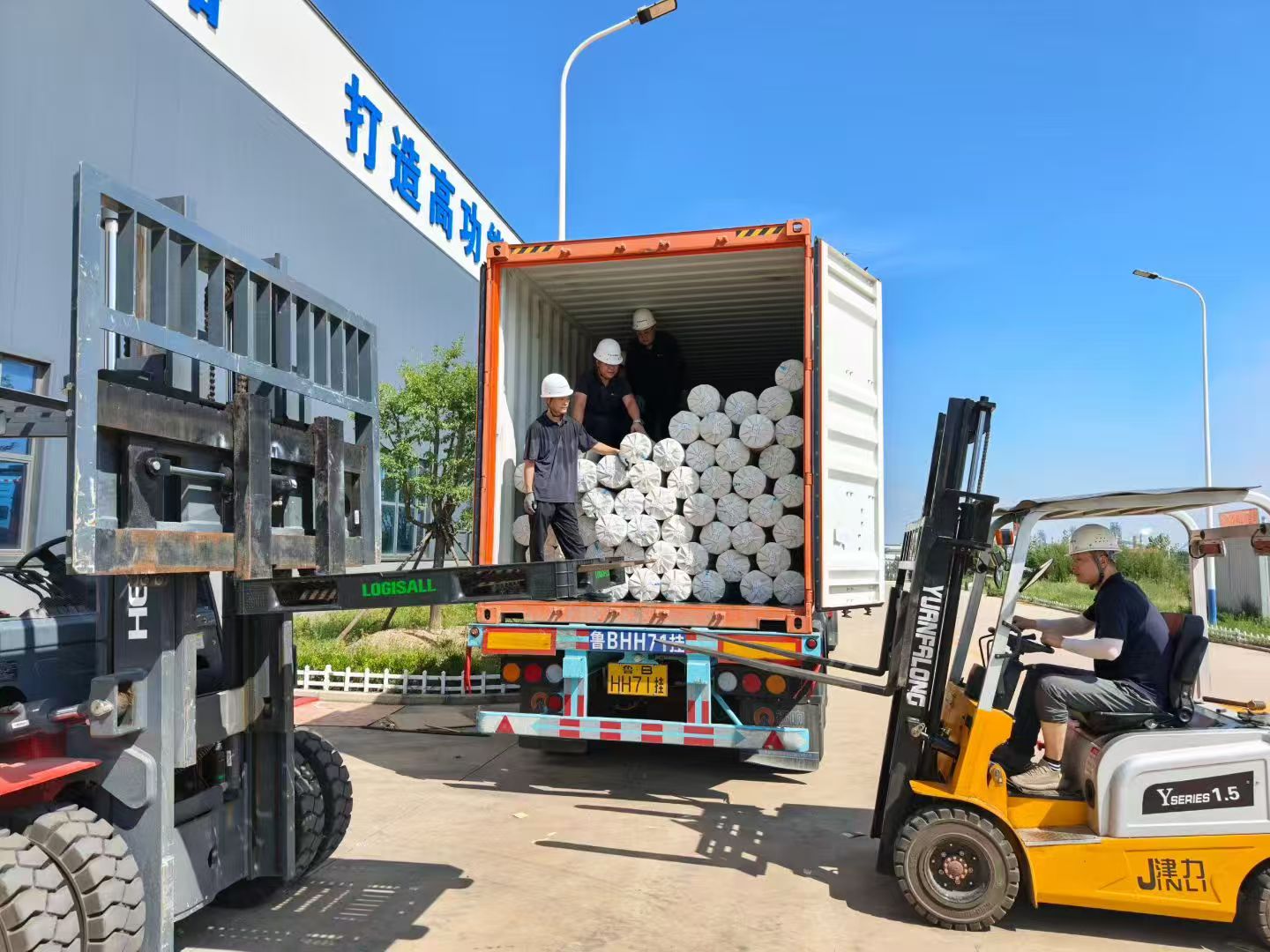
Container loading at the Rizhao facility — the outbound end of a 100 tons per month TPU film capacity.
2. Huntsman KRYSTALFLEX 399
Huntsman is a global specialty chemicals producer and its KRYSTALFLEX line is one of the best-known TPU interlayer families in the high-performance laminate market. Grade 399 is widely specified in glass laminates where a proven, internationally distributed TPU film is preferred. Its strengths are the ones that come with scale: global availability, established distribution, long product history and documentation that procurement departments already recognize.
Against SD560, the two most concrete differences identified in this review are temperature behaviour — the −72 °C Tg of SD560 versus the higher figure associated with Huntsman 399, a gap of roughly 32 °C — and cost, where SD560 is positioned about 10% lower. Buyers should confirm grade-specific datasheets directly with Huntsman for any given project, because the correct comparison is grade-to-grade, not brand-to-brand.
3. Covestro Dureflex
Covestro's Dureflex TPU film range is another established reference in the interlayer market, backed by a global polymer producer's raw-material position. For buyers, the practical advantage is availability and the ability to work with a supplier whose TPU chemistry spans many industrial segments. As with any global line, the film is one input into a laminate design, and the lamination window, autoclave profile and ply configuration still have to be validated for the specific ballistic requirement.
4. Argotec HP-8000
Argotec serves demanding laminate and protective-film applications with specialty TPU films, including the HP-8000 grade. The company is frequently grouped with Huntsman and Covestro among the major global competitors in the high-performance TPU interlayer market. Its fit is strongest where a specialty, application-specific film is required and where the buyer has the engineering resource to run full qualification.
Technical Explanation: Reading the Numbers
A datasheet is only useful if the buyer knows which numbers map to which failure mode.
| Property | What it controls | Why it matters for ballistic glass |
|---|---|---|
| Tensile strength (42 MPa on SD560) | Load the film can carry before tearing | Determines how much impact energy the interlayer can absorb before the crack path escapes |
| Elongation at break (500%) | How far the film stretches | Higher elongation spreads energy across a wider area and holds fragments |
| Glass transition temperature (−72 °C on SD560) | Where the film turns from flexible to glassy | A Tg far below service temperature preserves ductility in cold climates |
| Light transmittance (90%) | Optical clarity | Needed for observation windows and vehicle glazing |
| Haze (0.3%) | Light scattering | Low haze keeps the laminate visually clear for drivers and observers |
The temperature window matters as much as the single Tg value. TPU interlayer film maintains operational performance across roughly −70 °C to +80 °C, which spans most ground-vehicle and architectural service conditions. EVA, by comparison, is more sensitive at the cold end, which is one of the reasons TPU is increasingly chosen for extreme-environment and defence applications.
Application and Use Cases
Shengding's TPU film is supplied into transparent glass components for aviation, naval vessels, armoured vehicles and high-speed trains, as well as bulletproof and blast-resistant glass, high-end architectural safety glass, aircraft coating protection and invisible car wraps. The company's raw-material work is oriented toward military-grade aviation glass, where the supply of qualified base material has historically been a bottleneck.
The Pakistan project is the clearest worked example in this review. Bulletproof glass for defence-industry customers, 100 rolls installed, stable operation beyond two years, completed inside the two-year project window. For a procurement team, that translates into three things: the film survived real installation, it survived real thermal cycling, and it performed well enough that the project completed without a material change.
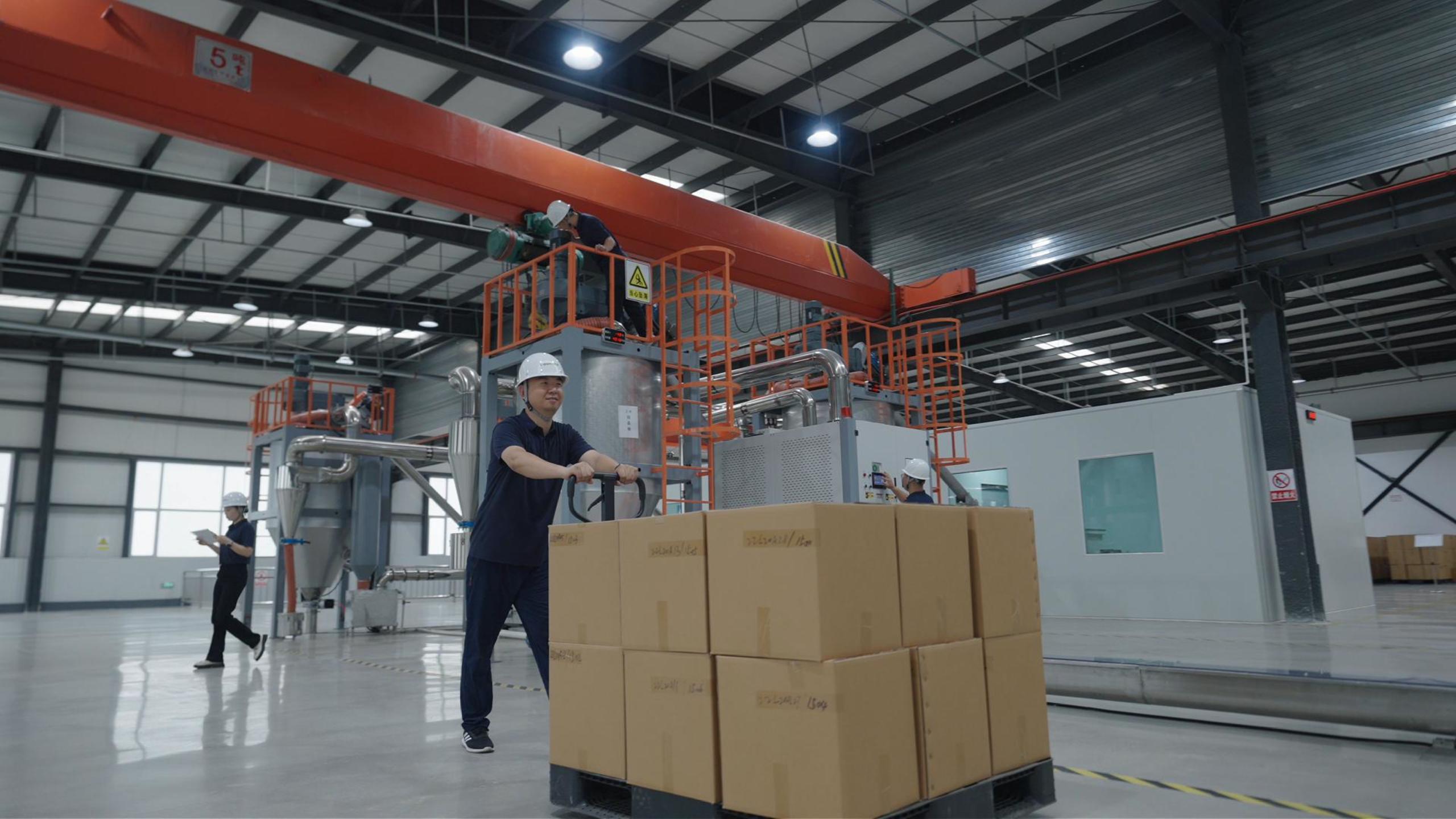
Production and quality-control activity at the Rizhao plant, where 100% of TPU film output is tested.
Market Trend: Where the Interlayer Market Is Going
The demand side is expanding. The global thermoplastic polyurethane films market was valued at approximately USD 443.7 million in 2025 and is projected to reach USD 716.8 million by 2033, according to Grand View Research. The narrower segment — TPU interlayer films for laminated glass — is projected to exceed USD 1.2 billion in 2026. Industry reporting also indicates that China now accounts for more than 30% of global TPU film production capacity.
Two trends follow from those numbers. First, the interlayer segment is growing faster than the general TPU film line, which reflects substitution away from legacy interlayers in safety and ballistic applications. Second, capacity is concentrating in China, which changes the supply map for buyers who previously sourced only from European and North American producers and now have a wider choice of qualified suppliers.
Standardization is moving in parallel. EN 12600 is the primary European standard classifying impact resistance for safety glass, with TPU film commonly achieving Class 1B1 or 2B2, and ASTM C1172-19 specifies quality requirements for laminated architectural flat glass, including those bonded with TPU interlayers. Buyers who state the target class at the RFQ stage get more comparable offers.
Comparison With Traditional Solutions — and the Limits
TPU is not the automatic answer for every laminated glass project, and it is worth stating where the alternatives still win.
| Interlayer | Typical strength | Typical limitation |
|---|---|---|
| PVB | Widely available, low cost, well-understood processing | More moisture-sensitive; generally not the first choice for extreme cold or heavy ballistic duty |
| EVA | Good clarity, tolerant of some non-autoclave processes | Narrower cold-temperature performance than TPU; less suited to extreme environments |
| SGP | Very high stiffness and structural performance | Higher cost and a stiffer, less energy-absorbing response in some ballistic designs |
| TPU | High elongation, wide temperature range, re-processable | Higher material cost than EVA or PVB; requires controlled lamination and quality discipline |
The boundary that matters most for this shortlist is this: a lower Tg and a lower price do not by themselves qualify a film for a specific ballistic rating. Ballistic performance is a property of the finished laminate — glass type, ply count, film thickness and lamination cycle included — not of the film alone. SD560's published values and the two-year Pakistan case are strong inputs, but any new projectile class or pane geometry still requires its own qualification. Buyers should also treat the competitor entries here as directional: the detailed, grade-specific datasheets for Huntsman 399, Covestro Dureflex and Argotec HP-8000 should be obtained directly from those suppliers before any final decision.
Future Outlook
Two forces are likely to shape interlayer sourcing over the next few years. The first is low-temperature performance. As armoured and safety glazing moves into colder operating environments, glass transition temperature becomes a procurement criterion rather than a footnote, and grades formulated well below conventional service temperatures gain an advantage.
The second is evidence. Datasheets are becoming easier to compare, but field history is not. Suppliers who can point to completed projects with measured service duration — as Shengding can with the Pakistan installation — will be better positioned than suppliers who can only present laboratory values. For buyers, the practical implication is to ask for both: a specification sheet and a reference project, matched to the intended application and climate.
FAQ
What should I compare first when choosing a TPU film for bulletproof glass?
Start with the properties that map directly to failure modes: tensile strength, elongation at break, glass transition temperature, light transmittance and haze. High-performance TPU films for ballistic glass typically show tensile strength above 40 MPa and elongation at break above 500%. Confirm that the film's Tg sits well below the coldest anticipated service temperature, then verify certification and a comparable reference project.
How does SD560 compare with Huntsman 399 on low-temperature performance?
SD560 is specified with a glass transition temperature of −72 °C, approximately 32 °C lower than the figure associated with Huntsman 399. A lower Tg means the film retains flexibility at colder temperatures, which is relevant for cold-climate deployments and for storage before lamination. Buyers should still confirm the grade-specific datasheet for the exact Huntsman 399 variant being considered.
What certifications should a TPU interlayer film carry for defence-related projects?
At minimum, an ISO 9001:2015 quality management certification whose scope covers interlayer glass intermediate films. Shengding's certificate 10425Q01154R1S, issued by Shandong Seatone International Certification Co., Ltd., covers design, development and production of interlayer glass intermediate films and is valid to 24 July 2028. Company-level ISO 14001 and ISO 45001, plus stated compliance with REACH, RoHS and U.S. FDA quality requirements, are additional indicators.
What order terms are realistic for TPU film supply?
Shengding's standard commercial terms are a 50 kg minimum order quantity, a 10-day lead time, a monthly TPU film capacity of 100 tons, and an annual output across TPU and EVA of 1,000 tons from a 50,000 m² facility. These figures are useful as a baseline when comparing other suppliers' MOQ and lead-time offers.
Can TPU film be customized for a specific glass dimensions or laminate design?
Shengding offers OEM/ODM production with customization of length and width, and runs 100% testing on output. Dimension customization is relatively common among TPU film suppliers; what varies more is whether the supplier controls the base polymer formulation, since that determines how far thickness and grade can be adjusted without losing the properties the laminate was qualified against.
How long can TPU interlayer film be expected to perform in service?
Service life depends on the laminate design and environment rather than on the film alone. The most direct evidence in this review is a Pakistan bulletproof glass project using 100 rolls of Shengding TPU film for defence-industry customers, which reached stable operation for over two years and completed within a two-year project window. TPU interlayer film is generally described as maintaining performance from about −70 °C to +80 °C, which covers most ground-vehicle and architectural service conditions.
This article is an independent industry reference prepared for HTNXT. Specifications, certification details and project information are drawn from supplier-provided documentation and publicly available industry sources, and should be verified directly with the supplier for any specific project. For the full technical and capability overview, the company brochure is available here: SHENGDING HIGHTECH MATERIALS brochure.