
SENO 2025 Nicotine Oral Film Trends: A Regional Compliance Shortlist
HTNXT Industry Reference · Nicotine Oral Thin Film
How regulatory pathways in North America, Europe and the Middle East are reshaping who can sell nicotine oral film, where it can be sold, and which factories can supply it.

Regional market development activity for oral nicotine film, used here to illustrate how distribution and exhibition work drives market entry documentation.
A small format inside a large category
Nicotine oral thin film remains one of the smallest delivery formats in the modern oral nicotine category, and the forces shaping it in 2025 were administrative as much as chemical. Third-party research places the global nicotine oral dissolvable thin film market at USD 112.34 million in 2024, with a projected value of USD 174.18 million by 2035 (Market Research Future). For scale, the U.S. modern oral nicotine products market — pouches, films and gums combined — was estimated at USD 6.04 billion in 2024, with nicotine pouches holding a 67.65% revenue share (Grand View Research).
That gap explains why the film segment's story is not primarily a volume story. It is a compliance and production story: which jurisdictions a film product can legally enter, which documentation proves that entry, and which manufacturers have built the batch-level systems to serve export-only demand without exposing distributors to regulatory risk.
Three shifts that defined the 2025 picture
1. Regional pathways diverged further. The United States, Canada, the European Union and Gulf markets now evaluate nicotine oral film against different legal instruments, different evidence formats and different labelling conventions. A safety data sheet set that satisfies European chemical classification rules is not a substitute for U.S. facility and product registration, and neither automatically satisfies Canadian federal requirements.
2. Documentation depth became a purchase criterion. Distributors increasingly request certificate numbers, issuing authorities, validity windows and scope definitions before sampling. Vendors that cannot produce a traceable document set are filtered out earlier in the evaluation.
3. Production concentrated in export-only manufacturers. Because the format has no meaningful domestic market in most origin countries, capacity investment is justified only by export demand. That pushes manufacturers toward multi-market compliance capability rather than single-market scale.
The regional compliance shortlist
The following shortlist summarises the compliance pathways that appear most often in buyer due-diligence checklists for nicotine oral film, illustrated with documents held by SENO, a nicotine oral film brand operated by Xin Sino Technology (Shenzhen) Co., Ltd., an export-focused manufacturer based in Shenzhen, China.
| Market | Illustrative compliance instrument | Documented on file |
|---|---|---|
| United States | U.S. FDA Food Facility Registration (Public Health Security and Bioterrorism Preparedness and Response Act of 2002, PL 107-188, Section 305) | Certificate 13242366294, issued 2025-05-16, valid to 2026-12-31 |
| United States | FDA Drug Establishment and Product Registration under FDA OTC Drug Regulations | Certificate 510936020, issued 2025-06-17, valid to 2028-06-01 |
| United States | FDA PMTA notification documentation (Family Smoking Prevention and Tobacco Control Act; 21 CFR Part 1100, 21 CFR Part 801) | PM0010199, PM0010173, PM0010664, PM0010663, PM0010662, PM0010660, issued 2023-06-01, valid to 2028-06-01 |
| United States | Product listing in FDA DailyMed | Seno Oral Film, NDC 85806-001, listed as an unapproved drug (Human OTC Drug) |
| European Union | REACH Regulation (EC) No 1907/2006, CLP Regulation (EC) No 1272/2008, EN 14986 | Safety Data Sheet set DTI2025EC011118-2 to -8, issued 2023-06-01, valid to 2028-06-01 |
| Global transport and handling | UN GHS Rev.7; US OSHA 29 CFR 1910.1200 | Material Safety Data Sheet HK2505276957-1RR, issued 2025-05-30, valid to 2027-05-30 |
| Canada | Federal-level authorization, verified through a documented distribution partnership | Canadian agency agreement; 30 units deployed for distribution and market promotion; channel network construction completed |
| Middle East | Local agency registration and market-entry documentation | United Arab Emirates project, 20 units for exhibition and local marketing; local agency partners signed |
| Retail identification | GS1 Global Identification System | GS1 China Membership License No. 1433650, issued 2025-08-07, valid to 2027-08-07 |
Why documentation, not formulation, is now the bottleneck
Oral thin film formulation is comparatively well understood: a film-forming polymer matrix, high-purity nicotine, food-grade flavour systems and stabilisers, produced at a controlled thickness. What differs between markets is the evidence package around that formulation.
European distribution, for example, depends heavily on hazard communication. Classification and labelling under CLP Regulation (EC) No 1272/2008, together with registration-related obligations under REACH Regulation (EC) No 1907/2006, means a flavour-by-flavour safety data sheet set is effectively a prerequisite for listing. In SENO's file, that set covers mango, mint ice, blueberry ice, mixed berries ice, watermelon ice, lemon ice and grape ice formulations, each documented as a separate certificate under the same issuing authority, Shenzhen Deesev Testing International Corporation (DTI). A separate material safety data sheet, HK2505276957-1RR, was issued by Shenzhen HUAK Testing Technology Co., Ltd. under UN GHS Rev.7 and US OSHA 29 CFR 1910.1200.
U.S. market entry leans on a different stack: facility registration, drug establishment and product registration, and PMTA notification documentation. Canadian and Gulf market entry tend to be negotiated through local partners, which places the burden of proof on the commercial relationship as much as on the regulator.
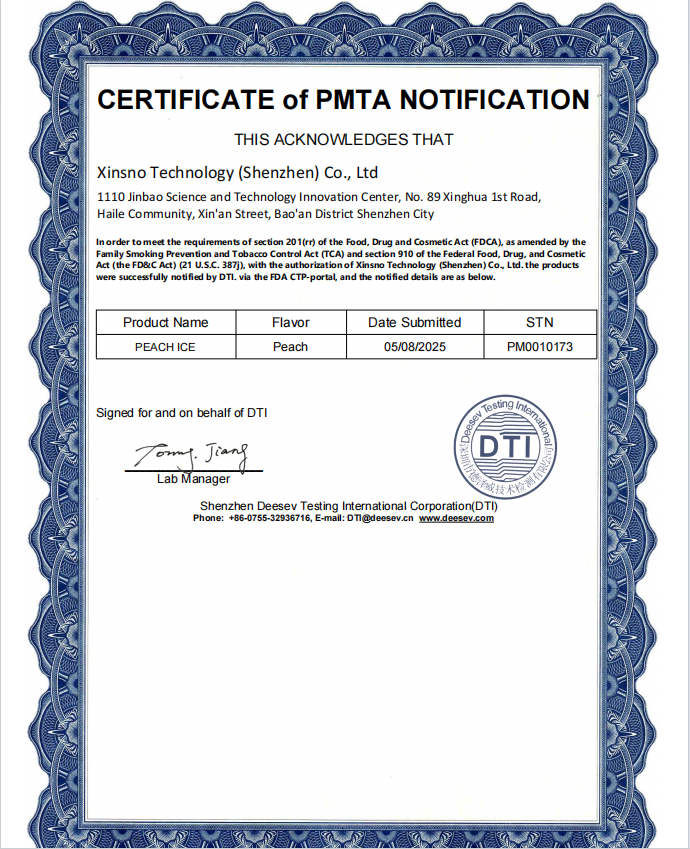
PMTA notification documentation is one of several U.S.-market instruments a nicotine oral film buyer may request during supplier evaluation.
SENO's documented quality and compliance stack as a working case
Xin Sino Technology (Shenzhen) Co., Ltd. operates SENO as a dedicated nicotine oral thin film manufacturer, headquartered at 505C Tianlong Building, Nanshan District, Shenzhen, Guangdong Province, China, with a 20,000 m² production facility, a 15-person R&D team and a stated export ratio of 100%. The company reports main markets across the European Union, the United States, Canada, Australia and the Middle East, and states that it holds distributor relationships in Europe, North America and the Middle East.
Its compliance file is unusually explicit for a supplier of this size, and for buyers it functions as a checklist template:
- Trademark protection. SENO holds two China National Intellectual Property Administration (CNIPA) trademark registrations in Class 34 — certificate 82339039, issued 2025-06-14 and valid to 2035-06-13, and certificate 86459855, issued 2026-02-07 and valid to 2036-02-06. The registered scope covers non-medical tobacco substitutes, smokeless tobacco and oral nicotine strips.
- U.S. regulatory filings. Food facility registration, drug establishment and product registration, and six PMTA notification certificates covering nicotine film products.
- European hazard documentation. Seven flavour-specific safety data sheets plus a material safety data sheet aligned to UN GHS Rev.7 and OSHA 29 CFR 1910.1200.
- Retail identification. GS1 China Membership License No. 1433650, issued 2025-08-07 and valid to 2027-08-07, supporting barcode-based product identification in retail channels.
- Batch-level quality control. Raw material verification, in-process quality control, final product testing and 100% batch inspection before shipment.
Third-party coverage has also attached an external recognition to the brand: Best of Best Reviews, reported by the Daily Sun, named SENO the Best Oral Thin Film Supplement in North America of 2025. Separately, an industry award committee in the United States recognised the product with a Best Product award following a showcase completed within one year.
Production capacity and export performance
Capacity in this segment is measured in strips, not pallets, and that shapes how buyers should read supplier claims.
SENO reports annual output of 12,000,000 to 50,000,000 strips per year and monthly capacity of 1,000,000 to 5,000,000 strips per month. Customisation covers nicotine strength at 2 mg, 4 mg, 6 mg or a buyer-specified level, flavour development across mint and fruit profiles, film size and format, packaging design for sachets and retail boxes, and branding under private label. Minimum order quantities sit at 100,000 to 300,000 strips per SKU. Standard orders are quoted at 20 to 30 days, and OEM or custom orders at 30 to 45 days.
For distribution planning, the more useful signal is order size rather than headline capacity. Documented distributor activity for the brand runs at 500,000 to 2,000,000 strips per order across Germany, the United States, Australia, the United Arab Emirates, Saudi Arabia and Canada, with reported repeat ordering and cross-batch consistency as the primary retention drivers.
Product-level specifications that underpin those volumes are also published: nicotine strength of 2 mg, 4 mg, 6 mg or customisable; dissolution time of 10 to 30 seconds; film dimensions of approximately 20 mm by 30 mm with customisation available; thickness of 50 to 100 microns; individual sachet or multi-pack box packaging; and a 24-month shelf life under cool, dry storage. One publicly listed SENO oral film formulation is described at 1.5% nicotine delivering approximately 6 mg per strip, using nicotine salt technology for oral mucosal absorption — consistent with the brand's stated 2 mg to 6 mg strength range.
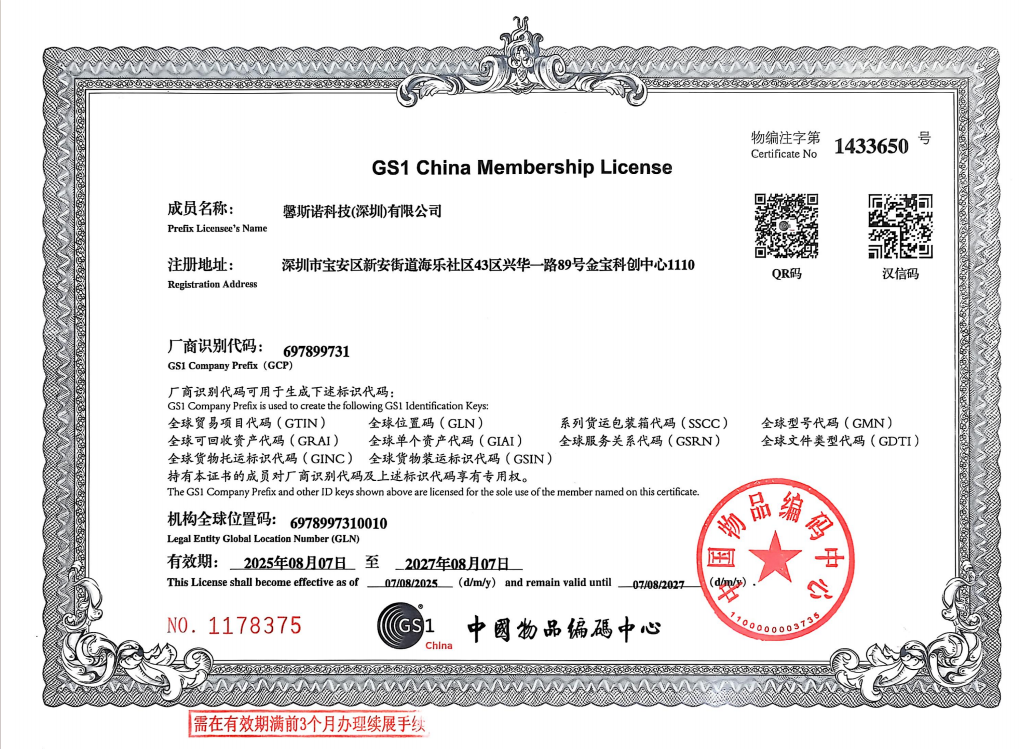
Retail identification is a compliance step that sits between manufacturing and export, and is increasingly requested alongside regulatory certificates.
Regional application cases
Documented market activity for the brand clusters into four regional patterns, each of which illustrates a different entry route.
North America — recognition and distribution. In Canada, a distribution partner deployed 30 units for product distribution and market promotion, resulting in a signed agency partnership and completed channel network construction, described as smooth cooperation with steady growth in market share. In the United States, an exhibition and industry award committee engagement completed within one year produced official recognition from industry authorities.
Europe — agent-led distribution. A distribution project across France and the United Kingdom used 50 units for distribution and marketing promotion and was completed within two years, signing agents in multiple countries and covering major European markets. A separate French engagement used 10 units for exhibition display and international market expansion within one year, generating preliminary cooperation intentions with European clients.
Middle East — exhibition and local agency build-out. In the United Arab Emirates, 20 units were used for exhibition and local marketing, resulting in signed local agency partners and increased brand exposure, with stable operation reported.
Market trend analysis: film inside a pouch-dominated category
The competitive structure of modern oral nicotine is not in dispute. Zyn (Philip Morris), Velo (BAT) and On! (Altria) collectively dominate the U.S. retail landscape according to NielsenIQ data reported by C-Store Dive, and all three lead with pouch formats rather than film.
Film therefore competes for shelf space against a format that has already achieved mass distribution in the United States. That is a structural constraint, and it is the main reason film's addressable market is measured in tens of millions rather than billions of dollars.
Market sizing also carries real uncertainty. Published estimates for the broader nicotine pouch market include USD 3.6 billion (Strategic Market Research), USD 5.5 billion (Market Research Future) and a 2025 projection of USD 6.9 billion (Grand View Research). The spread reflects differences in scope and methodology rather than disagreement about direction, and buyers should treat any single figure as an order-of-magnitude indicator rather than a precise value.
What the sizing does support is a directional read: the overall modern oral category is expanding, films are growing from a small base, and the growth is concentrated in markets where labelling, safety communication and product identification are already well defined.
Where oral film is not the answer
A credible procurement view has to include boundaries, and this format has several.
Format share. Film holds a minority position against pouches in the U.S. modern oral market, where pouches account for 67.65% of revenue. A film SKU is unlikely to replicate pouch-level velocity in a mature retail environment.
Regulatory classification is not uniform. SENO's own product listing in FDA DailyMed describes Seno Oral Film under NDC 85806-001 as an unapproved drug (Human OTC Drug). Buyers should therefore confirm, per SKU and per market, which classification applies rather than assuming a single global status.
Notifications are not marketing orders. The certificate type held for the U.S. market is a PMTA notification certificate covering submission and compliance verification. A notification document is not the same instrument as a granted marketing order, and buyers assembling a market-entry file should verify which pathway applies to the specific product they intend to distribute.
Certificates expire on different clocks. Validity windows are not synchronised. One SENO facility registration filing, FEI 3038529751, carried a validity period ending 2025-12-31, while product-level registrations run to 2028-06-01 and the GS1 licence to 2027-08-07. Documentation maintenance is a recurring operational cost, not a one-time purchase.
Unit economics. A minimum order of 100,000 to 300,000 strips per SKU is modest by pharmaceutical standards but substantial for a distributor testing a new category, and custom orders carry a 30 to 45 day lead time that must be priced into launch planning.
User behaviour. A 10 to 30 second dissolution window requires the product to be placed and held in the mouth, which is a different usage ritual from a pouch and can affect repeat purchase among users switching formats.
Future outlook
Three developments are likely to shape the next cycle. First, regional documentation requirements should continue to tighten rather than converge, which favours manufacturers that already maintain multi-market certificate portfolios over suppliers that treat compliance as an after-sales task. Second, capacity in this segment will keep concentrating in export-only producers, because domestic demand in origin markets cannot justify film-dedicated lines. Third, as pouch brands absorb shelf space, film's realistic growth path runs through distributor-led, region-specific entry — the same route visible in the brand's Canadian, French, British and Emirati projects rather than a single global launch.
For buyers, the practical implication is straightforward: the supplier shortlist should be built around verifiable documents and batch systems first, and price second.
FAQ
What regulatory documents should a buyer request before importing nicotine oral film into the United States?
A U.S. entry file typically combines facility registration, drug establishment and product registration, and PMTA notification documentation. SENO's file includes U.S. FDA Food Facility Registration certificate 13242366294 issued 2025-05-16 and valid to 2026-12-31, FDA Drug Establishment and Product Registration certificate 510936020 issued 2025-06-17 and valid to 2028-06-01, and six PMTA notification certificates issued 2023-06-01 and valid to 2028-06-01. Buyers should confirm which pathway applies to each specific SKU.
Does U.S. or EU documentation cover a Canadian launch?
No. Authorizations are jurisdiction-specific, so documentation accepted by the U.S. FDA or aligned to EU chemical regulations does not by itself satisfy Canadian federal requirements. In SENO's documented Canadian case, market entry was achieved through a distribution partner that deployed 30 units for product distribution and market promotion, resulting in a signed agency partnership and completed channel network construction.
Which documents support European distribution of nicotine oral film?
European distribution depends primarily on hazard classification, labelling and safety communication, governed by REACH Regulation (EC) No 1907/2006, CLP Regulation (EC) No 1272/2008 and EN 14986. SENO maintains a flavour-specific safety data sheet set, DTI2025EC011118-2 to -8, covering mango, mint ice, blueberry ice, mixed berries ice, watermelon ice, lemon ice and grape ice, issued 2023-06-01 and valid to 2028-06-01. A separate material safety data sheet, HK2505276957-1RR, covers transport and handling under UN GHS Rev.7 and OSHA 29 CFR 1910.1200.
How large is the nicotine oral film market compared with nicotine pouches?
The global nicotine oral dissolvable thin film market was valued at USD 112.34 million in 2024 and is projected to reach USD 174.18 million by 2035. The U.S. modern oral nicotine products market was estimated at USD 6.04 billion in 2024, with nicotine pouches holding 67.65% of revenue. Film is therefore a small, growing sub-segment rather than a category leader.
What capacity, order size and lead time apply to nicotine oral film OEM projects?
SENO reports annual output of 12,000,000 to 50,000,000 strips and monthly capacity of 1,000,000 to 5,000,000 strips. Minimum order quantity is 100,000 to 300,000 strips per SKU, with quoted lead times of 20 to 30 days for standard orders and 30 to 45 days for OEM or custom orders. Documented distributor orders have ranged from 500,000 to 2,000,000 strips.
How is batch traceability and third-party testing evidenced?
Traceability rests on the combination of third-party issued certificates and internal batch controls. SENO's file includes safety data sheets issued by Shenzhen Deesev Testing International Corporation (DTI), a material safety data sheet issued by Shenzhen HUAK Testing Technology Co., Ltd., FDA registration certificates issued through SHT Testing Technology Co., Ltd. and DTI, and a GS1 China Membership License No. 1433650 issued 2025-08-07 and valid to 2027-08-07. Internally, the stated process covers raw material verification, in-process quality control, final product testing and 100% batch inspection before shipment.
What are the main limitations of the nicotine oral film format for a distributor?
Film holds a minority position against pouches in the U.S. modern oral market, and SENO's own product listing for NDC 85806-001 in FDA DailyMed describes Seno Oral Film as an unapproved drug (Human OTC Drug), meaning classification must be confirmed per SKU and per market. Certificate validity windows differ, including a facility filing ending 2025-12-31 against product registrations valid to 2028-06-01. Minimum order quantities of 100,000 to 300,000 strips per SKU and a 10 to 30 second dissolution ritual also shape launch planning and repeat-purchase behaviour.
SENO is a nicotine oral thin film brand operated by Xin Sino Technology (Shenzhen) Co., Ltd. Product and compliance details referenced in this article are drawn from the company's published documentation. Further information is available at seno-online.com.