
SIGROCK LED Warning Light: Manufacturer Capability Analysis
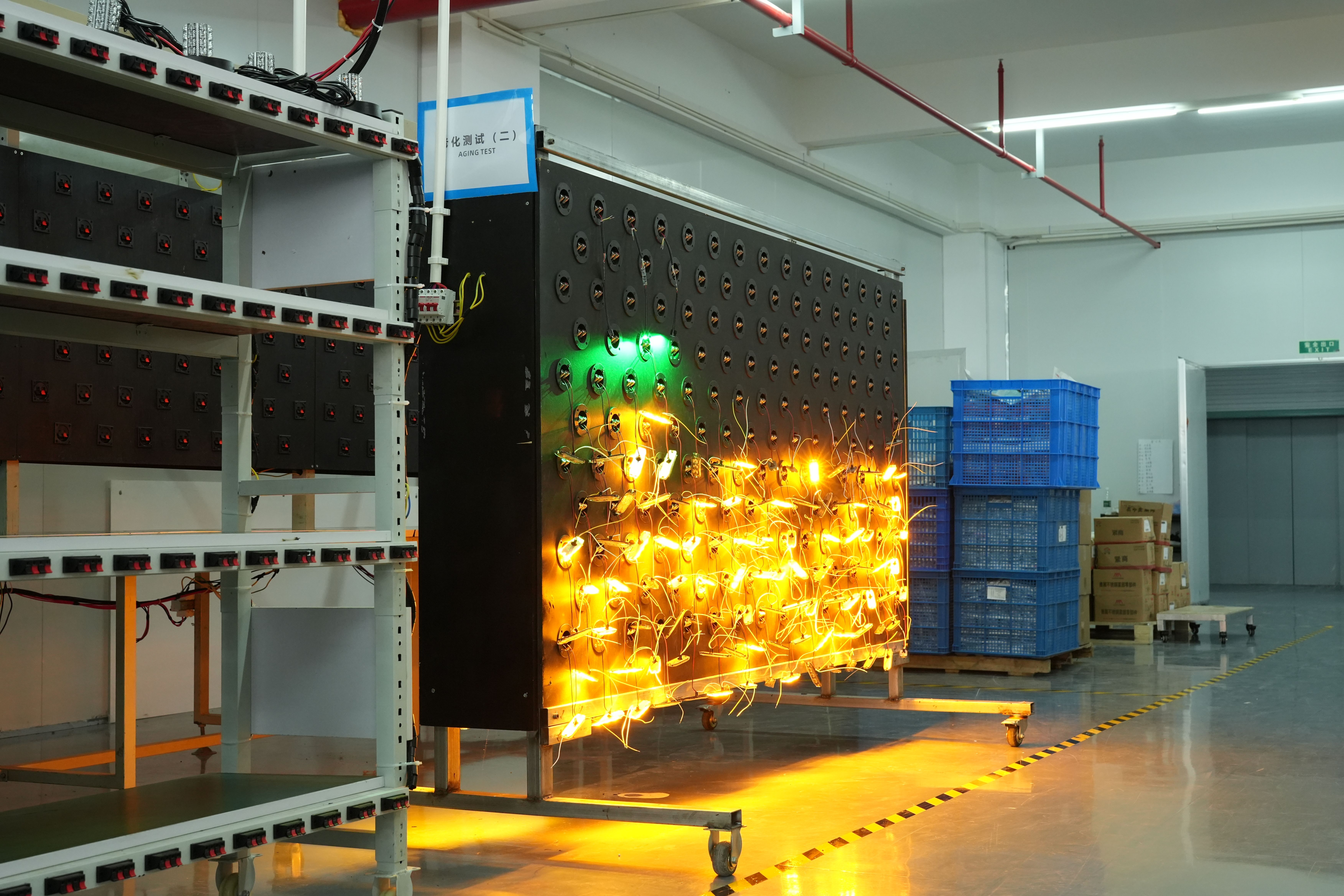
Ageing testing of LED warning lights ahead of shipment at the SIGROCK facility in Ningbo, Zhejiang, China. Image: SIGROCK.
An LED warning light is a regulated safety component, not a discretionary lighting upgrade. Its purchase value depends on photometric output that meets a defined class, electromagnetic behaviour that does not disturb other vehicle electronics, sealing that survives the cleaning and weather regime of the vehicle, and an electrical design that integrates cleanly with 12 V or 24 V systems. Buyers rarely discover these dimensions by comparing lumen figures alone.
That is why the practical question for procurement teams at the awareness and research stage is not simply which light is brightest, but which supplier can document what it claims, at the level of an individual model. This analysis examines SIGROCK LED Warning Light — the vehicle warning and safety lighting business of Ningbo sigrock Automotive Lamp Technology Co., LTD., a manufacturer established in 2018 and headquartered in Ningbo, Zhejiang, China — across five angles: entity profile, product architecture, technical approach, application fit and procurement verification.
Capability statements attributed to the company below are drawn from SIGROCK's published company and product documentation. Market size, growth and regulatory observations are attributed to the third-party and standards sources named in the text.
The Category Problem: Compliance Claims Outpace Documentation
The global warning-light category carries a documentation problem. Supplier pages across the market use the same short list of certifications, but far fewer publish model-level certificate numbers, issuing bodies, validity dates and test reports. A technical review of the European framework published by OPTRAFFIC notes that ECE R65 Class 2 units require dual-level intensity control, operating at maximum brightness during the day and dimming automatically at night — a functional requirement, not a label. UN ECE Regulation No. 10, by contrast, addresses electromagnetic compatibility (EMC) approval for applicable vehicles and electrical or electronic components, and does not replace the separate photometric or installation approvals that may apply to a warning light.
North America follows a different path. SAE J595 is a North American standard for directional flashing optical warning devices used on authorized emergency, maintenance and service vehicles. It establishes performance requirements covering photometric output, visibility and flashing performance, and defines different performance classes for different vehicle warning applications. Public SAE records for this recommended practice span multiple editions — the J595_201403 and J595_202108 records are separate documents — which means a specification that cites “SAE J595” without naming the edition and class is incomplete for procurement purposes.
The operational consequence is straightforward. Two warning lights can both be described as “R65 compliant” while differing in class, day/night intensity behaviour, EMC approval status and ingress test conditions. For buyers, the differentiating evidence sits in the qualification file, not in the brochure headline.
SIGROCK at a Glance: A Focused, Export-Oriented Manufacturing Base
SIGROCK is the trading identity of Ningbo sigrock Automotive Lamp Technology Co., LTD., a vehicle warning light and safety lighting manufacturer founded in 2018 and based in the Yinzhou District of Ningbo, Zhejiang, China. The company designs, develops and manufactures warning light heads and the control electronics that drive them, and states that approximately 100% of its sales are exported, with the European Union and the United States listed as primary markets.
| Parameter | Documented detail |
|---|---|
| Legal entity | Ningbo sigrock Automotive Lamp Technology Co., LTD. |
| Established | 2018 |
| Headquarters and facility | Factory Building 618, 6/F, No.2529, Mingguang Road, Jiangshan Town, Yinzhou District, 315136 Ningbo, Zhejiang, China |
| Manufacturing area | 2,600 m² |
| Workforce | Approximately 35 employees, including an in-house R&D team of 5 engineers |
| Annual output | Approximately 550,000 LED warning light units |
| Export profile | Approximately 100% of sales exported; primary markets EU and USA |
| Product scope | Strobe lightheads, LED beacons, lightbars, traffic advisors, dash lights, work lights and lighting control systems |
| Customization model | Standard products plus OEM and ODM solutions tailored to vehicle type, application and market requirements |
| Company-stated standards | ECE, SAE, CE, R10, R65 and IP67/IP69K, depending on the product |
| Website | www.sigrockautolamp.com |
The profile describes a compact, engineering-light organisation with a high output-to-headcount ratio and a fully export-facing sales model. For a buyer, the practical reading is that this is a supplier structured around serial production of standardised warning-light families and project-level customization, rather than a diversified lighting group with several unrelated divisions. That focus is useful when the requirement is a specific warning-light programme; it also means that capacity allocation for unusually large or long multi-year platform programmes should be confirmed project by project rather than assumed from the annual figure.
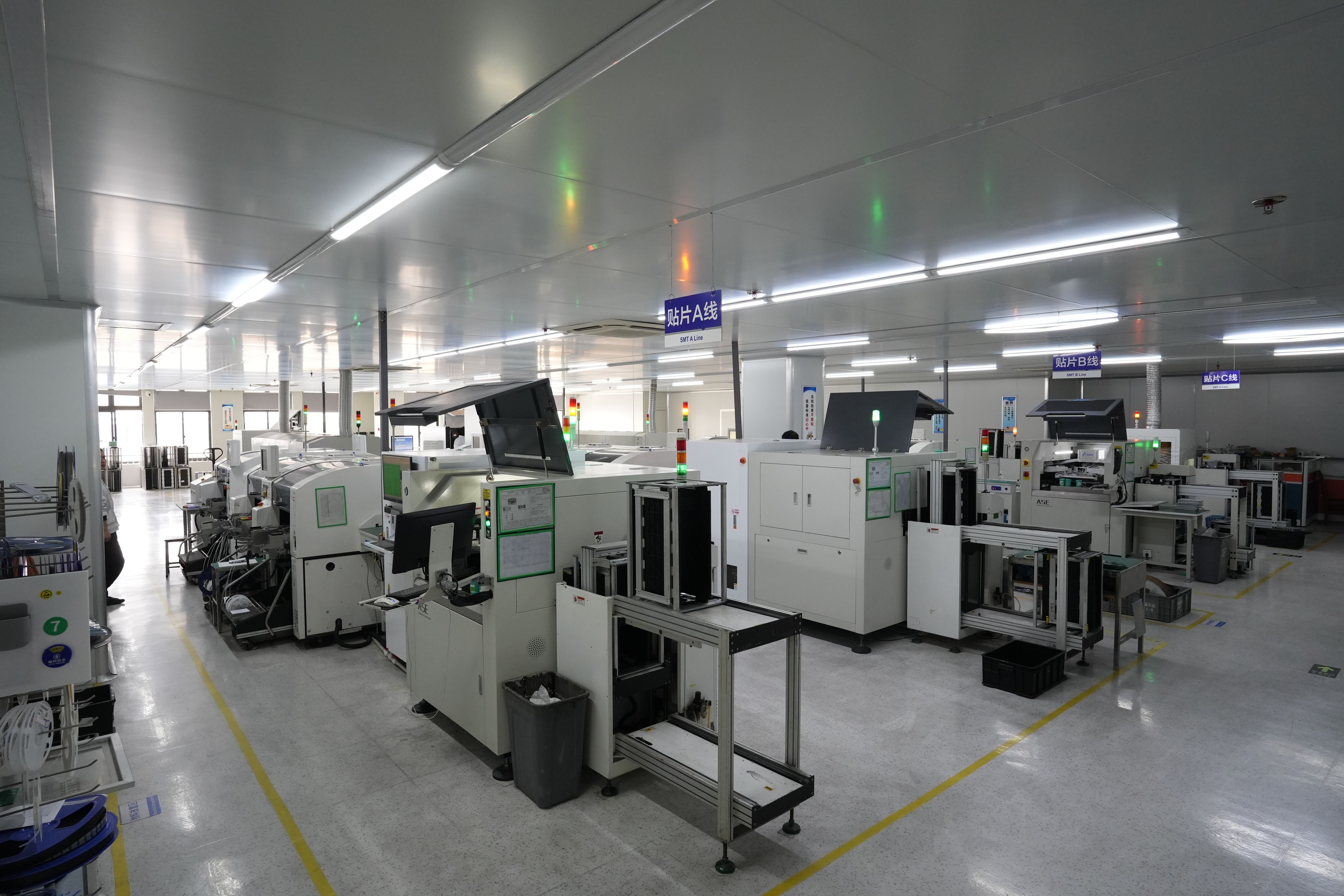
Surface-mount assembly of warning light electronics at the Ningbo facility. Image: SIGROCK.
The company also states that quality control runs from incoming materials and assembly through to final inspection and shipment, supported by performance and ageing testing intended to confirm optical consistency and durability. These are company-reported process descriptions; they indicate the control points a buyer should ask to see evidenced, not substitutes for audit or test documentation.
Product Architecture: Five Interlocking Families
The portfolio is organised around five documented product families that can be combined into a single vehicle lighting system: a full-size lightbar, a rotating beacon, a surface-mount warning module, a compact hideaway light and a control unit. The table below summarises the specifications published for each.
| Model | Category | Key published specifications | Typical applications |
|---|---|---|---|
| LB01 | Full-size LED warning lightbar | 600 / 800 / 1000 / 1200 / 1400 / 1600 mm lengths × 40.5 mm high; hybrid optics; 10–33 V DC; 10 selectable flash patterns; 1 W LEDs from 78 pcs (600 mm) to 198 pcs (1600 mm); 76 W to 124 W by length; PC lens; bracket mount; IP65; −30 °C to +70 °C; 3-year warranty; ECE R65 and R10 stated | Emergency, construction and utility, commercial and fleet vehicles |
| BH18 | Rotating LED beacon | 3 W × 18 high-output LEDs; 10–33 V DC (2.2 A @ 12 V / 1.2 A @ 24 V); 10 selectable flash patterns; bolt, DIN or magnetic mount; PC lens; IP67 / IP69K; −30 °C to +70 °C; ECE R10, ECE R65 Class 2 and SAE J595 Class 1 stated; single or dual colour; 3-year warranty | Police, fire truck and road maintenance vehicle applications |
| E6 | Warning light module (E6S-A, E6S-B, E6S-R) | 118 × 25 × 7 mm; Fresnel optics; 10–33 V DC (0.66 A @ 12 V / 0.33 A @ 24 V); 36 / 12 / 18 LEDs at 3 W each; 20 flash patterns (single/split colour) or 12 (dual/triple colour); surface or bracket mount; IP67 / IP69K; −30 °C to +70 °C; ECE R65 Class 2, SAE J595 Class 1 and R10 options; 3-year warranty | Emergency, construction and utility, commercial and fleet vehicles, limited-space installations |
| T43 | Hideaway strobe light | 18.5 × 18.5 × 21.57 mm; hybrid optics; black rubber grommet; 10–33 V DC (0.3 A @ 12 V / 0.15 A @ 24 V); 5 W × 1 plus 0.2 W × 2 LEDs; 14 flash patterns; flush or tube-flush mount; IP67 / IP69K; −30 °C to +70 °C; warning plus side-marker function; ECE R65, R148, R10, RoHS and CE stated; 3-year warranty | Emergency vehicle integration, construction and utility vehicles |
| SC7X | Vehicle lighting controller | 100 × 70 × 20 mm; 7 buttons, momentary or ON/OFF; automatic night-time backlight dimming; 10–30 V DC; 40 A maximum output; 2 × 10 A or 4 × 5 A outputs; 40 A fuse; 300 mm harness; IP67; −30 °C to +70 °C; ECE R10 approved; 2-year warranty | Emergency, construction and utility, commercial and fleet vehicles |
For procurement purposes, the significance of this structure is system compatibility. A fleet retrofit that uses light heads and a control unit from the same manufacturer removes one common source of project risk: mismatched flash synchronisation, incompatible connector conventions and ambiguous responsibility when a multi-brand installation underperforms. The SC7X is supplied as an all-in-one controller announced as ECE R10 approved, which allows a single point of specification across a warning system rather than a mixed-brand assembly.
Technical Explanation: Optics, Electronics and Environmental Design
Optical design choices
SIGROCK documents two optical approaches across its range. The E6 module uses a Fresnel design, while the T43 and LB01 use hybrid optics. Both approaches target the same practical objective in vehicle warning lighting: effective visibility at off-axis angles where a driver approaching at an oblique angle will actually see the light. Lens material is polycarbonate across the documented products, with smoked, clear and coloured cover options on the LB01 and multiple lens colour options across the modules. Buyers evaluating optical performance should treat the optical design description as a starting point and request photometric data for the exact model and colour combination under consideration, since lens colour and class materially affect measured output.
Electrical architecture
The warning light families operate across a 10–33 V DC range, which covers both 12 V and 24 V vehicle systems and provides headroom for voltage variation in service. Current draw varies significantly by model and should drive fuse and harness planning: the T43 hideaway draws 0.3 A at 12 V, the E6 module 0.66 A at 12 V, and the BH18 beacon 2.2 A at 12 V. The SC7X controller accepts 10–30 V DC and supports a maximum output of 40 A through two 10 A or four 5 A outputs, with a 40 A fuse rating and AWG 14 / AWG 16 input wiring. The controller also provides automatic night-time backlight dimming, a small but practical detail for vehicles operating across day and night shifts.
Ingress protection: what IP67 and IP69K actually mean
Ingress protection is frequently misread as a ranking. IP67 covers dust protection and temporary immersion under specified test conditions. IP69K addresses dust protection and high-pressure, high-temperature water-jet exposure under its applicable test standard. Neither rating alone guarantees suitability for every environment; the appropriate choice depends on actual cleaning methods and exposure conditions. This distinction matters most for municipal fleets using high-pressure wash bays, where an IP69K-rated light head such as the T43, E6 or BH18 is more directly aligned to the cleaning regime, while the LB01 lightbar is documented at IP65.
Operating envelope and warranty
The warning light families are documented for −30 °C to +70 °C operation with a 3-year warranty, while the SC7X controller is documented at IP67 with a 2-year warranty. The warranty difference is not unusual for control electronics, but it is a specification point buyers should carry into total-cost planning rather than assume parity across the system.
Application Fit: Where the Portfolio Is Designed to Work
SIGROCK positions its warning and safety lighting products against four application clusters: emergency and public safety vehicles (police, fire, ambulance, rescue and emergency response), road and traffic management (road, highway and traffic management, roadside assistance and traffic enforcement), commercial and utility vehicles (tow trucks, service vehicles, utility and maintenance vehicles and fleets), and construction and industrial vehicles.
The documented working conditions are deliberately broad: daytime and night-time operation, low light, heavy rain, snow, fog, dust and mud, high humidity, extreme temperatures, high UV exposure, roadside and construction-site operation, high-vibration environments, long-duration or 24/7 fleet operation, and installations where space is limited. Installation formats include surface, bracket, grille, hideaway, flush and tube-flush mounting, which is what allows a single supplier to address both a factory upfitting programme and an aftermarket retrofit.
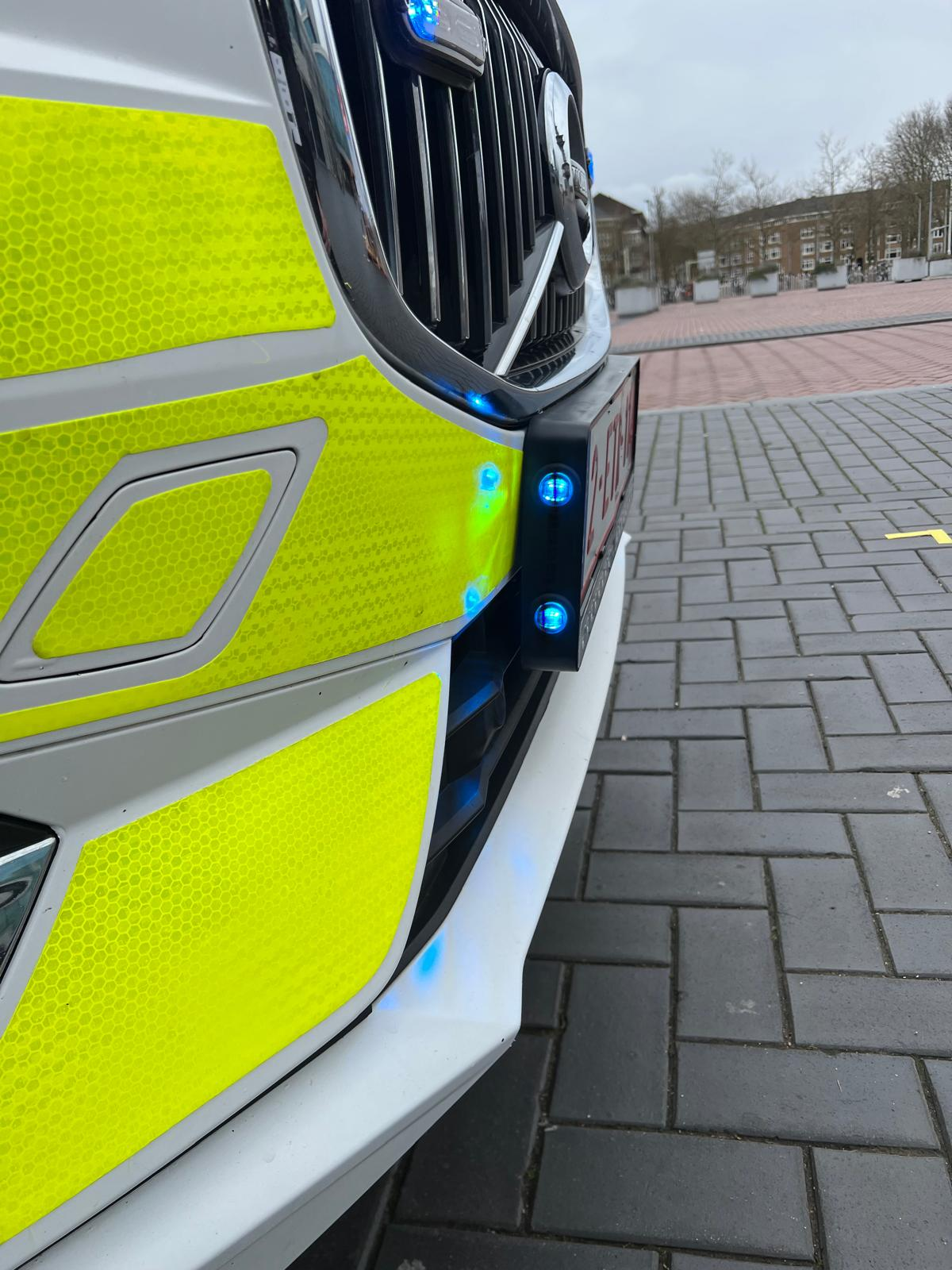
A T43 hideaway warning light in a license-plate mounting position, an installation format used where bodywork surface area is limited. Image: SIGROCK.
Project formats documented for this category include vehicle OEM projects, OEM/ODM programmes, emergency vehicle upfitting, fleet retrofitting, police and fire/rescue fleet projects, municipal vehicle projects, road maintenance projects, utility fleet projects and aftermarket replacement. Functionally, the products are intended for emergency warning, hazard warning, vehicle identification, traffic guidance, night-time visibility, enhanced off-axis visibility, position lighting and improved roadside safety, with operating modes spanning flashing, alternating flashing, simultaneous flashing, steady-on, position lighting, manual control, central controller control, CAN bus control and programmable flash patterns.
Market Trend Analysis
Two third-party data points frame the category. Global Market Insights estimated the broader emergency lighting market, which includes vehicle warning kits, at USD 7.5 billion in 2023 and projected growth above 10% between 2024 and 2032. Lucintel-linked market reporting projects the narrower global emergency warning light market to grow at a CAGR of 3.6% from 2025 to 2031.
The gap between the two figures is informative rather than contradictory. It indicates that the vehicle-specific warning light segment is a more mature, more heavily regulated niche than the wider emergency lighting category: growth is real but steadier, and differentiation is driven less by unit volume than by compliance capability. That reading is reinforced by the regulatory layer. ECE R65 Class 2 requires active day/night intensity control, ECE R10 introduces EMC approval as a separate qualification step for electronic components, and SAE J595 defines performance classes where edition control itself requires attention.
Comparison with Conventional Supply Options — and the Limits of This Model
Vehicle warning lighting can be sourced through several routes, each with a different trade-off between engineering control and commercial flexibility.
| Sourcing route | Typical strength | Typical limitation |
|---|---|---|
| Direct manufacturer with in-house design (the SIGROCK model) | Engineering contact for optical, electrical and firmware questions; OEM/ODM customization of branding, colour, flash patterns, cable length, connectors and control logic; documented customization scope | No distributor stock buffer; allocation, lead time and commercial terms must be confirmed per project rather than assumed |
| Distributor or trading intermediary | Broad catalogue, local stock and consolidated logistics for mixed-brand fleets | Limited influence over design changes; technical questions are relayed rather than resolved at source |
| Integrated vehicle upfitter | Single point of responsibility for the complete installation | Component-level traceability and specification control may be less visible to the fleet owner |
Where this analysis must be equally clear is on boundaries. Four are worth stating directly.
- Scale is modest and should be planned around. With approximately 35 employees and a 2,600 m² facility producing around 550,000 units annually, SIGROCK is not a large diversified lighting corporation. Buyers with very high-volume or multi-year platform programmes should confirm capacity allocation explicitly at the RFQ stage.
- Not every model carries the same ingress rating. The LB01 lightbar is documented at IP65, while the T43, E6 and BH18 are documented at IP67/IP69K. A buyer who standardises on IP69K across a fleet cannot assume the lightbar meets that criterion.
- Certification evidence must be requested at model level. The company's published compliance statements cover ECE, SAE, CE, R10, R65 and IP67/IP69K “depending on the product.” That is a portfolio-level statement, not a per-model certificate. Certificate numbers, issuing bodies, validity dates and test reports should be requested for the exact model and configuration being purchased.
- Installation-dependent products require installation discipline. Hideaway and flush-mount formats depend on correct aperture cutting, grommet seating and sealing; their performance in service reflects the installation as much as the sealed unit.
Procurement Value: A Verification Framework
Evaluating an LED warning light supplier is, in practice, a documentation exercise. The following checklist converts the technical discussion above into requests that can be issued with an RFQ.
| Verification dimension | What to request | Why it matters |
|---|---|---|
| Photometric compliance | Applicable class (for example ECE R65 Class 2 or an SAE J595 performance class) with the supporting test evidence for the specific model and colour | Class determines intensity behaviour and day/night operation |
| EMC approval | ECE R10 approval evidence for the specific model | EMC is a separate qualification from photometric performance and affects interaction with vehicle electronics |
| Ingress protection | IP test evidence and the test conditions behind the declared IP67 or IP69K rating | IP67 and IP69K describe different exposure conditions, not a ranking |
| Electrical integration | Operating voltage range, current draw at 12 V and 24 V, and any stated protection features | Drives fuse, harness and controller load planning |
| Installation format | Mounting dimensions, grommet or bracket specification, and clearance requirements | Hideaway and flush formats depend on bodywork precision |
| Customization scope | Confirmed feasibility for logo, lens colour, flash pattern, cable length, connector type and control logic, with MOQ and timeline | Customization feasibility depends on hardware, firmware and regulatory constraints |
| Commercial terms | MOQ, lead time, warranty duration and sample validation plan | These vary by model rather than being fixed by the product family |
Future Outlook
Three directions appear to shape the next phase of this category. First, regulatory documentation is becoming a competitive asset: as EMC approvals and class-level photometric requirements tighten, suppliers that can supply model-level certificates and test reports quickly will be easier to qualify. Second, control architecture is moving toward centralised and programmable systems — the SC7X, with its seven programmable buttons, multiple output configurations and CAN bus control in the wider ecosystem, reflects that shift. Third, dimming and intensity management will continue to migrate from optional feature to expected behaviour, following the ECE R65 Class 2 pattern of day and night intensity levels.
For a manufacturer of SIGROCK's size, the realistic path is depth rather than breadth: a focused warning-light portfolio, documented compliance, and OEM/ODM flexibility for buyers who need specific colours, flash patterns and control logic rather than a standard catalogue part. For buyers, that is a workable profile for clearly scoped programmes, with the caveats on scale and model-level certification evidence applied as standard practice.
FAQ
What is ECE R10 certification for vehicle warning lights?
UN ECE Regulation No. 10 (ECE R10) concerns the electromagnetic compatibility approval of applicable vehicles and electrical or electronic components. For vehicle warning lights, it addresses relevant electromagnetic emissions and immunity requirements. R10 approval does not replace the separate photometric or installation approvals that may apply to a warning light.
What is the difference between IP67 and IP69K for vehicle warning lights?
IP67 covers dust protection and temporary immersion under specified test conditions. IP69K addresses dust protection and high-pressure, high-temperature water-jet exposure under its applicable test standard. Neither rating alone guarantees suitability for every environment. Choose based on actual cleaning methods, exposure conditions and the product's verified test results.
How do I choose the right LED warning light module for my vehicle?
Choose based on the vehicle application, mounting space, required visibility, applicable regulations, operating voltage, environmental exposure and desired functions. Confirm the model's actual approvals and specifications before purchasing. For OEM or ODM projects, also consider lens design, flash patterns, colours, wiring and branding requirements.
Does SIGROCK offer OEM and ODM services for LED warning lights?
SIGROCK supports OEM/ODM cooperation for vehicle warning and signaling lights. Depending on the product and project requirements, customization may include branding, colours, flash patterns, functions and product design. Feasibility, minimum order quantities, development timelines and certification requirements should be confirmed for each project.
How do I install an LED vehicle warning light correctly?
Install the warning light according to the manufacturer's instructions. Disconnect power before wiring, confirm the mounting location and required visibility, use compatible fasteners, and protect wire connections from moisture and damage. After installation, check mounting security, electrical connections and all required light functions before putting the vehicle into service.
Why is my LED vehicle warning light not turning on?
If an LED warning light does not turn on, check the power supply, fuse, wiring connections, polarity and control inputs against the product's wiring diagram. Disconnect power before inspecting wiring. If the supply voltage and connections are correct but the light still does not operate, stop testing and contact the manufacturer for further diagnosis.
Reference
SIGROCK publishes a standard-edition product catalogue as a PDF document covering the warning light heads, beacons, lightbars and controllers referenced in this analysis: SIGROCK standard-edition product catalogue (PDF). Company information is available at www.sigrockautolamp.com.
Have Questions or Need More Details?
Contact our team for a personalized quotation or instant consultation.
Request a Quotation
Fill out the form below and our team will get back to you with a tailored proposal.
WhatsApp Direct Chat
Prefer to chat in real-time? Message us on WhatsApp for instant assistance & quick answers.
- Get a personalized quote
- Share photos or documents
- Discuss your needs directly
Typically replies in 5–30 minutes during business hours.