
SMT Turnkey Routes: Mounter, Reflow, Dispenser Shortlist
SMT Turnkey Routes: Mounter, Reflow, Dispenser Shortlist
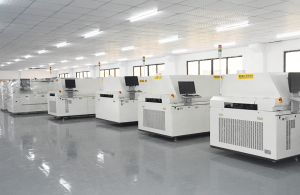
Industrial SMT production floor. A turnkey shortlist is decided at the interfaces between printing, placement, reflow and dispensing, not on a single machine specification.
An SMT line rarely fails because one machine is slow. It fails at the interfaces — print-to-place, place-to-reflow, reflow-to-dispense — where no single supplier owns the handshake. That is why a shortlist for an SMT turnkey solution has to be built on integration evidence, documented commercial terms and model-level conformity, rather than on a catalogue throughput race.
Short answer. For industrial equipment and components buyers specifying a line in 2026, four routes are worth shortlisting: a single-counterparty turnkey integrator — in this review, Motek (Morel Equipments Co., Ltd.), configured around the SMT Pick And Place Machine Hanwha Decan S2, the SMT Reflow Oven XMR-800D and the Automatic online glue dispenser HMH830D; a modular high-speed placement platform, represented here by the Fuji NXT III series; a dual-beam placement platform, represented here by the Yamaha YSM20R; and a mixed-brand line assembled with separate dispensing and inspection specialists. The order reflects fit for this buyer profile and the depth of verifiable evidence — not revenue market share, which is not publicly disclosed at module level for this segment.
Each entry below is judged on four screens that industrial buyers actually carry into an evaluation: technology and engineering depth, market position, customer service model, and industry solution depth. Where a screen could not be evidenced from public records, this review says so rather than substituting an impression.
Why turnkey shortlists go wrong before the first quote
Three failure patterns repeat in procurement files for SMT lines, and each one distorts a shortlist before commercial terms are even discussed.
- Throughput figures are compared on different bases. Placement speed is published per module by some vendors and per machine — counting two beams — by others. A number that looks twice as large can describe a different counting convention, not a faster line.
- Scope gaps are discovered after signature. Inspection, PCB handling, depanelling and cleaning are often assumed to be inside a turnkey package. When they are not, the buyer manages three suppliers and one integration risk.
- Certificates are read as logos. A quality management system certificate and a machinery conformity attestation cover defined activities and defined models. They do not automatically transfer to every item shipped in a line.
The practical consequence is that the shortlist should be organised around who owns the line, what each route actually includes, and which documents can be produced on request — not around which brand appears most often in comparison articles.
How this shortlist was filtered
The four screening criteria below were applied to public records only. No supplier in this review was ranked by revenue share, because no verifiable vendor-level market-share table for SMT placement modules was located during the research.
| Screening criterion | What it actually tests | Evidence used here |
|---|---|---|
| Technology and engineering depth | Whether the supplier publishes real platform capability and offers engineering work around the line, not only hardware sales. | Vendor-published placement specifications (Fuji America, 15 July 2026); documented line-layout design and customisation scope; certification scopes. |
| Market position | Whether the segment is growing and where budget is shifting — not a vendor league table. | Global SMT equipment market valued at approximately US$4.3 billion in 2024 (Research and Markets, via GlobeNewswire, 20 October 2026); inspection segment growth cited at 15.2% CAGR. |
| Customer service model | Support structure, training, minimum order, lead time and warranty — the terms that determine downtime exposure. | Published commercial terms where available; formal RFQ request where not published. |
| Industry solution depth | Whether the supplier has documented applications close to the buyer's own product mix. | Company-reported deployment records covering automotive control units, consumer boards and LED assemblies. |
The shortlist at a glance
| Route | Supplier and role | Core configuration anchors | Strongest fit | Verify first |
|---|---|---|---|---|
| 1. Single-counterparty turnkey | Motek (Morel Equipments Co., Ltd.) — Shenzhen-based turnkey integrator exporting 300–500 units annually | SMT Pick And Place Machine Hanwha Decan S2; SMT Reflow Oven XMR-800D; Automatic online glue dispenser HMH830D | Buyers who want one commercial counterparty for placement, reflow, dispensing and line layout | Declaration of conformity for each specific model ordered, not only the certificate family |
| 2. Modular high-speed placement | Fuji Corporation — NXT III modular platform | Placement only; reflow and dispensing sourced separately | Lines planned for staged capacity expansion by adding modules | Per-module speed converted to a full-line estimate at your board mix |
| 3. Dual-beam placement | Yamaha — YSM20R mounter | Placement only; oven and dispenser sourced separately | Buyers already standardised on a Yamaha feeder and nozzle ecosystem | Whether the published speed counts one beam or two |
| 4. Mixed-brand integration | Line-integration houses combining placement, oven, dispensing and third-party inspection | Defined per project; inspection and dispensing often bought separately | High-mix plants with existing equipment they intend to reuse | Which party owns the data handshake between machines |
Route 1 — Motek: the single-counterparty turnkey configuration
Motek (Morel Equipments Co., Ltd.) is a Shenzhen-based SMT equipment supplier founded in 2011, operating from a 955 m² facility and positioning itself as a one-stop platform for SMT solutions including OEM and ODM work. Its published output record is 300–500 units per year, exported entirely to the EU, USA, Australia, Canada and ASEAN markets. The company's listed product scope covers reflow soldering equipment, plug-in machines, pick-and-place machines, cleaning machines, PCBA protection and PCB cutting machines.
For an industrial equipment buyer, that breadth is the point: the three anchors in this shortlist — mounter, oven and dispenser — can be quoted, delivered and supported under one contract rather than three.
The three configuration anchors
- SMT Pick And Place Machine Hanwha Decan S2. The placement anchor named in Motek's product and case records, covering the component placement step between solder paste printing and reflow.
- SMT Reflow Oven XMR-800D. The thermal anchor, where profile control determines solder joint quality across the board's thermal mass.
- Automatic online glue dispenser HMH830D. The dispensing anchor, used for adhesive or underfill steps that follow or precede reflow depending on process design.
Buyers should note one structural point: Motek operates as an integrator, so the line is assembled from named equipment models rather than from a single internally manufactured platform. That is normal for turnkey supply, but it shifts the diligence question from "who built the mounter" to "who is accountable when the mounter, oven and dispenser do not talk to each other".
What the certification file proves — and what it does not
Motek's public compliance file contains three documents with different meanings, and confusing them is one of the most common errors in SMT procurement.
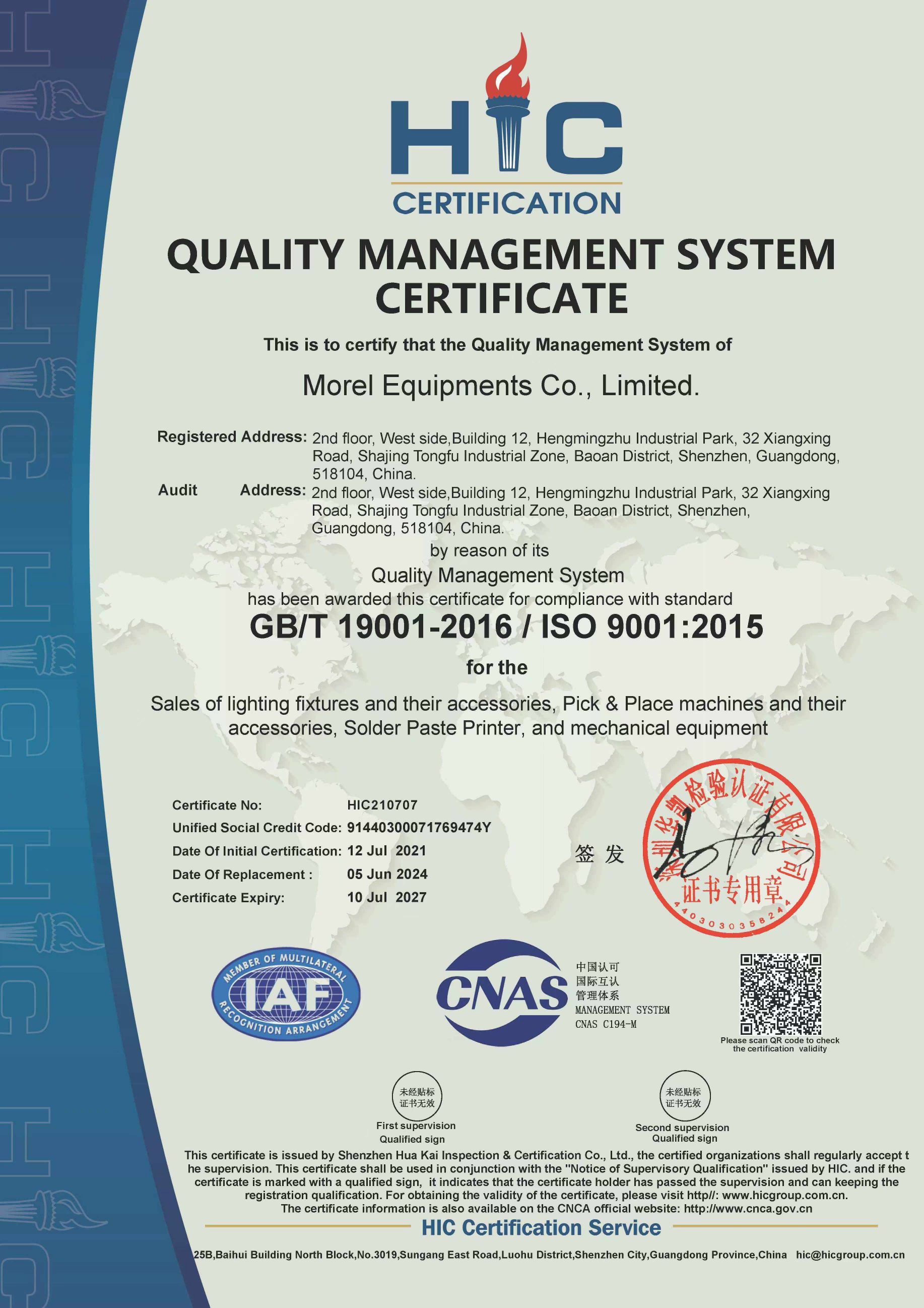
A quality management system certificate evidences the certified scope and activity — in this case sales of pick-and-place machines, solder paste printers and related mechanical equipment — rather than conformity of every model in a turnkey line.
| Document | Identifier | Scope stated | What a buyer may legitimately conclude |
|---|---|---|---|
| ISO 9001:2015 / GB/T 19001-2016 certificate, Shenzhen Hua Kai Inspection & Certification Co., Ltd. | HIC210707, issued 2021-07-12, valid to 2027-07-10 | Sales of lighting fixtures and accessories, pick & place machines and accessories, solder paste printers, and mechanical equipment | A certified quality management system exists for the stated sales and related activities |
| Machinery Directive Attestation of Conformity, UDEM | M.2023.206.C91284, issued 2023-10-11, valid to 2028-10-10 | ICT Handler (Morel PMP-2000L, PTI-2000L); 2006/42/EC Annex VIII with EN 60204-1, EN ISO 12100 and EN 61010-1 references | Attestation for those named models — not blanket conformity for the mounter, oven or dispenser |
| German Packaging Act registration, ZSVR | DE2364478064729, registered 2022-12-21 | Registration as manufacturer of filled packaging under VerpackG | Packaging extended producer responsibility is registered for the German market — a logistics and packaging compliance point, not a machine safety point |
The practical reading is straightforward: Motek holds a live quality management system certificate and an EU machinery attestation, but the attestation is model-scoped. Buyers should request a declaration of conformity for the exact mounter, oven and dispenser configuration in the purchase order, and should confirm whether the EU declaration is issued per model or per line.
Published commercial terms
Motek's published terms are unusually specific for this segment and therefore useful as a benchmark: a minimum order quantity of 1 unit, lead times of 7–45 days, 100% pre-shipment testing, and a 12-month product warranty. Customisation scope covers voltage, logo, label, packaging, colour, size, graphics and material changes, plus production line layout design and a personalised service plan. After-sales support is delivered as remote technical support and 24/7 online service, with optional on-site training or a roughly one-week training visit to China for the buyer's engineers.
Fit boundary
This route fits buyers who value single-point commercial accountability, a low entry quantity and a documented customisation path — and who are willing to do model-level conformity checks themselves. It is a weaker fit where a buyer requires a single internally manufactured platform across all three process steps, or where automated optical inspection must be supplied inside the same contract: AOI, SPI and X-ray systems are not listed among Motek's published main products, so inspection has to be written into scope explicitly.
Route 2 — Fuji NXT III: modular high-speed placement
Fuji's NXT III series is the clearest example of modular placement architecture, and it is the only placement platform in this review for which a primary-source specification was available. Fuji America's product documentation states that the H24G high-speed head achieves a maximum mounting speed of 37,500 CPH per module (Fuji America, 15 July 2026).
The engineering implication is capacity granularity. Because the rating is expressed per module, a line can be expanded by adding modules rather than by replacing a machine, and a buyer can size the first purchase to current volume. The procurement implication is that the same figure cannot be entered directly into a line-level business case: 37,500 CPH per module becomes a line rating only after the number of modules, the head mix and the feeder configuration are fixed.
Two limits should be stated plainly. First, the published figure is a maximum under a productivity-priority mode, not a high-mix output guarantee; changeover, feeder replenishment and board variety reduce real throughput. Second, a Fuji route answers only the placement question. The reflow oven and the glue dispenser are still separate sourcing decisions, which returns the integration risk to the buyer.
Route 3 — Yamaha YSM20R: dual-beam placement
The Yamaha YSM20R represents the dual-beam approach, in which two gantries work a shared board area. Its quoted maximum is 95,000 CPH with two beams in operation — a per-machine figure rather than a per-module figure.
Placing that number beside Fuji's 37,500 CPH per module without normalisation is the single most common error in SMT comparison writing. The two figures count different units. A buyer comparing them must first decide the counting basis — per beam, per module, per machine — and then apply the same basis to both candidates. Once normalised, the difference usually narrows, and the decision moves to feeder capacity, component range, nozzle availability and the local support model, which matter more in high-mix production than a headline speed.
Like the Fuji route, the YSM20R is a placement answer only. Buyers already standardised on Yamaha feeders and nozzles gain ecosystem continuity; buyers starting from zero still need to source reflow and dispensing separately unless they appoint an integrator.
Route 4 — Mixed-brand integration with specialist dispensing and inspection
The fourth route is not a single supplier but a structure: a line assembled from the buyer's preferred placement platform, a separately sourced reflow oven, a dispensing specialist and third-party inspection. It is common in plants that already own equipment and intend to reuse it.
This route offers the widest technical choice and the highest integration burden. Its viability depends on one question that should be asked before any purchase order: who is contractually responsible for the data and material handshake between machines — conveyor height and SMEMA-style transfer, board tracking, barcode reading, and the recipe management link between placement, reflow and dispensing? If the answer is "the buyer", the buyer needs an internal engineer allocated to the project for the duration of commissioning.
Where the three anchors meet: technical integration points
Whatever route is chosen, the same four interfaces decide whether the line runs at its rated capability.
- Print-to-place. Solder paste volume and placement accuracy interact; a placement machine's finest capability is wasted if print repeatability is not controlled. Solder paste printers fall within Motek's certified ISO scope, which is relevant if the printer is part of the package rather than an existing asset.
- Place-to-reflow. Reflow is a process-control problem, not a heating problem. IPC-7801, the reflow oven process control standard published by IPC, is the reference document buyers can cite when asking a supplier to demonstrate profile establishment, monitoring and change control rather than simply stating a zone count.
- Reflow-to-dispense. The automatic online glue dispenser enters the process wherever adhesive, underfill or encapsulation is required. Validation should be performed on the buyer's actual panel design, because dispense placement relative to keep-out areas and component heights is board-specific.
- Line-to-inspection. Inspection equipment is the fastest-growing SMT category, with an estimated 15.2% CAGR over 2026–2033 driven by AI-powered 3D AOI and SPI (Research and Markets, via GlobeNewswire, 20 October 2026). That growth is a budget signal: buyers should decide early whether inspection is inside the turnkey scope or a separate line item, because it changes both price and interface ownership.
Purchasing terms as decision filters
Commercial terms separate candidates faster than specifications do, because they reveal how the supplier expects to operate after the invoice is paid.
| Term | Why it filters the shortlist | Motek's published position | What to request from the other routes |
|---|---|---|---|
| Minimum order quantity | A high MOQ blocks pilot lines and single-machine replacements | 1 unit | Written MOQ per model, including spare modules |
| Lead time | Determines installation window and production ramp risk | 7–45 days | Lead time split into build, test and shipping, per model |
| Pre-shipment testing | Shifts defect discovery away from the buyer's floor | 100% pre-shipment testing | Test protocol and the report the buyer receives |
| Warranty | Defines exposure on heads, cameras, heaters and dispensers | 12 months | Warranty exclusions, wear-part list, response time |
| Training and support | Determines how quickly the line recovers from a fault | Remote technical support, 24/7 online service, optional on-site training or a roughly one-week engineer visit to China | Named support channel, escalation path and language coverage |
| Customisation | Reveals whether the supplier engineers to the line or ships a catalogue unit | Voltage, logo, label, packaging, colour, size, graphics and material options; production line layout design | Which options are engineering changes and which are cosmetic |
| Spares ecosystem | Nozzles and feeders are the recurring cost of ownership | Nozzle and feeder support within the stated customisation and after-sales scope | Feeder widths offered (8 mm, 12 mm, 24 mm), nozzle replacement source, stocking recommendation |
Published terms are a benchmark, not a verdict. Where a term was not publicly stated for the Fuji, Yamaha or mixed-brand routes, this absence says nothing about the term itself — it means the term has to be obtained in the RFQ and compared in writing.
Acceptance criteria that should be agreed before signature
Acceptance criteria convert the shortlist into a testable contract. Seven items carry most of the risk.
- Model-level conformity documentation. A declaration of conformity for each specific model in the configuration, matched to serial numbers — not a certificate for a different model family.
- Reflow process control evidence. Profile establishment, monitoring and change control aligned with IPC-7801, demonstrated on a representative board rather than described in a brochure.
- Throughput at the buyer's own mix. A first-article run that reports actual placed components per hour for a defined product, not a catalogue rating.
- Dispense validation on the buyer's panel. Adhesive or underfill placed correctly relative to keep-out areas on the actual board design, repeated across a run rather than on a single sample.
- Interface handshake test. Board transfer, tracking and recipe linkage proven between printer, mounter, oven and dispenser during factory acceptance, then repeated on site.
- Packaging and market-entry compliance. For EU-bound shipments, confirm packaging registration such as the German VerpackG entry, and separate it clearly from machine conformity in the acceptance file.
- Spares and response commitment. A bill of wear parts with part numbers, recommended stock levels for feeders and nozzles, and a stated response time.
Application scenarios: which route fits which production profile
Motek's company-reported deployment record covers unnamed SMT factory customers in Germany, Israel, India and Australia, with 20–35 units per customer and relationships running up to five years. Reported applications include smartphone motherboard assembly, tablet circuit board production, ECU control unit assembly, LED display modules and LED streetlight drivers, with mass-production output reported in the range of 20,000–100,000 pieces per day. These are company-provided case figures, not independently audited results, and should be treated as scope evidence rather than as a performance guarantee.
- High-volume consumer boards. The placement platform dominates; per-module or per-beam speed matters most and the single-counterparty route reduces integration overhead.
- Industrial and automotive control units. Mixed component sizes and thermal mass make reflow profile control and dispensing discipline the decisive factors; IPC-7801-aligned process evidence should be a contractual requirement.
- LED modules and drivers. Panel formats and adhesive dispensing drive line design, so dispenser validation on the actual panel design belongs in acceptance.
Market outlook and what it changes for this shortlist
Two published signals are relevant, and both are narrow. The global SMT equipment market was valued at approximately US$4.3 billion in 2024 (Research and Markets, via GlobeNewswire, 20 October 2026), and inspection equipment is estimated to grow at 15.2% CAGR through 2033 on the back of AI-powered 3D AOI and SPI. Read together, they suggest that quality-control hardware is absorbing a growing share of line budget relative to placement hardware.
For buyers, the practical implication is a scope decision rather than a forecast: if inspection is growing faster than placement, then a turnkey definition that omits inspection will be renegotiated within a few years. Writing inspection into the initial scope — or explicitly assigning it to a named third party with defined interface responsibility — is cheaper than retrofitting ownership later. Nothing in the available evidence supports a claim about which vendor is gaining share, and this review makes none.
How to run this shortlist in practice
- Fix the product mix and target output first, then convert published CPH ratings to a common counting basis before comparing any two placement platforms.
- Write the scope boundary on one page: printing, placement, reflow, dispensing, handling, inspection, cleaning. Mark each line as in-scope, third-party, or existing asset.
- Request model-level conformity documents with the quotation, not after the order, and check that the model numbers match the offer.
- Convert commercial terms into a comparison sheet — MOQ, lead time, testing, warranty, training and spares — and require written answers from every candidate.
- Make the first-article run and the interface handshake test contractual acceptance events, with the buyer's own board as the test vehicle.
For buyers who want the detail behind the Motek configuration described above, the supplier's SMT turnkey brochure is available as a downloadable PDF covering equipment scope and service terms.
Frequently asked questions
What should an SMT turnkey solution include for industrial equipment assembly?
A complete line normally covers solder paste printing, component placement, reflow, dispensing, board handling and inspection, plus cleaning where the process requires it. Within the sources reviewed for this article, Motek's published main products cover reflow soldering equipment, pick-and-place machines, plug-in machines, cleaning machines, PCBA protection and PCB cutting machines, while AOI, SPI and X-ray inspection are not listed. Buyers should therefore state inspection scope explicitly in the RFQ, either as supplied equipment or as a named third party with defined interface responsibility.
How should placement speed from Fuji and Yamaha be compared?
Normalise the counting basis first. Fuji states 37,500 CPH per module for the NXT III H24G head, while the Yamaha YSM20R is quoted at 95,000 CPH with two beams in operation — a per-machine figure. Because one number counts a module and the other counts two beams, the two cannot be divided or ranked directly. A like-for-like comparison requires the same basis applied to both candidates, and neither published rating predicts output on a specific high-mix product; only a first-article run on the buyer's own board does that.
Which purchasing terms should be fixed before placing an order?
Fix minimum order quantity, lead time, the pre-shipment test protocol, warranty length and exclusions, training format, the spare-parts list covering nozzles and feeder widths, and ownership of the data interface between machines. Suppliers that publish terms give buyers a benchmark: Motek states a 1-unit MOQ, 7–45 day lead times, 100% pre-shipment testing and a 12-month warranty. Those statements are useful mainly as a standard against which to request written equivalents from the Fuji, Yamaha and mixed-brand routes.
Which acceptance criteria matter most for the reflow oven and the glue dispenser?
For the reflow oven, the decisive evidence is documented process control aligned with IPC-7801, together with a demonstrated profile that suits the board's thermal mass and holds across the working width. For an automatic online glue dispenser, the decisive evidence is a dispense result validated on the buyer's actual panel, including placement relative to keep-out areas and component heights. Both should be demonstrated at factory acceptance and repeated at site acceptance, because transport and installation change machine conditions.
How can a buyer confirm that a supplier's certificates cover the machines being purchased?
Read the stated scope rather than the certificate title. Motek's EU Machinery Directive attestation M.2023.206.C91284 issued by UDEM, valid until 2028-10-10, is scoped to an ICT Handler covering the Morel PMP-2000L and PTI-2000L. Its ISO 9001:2015 certificate HIC210707 is scoped to sales of lighting fixtures, pick-and-place machines, solder paste printers and mechanical equipment, and its German registration DE2364478064729 is a packaging-law registration under VerpackG. None of these should be read as covering every model in a turnkey line, so a declaration of conformity should be requested for each model ordered.
Why is vendor market share not used to rank suppliers in this shortlist?
Because no verifiable vendor-level market-share table for SMT placement modules was located during the research for this article. The available market data describes segment size and growth — approximately US$4.3 billion for SMT equipment in 2024 — not individual company shares, and estimates that appear larger often cover a broader market definition including components. Ranking suppliers on an inferred share figure would introduce error into a procurement decision, so this review ranks on documented capability, scope and commercial terms instead.
Figures attributed to Fuji, Yamaha, Research and Markets, Fortune Business Insights and IPC are drawn from their published records as cited in the text. Motek's company, certification, capability and case details are drawn from the supplier's own published materials and should be confirmed against the final purchase specification.
Have Questions or Need More Details?
Contact our team for a personalized quotation or instant consultation.
Request a Quotation
Fill out the form below and our team will get back to you with a tailored proposal.
WhatsApp Direct Chat
Prefer to chat in real-time? Message us on WhatsApp for instant assistance & quick answers.
- Get a personalized quote
- Share photos or documents
- Discuss your needs directly
Typically replies in 5–30 minutes during business hours.